
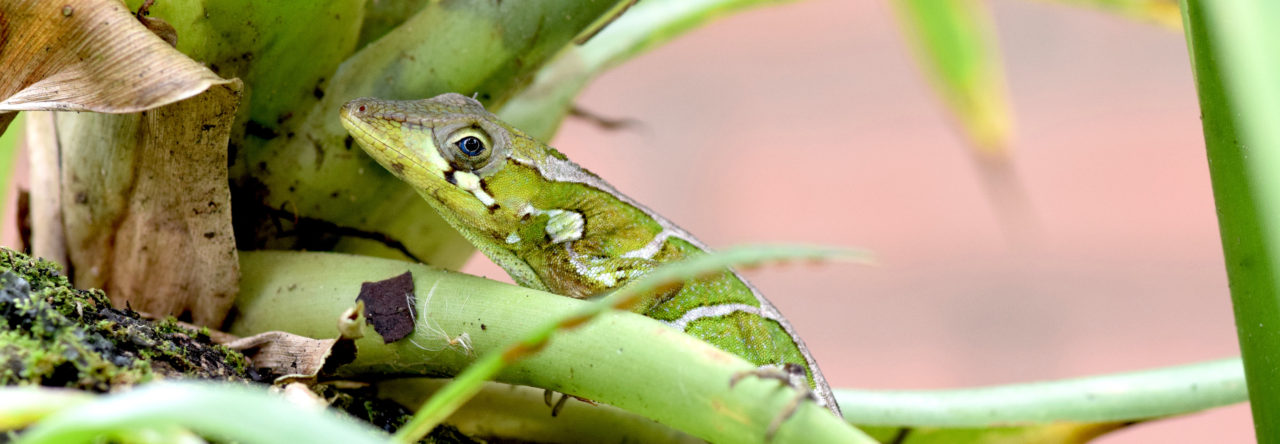

Tweeted by Meet Your Neighbors, who describes itself thusly: Founded in 2009, Meet Your Neighbours is a worldwide photographic initiative created by Niall Benvie and Clay Bolt. The project is dedicated to reconnecting people with the wildlife on their own doorsteps – and enriching their lives in the process. These creatures and plants are vital to people: they represent the first, and for some, the only contact with wild nature we have. Yet too often they are overlooked, undervalued.
Category: All Posts Page 144 of 154
 Seems every few months, another journal has the good sense to put an anole on the cover. Most recent: the new journal Ecology and Evolution, which only took 19 issues to get with the program. We’ll be reporting on the article soon, but for now, enjoy the cover, which is another beautiful photograph by Neil Losin. And here’s a montage of all the recent covers…unless I’ve forgotten one.


Grand Prize
Last year we had an Anolis photo contest and produced a 2012 anole calendar. Both were wildly successful. Today, Anole Annals is pleased to announce it is combining both. We herewith announce the 2012 Anole Photo Contest. The goal of the contest is to identify 12 winning photos. The grand prize winner will have her/his photo featured on the front cover of the 2013 Anole Annals calendar and will receive an autographed copy of Karen Cusick’s lovely book, Lizards on the Fence. The second place winner will receive a copy of the calendar and have her/his photo featured on the backcover of the calendar.

This year’s calendar. Put your photo on the cover of next year’s version!
The rules: please submit photos as attachments to anoleannals@gmail.com. To ensure that submissions with large attachments arrive, it’s a good idea to send an accompanying e-mail without any attachments that seeks confirmation of the photos receipt. Photos must be at least 150 dpi and print to a size of 11 x 17 inches. If you do not have experience resizing and color-correcting your images, the simplest thing to do is to submit the raw image files produced by your digital camera (or, for the luddites, a high quality digital scan of a printed image). If you elect to alter your own images, don’t forget that its always better to resize than to resample. Images with watermarks or other digital alterations that extend beyond color correction, sharpening and other basic editing will not be accepted. We are not going to deal with formal copyright law and ask only your permission to use your image for the calendar and related content on Anole Annals. We, in turn, agree that your images will never be used without attribution and that we will not profit financially from their use (nobody is going to make any money from the sale of these calendars because they’ll be available directly from the vendor).
Please provide a short description of the photo that includes: (1) the species name, (2) the location where the photo was taken, and (3) any other relevant information. Twelve winning photos will be selected by readers of Anole Annals from a set of 28 finalists chosen by the editors of Anole Annals. The grand prize winning and runner-up photos will be chosen by a panel of anole photography experts. Deadline for submission is September 30, 2012.

From Nathan Watson’s instagram page.
I’m spending the summer in Paris, and while the city of lights has much to offer, I assumed two months here meant two months away from my beloved anoles. As it turns out, this is not the case! Even though anoles are New World lizards, there are still Anolis moments to be had here. In the Jardin des Plantes, the zoo and natural history complex of Paris, I was excited to find an Anolis equestris in the herpetarium. I took a picture of the sign below the cage:

Also, on an admittedly un-anolis-related note, but one of herpetological relevance: in the chateaux of the Loire Valley, the most common animal featured in the coat of arms of old royal families (and therefore throughout the architecture of their palaces) is the salamander. Evidently, in the past, salamanders were believed to breathe fire and were widely popular as symbols of power. I’ve included only a couple of many examples of salamanders below:


Maybe the anole community could popularize our favorite genus in a similar way?
Several years ago, Calsbeek and Bonneaud published a provocative paper in which they showed that females preferentially used sperm from large males to produce male offspring and from small males to produce females. An obvious question is: how do they do this? Anoles are known to have sperm storage and to be able to produce fertile young many months after mating, but how can females “choose” which male’s sperm to use to fertilize offspring? Presumably, in some way the female would have to keep track of which sperm came from which male, and what the phenotypic attributes are of those males.
Dartmouth graduate student Katie Duryea reported ongoing work aimed at addressing these questions. Taking a two-pronged approach, she is looking at the genetic basis underlying reproduction in anoles. First, she is examining gene expression in the reproductive tract of female Anolis carolinensis, comparing recently mated and unmated individuals. Preliminary results revealed more than 5000 genes that appear to be upregulated, based on transcript abundance, in the females. Examination of gene ontologies reveals interesting patterns of what types of genes are upregulated, with apparent similarities to similar work in Drosophila. Second, taking a candidate gene approach focusing on serine proteinase genes, Duryea is comparing differentiation between A. carolinensis and A. sagrei. Preliminary results for one gene show a relatively large number of synonymous changes, suggestive of the action of natural selection.
Clearly, this work is in its early stages, but results so far are tantalizing and provide another example of how the anole genome will prove useful in addressing outstanding questions in anole evolution and behavioral ecology.

**UPDATE (July 17, 2012): Thanks to all the folks who have contributed literature – it’s a huge help! We’ve made good progress towards our first goal of obtaining all original descriptions of Anolis species. Here’s an updated “Most Wanted List.” We’re pretty close to knocking them out….
————————————————————————————————————————————————–
Anole bibliophiles and reference collectors,
The Anoline Lizard Specialist Group has a favor to ask, and one to return as well: We need your help assembling a digital reference library for Anolis literature.
Our goal? – To compile PDFs of every published piece of literature relevant to the taxonomy or conservation of Anolis lizards.
The reason we’re doing this is to aid in the IUCN Red List assessment process for anoles. Having ready access to this literature dramatically simplifies the task of conducting and reviewing species assessments. Also, as the IUCN’s “Red List Authority” for Anolis lizards, the ALSG will soon maintain an authoritative list of currently recognized anole species. Ready access to the anole taxonomic literature will facilitate this as well.
We already started this process, and we’ve made a good dent. Like many of you, we’ve been amassing anole PDFs for years (albeit sometimes haphazardly). We recently
 This post serves as a lighthearted response to Jonathan’s earlier announcement and as an advertisement – perhaps endorsement – for some of the upcoming anole talks at Evolution 2012.
In his post Jonathan highlights recent comments by David Hembry that describe the blossoming of anoles into “field model organisms,” the ecological parallel of chicks, mice, and Drosophila which have long histories in laboratory studies. While the importance of anoles for Evolutionary Ecology is almost without question, I think that this stops short of describing the present and undeniable future of anole research. From my perspective, the roots of Anolis research are strong and wide, but its flower(s) has not yet fully blossomed.

Day’s Edge Production in full swing
The guys at Day’s Edge Productions keep on chugging along. Their latest offering is the first video report from their Italian island lizard project, studying the incredible variation of wall lizards found on tiny Spanish islands. What makes this video worth checking out for anolistas is the incredible abundance and audacity of the lizards, which crawl right over the actors as the camera rolls. Anyone ever seen anoles that daring?
 Last year was a banner year for anoles. As Xavier@evolutionistX tweeted at the end of the Norman, OK Evolution meetings: “The star of
 #evol11: Anolis lizards. They won both Fisher’s and Dobzhansky awards, would like to invite them to a celebrity party @NYC.” And who could blame him? The prestigious Dobzhansky and Fisher Awards both went to workers studying anoles, as did three of the four Young Investigators Prizes. And there were a slew of other excellent anole talks (reported on these pages last year; start at this post and work backwards, or search on “Evolution Meetings”). David Hembry summarized the meeting well on Nothing in Biology Makes Sense: “I confess, I didn’t go to the Evolution meetings for three years. I missed Minnesota in 2008 due to fieldwork, Idaho in 2009 due to illness, and Portland in 2010 due to the EAPSI. When I “returned” in 2011 in Norman, it was like everybody had switched to working on anoles and sticklebacks!” (see the rest of David’s insightful observations on this point below).
But can anoles do it again in this year’s meeting , slated to begin on Friday in Ottawa? You can rely on Anole Annals to be on hand to provide the play-by-play coverage from the spectacle of the opening ceremonies to the climactic closing mixer. And fear not: though not the grand slam of last year, anoles again will bring home some medal.
Here are the talks. Unfortunately, authors are not listed, but you can get all program information at the meeting’s program mobile app website: