Category: All Posts Page 136 of 154

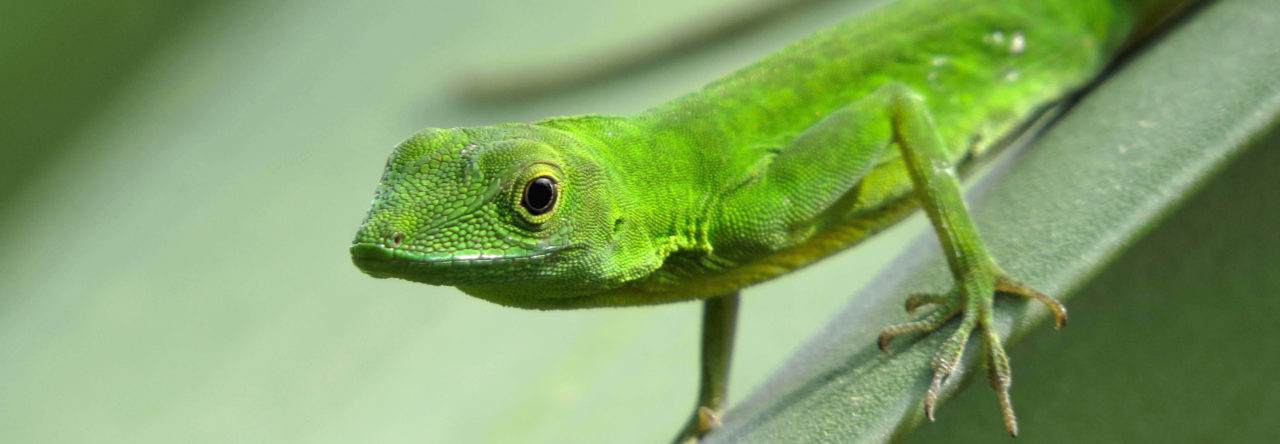
Colors And Shapes Of The Horned Anole


Ecuador's most wanted! This lizard was thought to be extinct for nearly fifty years, and still after its "rediscovery" in 2005, it remains hard to locate.

Ecuador’s most wanted! This lizard was thought to be extinct for nearly fifty years, and still after its “rediscovery” in 2005, it remains hard to locate.

Most records of Horned Anole are in disturbed areas, including near roads vegetation, botanical gardens and bamboo trees.

Most records of Horned Anole are in disturbed areas, including near roads vegetation, botanical gardens and bamboo trees.

It took me more than two years of constant visits to Mindo, a cloud forest-town in the Western Ecuadorian Foothills, to meet with the Horned Anole (Anolis proboscis)! I always felt it was a mythological reptile, not only for Ecuadorian herps but throughout the world. Has anyone seen a lizard with a long appendix on the tip of his nose, a wide color throughout the body, prehensile tail and even spines on the back? It is difficult not to speak mystically when we refer to Horned Anole.

For over 50 years it was listed as “Possibly extinct,” until 2005, when a group of Ecuadorian scientists “rediscovered” it. But it was not until two years ago when the global and local Anole experts, led by Jonathan Losos, Steven Poe and Fernando Ayala, started several expeditions to investigate everything about its morphology, phylogeny and natural history.

Its tail is prehensile and is possibly used to embrace the branches when it sleeps.

Its tail is prehensile and is possibly used to embrace the branches when it sleeps.

The Horned Anole is a diurnal and slow-moving lizard that usually is found perched between 4-8 meters above the ground. Although most records are in vegetation on roadsides, highways and near open areas can be very difficult to find due to their excellent camouflage that blends perfectly with twigs full of mosses, lichens and epiphytes, perfectly rhyming its colorful skin.

But what use their proboscis? Sexual selection and defense of territory are the first hypotheses that leap to the mind. Science will tell us soon! But even that, we are left to enjoy its beauty and unparalleled mystique.


Definitely its silhouette is unmistakable. His sharp proboscis distinguishes it from all Ecuadorian lizards.

Definitely its silhouette is unmistakable. His sharp proboscis distinguishes it from all Ecuadorian lizards.

It can be difficult to find. Not only because they are commonly perched on high branches, but also for their camouflage, forming an ideal combination with branches and colorful leaves.

It can be difficult to find. Not only because they are commonly perched on high branches, but also for their camouflage, forming an ideal combination with branches and colorful leaves.

It is slow-moving and spends most of its time 450–800 cm from ground and feeds on a variety of arboreal arthropods.

It is slow-moving and spends most of its time 450–800 cm from ground and feeds on a variety of arboreal arthropods.


Anolis proboscis sleeps on horizontal twigs and leaves (juveniles seem to prefer lower perches).

Anolis proboscis sleeps on horizontal twigs and leaves (juveniles seem to prefer lower perches).

Weekend Brown Anoles From Daffodil

Photojournalist, anole aficionado and AA has devoted yesterday’s post to the goings-on of her local brown anoles. Check it out Daffodil’s Photo Blog.

True Facts About Chameleons

httpv://www.youtube.com/watch?v=UR_byRbXxvs

Anole researcher Anthony Herrel showed his true colors recently in a seminar when he said that chameleons are cooler than anoles. Be that as it may, this video is a fun demonstration of the amazing traits that make chameleons the second coolest lizards. It’s part of the “True Facts” series of videos, which are quite entertaining–one episode on tarsiers was featured in a recent AA post.

Katydid Eats Anole

princeps eating by conehead katydidHere’s a disturbing photo that came across Facebook the other day. And I always thought these katydids seemed like delightful, gentle forest nymphs. Who knew they could be vicious killers. This comes from The Biodiversity Group’s Facebook page, but I couldn’t locate the image on their website, though I didn’t look that hard. They identify the anole as A. princeps but don’t provide any further information.

Evo-Devo Meets Sexual Dimorphism: The Face Does Not Tell The Whole Story

Males and females of many species vary in their morphology, behavior, and physiology. Whether exaggerated weapons, elaborate coloration patterns, or dramatic differences in size, these sexual dimorphisms form some of the most eye-catching elements of biological diversity. These striking differences are often considered as a product of sexual selection, whether due to direct female choice for an elaborate structure or traits used by combative males to assert dominance. But additional patterns of dimorphism become visible with quantitative comparisons of male and female body proportions, which may yield additional clues to ecological differences between the sexes. Considering that patterns of sexual dimorphism can diverge rapidly among species it is no surprise that they have intrigued biologists since before Darwin.

Anolis brunneus from Crooked Island, Bahamas. A member of the carolinensis clade of anoles exhibiting extreme levels of facial length dimorphism.The male is the large lizard to the bottom left, the female to the upper right.

(Un)true Facts About The Tarsier

According to Ze Frank, this screen capture shows the cover of the children's book "Lizard Has A ****** Day."

According to Ze Frank, this screen capture shows the cover of the children’s book “Lizard Has A ****** Day.”

If you’re not already familiar with Comedian Ze Frank’s True Facts Series, you need to check them out. Frank interweaves interesting facts about wildlife with hilariously (off)color commentary. He’s done videos on everything from star-nosed moles to dung beetles (I was first alerted of the series by a comment made by Tracy Heath over at the new Treethinkers blog). I was recently viewing True Facts About The Tarsier, and was shocked to see this puny little Southeast Asian quasi-monkey feeding on one of my favorite lizards. At around 1:26 into this video, Frank notes that the Tarsier is “the only entirely carnivorous primate, eating insects, rodents, reptiles and small birds. This incidentally is the cover of the children’s book “Lizard Has A ****** DAY.” Very funny. Of course, its practically impossible that a tarsier in nature would be feeding on what appears to be a  green anole (Anolis carolinensis). As far as I’m aware A. carolinensis is not been reported from any of the Southeast Asian islands occupied by the tarsier. Thus, if there’s we’ve learned from this video, it is that this lizard is having a ****** day because somebody just thrust it into the waiting arms of a captive tarsier.

httpv://www.youtube.com/watch?v=6Jz0JcQYtqo

Reptile Database Reverses Courses, Places All Anoles Back Into Anolis

Presentation1

The saga continues. Last December, the Reptile Database, the online listing of all recognized reptile species, issued an update in which anoles were split into the eight genera proposed by Nicholson et al. Now, in the subsequent update released yesterday, they’ve done an about-face and changed all anoles back to Anolis. Here’s what they have to say:

Anolis. After serious contemplation (and consultation with several experts) we changed the names of anoles back to Anolis. For some reasons see Poe et al. (2013) Zootaxa 3626 (2): 295–299.”

Interestingly, the very next item was this:

Teiidae. The names of many teiids have changed following the suggestions of  Harvey et al. (2012) Zootaxa 3459: 1–156. However, we are already getting complaints that this may not be tenable…”

So, seems like these issues may not necessarily be unique to anoles. The Reptile Database is a great resource for the herpetological community, but I don’t envy it the task of trying to decide when to change names and when not to. Moreover, since it has become so widely used, its decisions probably have an outsized impact on whether people adopt proposed changes or not.

In any case, for any readers who need to get up to speed, the Poe et al. paper referred to above was discussed several weeks ago, and the entire discussion thread on the proposed taxonomy of Nicholson et al. is probably best found by searching with the term “Nicholson” in the search bar to the right.

An Anole Easter Egg Story

AA reader Ava writes: “Ironic that on Easter, I found myself on an egg hunt and found a green anole egg that I suspected had just been laid.  She would have laid it last night.  I put it in a cricket keeper (covered big holes), included the very soil the egg had been laid in and placed the keeper back in the main terrarium in the area where I had found it.

I read, afterward, that the position of the egg should not be disturbed. I fear I may have shifted it around in transfer. Have I blown it? Can one tell which end is up?

I live in Florida where the ‘takeover’ of the brown Bahamian anoles has been increasingly apparent.  The ‘greenies’ as we call them have taken to the trees, but seem fewer every year.  The browns are so aggressive. My hope is to ‘repopulate’ a certain mango tree where we used to see them. Pointless?  Anyone?

Anoles And Other Biodiversity Of Haiti: A Calendar

Calendar_June
Haiti has some spectacular anoles found nowhere else. For example, if you go to CaribHerp and click on “Haiti” in left toolbar, you see the 176 species of herps in the country. Then click filter by “Dactyloidae” and you see the 32 recognized anole species.

13 of those are endemic to the country, but there are quite a few in the works (not yet described). One beautiful endemic Haitian species, Anolis monticola, is on the cover of Jonathan’s book “Lizards in an evolutionary tree.” Deforestation continues, with only 1% forest cover remaining, so almost everything will be disappearing soon.

For several years I’ve been doing some intense field work in Haiti, and professional photographers have joined on the trips. In collaboration with the Audubon Society of Haiti (Philippe Bayard, president), we put together a large biodiversity calendar for this year, with text translated in 3 languages. It opens into a 24″ x 12″ poster. Anoles are on the cover and a month is mostly devoted to anoles. After some unexpected delay they have arrived and we’re happy to give them away, for cost of shipping/packing. If interested, see Caribnature for images of the calendar, and instructions to order:

Dewlap Research On Grand Cayman

Tess Driessens, but that’s no lizard

Channel 27 in Grand Cayman has just aired a report on the doctoral work of Tess Driessens (co-winner of the 2012 Anole Photo contest!) and Simon Baeckens (actually, from their webpages, this seems like Tess’s project). They’re studying the diversity of dewlap color in Anolis sagrei by looking at brown anoles throughout their range.

Page 136 of 154

Powered by WordPress & Theme by Anders Norén