Category: All Posts Page 132 of 154

Blue-Eyed Agamids

In flipping through field guides to look at agamid dewlaps, I came across a couple of South-East Asian Agamid lizards with blue eyes. Given our recent discussions of blue-eyed anoles, I thought I’d point out these lizards as well. All information is from L. Lee Grismer’s Lizards of Peninsular Malaysia, Singapore, and their Adjacent Archipelagos
(and here’s an AA review of the book).

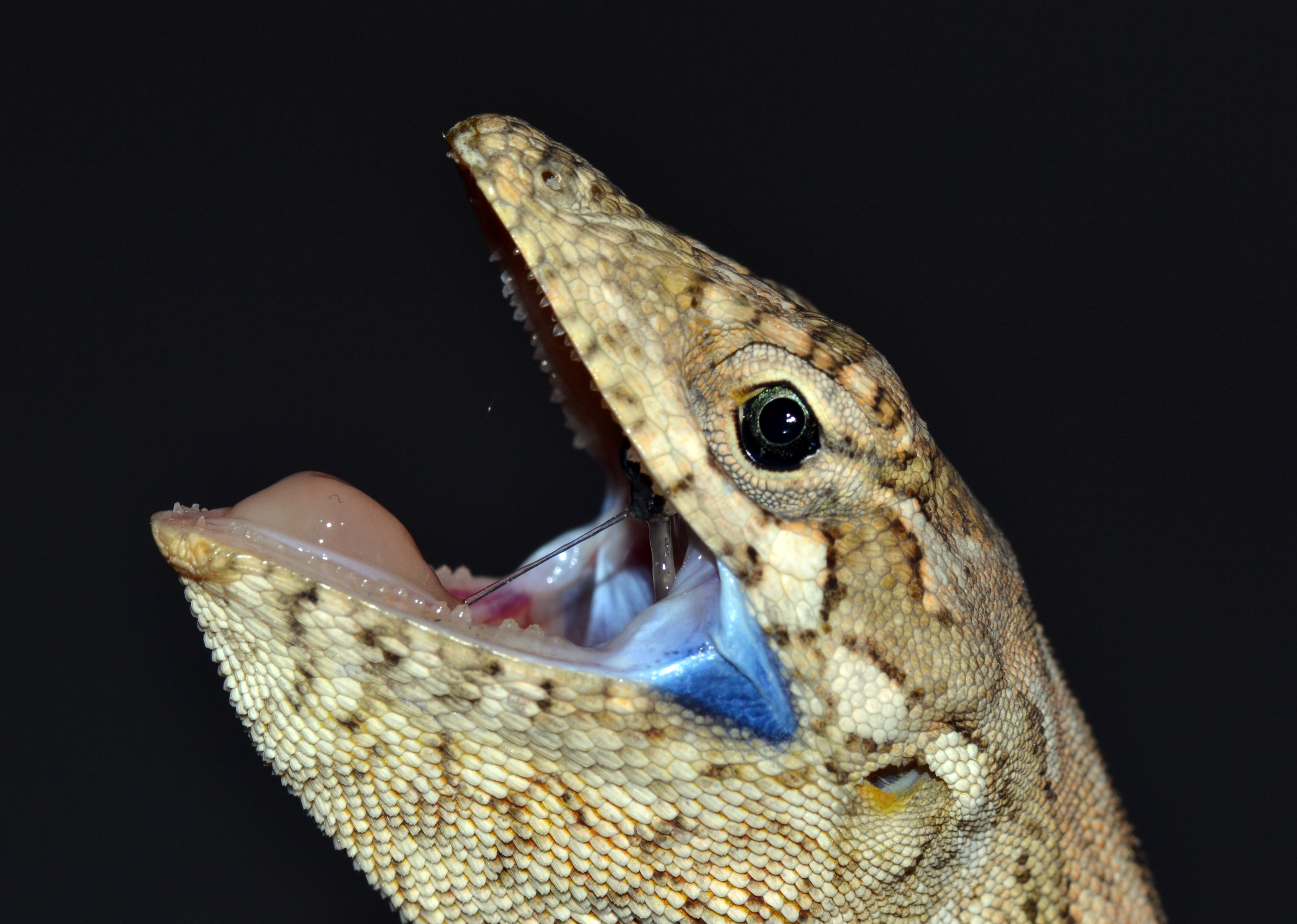
Aphaniotis fusca (Dusky/Peninsular Earless Agama): more fascinating than the blue eyes themselves is the variation among individuals in iris colour–A. fusca irises can be blue, orange, or brown. It appears that blue irises are restricted to adult males, but not all adult males have blue eyes. Further, the inside of these lizards’ mouths (the oral mucosa, to be precise) are also bright blue, similar to  Anolis onca.

Aphaniotis fusca (photo from www.fieldherpforum.com)

Aphaniotis fusca (photo from www.fieldherpforum.com)

Gonocephalus liogaster (Orange-Ringed Anglehead Lizard): hands-down winner for lizard with the most dramatic eyes, adult males of this species have a bright blue iris surrounded by a bright orange ring.

Gonocephalus liogaster (photo by Robert Yeoh)

Gonocephalus liogaster (photo by Robert Yeoh)


Anolis Photo Contest Voting Deadline This Sunday

Will this lovely photo by Diana Troya take home the gold?

Will this lovely photo by Diana Troya take home the gold?

With nearly 500 votes cast, it’s coming down to the wire. Get your vote in before the Sunday, 6 p.m. deadline!

Urban Anole Phylogenetic Study: You Can Help!

A. cristatellus on a rooftop in Mayagüez, PR

A. cristatellus on a rooftop in Mayagüez, PR

Urbanization poses a major challenge for many species, altering natural environments in ways that few animals can tolerate. Despite this, some species persist and even thrive in urban areas. In my research in the Revell lab at UMass Boston, I’ve been studying adaptation in response to urbanization in Anolis cristatellus, the Puerto Rican crested anole. However, among anoles urban tolerance is by no means restricted to A. cristatellus. We suspect that readers of this blog have probably observed many different anole species occupying and thriving in urban areas.  Consequently, we would like to ask for your help in gathering some information on this topic.

What Exactly Is A Dewlap?

Now that’s a dewlap! Photo by Niranjan Sant

All of us that observe and study Anolis (and Sitana) know that dewlaps make our favourite lizards special. Dewlaps can be key for species identification, and we pay a lot of attention to variation in their size and colour. But what exactly constitutes a dewlap?

I’m currently compiling a list of all lizard species with dewlaps, and have run into the problem of how to define a dewlap. Our trusted friend Wikipedia defines a dewlap thus:  a longitudinal flap of skin that hangs beneath the lower jaw or neck of many vertebrates. Helpful, perhaps, but only slightly, as the difference between a small dewlap and a puffed-out throat is not always obvious.

So we’re turning to you, dear reader, to help us figure out what a dewlap is. I think the easiest way to do so is by showing you a number of pictures of lizards and asking you to deliver a verdict on whether these lizards are in fact dewlapped (photos from various internet sources). Feel free to offer an alternative definition also, if you’d like.

1. Rock Agama

Kenyan Rock Agama


2. Calotes calotes from Sri Lanka

Green Forest Lizard (Calotes calotes)


3. Panther chameleon

panther-chameleon-01


4. Varanus griseus

varanus_griseus_8202


5. Iguana iguana

Re-Branding The Brown Anole

Doesn’t get much more festive than this guy!

I’m currently preparing a grant proposal featuring Anolis sagrei for a philanthropic foundation with broad goals that extend well beyond biology. The people reading this proposal will thus have diverse backgrounds, probably mostly non-biological and certainly non-herpetological. In reading a draft of the proposal, a friend remarked “This lizard needs a new name for this grant!” And, indeed, on reflection perhaps “brown anole” is not the most exciting name for the general public.

So, who wants to help re-brand A. sagrei? Of course, an obvious possibility is Sagra’s Anole, since the species was, after all, named after Mssr. Ramon de la Sagra*. But…that’s not really that exciting either. My friend (a biologist) suggested “the tramp anole,” using “tramp” in the ecological sense of a weedy species that is able to colonize and establish in a wide variety of habitats. A possibility, for sure, but maybe some of the other connotations aren’t so good. His second suggestion, though,  merit’s consideration. Turns out that “sagre” in Italian means “a festival.” And what lizard could be more of a partier than the ever-flashing, always rollicking, A. sagrei? So, I put it to you, anole world, what if we start referring to this species as “the festive anole”?

*It’s an interesting story how the species ended up A. sagrei, and not A. sagrai, but that’s a tale for another time.

50% Off Anole Watches Until 3 PM Eastern Time Today

Daylight Savings End Special! Less than $25! If you’re going to buy an anole watch (check out the five different ecomorphs), now’s the time. Go to www.zazzle.com, use code watchclocks3

Sale On Anole Watches! Grass-Bush Anole Added To The Ecomorph Line Of Wristwatches

Just when you thought it couldn’t get better, it has: a grass-bush anole has been added to the original four ecomorph wristwatches. The watch features a Puerto Rican Anolis  pulchellus  from a beautiful photograph kindly provided by Manuel Leal. Check it out along with the other four ecomorph watches at zazzle.com.

And if you order by 9 p.m. eastern time today, it’s 31% off! Use this code: HALLOWEENDAY

On Vocalizing Anoles

Greetings to the Anole Annals community,

'Many anoles vocalize , most however are either trunk ground or arboreal forms such as this A.grahami

‘Many anoles vocalize. Most, however, are either trunk-ground or arboreal forms such as this A. grahami (photo by J. Losos).

I love anoles and spend a lot of time wishing that I could personally observe the cornucopia of species that the world  has to offer, though not being a scientist by profession and only encountering a small number of anole species in my immediate vicinity, I am limited to finding all about anoles that I can  and trying my best to explain any interesting patterns that I notice, which brings me to the subject of this post.
On Jamaica, the island where I currently reside, there are seven species of anole lizards. However, only two of these, A. grahami and A. lineatopus, have an island-wide distribution  and, more importantly, they are the only two which occur with great frequency in urban areas of south-eastern Jamaica, so naturally when I first began catching anoles these guys were my most frequent quarry. My surprise came while I was holding a large, freshly noosed grahami, which I soon discovered is not among the list of creatures that readily accept being caught. In addition to thrashing wildly and making several futile attempts to do whatever damage it could with its diminutive teeth, the lizard let out a high-pitched squeak, sort of like a rubber duck being stepped on; this was so surprising to me that I immediately flung the lizard away and was left to watch as he scrambled away, no doubt feeling pretty good about his completely accidental victory.

It didn’t take me a lot of searching on the web to find out that vocalizations had been recorded for other species of anoles before, and so I decided to compile a list of every species that I could find for which there was any record of them vocalizing; so, for anyone who has ever wondered, here it is:

    • All the cybotoids  (A. cybotes and relatives)
    • A. garmani, A. valencienni, A. opalinus, A. grahami
    • A. biporcatus, A. petersi, A. salvini (synonymous with A. vociferans)
    •  A.roquet, A. trinitatis, A. extremus
    • A. chocorum
    • A. chlorocyanus , A. coelestinus, A. vermiculatus, A. hendersoni     
    • A.occultus  

Anolis conspersus. Anybody?

The list is immediately confounding in that there are at least three species groups up there (the grahami, hendersoni and roquet groups) in which all species are very closely related, but only some species vocalize; why is this ability popping up so inconsistently? I don’t think it has anything to do with any particular ecomorphs having more use for this ability than others as only one of the six ecomorphs is not represented, and it is also obvious that this trait is completely absent from some of the distinct lineages within Anolis (the genera proposed by Nicholson et al. 2012) while it shows up here and there in others. There are some species I suspect may possess the ability… such as A. conspersus, a close relative of A. grahami, but I have been able to find no mention or vocalization for this or any other species not listed above. I would love to hear if anyone has personally observed this for any other species (Anolis cybotes was the only cybotoid I had read about vocalizing, while all the others only came to my attention after an AA commenter gave an eyewitness testimony).

As to why this ability is present in some anoles in the first place, this seems to be a mystery. I know that a study was once conducted on A. grahami in which a few individuals were dissected and an attempt was made to identify sound producing structures, but none were found. The study also found that while the anoles vocalized while in aggressive confrontations, they did not respond to playback of these same vocalizations, at least not in the presence of visual stimuli, suggesting that these vocalizations do not play a pivotal role in anole social interactions. The effects of environment on whether an anole is able to vocalize are also probably negligent as the ability is present in all sorts of anoles, from mainland twig species living in mesic environments like A.salvini to West Indian xeric species such as A.whitemanni and all-around generalists like A.roquet of Martinique.

A. cybotes, very far from being arboreal

Then again, perhaps we are just looking too deeply into this. After all, when that anole squeaked at me I dropped him, which I’m sure is what he would have wanted to come out of that situation. Also, I have read that some anoles hiss ultrasonically when threatened or confronted; perhaps the big squeakers are just more intent on getting their point across.

Whatever the answer to this seemingly perplexing question is, I hope somebody figures it out eventually. Unfortunately I have stopped catching anoles and for the most part have stopped reading about them as well, so I probably won’t be adding any new species to the list. I hope anybody else with an interest in anoles comes across this post so they can find the full list of species. Unless there are more out there still, that is.

Mystery Anole From Haiti

anoli-l

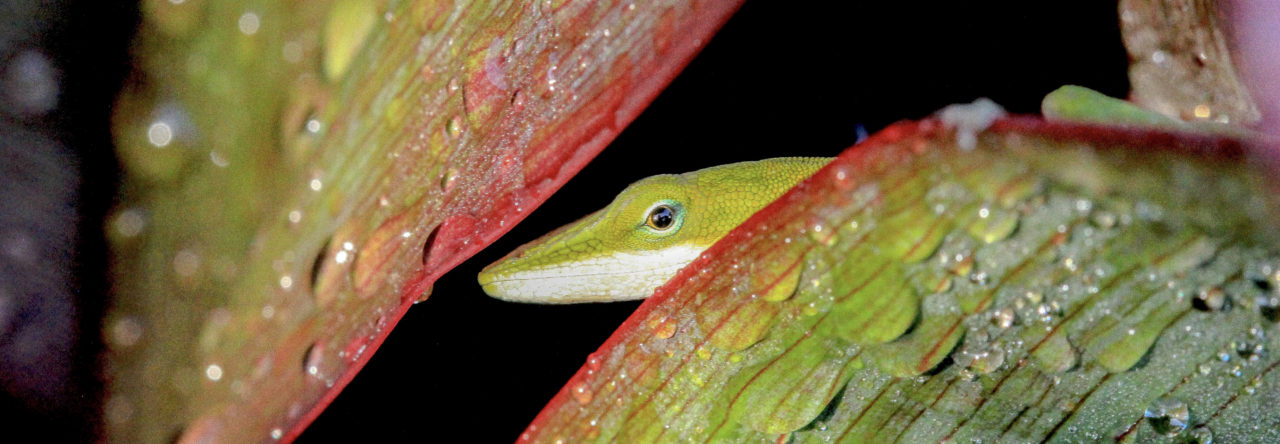
Olivier Testa, a french speleologist in Port-au-Prince, just returned from a five week speleological expedition in the area, where the team recorded more than 80 shafts and encountered this anole at the bottom of one. There’s a video, too. Anyone know what it is?

Help Needed Identifying Anole From Costa Rica

Dear anole experts,

I recently met this anole on the slopes of Mount Chirripo (Costa Rica), at an altitude of ca. 1300 m, perching on rather low vegetation (agave leaves, small perches…). The dewlap was uniformly yellow.

Anolis sp. (San gerardo)

Is there anyone who knows what species this could be?

Thanks in advance. All best,

Florian Boucher

Page 132 of 154

Powered by WordPress & Theme by Anders Norén