Category: All Posts Page 104 of 153

A Lizard Whodunnit: Field Work Is Not Always about Answering the Question You Set Out to Study

On her own blog, Ambika Kamath explains that field work is often about surprises and unexpected mysteries. Check out A Macabre Start to My Time in Florida.

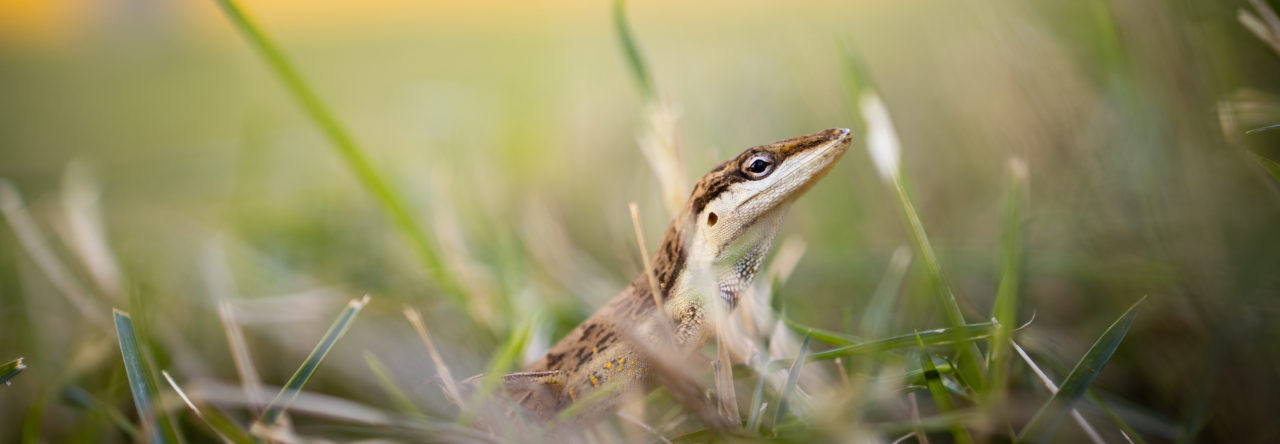
Help Identify Anole from Guyana

Photo by Thadaigh Baggallay

Thadaigh Baggallay writes: “I took this picture in Kaieteur National Park, Guyana. Anolis chrysolepis perhaps?”

Looks to me like whichever chrysolepis-type anole occurs in Guyana. Exactly a year ago today, we had a post on a new field guide to Guyanan herps by Cole et al. which probably would help. According to that guide, I believe the species would be A. planiceps. Any thoughts any one?


Neat Ditty About a Thermoregulating Lizard

Screen Shot 2015-02-22 at 10.26.03 PMHarry Bird and the Rubber Wellies is described as a nomadic folk band, and they’re based out of Dublin, Ireland and Bilbao, in the Basque Country of Spain. Maybe it’s the cold rainy climes of both those places that inspired these musicians to create a wistful song about a tropical lizard basking on a palm tree. It’s a catchy tune, so check it out.

Here are some of the lyrics from the song:

“When Sun come out / Out come the lizard / Lazing around / And a’flicking her tail/ When Sun go home / Home go the lizard / Till the Sun come out again.”

“See the way she slide / My, what a lizard! / She got so many beautiful scales / She the way she shine.”

“Oh she’s catching flies / That greedy lizard / Her long sticky tongue / Doesn’t make any sound / She gets pomegranate / Out of the cupboard / That’s the way to wash them down.”


Video of Anolis pentaprion Displaying

Little is known about the Central American twig anole, but it does have a beautiful dewlap! In recent years, what used to be known as A. pentaprion has been split into a large number of species, the most recently described of which is A. triumphalis. (Editor’s note: Gunther Kohler points out that this is one of the newly named species, A. charlesmyersi).

Here’s the backstory from the videographer who posted this on Youtube: Greetings Casa Alta Vista, Costa Rica. That video was shot about 15 feet above ground, on the guava wood handrail that goes up my stairs. Our house is a rustic style “pole” house, constructed from plantation grown gmelina and teak woods. We are located about 2 miles inland of the shores of Golfo Dulce , Costa Rica, at about 600 feet elev. in a mostly second growth seasonally dry rainforest. Dry season from Dec to April, then usually 300 inches of rain , a lot of which is in September-October usually. We are across the gulf from Corcovado National Park . Maybe 15 miles as the toucan flies. The area around the house was pasture up until about 20 years ago, but now pretty lush with second growth. Fairly undeveloped, and there is some primary growth surrounding us down in the “quebradas” or streams that are all around here. Down there we have stream anoles, and lots of snakes and critters. Saw a bushmaster down there once . Yikes. We also see slender anoles (I think) but they aren’t very “brown” and the yellow spot on the dewlap isn’t as prominent as the picture in my book . We also sometimes see the dry forest anole, which seems to trade off the territory of my deck railing system with the lichen anoles. We see green anoles down on some of the fruit trees we have planted as well. Amazing creatures all, they don’t seem fearful of us, and maintain eye contact . And will bite of course if they are provoked and can catch hold of you. I once had a full grown basilisk lizard that I was rescuing from some dogs bite me nicely on the hand. We have really a lot of all kinds of wildlife here. The birding is great, and we have a large troop of mono titi’s (squirrel monkeys) that occasionally traverse our back deck, peek in the windows, and move on to eat guabo beans in the trees surrounding our house. We’re built about 4 meters off the ground, not a treehouse , but kind of up in the trees .
My camera is new, and I will be posting other animal videos soon. And will try to get more anole videos.

Editor’s Update, 2/23/2015:

Here’s another clip of the same animal:

Anolis huilae Displaying


Photo by Cristian Castro Morales

Photo by Cristian Castro Morales

AA reader Cristian Castro Morales has sent in this photograph of the little known Anolis huilae. He says: Male of Anolis huilae display their dewlap to ward off a possible predator or rival from his perch. This species is reported in Colombia in the departaments of Huila and Tolima.

Geographic Variation in the Mainland Grass Anole Anolis auratus

Photo by James Christensen

Anolis auratus is one of the most widespread mainland anoles, with a range stretching from Costa Rica through much of northern top of South America on both sides of the Andes. It’s biology is surprisingly little known, though it is thought to be a grassland species; that and it’s morphological similarity to grass-inhabiting Caribbean anoles has led some to argue that this species is a member of the grass-bush ecomorph category.

Given it’s wide range in Colombia traversing the Andes, the species is ripe for investigation of geographic variation, and that is just what Martha Calderón-Espinosa and Leidy Alejandra Barragán-Contreras did, examining a large number of museum specimens in the collection of the Instituto de Ciencias Naturales, Universidad Nacional de Colombia. Their work was recently published in Acta Biológica Colombiana. The abstract is appended below, but to make a not-so-long story short, sexual dimorphism exists for several characteristics independent of body size (the sexes don’t vary in size), and these same characters vary geographically. What this means about variation in habitat use of the species across its range remains to be studied.

Abstract

Anolis auratus is a widely distributed species, from Costa Rica in Central America, through northern South America, including Colombia, Venezuela, northern Brazil, Surinam and the Guyanas. In Colombia, its widespread distribution across different life zones suggests that these lizards occupy different environments and exhibit different microhabitat use in different geographic areas. On the other hand, some observations suggest that this species prefers open areas, selecting grasslands over brushy areas, and thus, an alternative hypothesis is that microhabitat use is similar among different populations. In Anolis, body variables related to locomotion (body size and shape) define structural microhabitat use, so two distinct patterns could be expected in this species: conservative or highly variable body size and shape throughout the species distribution. To test these predictions, we characterized geographic variation in morphometric traits of this species in Colombia. Females and males were similar in body size, but exhibited differences in some variables related to body shape. These characteristics also varied among males and females from different regions, suggesting heterogeneous use of structural microhabitat, between sexes and among populations. As an alternative, phylogenetic divergence among populations could also account for the observed differences. Absence of ecological and phylogenetic data limits our ability to identify the underlying causes of this pattern. However, we provide a general framework to explore hypotheses about evolution of body size and shape in this species.

Another Egret Eats a Brown Anole

We’ve previously had both a photo and a video of egrets downing not-so-festive brown anoles, and here’s another example from Wild about Spain. Word on the street is that egrets can be major anole predators in some places.

Two New Species of Fan-Throated Lizards from Sri Lanka

Fan-throated lizards (Sitana) are one of the Indian Subcontinent’s most widespread and charismatic lizards, found in many of the region’s drier, scrubbier habitats. Not surprisingly, lizards across this vast range vary dramatically, most strikingly in the size and coloration of the throat-fans for which they’re named. Everyone has long suspected that the lizards in this genus must belong to several different species, and Sitana taxonomy has been long overdue for an upheaval.

Coloured-fanned, intermediate-fanned, and white-fanned male Sitana ponticeriana. Photographs by Shrikant Ranade, Jahnavi Pai, and Jitendra Katre respectively.

Sitana from India. Photographs by Shrikant Ranade, Jahnavi Pai, and Jitendra Katre.

The beginning of the revolution is finally here! Amarasinghe et al. (2015) have just published descriptions of two new species of fan-throated lizards, both from Sri Lanka. The authors also clarify some of the very confusing taxonomic and nomenclatural history of Sitana, paving the way for a comprehensive revision of the whole genus.

As is customary, the species descriptions of Sitana bahiri and S. devakai presented in this paper are based largely on morphological traits, including scale counts and throat-fan size, and I refer you to the paper for the details. The two species also differ in where they’re found, the former restricted to south-eastern Sri Lanka, the latter to the north of the island, separated by the Mahaweli River and surrounding wetter regions. Most interestingly, from my perspective, the authors suggest that S. bahiri and S. devakai differ in the coloration of their throat-fan. Sitana devakai is said to have brighter red coloration as well as a black patch on the throat-fan, whereas S. bahiri is described to have lighter orange coloration and no black patch.

Sitana bahiri and Sitana devakai, two newly described species from Sri Lanka (photos from Amarasinghe et al 2015).

Sitana bahiri and Sitana devakai, two newly described species from Sri Lanka (photos from Amarasinghe et al 2015).

I’m not sure I’m completely convinced of this difference in coloration. Though the differences are apparent in the examples shown above, another photo of S. bahiri shows some black coloration on the throat-fan (Figure 2 in the paper). I’ve also seen variation from bleached orange to deep orange, if not red, coloration within a single population of Sitana in southern India (in what Amarasinghe et al. refer to as Sitana cf. devakai):

Sitana Dewlaps

Variation in orange coloration on the throat-fan of Sitana from the southern tip of India

The need of the hour for Sitana taxonomy is not only more comprehensive geographic sampling across the whole range of this genus but also close examination of intra-population variation. Moreover, phylogenetic methods for delimiting species and discovering  relationships between species will be necessary to understand both morphological evolution  and biogeographic patterns in this group. The two species described by Amarasinghe et al. (2015), as well as their clarifications of the descriptions of S. deccanensis and S. ponticeriana, are just the start of an exciting period for Sitana systematics, so stay tuned!

Anole T-Shirts

AnoleShirt20150116_54

We previously mentioned that the Wild Amelia Nature Festival is featuring the green anole for this year’s shindig in mid-May. Now comes the welcome news that our favorite green graces this year’s t-shirt, a picture of which is shown above thanks to the kind offices of Karen Cusick. A bargain at $15!

Mating and Egg-Laying Behavior of Anolis smallwoodi

copulating smallwoodi

Despite the intense study of all things anoles for several decades, some aspects of their natural history are not all that well known. For example, the mating behavior of most species has not been described, and egg-laying behavior has been documented for only a few species.

In the most recent issue of IRCF Amphibians & Reptiles, Alfonso et al. take a small step to remedy this situation by describing these behaviors in the Cuban crown-giant anole, A. smallwoodi. The mating observations are from a year’s fieldwork by the senior author, whereas the observations of egg-laying are from the captive husbandry efforts of second author Veronika Holanova.

I was particularly interested in the description of how gravid females come down to the ground and poke around with their snouts until they find just the right spot, at which point they dig a hole with their snout, lay the egg, and then cover it up by pushing soil over it with their snout and forelegs.

Page 104 of 153

Powered by WordPress & Theme by Anders Norén