
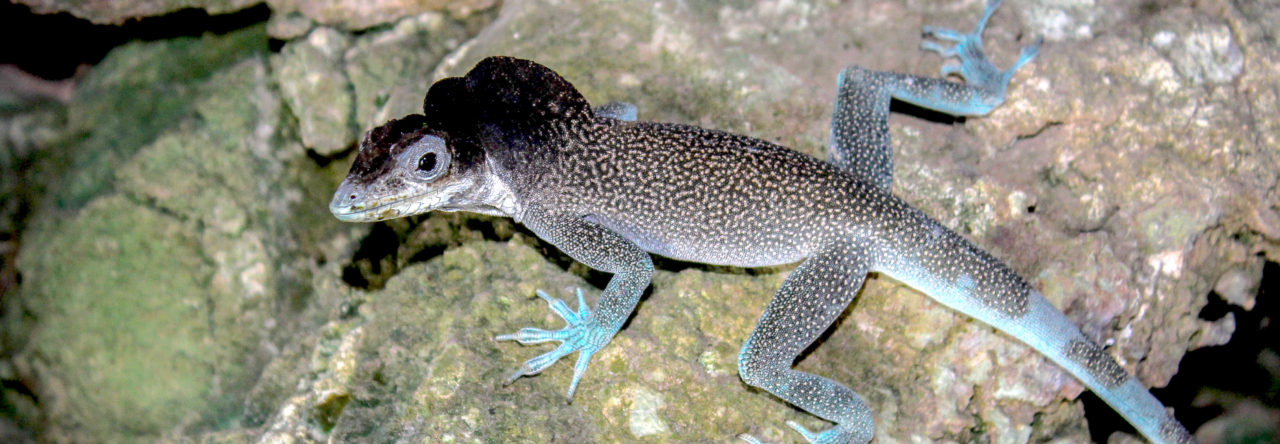
 Earlier in the year, we reported on a pair of papers describing the enigmatic and little known Ecuadorian horned anole, Anolis proboscis. Now, the Tropical Herping website has put up an information page on this species which comprehensively summarizes what we know and, as a bonus, reports unpublished observations that the species has been located at a number of new localities, bringing to 12 the total sites from which the species has been reported.
Author: Jonathan Losos Page 91 of 133
Professor of Biology and Director of the Living Earth Collaborative at Washington University in Saint Louis. I've spent my entire professional career studying anoles and have discovered that the more I learn about anoles, the more I realize I don't know.
 Reader Thomas McLellan writes in: “I recently found this photo online (Editor’s note, April 20, 2013: the photo won’t reproduce here, but if you click on the link, you can see it) & was hoping someone might have info on what this is. Is it a color phase of Anolis equestris or something else? (This photo was apparently taken at the Detroit Zoo.) Any ID info about them? Can anyone help?”
And I’d be remiss not to mention our old post on blue knight anoles, which oddly enough, is one of our most frequently viewed posts. Lots of people get to it by searching for “blue beauty.” Am I missing something here? Are they looking for blue knight anoles, or something else?
p.s. Shortly after this post was written, I received the photos below from Amber Carney, a zookeeper in Miami, by way of Yoel Stuart, who asks if this pattern and coloration is unusual. Thoughts, anyone?


Battling green anoles. Photo from http://dmcleish.com/Maui2009/AnoleFight/DSC_0278.jpg
 Both theory and empirical examples from many types of organisms indicate that animals alter their fighting behavior based on the outcome of previous fights. That is, if an animal won its previous fight, it is likely to win its next one, whereas previous losers are likely to keep on losing. In a new paper in Ethology, Garcia et al. examine whether such winner and loser effects occur in the green anole, A. carolinensis.
To create winners and losers independent of their innate fighting ability, the investigators first staged encounters in which one lizard was 40% larger than the other. Because size is a very good predictor of encounter outcome, they used this method to create animals which had won or lost their first encounter. Indeed, most of the larger animals won in these matches. Then, in the second round, they placed individuals of the same size together, one of which had won its previous encounter and the other that had lost.
Results did not support the hypothesis: probability of winning was not affected by previous experience: winners in the first round were no more likely to triumph in the second round than were first round losers. However, there was one interesting finding: losers that had put up a good fight in Round 1 were likely to win Round 2, whereas those who hadn’t continued to lose. Two possible explanations are either: 1) that the feisty losers were intrinsically more aggressive and couldn’t overcome the size disadvantage in Round 1, but when paired against similar-sized animals, were able to use their aggressiveness to overpower their opponent; or, second, that this is an example of a variation of the “loser effect,” only that it is not the outcome of the fight, but the quality of it, that matters. Losers who put up a good fight might still feel emboldened and thus do well in the future, whereas losers that lose badly may continue to lose in the future.
Mark J. Garcia, Laura Paiva, Michelle Lennox, Boopathy Sivaraman, Stephanie C. Wong, & Ryan L. Earley (2012). Assessment Strategies and the Effects of Fighting Experience on Future Contest Performance in the Green Anole (Anolis carolinensis) Ethology, 118, 821-834 DOI: 10.1111/j.1439-0310.2012.02072.x
It’s time to vote for the best anole photos of 2012. We had an overwhelming response with more than 60 entries, most of them excellent. Our panel of experts slaved over the submissions to choose 24 semi-finalists. Decision criteria were the quality, crispness, and composition of the photo, as well as the species.
You can vote for up to 3 photos. Voting will end on October 31st, at the stroke of midnight.

That’s right, you heard it here first. Read all about it, including a great sequence of photos and the story behind it, at Daffodil’s Photo Blog. We’ve mentioned this site before, as it’s the site of anole lover and author Karen Cusick, who wrote Lizards on the Fence. If you check out her blog, you’ll see that there are regular posts on the antics of her backyard greens and browns. Worth a visit!
 It’s been a good couple of years for studying lizard smarts. Last year, Manuel Leal demonstrated keen cognitive abilities in Anolis evermanni. More recently a couple of studies Down Under have shown that slippery Aussie skinks have a lot going on upstairs as well. Over at The Lizard Lab, Martin Whiting has just posted a nice review of these studies.

From Dustracks on the Web.
Janson Jones has a binder full of anoles.

Variation in the back patterns of Anolis sagrei in the Bahamas. From Calsbeek and Cox (2010).
Last year, we had a series of posts discussing the evolution of dorsal patterns of female anoles, as well as several studies that reported intrapopulation variation in female patterning. Why such variation should exist is a mystery, and studies on both A. humilis in Costa Rica and A. sagrei in the Bahamas failed to find evidence that natural selection was acting on this variation.
Now, Calsbeek and Cox report an experimental study of natural selection on dorsal pattern on small islands in the Bahamas. They introduced anoles with the three patterns shown on the left onto four small islands. Two of the islands had birds and snakes, the other two had neither. One predator-exclusion island was studied in 2008, the other three in 2009. In addition, the authors measured selection in a natural population over the course of four years.
The major result of the study is that not only was survival reduced on islands with predators, but also in the presence–but not absence–of predators, the intermediate diamond-bar pattern had higher survival than the other two patterns. How this intermediate pattern leads to heightened survival is not clear, and the authors propose a few hypotheses for future testing.
R. CALSBEEK & R.M. COX (2012). An experimental test of the role of predators in the maintenance of a genetically based polymorphism Journal of Evolutionary Biology DOI: 10.1111/j.1420-9101.2012.02589.x
Three weeks ago, I initiated discussion of Nicholson et al.’s recent monograph by noting that it is the most important paper on anoles published in recent years. We’ve had a lot of interesting discussion of many aspects of the paper since then, but we should keep in mind, even in the light of this discussion, that regardless of what one thinks about the various issues debated on our pages, this paper certainly represents a comprehensive compendium of knowledge about anole taxonomy, systematics, biogeography and ecology, and as such will remain an important resource for years to come.
Having said that, I wanted to use this last post of mine to synthesize what I see as the conclusions of the past three weeks’ discussion concerning the “bold hypothesis” of anole biogeography and evolution presented by Nicholson et al. Their hypothesis can be boiled down to three main points: Anolis is much older than previously recognized; divergence into eight major clades of anoles (which this paper raises to generic status) occurred when the geological blocks that now form the Caribbean islands separated from their previous, connected position where they had served as a landbridge connecting North and South America (and, hence, anole biogeography is primarily the result of vicariance, rather than dispersal); and the history of anole habitat use is primarily one of change from a large, crown-inhabiting species to smaller species found on or near the ground. How does this scenario stand up in light of discussion on AA?
Anolis Is Much Older Than Previously Recognized
Nicholson et al. conclude that the ancestor of anoles diverged from their nearest relative 95 million years ago (mya) and that diversification to produce the eight major clades occurred 72-87 mya. These dates are far older than other estimates; three recent studies have pegged the split between Anolis and its sister taxa as occurring 25-80 mya.

Nicholson et al. molecular phylogeny with their dates of divergence and with dates corrected assuming a younger date for the Mexican amber anole, A. electrum in parentheses. The arrow points to the phylogenetic position where A. electrum was placed by Nicholson et al.
This proposed antiquity of anoles is surprising, but is almost surely mistaken.
In my three previous posts [1,2,3], I have discussed Nicholson et al.’s ecomode concept and their conclusion from it that the ecomorph concept should be rejected. Here I conclude my discussion by addressing two other related points raised in Nicholson et al., whether differences in forest structure are responsible for different evolutionary patterns in the islands and on the mainland, and their critique of my 1992 paper on the sequence of ecomorph evolution.
Are Differences in Forest Structure Responsible for Different Evolutionary Patterns in Mainland and Island Anoles?
Nicholson et al. state (pp. 54-55): “In discussing differences between island and mainland anoles, Losos (2009) considered, but dismissed, forest structure as a driving factor in shaping anole assemblages, suggesting that, to anoles, a tree is a tree…[W]e are impressed with the complex nature of the moist, wet, and rain forests of Central and South America (Solé et al. 2005) that are home to the majority of anole species. The heavily fluted bark of Neotropical rainforest canopy trees such as Lecythis must require substantially different limb and toe pad shapes in anoles that use these trees than those that use the smooth bark of canopy trees such as Pterocarpus. The facts that bark texture is likely to be much more diverse in mainland than island forests, and that trees with appropriate bark texture are likely to be so much more widely dispersed in mainland than island forests, must play an important role in making morphology of mainland anoles so much less predictable than it is for island anoles. The fact that island forests are dominated by a relatively few short, smooth-barked tree species must limit the number of morphs that anoles can attain, must increase the density that anole populations can maintain, and must increase the interactions among sympatric species above that experienced by mainland anoles. Additionally, the differences in the structure of understory shrubs associated with mainland areas possessing an ancestral fauna that includes grazing mammals, compared to island areas that lacked such grazers (Dirzo and Miranda, 1990), must affect habitat available for adaptive radiation in anoles. In short, we see little evidence that the assembly rules proposed for anole communities on Caribbean islands will ever be discovered as applicable to mainland anoles, because the factors shaping vegetation structure are so different between island and mainland forests.”
And by the end of the paper (p.68), the idea has been transformed into a firm conclusion: “We note that evolution of ecomodes appears to be widely constrained within anoles and does not necessarily lead to constrained morphology within an ecomode because variation in forest structure across the geographic range of anoles is so great.”
It is certainly plausible that differences in vegetation structure between mainland and island forests are responsible for different patterns of ecomorphological evolution in the two regions. But what is the evidence for this? I have actually looked for comparisons of structure between mainland and island forests and have not found any relevant literature. The authors only cite two papers and neither documents differences between mainland and island forests: Solé et al. (2005) is about differences between canopy and understory at Barro Colorado Island, and Dirzo et al. (1990) is a comparison of mainland sites with and without large mammal herbivores (note: these references were presented by Nicholson et al. to document appropriate points about mainland forests; I am not claiming they were inappropriate citations, only that application to Caribbean forests is entirely an extrapolation of the authors). The authors may well be correct that mainland and island forests differ, but they do not provide any evidence to support this claim. Moreover, even to the extent that mainland and island forests do differ in structure, the effect such differences have had on anole evolution is entirely conjectural (e.g., perhaps different bark texture would select for differences in toepad structure, but to date, there are no data relevant to such a claim).
Indeed, one may question how likely it is that differences in tree structure actually affect anole morphological adaptation.