

Turns out that it happens more commonly than you might think! Here’s the latest report from The Bulletin of the Chicago Herpetological Society, a ferruginous pygmy-owl eating a clouded anole in Mexico.
Professor of Biology and Director of the Living Earth Collaborative at Washington University in Saint Louis. I've spent my entire professional career studying anoles and have discovered that the more I learn about anoles, the more I realize I don't know.
Turns out that it happens more commonly than you might think! Here’s the latest report from The Bulletin of the Chicago Herpetological Society, a ferruginous pygmy-owl eating a clouded anole in Mexico.
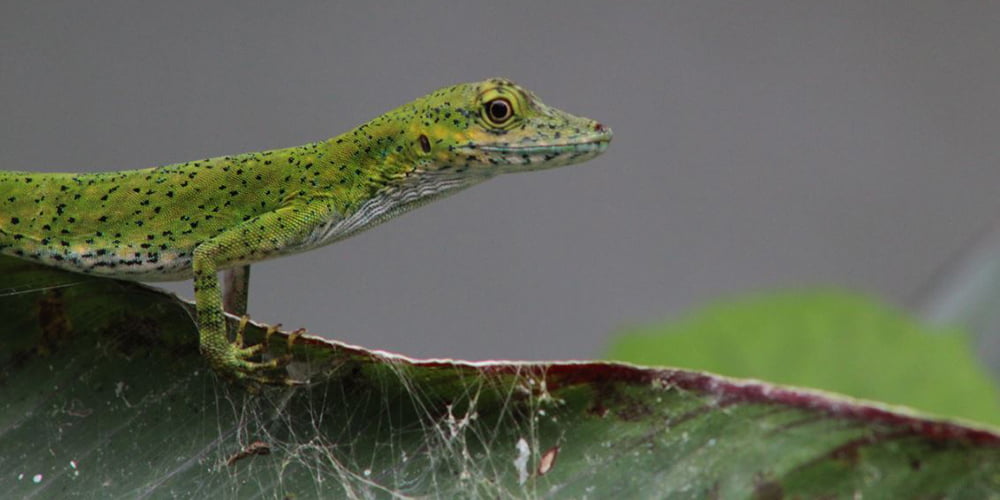
A biologist at The University of Texas at Arlington is studying the diversity of anole lizard species in the Caribbean islands to gain insight into why some species are common, while others are rare and possibly at risk for extinction.
The National Science Foundation awarded Luke Frishkoff, assistant professor of biology, a $1.1 million grant to investigate the reptile’s ecological niches, the set of conditions in which an organism can survive and reproduce.
Anoles with a broad niche thrive in a range of ecological conditions; those with a narrow niche are specialized to live in environments that meet their precise biological needs. Knowing the lizards’ niche characteristics will help scientists identify which species are in danger of dying out.

“We are in the middle of an extinction crisis right now, and some species are more likely to go extinct in the next 100 years than others,” Frishkoff said. “Among researchers, there is a common assumption that specialization is a predicting factor for extinction. The narrower the niche, the less likely it is that a species could survive.”
Frishkoff will collaborate with Martha Muñoz, a thermal biologist at Yale University, and Luke Mahler, an evolutionary biologist at the University of Toronto, to examine three aspects of the animal’s niche: diet, where they live among vegetation and how they interact with temperature.
The team’s findings will inform researchers’ strategies to conserve vulnerable species. As a community ecologist fascinated by the question of why various types of animals choose to live where they do, Frishkoff has a driving ambition to preserve the world’s biological diversity.
“When we go hiking and observe the plants and animals that are assembled there, I feel a deep sense of mystery,” Frishkoff said. “For me, the deepest motivation is to understand the rules by which life exists in these complex ecosystems.”
Frishkoff said humans can learn a lot from anoles about how to sustain life on earth.
“These lizards are a treasure trove of knowledge about ecology and evolutionary history, and they are a great model for understanding the fundamental properties of life on earth,” Frishkoff said.

The mainland ground anole Anolis tandai from Brazil. (Photo: Ivan Prates)
The mainland ground anole Anolis tandai from Brazil. (Photo: Ivan Prates)
June 02, 2021
By Kristen Mitchell
A George Washington University Columbian College of Arts and Sciences Ph.D. student recently published a paper about the evolution of Central and South American anoles, a group of tropical lizards that have been historically understudied compared to their distant relatives in the Caribbean. The study was a collaboration with researchers from the Smithsonian National Museum of Natural History.
Jonathan Huie, a Ph.D. candidate in the Department of Biological Sciences, got involved in this work as an undergraduate student through a National Science Foundation research internship at the Smithsonian National Museum of Natural History. This research sparked his passion for lizards and ultimately guided him toward a doctoral program studying salamanders at GW.
Mr. Huie is lead author of the new paper, published in The Biological Journal of the Linnean Society on Wednesday. Mr. Huie spoke to GW Today about the impact of this research.
Q: Why has there historically been such a significant gap between what researchers know about Caribbean anoles and what they know about anoles found in Central and South America?
A: Most of the 400-plus species of anoles live in Central and South America, and yet the lion’s share of anole research has focused on Caribbean species. There are likely several reasons why, but ease and accessibility are definitely important factors. In the Caribbean, anoles are quite abundant and easy to find but mainland anoles are more secretive, likely because they have more predators to hide from. It’s difficult to study what you can’t see.
Another reason may be because islands themselves are excellent study systems. They’re small and easier to make sense of compared to mainland systems. There’s also a lot of them, which is ideal for replication and hypothesis testing. Lastly, science is often conducted where it’s easiest or most desirable to establish a field site so it’s probably no coincidence that many well-studied anoles occur near vacation spots.
With that said, there’s been a huge push in recent years to learn more about mainland anoles. Our study wouldn’t have been possible otherwise, but there is still a lot we don’t know about mainland anoles.
Q: What did your research reveal about how anoles in Central and South America have evolved to fill various ecological niches?
A: Anoles originated on the mainland, then they colonized the Caribbean, and eventually re-invaded the mainland. Caribbean anoles are well-known among biologists for repeatedly evolving sets of species with similar ecologies and morphologies on Cuba, Hispaniola, Jamaica and Puerto Rico. For example, some species live on thin perches like twigs and have convergently evolved short limbs and well-developed toe pads. Other species specialize in living in tree-crowns, on tree trunks, grasses and bushes. We found that when anoles diversified on the mainland the second time, they convergently re-evolved all of the same habitat specialists and morphological adaptations found in the Caribbean—but this time in Central and South America. This is fascinating given what we often believe to be true about islands and continents.
Our second main finding was that ground-dwelling anoles are really common on the mainland and have their own set of morphological adaptations. Many Caribbean anoles forage on the ground, but very few live there full-time. Mainland ground anoles, on the other hand, really took off. We hypothesized that ground anoles are common on the mainland—at least among the group that re-invaded the mainland—because most arboreal niches were already occupied by other lizards. It’s unclear why Caribbean ground anoles are not more abundant.

GW Ph.D. student Jonathan Huie (center) poses with his mentors Ivan Prates (left) and Kevin de Queiroz (right) at the Smithsonian’s National Museum of Natural History in 2018. (Photo: Smithsonian)
Q: How do your findings challenge long-held assumptions made about evolution on islands compared to mainland habitats?
A: We found that island and mainland anoles are more similar than previously thought. For a long time, it was believed that islands were hotbeds for extreme morphologies and that continents lacked the necessary conditions. In the context of anoles, island species were considered to be unique—that the relationship between habitat and morphology was fundamentally different on islands versus the mainland. However, we found strong evidence that this is not the case.
That is not to say that everything we once thought to be true is now wrong—there are still many differences between island and mainland anoles. However, our research shifts how we should view island and mainland comparisons. Our paper joins other recent studies in suggesting that the mainland is equally good at cultivating morphological diversity as island environments.
Q: How did you get involved in this research, and how did it shape the kind of research you are doing now as a Ph.D. candidate?
A: I got involved as an undergraduate National Science Foundation Research Experiences for Undergraduates (REU) intern at the Smithsonian’s National Museum of Natural History in 2018, under the co-mentorship of Ivan Prates and Kevin de Queiroz. I was a total fish geek and had never studied anoles, but I signed on to investigate the link between habitat and morphology in a handful of mainland anoles.
I measured their body proportions using the museum’s natural history collection but finished quickly. So, we started adding more and more species, and even after the internship was over, I continued to visit other natural history collections to measure even more lizards. The next thing I knew, I had looked at more than 200 species. Natural history collections like the Smithsonian were absolutely critical for this work and fostering my interests beyond fishes.
As a Ph.D. student, I am currently studying salamander limbs to better understand the type of adaptations needed to make the water-to-land transition. The kinds of questions I am interested in for my dissertation are similar to the ones we approached with the anole project. Without my internship, it’s very unlikely that I would have ended up at GW studying salamanders.
Q: How are you planning to build on this research moving forward?
A: There is still so much left to do. In our recent paper, we only published about half of the data I initially collected. We are excited to dive deeper and look at how body size influences patterns of morphological adaptation.
There’s also the other group of mainland anoles that we didn’t look at. I am interested in knowing more about how these other mainland species fit into the puzzle. Did they adapt in a similar manner as the group of mainland anoles we looked at? Or are they doing something different? We would like to know how often evolution repeats itself to produce similar outcomes.
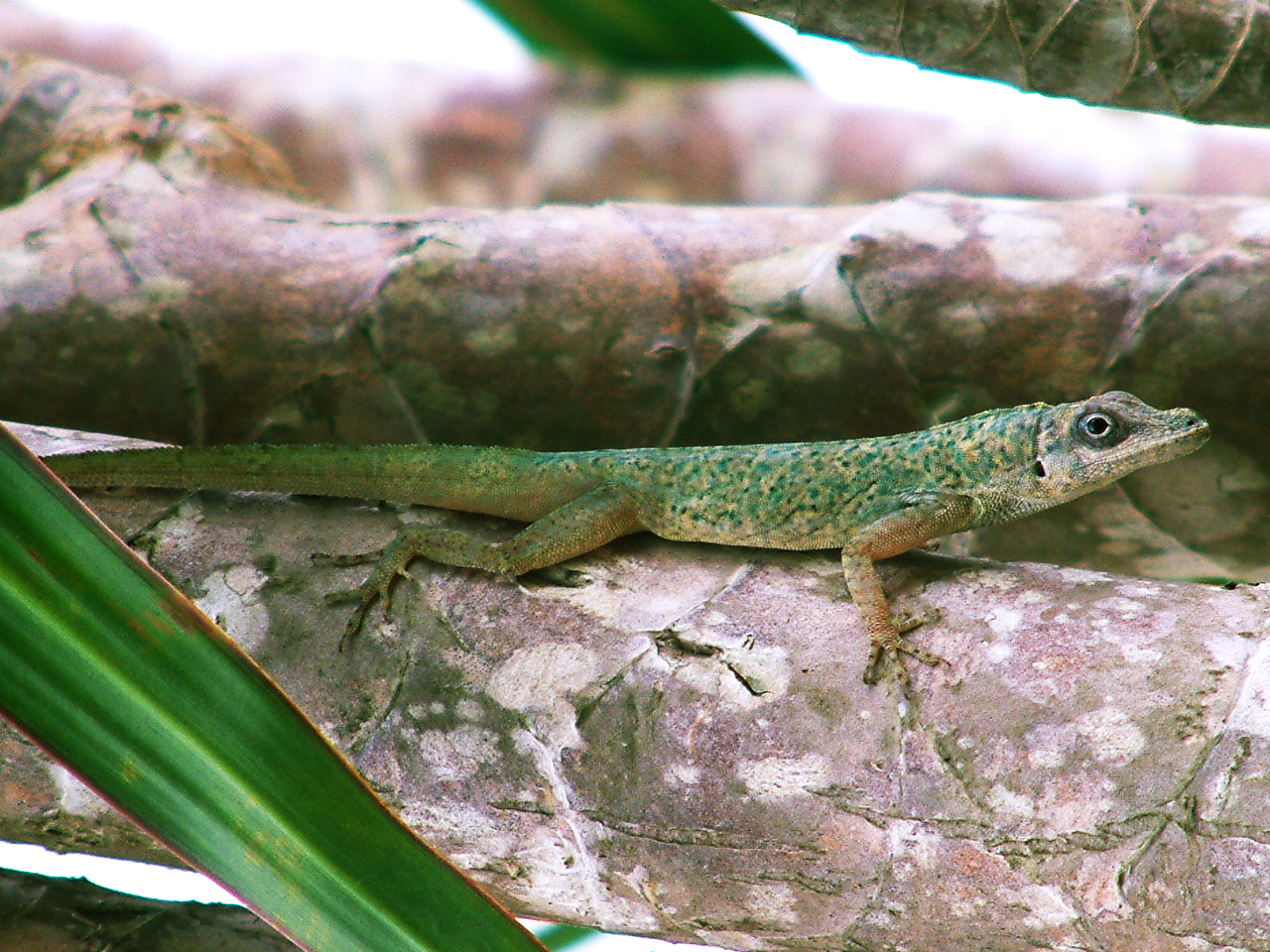
Anolis aeneus. Photo by shanelkalicharan.
Vaneisa Baksh is an editor, writer and cricket historian for the Trinidad Saturday Express. She’s written two essays on the local lizards and along the way has chided up herpetologists for not responding to the first one. Let’s get to work!
First she writes several weeks ago, in an article entitled “The LIzards Running Up and Down”:
The first time I heard the sound, I thought a bird had flown into the house, although none of my regular feathered folk chirped like that. I searched and searched, remembering how one time a little dove had come in and had been frantically trying to escape while I tried to guide it to the open window in the kitchen. My efforts were just increasing its anxiety and I had to leave it alone to simmer down until it mercifully found its way to freedom.
This time, there was no bird and eventually, as the sound repeated itself, I spotted the culprit. It was a lizard, a gecko, and although we have co-habited in different houses since I was a child, I’d never heard one of the buggers speak. That was a couple years ago, and curious to know if this was a mutation of the creature we called “24-hours” on account of the myth that if it fell on you, it would stay there for an entire day, I went looking for information.
It turned out that these are really house-loving critters. They prefer to be indoors and are harmless, and might even be regarded as useful. I learned that they feed on insects, cockroaches, termites, wasps, flies, spiders, moths and poor butterflies. I’d decided that I would just have to get used to the unusual sound—the most apt description on Wikipedia was “tchak tchak tchak”, which it said was often sounded six to nine times in sequence. I have a way of seeing words in shapes, and maybe sounds as well. Every time I hear the gecko chirp, I would see the sound like a fairly squared-off pellet. Perhaps it is because the sounds are evenly pitched and last for roughly the same length of time. I don’t know, but I have tried to get used to it suddenly rapping into my consciousness.
At first, it was restricted to my bedroom and my study, but now it seems the lizards are everywhere. Whereas I found it an occasional interruption, now I feel there are colonies of them living in my house and even though I hardly see more than one at a time, I feel that they have taken over.
It is one thing to adjust to the sound they make—tchak tchak tchak is far more bearable than the abrasively loud grinding from the welding next door—but these discreet urban dwellers leave their little droppings everywhere. Everywhere. Not only do I have to clean them off the floors, especially at the base of the walls, but the area that really trips me is by my bedside table and on my bed. Yesterday, I washed my sheets and replaced them. As I prepared to turn in last night, I spotted the droppings on the edge of the bed. I suppose that’s why I am bringing them up now.
I would dearly like to know if other householders are experiencing this increased presence that is now forcing a whole different level of housekeeping. I have been getting faint whiffs of urine as well, and it drives me crazy, because I am washing cushion covers, curtains, sheets, everything that could be contaminated, and mopping the floors far too often.
It’s not just being finicky, which I am, but for some time now, my eyes have been unusually sensitive and gritty. While it is true that I am spending a considerable amount of time reading and writing in front of various screens, and that the presence of Saharan dust has been exacerbating things, my ophthalmologist says there is evidence of some kind of persistent irritant, or allergy affecting my eyes.
Naturally, I am mindful that it is possible that the creatures overhead who seem to like my bedroom might be doing numbers over my bed and that might be messing with my eyes. I am not trying to gross anyone out, it just seems that it is likely that there is a growing population of the lizards, which I think we also call woodslaves, and that while we might be adjusting to their presence and their noises, we might not be aware of the side effects.
I’ve never had a problem with lizards. When we were children, the whole brood of about 15 to 20 cousins on any given night would gather in my grandfather’s living room to look at television shows because nobody else had a TV.
We’d start streaming in when the news programme, Panorama, began at seven o’clock. That was when he would turn on the black and white beauty with the wooden cabinetry. Afterwards when some other show began (the real reason we were there), he would sit there with us, and if there was any sign of anything remotely inappropriate for us, like a kissing scene, he would suddenly exclaim, “Look, look, look, the lizard up there!” Naturally, we would all momentarily turn our heads away from the screen at the unexpected shout. Sometimes there was a lizard, but more often not, and he would say, “Ah, he run away!” But his distraction worked well enough, or so he thought.
Harmless enough.
But I feel something has changed. There are more, they are loud and though they love being indoors, they are not house-trained! This might sound creepy though I say it in jest, what if I am now the interloper in the house of the lizards?
—Vaneisa Baksh is an editor, writer and cricket historian.
E-mail: vaneisabaksh@gmail.com
And then Vanessa writes yesterday in “Welcome to the Lounge of Lizards”:
I’D hoped that bringing up the ungovernable appearance of house lizards might have elicited a response from a couple of herpetologists. Disappointingly none came; but many people shared their experiences and theories. There was much to learn from these personal stories, and they broadened my sense of community, so I want to share some titbits from a few.
I mean, here we are, locked down in our separate cubicles, not knowing anything about one another, and suddenly, we are sharing lizard tales, revealing snippets of our lives that tell us something about daily trials we have in common. It’s not something we’d chat about, and noticing that our traditionally unobtrusive house mates have become loquacious would hardly qualify as a subject for conversation—unless you have physical visitors and the lizards are contributing their five cents to the discussions. Innocuous things have to force themselves unto your radar—usually by causing some disruption—before they register on your consciousness. Like the jiggly latch on a window that you notice every time you open or close it, but never outside that moment.
Curious if these chirpy critters were mutants or had just been imported, I read of work done by Jonathan Losos, a professor of evolutionary biology and a herpetologist, whose research is mostly concerned with how lizards interact with their environment and how they have diversified. Apparently they have focused on the “evolutionary radiation” of Caribbean Anolis lizards, among others, but they are also looking at how species are adapting to urban environments.
One related study examined the impact of an invasive anole species in Dominica. Up until two decades ago, it was home to a single species until a second species arrived tucked inside a shipment of lumber. Not hard to imagine our lizards coming in by sea. I remember landing in Nevis on one of those small aircraft and as we disembarked, a scorpion scurried down the aisle as soon as the door was opened. Naturally, passengers let the hustler disembark first.
A 65-year-old reader sent this: “Our first house was a small ‘board-house’ with a thatched roof and termite-ridden boards. I could knock on a board to find out if it was termite-eaten by the hollow sound that emanated. Prying into the thin cover, I would find the hollow cavities. Here the house-geckos laid their eggs. Unfortunately, sometimes I would remove the eggs. The old Indian people used to call them ‘bistooyas’, the ones about three inches long, sometimes with white stripes from their eyebrows to the body.”
Quite a few people said they had been hearing the noises but couldn’t figure out the source, assuming it was some kind of night bird, and some thought they were alone in this experience.
One person said that around the same time they began hearing those sounds they noticed that “my eyes felt like I had nits in the base of my eyelashes, and the attendant discomfort… At the same time, I had noticed a reduction in small spiders, spider’s webs, and mosquitoes”.
A woman of the West included a delightful description of the upsurge of geckos. “There’s quite a lot of courtship going on between pairs, appropriately, in our bedroom, and each pair seems to play tag, with a pursuer and its quarry. Inevitably, though, they come to an agreement and tiny baby lizards pop up soon after.” She doesn’t mind them, she says, but most of the women harbour strong feelings.
“I detest those creatures. They are annoying. They feed on the insects in the house. If by chance I should see one within easy reach, I implore my husband to get rid of it, and he would hold it using a piece of cloth and throw it outside. He doesn’t harm them,” said one.
A few mentioned that peppermint infused with water makes a reasonable repellent. One had specific directions: peppermint oil may be used by soaking cotton balls and placing them on the top of shelves, inside closets, behind books and similar places. I prefer using a spray bottle, measuring half water and quarter oil and spraying in the same places. It’s been keeping them away so far and the smell becomes less pungent after a few days.” Another said she had tried it, but is worried about the larger implications.
“There is something amiss in the ecosystem. This, what can only be described as an infestation, is a new phenomenon. Is this a new and invasive species or has this lizard been blessed by depleting stock of its natural predators? I do think it is something which the scientists need to investigate. Is there something more sinister at work? And what are the implications? I have always been leery of lizards. Their presence disconcerts me. And now this is like living in some kind of mild horror story—in my own house! Lizards pop up everywhere—in the vegetable basket, in the clean-clothes basket, drop from the roof. One found its way into my glass of water; fortunately, I looked down before I sipped!”
Another said, “I agree with you totally on all that you said, and I believe that these creatures are being used for sinister purposes.”
I don’t know about that, but I enjoyed learning more, like discovering that a group of lizards is called a lounge. I imagine them lounging about our homes and I figure what better place for a lizard to lime than this country!
![A male green anole flashes its dewlap in a territorial display. Males flaunt the red throat fan to challenge other males. [Photo by Tom Jenssen]](https://i0.wp.com/www.gannett-cdn.com/presto/2021/04/27/NTTN/6cd12f55-47f2-44a2-9328-c9ab58ededa9-05-02-21_Anolis_carolinensis_Tom_Jenssen.png?w=629&ssl=1)
One of the most commonly seen lizards in the Southern states is the green anole, also known as North American green anole or Carolina anole. (Its scientific name is Anolis carolinensis.) Although more than 400 species of anoles are known to science, the green anole is the only one native to the United States. Most people appreciate seeing them in their yards.
Q. A type of lizard we have in Birmingham, Alabama, is sometimes green and sometimes brown. I know it is not two different kinds of lizard because I have watched one change from brown to green. Are these a type of chameleon that can change skin color to match their surroundings?
A. No. Anoles are in a different family of lizards from Old World chameleons. Those are the ones famous for being able to change skin color based on the background, thus creating a true camouflage. In green anoles, color change is a response to external factors, such as temperature and humidity. It may also be influenced by hormonal changes. Whether lizards experience emotions comparable to humans remains a mystery. Researchers continue to investigate why anoles change color, as well as what purpose that change serves for the individual lizard. Most anoles found hidden under bark or leaves on cool days will be brown. If you pick up a brown one and hold it, it will usually turn green.
To learn more, I contacted Tom Jenssen, an expert on the subject of color-changing behavior in green anoles. During his career as a professor at Virginia Tech, Jenssen observed thousands of green anoles while conducting research on the species.
His observations confirmed categorically that the color of a green anole has nothing to do with what the lizard is standing on. One on a green leaf can be brown; one on dark soil can be green. He indicated that factors causing a green anole to exhibit the brown color phase are not completely understood, but he explained the biological mechanism: “Color-shifting comes from melanophore activity over a sub-dermal layer whose structure reflects green wave lengths.”
In other words, the concentration of black or brown pigment cells determines the color exhibited. If the pigment cells are large, they obscure a lower level in the skin that reflects green light. When the cells are concentrated, the lizard looks dark brown, mottled brown or even like a bad bruise of blotchy brown and olive-green. If the pigment cells contract in size, the lower level is exposed, and the lizard appears green.
He further noted that the activity of pigment cells and their concentration are controlled by the endocrine system, the glands that affect hormones and mood changes for many animals.
The remaining biological mystery: What triggers the endocrine system to cause the pigment cells to contract or expand? Body color in anoles is highly complex with no simple answer for why an individual is a particular color at any given time. Social interactions with other lizards may be responsible in some cases. Brown coloration could possibly result in faster warming of the body on a cool sunny day.
Q. Why do these lizards that can change from brown to green sometimes have a bright red throat?
A. Male green anoles use the vivid red throat fan, or dewlap, to challenge other male anoles and sometimes even other animals. The dewlap display is often accompanied by push-ups and head-bobbing. An invasive species from Cuba, the brown anole, now found in Florida, Georgia and Alabama, has an orange dewlap. Next time you see a green anole displaying a red throat, take a moment to watch its performance. Who is its audience? Is it another anole in the vicinity — or is it you?
Native green anoles are completely harmless and offer fun outdoor entertainment. Enjoy watching them stalk bugs and interact with each other. They are indicative of a healthy environment and deserve our appreciation wherever we find them.
Whit Gibbons is professor of zoology and senior biologist at the University of Georgia’s Savannah River Ecology Laboratory. If you have an environmental question or comment, e-mail ecoviews@srel.edu.

Charles Leeper shows us a green anole in action from around his home. And here’s an oldie of Anolis smaragdinus doing the same:
Or should we call it dine-dash-and-dewlap? Anole video-chronicler Charles Leeper has provided another view of green anole life around his house. He describes it thusly: I recently captured some anole footage that you might find interesting. In the video, we see the anole repeatedly extending its dewlap after catching the insect. I know dewlap extension is for displaying to a mate and establishing territory, but could it also be a show of triumph or excitement. I ask because there don’t appear to be any other males in sight, and the anole does it immediately after catching the prey.

Harry, the lizard, clearly a Lesser Antillean anole from the fictitious island of Saint Marie near Martinique and Guadeloupe in the British detective series Death in Paradise, is in jeopardy. Read all about it, but beware of spoilers.


Over the years, Anole Annals has featured several posts on the appearance of anoles on postage stamps from countries around the world (e.g., 1, 2, 3), mostly thanks to Uwe Bartelt. Now AA stalwart George Gorman has taken up the mantle.
In reference to the stamps above, George writes:
“Djibouti, on the Horn of Africa somehow must have learned from P.T. Barnum that there’s a sucker born every minute. As a collector of anoles on postage stamps , I couldn’t refrain from purchasing this recent issue that featured two very classy anoles: Anolis gorgonae and A. proboscis (male and female). I would bet there aren’t five people in Djibouti who have ever heard of these species, let alone who worry that they are endangered.”
And with regard to the famous iguana ecomorph (below), George writes: “I had enough trouble dealing with Dactyloa and “Norops” and the like… but this is getting out of hand. This mini-stamp- sheet from Nevis .. (ok.. it is labeled “reptiles of the Caribbean”) identifies the creature as…Anegada Ground Iguana, Cyclura pinguis!”

Finally, I can’t keep from reprising a post of mine from nine years ago, in which I point out that one of my photographs was used without permission on a postage stamp. Anyone know a good anole intellectual property attorney?

This prototype video from a nature center in Bellaire, Texas has a degree of charm and entertainment, but a few factual errors and some unexpected historical/geopolitical statements. Still, it’s nice to see anoles chosen as the subject of their first video in what could be a series of micro-documentaries. More on the video and anoles at this website.
Powered by WordPress & Theme by Anders Norén