

Anole holiday shopping season is now officially open! What could be better than a Christmas tree festooned with ecomorphs?
Professor of Biology and Director of the Living Earth Collaborative at Washington University in Saint Louis. I've spent my entire professional career studying anoles and have discovered that the more I learn about anoles, the more I realize I don't know.
Anole holiday shopping season is now officially open! What could be better than a Christmas tree festooned with ecomorphs?

Dickerson’s collared lizards. Photo from http://www.herpnation.com/wp-content/uploads/2012/05/Dickersons-Collared-Lizard-Crotaphytus-dickersonae-700×466.jpg
What the heck gives with blue lizards? Collared lizards, geckos, lacertids, teids, anoles—there’s more blue lizards than you can shake a stick at. And they stand out like a sore thumb. How can they possibly survive? And in those species in which only the males are blue, do the lady lizards really have an azure fixation?

Male Anolis allisoni from Atkins Botanical Garden, Cienfuegos, Cuba. Photo by J. Losos.
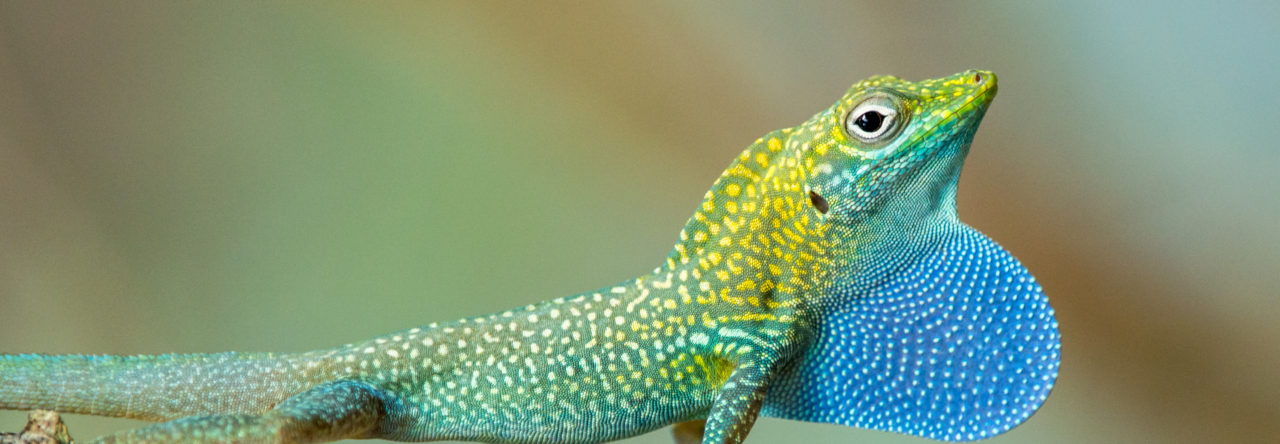
Male Anolis allisoni from Cuba are famous as the day-glo green lizard with a blue jumper. But their Honduran descendants are much less cerulean—indeed, here on Roatan, they barely have a hint of the cobalt (see below). What’s going on? It would seem that whatever has favored blueness in Cuba is not favoring it here. Do the ladies out here swoon not as much for indigo? Are the predators tougher? Is the environment different? Who knows. And has the population here reached a new, less blue, stable-state, or is it in the process of losing its turquoise entirely, returning to its verdant roots. At this point, we don’t have a good time estimate for how long allisoni has been here—if it’s a recent arrival, it would certainly be a reasonable hypothesis that the blue wash is on its way out entirely.

Male Anolis allisoni from Roatan. Photo by J. Losos

See if you can spot the lizard.
But while we’re on the topic of color craziness, here’s another question: how come green anoles can’t—or don’t—match their background? Color mavens may be offended at my non-analytic assertions, but I insist that green anoles often are conspicuous. On white tree trunks (much less brown or red ones), a green anole stands out a mile away.

How about this one?
Sure, green’s great for camouflage when you’re in the vegetation, but if you could change colors, wouldn’t you do so when on non-green backgrounds. Octopi can do it, why not anoles? Or, at least, why don’t they stay on green surfaces when they don’t want to be detected. Although, truth be told, not all greens are the same, and the bright green of these species often stands out against darker green vegetation (check out the anole in the grass in yesterday’s post, reprinted to the left).

Green lizard in the grass: not so cryptic
Now, some contrarians may claim that they’re actually trying to be conspicuous—Bob Trivers, for one, suggested that the beautiful green A. garmani intentionally perched in conspicuous sites in order to be seen. Maybe that’s so, but most of the time, anoles don’t seem like they’re trying to be seen, especially the females. And, yet, you can’t miss them.
Finally, of course, I have to acknowledge that it’s possible that I failed to spot one or two green anoles in green vegetation, especially high in trees. So, it may be that green is the color that camouflages them most effectively. Still, they could do better by changing color to match where they’re sitting, or by only sitting where they don’t stand out.

A female Anolis allisoni, no worse for the wear, from Roatan, Honduras
In advance of our trip out to Swan Island, I’ve come to Roatan, one of the Bay Islands just off the coast of Honduras, to check out its anole fauna. Of particular interest is the mixture of island and mainland faunas: A. allisoni¸ a trunk-crown member of the carolinensis group, somehow found its way here from Cuba, whereas A. roatensis (nee lemurinus) represents the mainlanders. And, as a bonus, A. sagrei is here, too, apparently introduced. I’m looking forward to seeing how they mix it up.
Things didn’t get off to a good start yesterday when I arrived mid-afternoon. It was very overcast and drizzly, and the temperature probably barely topped 70. Brrr! With more of the same forecast for today, I was not optimistic.
But although it looked like it was on the verge of raining all day, it held off until after dark. The sun was in and out, and so were the lizards. My expectation was that the balance of color would be like it is in other places where carolinensis and sagrei group anoles co-occur: lots of brown anoles on the ground and low on trees, bushes and buildings, and a small to moderate number of greens at eye level up to the treetops.
I couldn’t have been more mistaken. Green anoles were seemingly everywhere—as thick as anywhere I’ve ever been. And the browns? I saw three. The greens were on the buildings, on the fences, in the bushes up the trees, even doing their best grass-bush anole imitation along the roadside. They were everywhere, except one place: the ground. And therein lies the explanation for this green:brown inversion. There were brown lizards in great abundance—at least in open sunny localities—but although they skittered about and occupied the same place, they weren’t anoles. Rather, they were these fellows.

Brown basilisk on Roatan
Brown basilisks, Basiliscus vittatus. Many of them were sagrei-sized, and if you weren’t paying attention, their abundance might have convinced you they were anoles. But then there were the bigger fellows, not as abundant, but plenty of them. My hunch is that they’re why brown anoles haven’t gotten much of a foothold. The little guys compete with the sagrei, and the bigger ones eat ‘em. I speculated earlier this year about interactions between basilisks and introduced A. cristatellus in Costa Rica—there, they seemed to coexist and cristatellus was doing fine. Here, I think the story is different. Of course, brown basilisks have also been introduced to Miami, where they coexist with sagrei, so maybe I’m barking up the wrong tree, but the great abundance of basilisks, living exactly where you’d expect to see the sagrei, seems too much of a coincidence to me.

The proverbial lizard in the grass
Whatever the cause, the absence of sagrei seems to have given allisoni the green light to go crazy. They’re enormously abundant and use many off-the-ground habitats—fences, buildings, etc.—where you’d expect to see sagrei. At least in open places, like hotels, they are very common from 1-2 meters in height, or even lower. In more forested areas (and remember, this is based on one day’s observations, and the forested areas were visited in the afternoon), they seem mostly high up, generally in sunny spots. I was particularly struck that they were very common in the thick grass, while at the same time as high up in the tree as I could see them. Those of you who live with green anoles in other places (I’m thinking of certain Georgians and Little Caymanians), I’d appreciate your thoughts. Does this seem different from your abundant greens?
Now, as for the other native anole, A. roatensis, today I was shut out. They’re supposed to be in forested areas, and I have a hot lead for a spot tomorrow, so hopefully will have more to report then.

Anolis sagrei nelsoni from Little Swan Island. Photo by Steve Busack.
Yesterday I wrote about our upcoming trip to look for the giant brown anole, A. sagrei nelsoni (and other reptiles), in the Swan Islands of Honduras. To give a little flavor of what we have in store, here are two mini-reports from trips here in the 1970’s.
First, Steve Busack’s reminiscences from a Smithsonian sponsored expedition 40 years ago:

Swan Islands iguana. Photo from http://www.tarleton.edu/Faculty/dekeith/iguana2.jpg
“Wow! It was so long ago, and my memory—aside from some pretty interesting aquatic (diving) iguanas at the dock around dusk—doesn’t recall very much. And I’m afraid that my experience with Anolis in the field is less than bountiful. I could help much more if it were Podarcis on Swan Island.
If I were given an opportunity to return, I’d have to think twice. BUT there is one issue I’ve always wanted to address if I had the opportunity. Great Swan was—at that time—”loaded” with worm snakes (Leptotyphlops if I recall correctly). One evening we took a handful (probably about 20 or so) and placed them in a chest type freezer available at the NOAA main building. After we had dinner, we returned to the dormitory and removed the specimens from the freezer. They were all frozen. We placed them on a bed in the dormitory while we worked with other specimens — allowing them to thaw before we preserved them. Several specimens actually thawed out and begain crawling off the bed. I was amazed!! A tropical snake with the ability to become frozen to the point that it is quite stiff—truly a surprising result. Because the island was accessible only by flying over from San Jose on a NOAA “supply flight,” and at the time I had no access to anything physiological, I dropped the idea of pursuing it further—thinking others I mentioned this to would have better access. To my knowledge, nobody has investigated survival of these snakes after freezing, or—more interesting—the physiological pathway they have available allowing such resistance.
One hint: if you decide to go, and wish to visit Little Swan as well, bear in mind that Little Swan is uninhabited and it’s basically a rock in the water with no fresh water. We had a tent with us, and air mattresses, but finding a place to sleep wasn’t easy. Also the island is full of the mites that infect sea birds—and people. I am not generally allergic to insect bites, but these mites sent me to an ocean bath one morning. I can’t remember if DEET was available back then, but I’d highly recommend it now. As I recall we stayed only one night on the island (radio contact and transport with the main island thanks to NOAA personnel).”
And Brad Lister, whose work I summarized yesterday, recollects:
“I do remember Swan Island and the giant sagrei very well (or is it nelsoni now?). Of all the places I’ve been, Swan seemed the most remote and enchanted.
It was the summer of 1972 and I was on the last leg of a trip to Jamaica and the Cayman Islands. NOAA had a weather station on the island and they flew me in and out. The CIA had used Swan as a staging area for the Bay of Pigs and had created a landing strip that destroyed maybe 1/4 of the forest. Apparently the island was also used for a coconut plantation at one time. At least the time I was there, the remaining forest was fairly open with a low (<10m) canopy, mainly small (10-20cm trunk diam) trees, with lots of small palms in the understory. The sagrei were fairly abundant, but not really dense. Not sure what predators might have been on the island back then, but I did see a several feral cats. I did not see any other reptiles except the big iguanas, though as I’m sure you know, Aristelliger nelsoni is listed as a resident.
Qualitatively, the anoles certainly looked like your average, every day sagrei scaled up to a larger size. Nothing striking morphologically that would distinguish them from the basic sagrei body plan. I remember being somewhat disappointed that they hadn’t evolved a more exotic look given how isolated the island is, and having just left Little Cayman and being so impressed by the really cool A. maynardi. Then again, I just measured SVLs & head size, counted lamellae, and did some other basic scale counts. In retrospect, it would certainly be interesting to get an estimate of how long the population has been on Swan and to look for the the adaptations that have been identified in solitary anoles that are utilizing a broader range of perch sites. My guess is that the large size is primarily due to competition for females, and would expect the males to spend the lion’s share of their time courting and defending their territories. Little Swan island intrigued me, but there were no small boats so I was never able to land and explore. Amazingly enough it had a species of hutia that went extinct sometime in the 1930s(?).”

The endemic and extinct hutia of Little Swan. Photo from http://www.redorbit.com/media/uploads/2004/10/42_8cf650ddccd939f96fdf01fb8572efa0.jpg

Great Swan Island. Image from http://4.bp.blogspot.com/-r2giIJn_MqU/TinmSdNEWgI/AAAAAAAAHYU/m4CSy8_7NU8/s640/An+aerial+view+of+the+eastern-end+of+Swan+Island+..jpg
 The Swan Islands are a tiny specklesome trio stuck in the middle of the Gulf of Mexico. Great Swan, picture above, is scarcely two square males in area; Little Swan to its east is smaller yet and Booby Cay barely deserves mention.
The islands have an interesting history. Christopher Columbus is said to have stopped there to collect wood, for which reason Honduras, as the last vestige of the Spanish Empire in the New World, claimed it as its own. However, the U.S. also claimed the islands based on a visit there by a sailor in the mid-19th Century. In the middle of the last century, the U.S. operated a weather station there, and in 1960, a radio transmitter was put into place to beam Spanish language propaganda into Cuba; Radio Swan gained attention as it operated before and during the Bay of Pigs invasion. At that time, there were 28 inhabitants of Great Swan, possibly an all-time high. The radio station was removed in the late 1960’s, and in 1972, the U.S. relinquished control to Honduras, and now the island is home to a small Honduran naval garrison. In 1988, Hurricane Mitch devastated the island.
 From photographs, the island seems pretty typical of many in the Caribbean; scrubby and somewhat xeric, with some palm trees. One curiosity is that almost the entire length of the island is bisected by an airstrip, presumably put in by the US during the halcyon days of the 60’s and 70’s. Little Swan island has a much different aspect, with karst rock formations and covered with cacti.
So, who cares?

From dust tracks on the web.
Janson Jones is on another mini-anole tear over at dust tracks on the web. Today–distichus. Yesterday–sagrei. He’s threatening to switch to snakes. Head over there and demand he run the Floridian anole gamut!
 Picture this on your wall! You can buy this enormous anole graphic and put it wherever you want. The 52″ version is less than $60. Interestingly, this is the same image that was in the book Snakes and Reptiles: The Scariest Cold-Blooded Creatures on Earth, which I reviewed a year ago and which was panned by several commenters.
We recently posted the lovely guide to Mexican anoles prepared by Gray et al., which featured photographs of 46 species and attracted a lot of attention. Close on its heels comes a new paper in Zootaxa by Gunther Köhler who examines two little known species, A. cumingii and A. guentherii, each known from a single specimen. To make a not very long story short, Köhler examined the type (and only) specimens of both species and concluded that neither is a valid species: cumingii is sunk within A. sericeus and guentherii into the Jamaican A. grahami. In the latter case, it is much more likely that the type locality of “Mexique” for the 1870’s vintage specimen is incorrect than the alternative, that a population of grahami occurs somewhere in Mexico.
This would seem to be a major setback in Anolis’s inexorable climb to the 400 species plateau (put most recently at 386 in a paper I read). Fear not, though—these species have been so poorly known that they were not included in most species listings, including the Gray et al. poster (except A. forbesi).
Köhler concludes by noting that there are a number of other extremely little-known Mexican species requiring further examination, concluding: “However, there are still several nominal species associated with the anoline herpetofauna of Mexico that are of uncertain status, such as Anolis adleri Smith 1972, A. damulus Cope 1864, A. forbesi Smith and Van Gelder 1955, and A. simmonsi Holman 1964. I agree with Lieb (2001) that, as has been the case with the two species treated in the present paper, some, if not the majority, of these enigmatic taxa will be shown to be synonyms of well-known species.” As mentioned, A. forbesi is illustrated in Gray et al.’s guide, and they note that they intend to sink adleri and simmonsi into other species.

Stephanie Zembillas, who posted this photo on Twitter and another on Tumblr, had this to say: “I wanted a picture of a moth, but an anole wanted lunch. We made a compromise.”
 For a number of years, Roger Thorpe and colleagues have been studying patterns of geographic variation in Anolis roquet on the island of Martinique. This species is famous–along with A. marmoratus on Guadeloupe to the north–for the tremendous amount of phenotypic variation that occurs on a relatively large island, so great that Skip Lazell described six subspecies of A. roquet. The photo above illustrates how different looking these populations can be.
Martinique is an unusual island, unique in the Caribbean as far as I’m aware, in that it is an amalgam of several different islands that were distinct for millions of years before being united by a volcanic eruption that poured out lava that connected them. Previous work has shown that there is still a clear genetic signature of this historic isolation, with different lineages occupying their ancient homelands. In addition, Martinique harbors considerable environmental heterogeneity, from sealevel to the 1400 meter peak of Mount Pelée. Much of the mountainous area is cloaked in rainforest, whereas in the rainshadow of the mountains, the environment is quite dry.
This situation has allowed Thorpe and colleagues to ask: which drives divergence more, historic isolation (i.e., allopatry) or the divergent selection pressures that occur in different environments? To examine this question, they have sampled along transects that either cross the boundaries where two lineages meet or that cross environmental transition zones within a single lineage. These transects are exhibited in the figure above–the white lines are the separation among the lineages, the background color represents the environment, and the red lines are the transects (note that the transects cross the lineage boundary at one end, but those sites were excluded from the analysis). Across these transects, the authors measured genetic and morphological differentiation, the latter by examining body patterning and the color of the dewlap and body, as well as limb dimensions and scalation.
The results reported in their most recent paper show that both isolation and environmental differences can lead to divergence, though more predictably so for the latter.
Powered by WordPress & Theme by Anders Norén


