
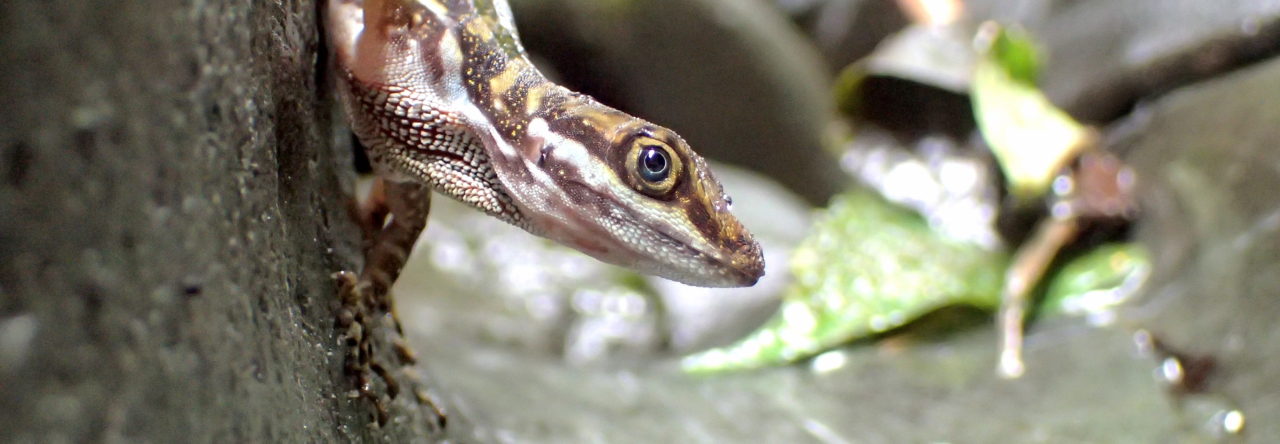

The rise in number of recognized reptile species through the years.
The number of described species of reptiles has increased extraordinarily in recent times. In a fascinating recent article, Pincheira-Donoso and colleagues have catalogued this increase, as well as describing the taxonomic distribution of present-day reptile diversity. They report that since 2000, the number of described species of lizards has increased by 1164, a remarkable increase of 26%. They also point out that reptile diversity among clades is right-skewed, with most genera containing relatively few species and a few containing a lot. And, of course, they highlight everyone’s favorite genus, Anolis, as one of the largest outliers.
Speaking of anoles, AA wondered how anole diversity has changed since 2000. Daniel Pincheira-Donoso kindly provided the answer, with information provided by co-author Peter Uetz. Since 2000, 42 species have been described, bringing the total in March 2012 (when data were compiled) to 384 (the list of new species from 2000 til the present appears below). That’s only a 12% increase, lagging behind lizards in general, but more on par with the description rate for snakes, which has increased 16% over that period. As AA readers are well aware, however, new anole species are being described at a high rate (e.g., 1,2) and, indeed, Uetz’s Reptile DataBase now puts the number at 391.
What’s behind this incredible burst of species description, both in anoles and more broadly? Some of it is the result of exploration and discovery of truly new, previously unknown, lizards. But most of the increase—in my humble estimation—is the result of the taxonomic splitting of previously widespread species into multiple species. Systematics goes through phases of “lumping” and “splitting” and the field in general seems to be experiencing a massive phase of splitting at the moment. In some cases, this is the result of taxa being differentiated on the basis of morphological characters. However, most is the result of the discovery of genetic differentiation among populations. A naysayer might be prompted to say that this has gone to far, that species are sometimes being described on the basis of minor, insubstantial differentiation. It will be interesting to see if and how much the pendulum swings back.

Are these really the same species?
Regardless, one of the reasons that anole diversity has not increased as much as that in other taxa is that anole systematists—to date—have been restrained in their splitting, particularly in the West Indies. Substantial genetic diversity has been found among populations in many anole species, differentiation so great that many would have described four, six, or eight species from single widespread Caribbean taxa. This, of course, may change in the future, and the diversity of Caribbean anoles may skyrocket.
Below are the abstract of the Pincheira-Donoso paper and then the list of new anoles described from 2000-2012. And when you’re done reading those, check out Daniel Pincheira-Donoso’s website, with much information on Daniel and his work on Liolaemus.
Abstract:
Reptiles are one of the most ecologically and evolutionarily remarkable groups of living organisms, having successfully colonized most of the planet, including the oceans and some of the harshest and more environmentally unstable ecosystems on earth. Here, based on a complete dataset of all the world’s diversity of living reptiles, we analyse lineage taxonomic richness both within and among clades, at different levels of the phylogenetic hierarchy. We also analyse the historical tendencies in the descriptions of new reptile species from Linnaeus to March 2012. Although (non-avian) reptiles are the second most species-rich group of amniotes after birds, most of their diversity (96.3%) is concentrated in squamates (59% lizards, 35% snakes, and 2% amphisbaenians). In strong contrast, turtles (3.4%), crocodilians (0.3%), and tuataras (0.01%) are far less diverse. In terms of species discoveries, most turtles and crocodilians were described early, while descriptions of lizards, snakes and amphisbaenians are multimodal with respect to time. Lizard descriptions, in particular, have reached unprecedented levels during the last decade. Finally, despite such remarkably asymmetric distributions of reptile taxonomic diversity among groups, we found that the distributions of lineage richness are consistently right-skewed, with most clades (monophyletic families and genera) containing few lineages (monophyletic genera and species, respectively), while only a few have radiated greatly (notably the families Colubridae and Scincidae, and the lizard genera Anolis and Liolaemus). Therefore, such consistency in the frequency distribution of richness among clades and among phylogenetic levels suggests that the nature of reptile biodiversity is fundamentally fractal (i.e., it is scale invariant). We then compared current reptile diversity with the global reptile diversity and taxonomy known in 1980. Despite substantial differences in the taxonomies (relative to 2012), the patterns of lineage richness remain qualitatively identical, hence reinforcing our conclusions about the fractal nature of reptile biodiversity.
New Anole Species:
Anolis cusuco (MCCRANIE, KÖHLER & WILSON 2000)
Anolis kreutzi (MCCRANIE, KÖHLER & WILSON 2000)
Anolis toldo FONG & GARRIDO 2000
Anolis hobartsmithi (NIETO-MONTES DE OCA 2001)
Anolis ocelloscapularis (KÖHLER, MCCRANIE & WILSON 2001)
Anolis oporinus GARRIDO & HEDGES 2001
Anolis roatanensis (KÖHLER & MCCRANIE 2001)
Anolis terueli NAVARRO, FERNANDEZ & GARRIDO 2001
Anolis wampuensis (MCCRANIE & KÖHLER 2001)
Anolis yoroensis (MCCRANIE, NICHOLSON & KÖHLER 2001)
Anolis zeus (KÖHLER & MCCRANIE 2001)
Anolis ruibali NAVARRO & GARRIDO 2004
Anolis paravertebralis (BERNAL-CARLO & ROZE 2005)
Anolis umbrivagus (BERNAL-CARLO & ROZE 2005)
Anolis anatoloros (UGUETO, RIVAS, BARROS, SÁNCHEZ-PACHECO & GARCÍA-PÉREZ 2007)
Anolis datzorum (KÖHLER, PONCE, SUNYER & BATISTA 2007)
Anolis gruuo (KÖHLER, PONCE, SUNYER & BATISTA 2007)
Anolis kunayalae (HULEBAK, POE, IBÁNEZ & WILLIAMS 2007)
Anolis magnaphallus (POE & IBÁNEZ 2007)
Anolis pseudokemptoni (KÖHLER, PONCE, SUNYER & BATISTA 2007)
Anolis pseudopachypus (KÖHLER, PONCE, SUNYER & BATISTA 2007)
Anolis williamsmittermeierorum POE & YAÑEZ-MIRANDA 2007
Anolis apletophallus (KÖHLER & SUNYER 2008)
Anolis campbelli (KÖHLER & SMITH 2008)
Anolis cryptolimifrons (KÖHLER & SUNYER 2008)
Anolis cuscoensis (POE, YAÑEZ-MIRANDA & LEHR 2008)
Anolis soinii (POE & YAÑEZ-MIRANDA 2008)
Anolis anchicayae (POE, VELASCO, MIYATA & WILLIAMS 2009)
Anolis ibanezi (POE, LATELLA, RYAN & SCHAAD 2009)
Anolis lyra (POE, VELASCO, MIYATA & WILLIAMS 2009)
Anolis monteverde (KÖHLER 2009)
Anolis morazani (TOWNSEND & WILSON 2009)
Anolis anoriensis (VELASCO, GUTIÉRREZ-CÁRDENAS & QUINTERO-ANGEL 2010) Anolis charlesmyersi (KÖHLER 2010)
Anolis osa (KÖHLER, DEHLING & KÖHLER 2010)
Anolis otongae (AYALA-VARELA & VELASCO 2010)
Anolis podocarpus (AYALA-VARELA & TORRES-CARVAJAL 2010)
Anolis unilobatus (KÖHLER & VESELY 2010)
Anolis benedikti (LOTZKAT, BIENENTREU, HERTZ & KÖHLER 2011)
Anolis tenorioensis (KÖHLER 2011)
Anolis sierramaestrae (HOLÁŇOVÁ, REHÁK & FRYNTA 2012)
Anolis ginaelisae (LOTZKAT, HERTZ, BIENENTREU & KÖHLER 2013)


 This, in turn, reminds us of

 Periodically, we’ve discussed how green and brown anoles interact now that they’ve been thrown into sympatry in the southeastern U.S. and elsewhere–do they