
Author: Jonathan Losos Page 68 of 133

Professor of Biology and Director of the Living Earth Collaborative at Washington University in Saint Louis. I've spent my entire professional career studying anoles and have discovered that the more I learn about anoles, the more I realize I don't know.

Parasitism By Moth Flies On Anolis Lionotus

AA reader Angel Sosa sends the attached photo and writes: ‘During monitoring of amphibians and reptiles in Cerro Azul region of Alto Chagres, Panama, I photographed three moth flies on the back of Anolis lionotus. The moth flies had bellies full of blood, which is clearly seen in the photograph. It’s the first time I have seen this group of arthropods feeding on a reptile. This is an endemic area of leishmaniasis, but little is known of the ecology of parasites in reptiles and their medical importance.”

Anolis Sagrei In The Mexican Interior

DSC_0004 (2)

A view of our hotel from the parking lot, right in front of the spot where the brown anole was lounging.

A view of our hotel from the parking lot, right in front of the spot where the brown anole was lounging.

On our recent trip to Mexico, we had been warned that brown anoles were spreading beyond the coast, and sure enough, we found ’em. The photo above is a female A. sagrei we spotted in the parking lot of our point five-star hotel located in downtown Chinantla, Veracruz, Mexico. The photo ain’t pretty, but the ID is unmistakeable: them’s Cuban emigres, doing just fine in the Mexican heartland.


map chinantla mexico - Google MapsWe actually found brown anoles at two spots in Chinantla. The other was a small, bright green pained shack near the intersection of the highway and the main road through town. A bunch of female and juveniles brown anoles were running up and down the walls of the shack, easily seen from the side of the road. You can’t miss it, not only due to its bright color, but also because of the transit police standing in front, randomly waving over cars–especially those driven by oddly-attired biologists–and then finding problems with their registration or what-not. In fact, you’ll have plenty of time to watch the anoles as the officers explain at great length why they will have to impound the car, even though it is a rental and you are five hours from Veracruz, where your flight leaves the next morning, because the car’s tax certificate for 2013 is not plastered to the back window. You’ll probably be distracted by your colleague on her cell-phone berating the rental car office, but stay focused, even when–finally–the police officers realize (as the rental car people predicted) that it is possible to pay the registration tax, on the spot, in cash, and without being given a receipt. Any way, that’s where to look for brown anoles in Chinantla.

Hertz Rent-a-Car won't make that mistake again!

Hertz Rent-a-Car won’t make that mistake again!

The Anole Community Of Los Tuxtlas, Mexico

Anolis barkeri. Photo by J. Losos

Anolis barkeri. Photo by J. Losos

As part of its ongoing studies of Central and South American anoles, Team Mainland—fresh off successful field work in Colombia and Venezuela earlier this year, traveled to the Veracruz, Mexico to sample that state’s anole fauna. Joined by Anne-Claire Fabre, Victor Jiménez, and Ramón Martínez, Team Mainland worked at the fabled Estación de Biología Tropical Los Tuxtlas, home to eight or nine (depending on which paper you read) species of anoles. The goal of the trip was to characterize the ecology, behavior, and morphology of the species residing at the station. Although all anoles are interesting in their own right, as we know, not all anoles are created equal. And, indeed, there was one special species we had our heart set on seeing: the large aquatic anole, Anolis barkeri.

Anolis barkeri. Photo by J. Losos

Anolis barkeri. Photo by J. Losos

Anolis barkeri. Photo by

Anolis barkeri. Photo by Victor Jimenez.

And lo and behold, we saw them! Aided by Bob Powell’s advice to visit his old field site, a lovely stream located several kilometers from the station, we spent several days observing the antics of these gorgeous anoles, the largest of the mainland aquatics. And by antics, I mean primarily sitting around doing nothing, though they did flash their gorgeous red dewlaps occasionally (alas, not caught by camera, but several times on video—stay tuned once they get processed). Actually, they were sometimes quite active, running rapidly from one place to another. Like other mainland aquatics, these guys hang out right next to streams, and when threatened will sometimes jump in. They don’t go swimming away, though, at least not in our observations (which agree with others); rather, they immediately go to the nearest water-land interface and hang out, hoping they have not been detected.

Our trip occurred in early August, at the end of both the reproductive and dry seasons. We were told that it had been a particularly dry dry season, which may explain some of the observations. For example, A lemurins is supposed to be very common, but we didn’t see a one. Also, males of two other common species, A. sericeus and A. rodriguezi, were few and far between. This was surprising, but perhaps these—like many mainland species—are primarily annual, that is, with a lifespan averaging less than a year.  Perhaps the males, spent by their exertion, are all dead, explaining why we saw so few of them. That was a classic hypothesis borne of field observations, but the Malice of Nature did not intervene to refute it. A number of people suggested that A. barkeri is only found in shaded streams; in the open, it is pushed out by basilisks. “Find a basilisk,” we were told, “and you won’t find A. barkeri.” For the record, we did find several small basilisks along the stream, though only in open, sunny spots in the otherwise well-shaded watercourse. The A. barkeri were found on logs and rocks, always near the water. They didn’t impress me as brilliant swimmers, but could immediately climb onto rocks—very good graspers, with long arms and sharp claws.

I was particularly curious to learn more about A. sericeus.

Potted Plants And Invasive Lizards: A Case Study

Could a lizard stowaway on a succulent?

We hear a lot about invasive anoles–A. sagrei and others–showing up all over the place: Singapore, Taiwan, you  name it. But how do they get there? I was recently reminded of an article by Gad Perry and colleagues in the journal Iguana (now Reptiles and Amphibians: Conservation and Natural History–a quarterly journal available online and worth a look). Perry et al. examined a barge delivering a large number of potted plants to the small island of Guana in the British Virgin Islands. The plants came initially from Florida, but had been sitting in a nursery on a nearby island for at least ten days. What would they contain?

To find out, the investigators laboriously inspected the plants, all 220+ of them, one by one. And sure enough, there were stowaways: six juvenile Puerto Rican crested anoles (A. cristatellus); a dwarf gecko, Sphaerodactylus macrolepis; also, an immature spider, three snails and nests of the red fire ant. In addition, the barge carrying the cargo contained two other lizards, Ameiva exsul.

And remember, this is one just one shipment. Now, in this case, all of the lizards were natives, as were most of the invertebrates. But imagine all of the plants being shipped out from Florida, containing brown anoles, Cuban treefrogs, and who knows what else? My prediction: it’s just a matter of time before brown anoles are everywhere in the urban tropical world.

Evidence From VD That Small Territorial Males May Be Successfully Mating

The parasite in question. Photo from an Anole Annals post by Gerrut Norval.

Recently, Bryan Falk wrote an interesting report on how nematode parasites are passed from one anole to another by sexual contact. He summarized a fascinating paper by Langford et al. in the Journal of Parasitology that convincingly demonstrated this phenomenon. In reading that paper, I found one idea they suggested in the Discussion to be particularly intriguing. I’ll let them describe it:

“Our finding that C. penneri” (the nematode parasite) “is transmitted by copulation has some interesting implications for the host’s reproductive and behavioral biology. Anolis sagrei reproduces in a female-defense polygyny, wherein large males (e.g., SVL = 50 mm) establish and maintain territories containing multiple, relatively small females (Schoener and Schoener, 1980). In Anolis mating systems, young males are generally thought to have little mating success because they are excluded from females by large territorial males (Losos, 2009). In contrast, our parasitological results suggest that small male lizards are copulating with mature females and becoming infected with a sexually transmitted parasite. Thus, our results provide some support for the female mimicry hypothesis (Orrell and Jenssen, 2003) and/or the ‘‘dear enemy’’ phenomenon (Paterson, 2002) in anoles. This insight into A. sagrei reproduction should encourage anologists to reconsider the role of covert and satellite males in anole mating systems where C. penneri infects small male lizards. In conclusion, the major contribution of our study is the establishment of copulation as the route of transmission for C. penneri between lizards and the discovery of both ecological and physiological host specificity in these worms.This study also provides insight into the host’s biology, specifically support for the female mimicry hypothesis in anoles proposed by Orrell and Jenssen (2003).”

I queried Gabriel Langford, “just how small are these infected males?” He responded: “We sampled an evenly distributed group of females and males that ranged from a few days old to large (male SVL 68mm) adults. If memory serves (I’m on my tablet, no data in front of me), at least 35 of the 87 males fell into the range of 34-50 mm. Also, we had several males just above (infected) and below (uninfected) the 34 mm cut-off, which allowed us to be fairly confident about this number in A. sagrei.”

These results suggest that even quite small males may be mating, even though they are far too small to hold a territory. The idea that “sneaker” males may exist in anole populations has been suggested before, but not demonstrated. The occurrence of such matings has all kinds of interesting implications for anole sexual selection and evolution.

Rapid Color Change In Anoles

Anolis gundlachi. Photo by  Alejandro Sanchez.

Anolis gundlachi. Photo by Alejandro Sanchez.

Anolis gundlachi 10 seconds later. Photo by Alejandro Sanchez.

Anolis gundlachi 10 seconds later. Photo by Alejandro Sanchez.

West Indian photographer and natural historian extraordinaire Father Alejandro Sanchez sent in these photos, commenting “I took these two pics less than 10 seconds apart from each other – the time it took for me to modify the flash’s settings. Yet the lizard noticeably changed color patters in such a short time, surely for being scared by my proximity. Anolis gundlachi is one of my favorites.”

And note those blue eyes!

Anole Sculpture

IMG_2598IMG_2599On our recent field trip to Mexico, we were joined by AA contributor Ramon E. Martinez-Grimaldo. Ramon kindly gave me this lovely sculpture of Anolis sagrei. It’s the nicest anole sculpture I’ve ever seen! It’s made of resin and the artist is Luis Ivan Huerta. Check out his website;  in the section “dermoplastias,” he put a picture of the anole’s sculpture. Perhaps Luis will see this post and tell us whether it’s possible to order other anole creations!

Anole Eats Morpho Butterfly

Photo by David Herasimtschuk

Photo by David Herasimtschuk

David Herasimtschuk took this striking photo along the Rio Carbon near the town of Bribri in Costa Rica. Here’s what happened: “The story of how I photographed this image was very bizarre. I was working my way up a stream with the intent to film poison frogs along the bank, and I saw the blue morpho floating down the stream. It was fluttering and still alive, but was being harassed by a school of very hungry fish. Feeling sorry for the animal and curious to see a blue morpho up close I pulled it out of the water. At that point it wasn’t doing to well, but I felt bad throwing it back in the stream, so I placed it on a branch thinking if it might be able to rest and dry off. I then left to film frogs, and came back about a half an hour later. When I returned the butterfly was gone.  Initially I thought it had survived and flew off, but then I saw a bright blue shape in the mouth of stream anole a couple feet from where I had placed it. It was a strange set of events, and it definitely reinforced my belief that when you live in a tropical forest everything wants to eat you.”

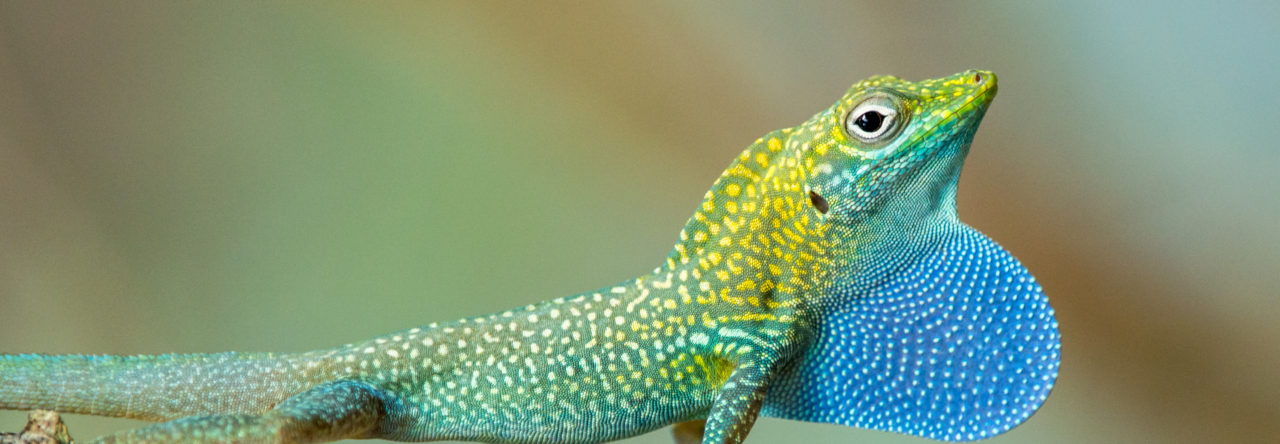
Anolis Taylori’s Massive Dewlap

taylori from twitter

This photo is a treat from tweet-o-sphere, posted by Miguel Angel Zapata, who did not respond to my request for more information. And that’s really all I’ve got to say. Anolis taylori is a relatively little-known anole from southern Guerrero, Mexico. As far as I’m aware, there’s only been one paper written on this species, by Fitch and Henderson in the Journal of Herpetology in 1976 (and this paper, in turn, has only been cited five times). The species apparently is usually round in boulder piles, on the sides of rocks, as well as on rocks and trees. Does anyone know any more about this species?

Here’s the abstract to that paper, which also concerned Anolis gadovii:

Anolis gadovii and Anolis taylori are medium-large, saxicolous anoles of southern Guerrero, Mexico. The first named species is confined to a small area near Tierra Colorada, about 50 km inland, the second is limited to the immediate Coast Range in the vicinity of Acapulco. For both the habitat is on steep, wooded slopes with piles of large, loose boulders. Compared with other anoles, these are relatively stenothermic and tolerant of high temperatures, with a preferendum between 29 and 30 (at least for A. taylori). The habitat of A. gadovii, especially, is xeric, and during the dry season the anoles tend to stay deep in the rocks where temperature remains low and humidity is high. In both species reproduction is suspended during the drier part of the year and by the beginning of the rainy season in July the population consists essentially of adults. In areas of favorable habitat with high population density of A. taylori many home ranges were found to overlap. Favorite perches and look-outs were used by a succession of individuals with frequent territorial contests. Males of A. gadovii and A. taylori are about the same size, females of A. gadovii are somewhat smaller, and females of A. taylori are markedly smaller. Anolis dunni, a non-saxicolous species living at somewhat higher altitude, is like A. taylori in many of its characters, and is annectent to other montane species.

Coming Soon To A Theater Near You

IMG_1269x

IMG_1210x

Page 68 of 133

Powered by WordPress & Theme by Anders Norén