Professor of Biology and Director of the Living Earth Collaborative at Washington University in Saint Louis. I've spent my entire professional career studying anoles and have discovered that the more I learn about anoles, the more I realize I don't know.
Who wouldn’t delight in a passel of festive anoles, frolicking around in mid-December? Janson Jones, a raconteur if there ever was, certainly knows how to live for the moment. Check out his latest saurian musings on Dust Tracks on the Web.
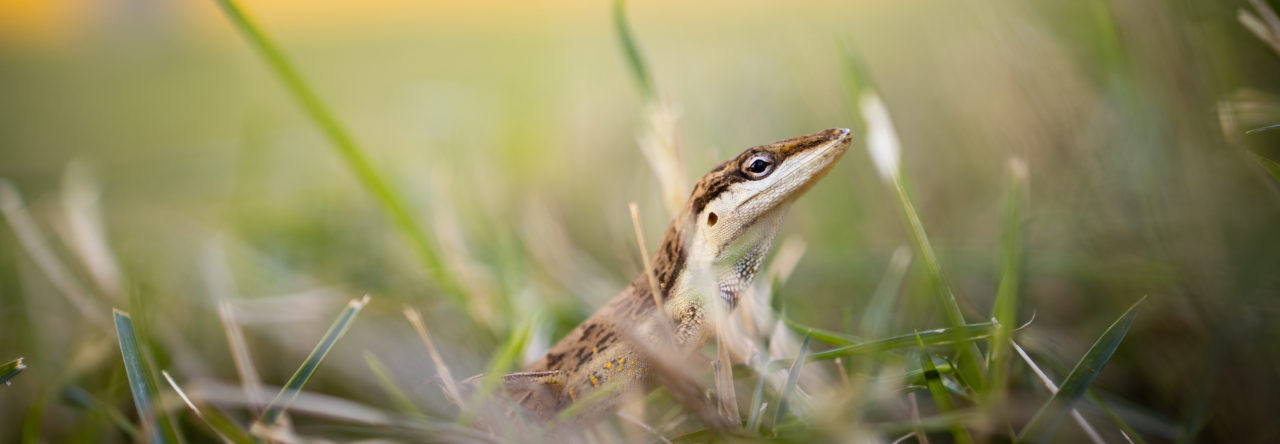
Anolis desechensis is a member of the A. cristatellus species complex from Puerto Rico. Found only on the tiny island of Desecheo, very little is known about its natural history. In fact, some might question whether it should be a distinct species, but in the absence of any data, it’s hard to say.
This lovely photo comes from the Facebook page of Island Conservation, a wonderful organization devoted–as its name implies–to the conservation of island biota. I just heard a talk yesterday crediting them for eradicating rats from an island in the Galapagos, paving the way for preservation of a unique giant tortoise race. But that’s another story.
“Dear Blair, of course you are right, but the scale is all wrong. Predictability of course within a constrained design and clade of close relatives as in your example. My contingency is at the much higher level of designs themselves.”
Blair Hedges recently sent me the image on the left with the following explanation:
“I was preparing a lecture for my evolution class and came across this reply from Steve Gould to me many years ago (Oct 1986), on a post-it note!
I can’t find my original letter to him but I recall it well. As a grad student, I heard him give a lecture about the Cambrian Explosion where he claimed that evolution operated differently –contingency instead of adaptation or predictability– at the higher level of animal designs. I told him I disagreed because I was seeing too much predictability in the adaptive radiations on Caribbean islands to believe that it was not happening throughout life at all levels.
Translation of his reply: “Dear Blair, of course you are right, but the scale is all wrong. Predictability of course within a constrained design and clade of close relatives as in your example. My contingency is at the much higher level of designs themselves.”
Not sure how you feel about it, but I still don’t agree with his explanation! 500 mya the Cambrian explosion was just an adaptive radiation like anoles.”
Interestingly, this story jibes very closely with a story of my own. In 1998, a number of colleagues and I published a paper in Science reporting a phylogenetic analysis of Caribbean anoles demonstrating convergent evolution of the anole ecomorphs. A reporter for Science contacted me and in the ensuing discussion, I suggested that an interesting person to contact to get an opinion of the paper would be Stephen Jay Gould. I was quite disappointed when her piece appeared and had no quote from Gould. When I subsequently talked to her, I was astounded to learn that she had, indeed, talked to Gould and he had given a reply pretty much exactly the same as on the post-it above. And…she had decided no one would be interested in what S.J. Gould had to say about replicated, convergent adaptive radiation, and so she didn’t include the quote in her article.
Brown/Grey phase Anolis cuvieri, just awakened from a nap. Photo by Alejandro Sanchez.
Most arboreal anoles are green, and for a good reason: it’s hard to pick out a green lizard amidst green vegetation. Yet, some species are more subdued in their coloration, with browns or grays–e.g., Anolis luteogularis from Cuba or Anolis microtus from Costa Rica.
An interesting twist is provided by Cuvier’s anole, the crown-giant of Puerto Rico, in which a polymorphism exists in which most lizards are green, but some are brown-grey. We were reminded of this situation by Alejandro Sanchez, who sent the photo displayed above with the comment that it had been a long time since he’d seen one of these morphs. Contrast that with his spectacular photo of the more common green morph below.
Green Anolis cuvieri. Photo by Alejandro Sanchez.
Rivero in his epic Los Anfibios y Reptiles de Puerto Rico notes the polymorphism, but does not provide any explanation or discussion, and I am unaware of any other literature on this subject. Puerto Rican readers out there: what else do we know? Are they definitely different morphs? Someone once whispered in my ear he had seen brown ones turn green, but the only publication of which I’m aware to discuss this phenomenon, Rand and Andrews (1975), says they don’t. But that was based on a very small sample size. Does the gray/brown morph occur throughout the island? Any idea what it’s all about? Any difference in habitat use? As far as I’m aware, the adaptive significance of this polymorphism has never been studied.
Results of mating trials in Ng et al.’s study. Top two rows are within-population crosses; bottom two are between crosses from different populations that differed in dewlap color. Note that in the top, individuals look like their fathers, whether at the bottom, dewlap colors are intermediate between that of the two populations.
Everybody loves a pretty dewlap, and recent years have seen a lot of interest in studying the factors that determine dewlap color, as well as the role dewlap color may play in species recognition, sexual selection and other processes. Many have suggested that the dewlap is a focus of sexual selection; some have even opined that it is an honest signal of something, maybe good genetic quality, maybe the ability to procure lots of color-inducing dietary items. Unfortunately, we know almost nothing about the genetic basis of dewlap color, nor about the effect of environmental variation.
Anolis distichus exhibits more variation in dewlap color and pattern than any other anole, and thus is the perfect choice for such a study. Julienne Ng just completed her doctoral research at U. Rochester on this species, documenting that variation in dewlap color correlates with environment among populations. Now she and colleagues report on laboratory studies to assess the extent to which variation is determined by genes vs. diet.
Why diet? Because reds and oranges are likely determined by carotenoids, which vertebrates cannot synthesize. Thus, it is plausible that the amount of carotenoids ingested by a lizard may correlate with its color. This hypothesis has only been tested once before, in a study on A. sagrei by Steffen, who failed to find evidence for a diet effect on the red-orange dewlap of this species.
This study had two components. First, to study genetics, lizards from two populations–one with an orange dewlap, the other with a plain whitish dewlap–were crossed in the laboratory. Second, lizards were fed lots of carotenoids.
The results: strong evidence for a genetic basis for variation in dewlap color. Purebred individuals looked like their fathers (top two rows in figure above), but crosses were intermediate in color (bottom two). Pretty strong evidence for a genetic basis for the trait. And the effect of diet? Not so much. No difference in color between lizards in the carotenoid supplementation treatment vs. the control lizards.
The bottom line is that, at least in this species, genes control variation in dewlap color. Combined with Steffen’s study, there are now two negative results for a role of diet. Of course, work on other species is necessary to confirm the generality of these results, as well as additional investigation into the exact genes responsible for dewlap color.
A message from Monty Harper, the genius behind Anole in Love:
We are down to our last day and a half.
We are 44% funded. We need $5,600 more in pledges to make this CD happen.
That sounds like a lot. But consider…
Kickstarter says the average pledge amount is $70. If each of us – there are 80 backers right now! – if each of us was to bring in just one additional backer today, that could mean $5,600 in additional pledges, which is exactly what we need!
Even if Kickstarter’s average is a bit high for this project, 80 additional backers today would put us within sight of the goal, and would make tomorrow a very exciting day!
So your mission, should you choose to accept it, is to bring in at least one additional backer today.
What tools have you with which to accomplish this Herculean task, you ask?
Facebook, Twitter, Google+, email lists – these are great, but…
A personal email, a text, a phone call, a (gasp) face-to-face conversation! – these are very effective for engaging one person. Who do you know that would really appreciate great kid-friendly science music? A parent, an educator, a librarian, a scientist?
Here are some general talking points –
Any pledge of $5 or more gets you an immediate download of 12 science songs
The new songs are all written and waiting to be recorded
These songs are inspired by conversations with scientists – they are unique in their focus on the scientific process
The funding is necessary for hiring musicians and studio time, paying for design and duplication
Public libraries are using science as a theme this summer – here is a chance to get some really good material into the hands of people motivated to use it with kids
If we don’t reach the funding goal, the CD will be put on hold, and who knows when or if it will ever get made?
Match a song to the person – who do you know that would be excited about one of these song topics?
“Vaccination!” – a pro-vaccination anthem!
“Anole in Love” and “My One and Only Vole” – science themed love songs!
“Left Brain” and “This Is Your Brain on Music” – brain science!
“Quarks and Electrons” – particle physics, the nature of the universe!
“Citizen Scientist” – citizen science is huge right now!
“Photosynthesis,” “Green Footprint,” and “Rustbusters” – alternative energy!
“Psychology” and “Popular” – psychology!
“What Goes On?” – ecology!
“Predators, Prey, and the Games They Play” – evolution!
“Fizz Boom Read” – a theme song for 2014 summer reading!
Most of these songs are up on YouTube now:
One other tool I can give you is – images to share on social media. You can look for these on my facebook feed, or download and post them yourself:
You must click on this link and listen to the song (click the red circle in the upper left corner of the page). Then come back here and read the rest.
Anole In Love – The song the Beatles would have written if they were green anoles! This lovely ballad is the work of Monty Harper, who writes: “I write songs that convey what I find awesome about science: the questions, the methods, the passion, dedication, and creativity of the people who do it. My inspiration comes from speaking directly with scientists about their latest research projects.”
This has Top 40 written all over it, all it needs to do is get produced. Help make it happen by going to Monty’s Kickstarter page and making a donation. But, hurry–the deadline is Friday.
Almost nothing is known about Anolis macrinii, which is a little surprising because it is rather large (nearly 100 mm snout-vent length) and apparently locally moderately abundant. However, it’s small, localized range in Oaxaca, Mexico is no doubt the explanation. In any case, now a bit more is known, thanks to a recent paper by Gunther Köhler and colleagues in Breviora (freely available on the MCZ publications website).
The paper includes a detailed morphological description of the species, as well as notes on natural history and conservation status. Most interesting to me is the sexual dimorphism in dewlap size (males on top above, females below), which we have discussed in previous posts, and the aberrant patterning of one juvenile individual (right).
Here’s the abstract:
During three short visits to the coffee-growing region in the hills north of Pochutla (Oaxaca, Mexico), we observed Anolis macrinii in its natural habitat. The species appeared to be relatively abundant, and we collected 12 individuals, including several adult males. The holotype of this species was reported erroneously to be an adult male but actually is a female. The confusion might have arisen from the moderate-sized dewlap present in adult females. However, males have a very large dewlap and a pair of moderately to greatly enlarged postcloacal scales. We provide color descriptions in life for three individuals, color photographs in life, description and illustration of hemipenis morphology, and some natural history notes. Finally, we discuss the conservation status of this species.
Editor’s Note: The sale has been extended until midnite Saturday night!
If you’re going to buy a Anoles 2014 calendar, do it now. Zazzle.com is having a Black Friday sale, and calendars are 60% off until 2 pm Eastern time. Order your calendars here with code BLKFRIZAZZLE.
Book-ended by this year’s photo contest winners, the 2014 anole calendar features 13 spectacular anole photographs selected by you, Anole Annals’ readers. Unlike previous year’s calendars, this year’s edition has a heavy South American influence thanks to photographs by Lucas Bustamante and Diana Troya. In addition to the two contest winning snaps of A. chrysolepis and A. gemmosus, other pin-ups include A. princeps, A. proboscis, and A. biporcatus. That’s not to say that some of our favorite Caribbean species don’t also make an appearance. Hispaniola is particularly highlighted, thanks to several photos by Cristian Marte, including stunning shots of A. bahorucoensis and A. coelestinus. in addition, there’s a lovely silhouette of A. sagrei displaying and an intriguing vignette of a tree boa and a sleeping A. aeneus. Check them all out at zazzle.com, where the calendars are now on sale. Til midnite tonight, you can get 20% with the discount code “TDAYPOSTSALE.”
Editor’s Note, Monday, Dec. 2: 60% off until 1 pm Eastern time today, code : ZAZZLEMONDAY



 A message from Monty Harper, the genius behind


