
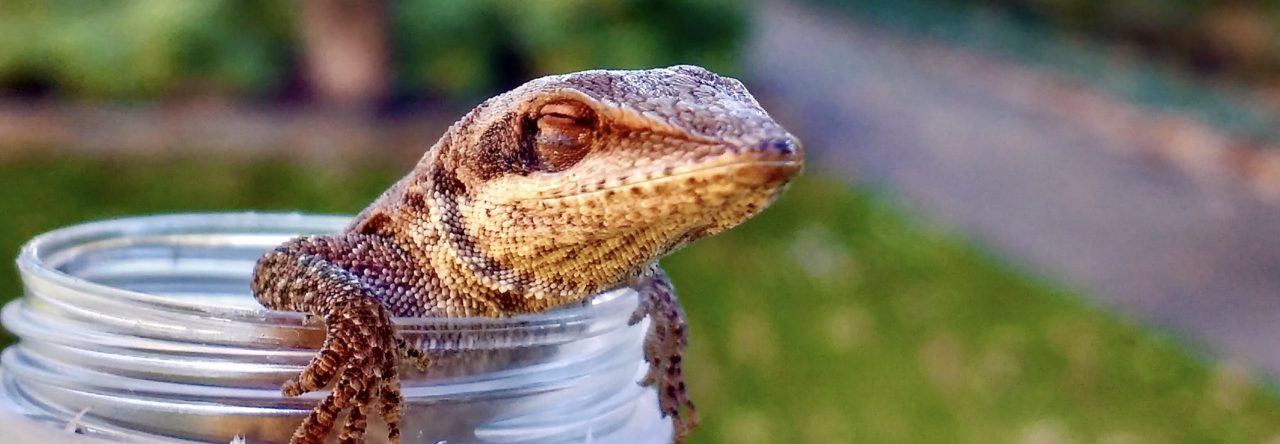
 The University of California Museum of Paleontology has a wonderful website on evolution education, including a number of classroom exercises. One of these focuses on using phylogeny to understand the evolution of the Greater Antillean ecomorphs.
Author: Jonathan Losos Page 125 of 133
Professor of Biology and Director of the Living Earth Collaborative at Washington University in Saint Louis. I've spent my entire professional career studying anoles and have discovered that the more I learn about anoles, the more I realize I don't know.
Sitting on an airplane from Boston to Miami, en route to Marsh Harbour, I realized that this trip marks the 20th anniversary of my Bahamian fieldwork. It was as a callow new postdoc at the University of California, Davis, that I first embarked to the Bahamas in May, 1991, setting forward a research program that has brought me back every year in the past two decades, some times more than once per year. I’ve lost track of how much time in total I’ve spent there, but it’s been more than a year of my life (of course, I should point out that my colleagues in crime have been going there even longer, Dave Spiller since the 80’s and Tom Schoener, since the 70’s).
What keeps bringing us back? Despite what you might think, it’s not the beaches, or even the casinos! The primary reason is that in many areas of the Bahamas, there are a large number of very small islands. They are officially termed “rocks,” and aptly so: they are craggy dots of limestone sharpness, ranging in size from a few square meters  on up. There are several things that are great about these islets. First, they have complex ecosystems, but not too complex: a few species of bushes and trees, a variety of insects and other arthropods, and often only one species of lizard, the brown anole, Anolis sagrei. As the islands get bigger, they become lusher and more species rich in everything, including lizards. Second, many of the islands are just the right size: big enough to have lizards (the smallest islands generally don’t), small enough that we can easily census the populations of lizards, spiders, plants, and other creatures.
 An avid AA reader writes: “Since you’re always on the cutting edge of everything, are Cabela’s Panfish Poles still your favorite noosing implement, or has something better shown up on the market?” Indeed, this reporter is still a fan of said product. Light, collapsing to pocket size, and cheap, these are the real deal for anole wrangling. Extendable to 10’ to 14’, they are suited for all but the most arboreal of anoles. Though a bit fragile—it’s easy to break the most distal segment—their low price more than compensates; just bring a few to the field and you’ll be fine (note added in press: a quick look at their website shows the price has gone up! Not quite as cheap as in the old days). Warning: although they’re tough enough for most anoles, if you swing a good sized crown-giant out of tree, you’ll probably snap off the end of the pole (and then have an infuriated anole with a noose and pole tip around its neck to contend with). Still, all-in-all, this is the best on the market. Anyone care to differ?

From Dust Tracks on the Web
In a recent post, AA mentioned Janson Jones’ (Dust Tracks on the Web) report on catching a magnificent knight anole. Turns out that Jones is not only a kindred spirit, but a keen observer and an excellent photographer. Over the course of the last few days, he has posted a series of stories of observations of Florida anoles that are worth checking out.
Just a few comments. In “Clash of the Anole Titans” (photo above), he tells of a territorial battle between two male green anoles. Ultimately, the fight concludes when one male loses his grip and falls to the ground. Those who study the functional capabilities of anoles are always surprised at the great sticking ability of the anole toepad, much greater than is needed to support the lizard’s body weight (anoles can hang from a single toe!). Perhaps this ability has evolved, not for every day living, but for exceptional circumstances, such as prolonged, hand-to-hand combat or hanging on to a mini-van.
 The Society for the Study of Evolution gives the R.A. Fisher Prize “for an outstanding Ph.D. dissertation paper published in the journal Evolution during a given calendar year.” This year’s awardee is Luke Mahler, for the paper, which appeared on the cover of the Sept, 2010 issue of Evolution: Mahler, D.L., L.J. Revell, R.E. Glor, and J.B. Losos. 2010. Ecological opportunity and the rate of morphological evolution in the diversification of Greater Antillean anoles. Evolution 64:2731-2745.
The Fisher Prize is relatively young, but already boasts an impressive list of past winners, to which Mahler is a worthy addition:
2006 Maurine Neiman
2007 Guillaume Martin
2008 R. Brian Langerhans
2009 Megan Higgie
2010 Britt Koskella
2011 D. Luke Mahler
It turns out that Anole Annals isn’t the only member of the WordPress.com stable that has a thing for our favorite lizard. While recently doing some tag surfing, we came across the following posts.
 Catholic mom tells the gripping (or not) story of a green anole that went for a ride on the minivan windshield. You can probably guess the outcome, but the photos are nifty.

Anolis nitens (formerly A. chrysolepis). Photo from http://www.sciencephoto.com/images/download_lo_res.html?id=907650178
Today I had a chat with an evolutionary biologist who specializes on the evolution of tropical forests. We were discussing the effect of climate change on the Amazon, and he first made the point that dire warnings about the Amazon are possibly slightly overstated. Yes, the rainforest may be in big trouble, but it’s not as if the trees will fall down and the area turn into barren desert. Rather, there are many dry-adapted tree species in South America, and they will probably take over, replacing wet forest with dry forest. Conversation then turned to what is known as the Pleistocene Refugia Hypothesis (PRH), the idea that during the ice ages, the climate became drier because so much water was locked up in glaciers. As a result, so the theory goes, rainforests were fragmented as the forest was replaced in many places by other habitats. As a result, a formerly widespread species might become isolated into multiple, unconnected populations. The PRH suggests that these isolated populations often evolved into different species, and the famously high species richness of the Amazon may be a result of high rates of speciation resulting from a series of cycles of forest contraction and expansion. The PRH, however, has fallen on hard times for a variety of reasons, and I think it is safe to say that most workers in the field no longer favor it. Nonetheless, my colleague averred that the hypothesis has been too hastily discarded; in his mind, the idea has been caricatured, and more reasonable versions of the idea have merit and deserve more attention.

Core areas of A. chrysolepis distribution in the Amazon. Map H from Vanzolini and Williams (1970)
Of course, this conversation immediately turned my mind to one thought: anoles! In particular, it reminded me of two significant, yet in recent years little read, papers on Amazonian anoles. The first was a 1970 monograph in Arquivos de Zoologia by Paulo Vanzolini, famed Brazilian herpetologist and samba composer, and Ernest Williams on the pan-Amazonian anole then referred to as A. chrysolepis, now known as A. nitens, and soon to be divided into several species (stay tuned to these pages for more on that as the story develops).

- An egg of Anolis lionotus. Photo courtesy Edgardo Griffith.


One day, years ago, I was collecting data on the behavior of the Jamaican twig anole, A. valencienni. As I was watching a female, to my surprise, she entered a hole in a tree trunk, and then emerged a little while later. To my amazement, I then saw another valencienni do the same thing! Overcome with curiosity, I approached the tree, peered into the hole, and spied to my astonishment a large number of what seemed to be anole eggs. I was not aware that communal nesting—in which multiple females lay their eggs in the same place—is known in a number of anole species, including A. angusticeps, A. bartschi, A. lucius and A. valencienni. The seminal work on the subject is still Rand’s 1967 Herpetologica paper.
A recent paper adds another species to the list of known communal nesters, the first from Central America of which I’m aware.

In the pantheon of anoles, Anolis maynardi has a special place as one of the funniest looking species around. To the casual observer it appears that someone has taken an A. carolinensis (to which A. maynardi is closely related), grabbed it by the tip of the snout, and pulled it forward. The purpose of this pincer-like proboscis, much more extreme in males than in females (which are smaller), is unknown. Indeed, until recently, just about everything about the species was unknown.
Anolis maynardi is endemic to the tiny island of Little Cayman. Remarkably, although visible in the distance, the nearby island of Cayman Brac does not harbor the species. At least naturally. In 1987, A. maynardi was reported at the Cayman Brac airport, most likely a beachhead resulting from a stowaway on an island-hopping airplane. Another survey in 1991 still found it only near the airport, and nothing further was known.
 The long awaited paper describing the genome sequencing of Anolis carolinensis was submitted for publication on Thursday. Containing seven figures and with 50 authors, the paper is an epic step forward in our understanding of anole genetics. Stay posted for updates as the story develops.