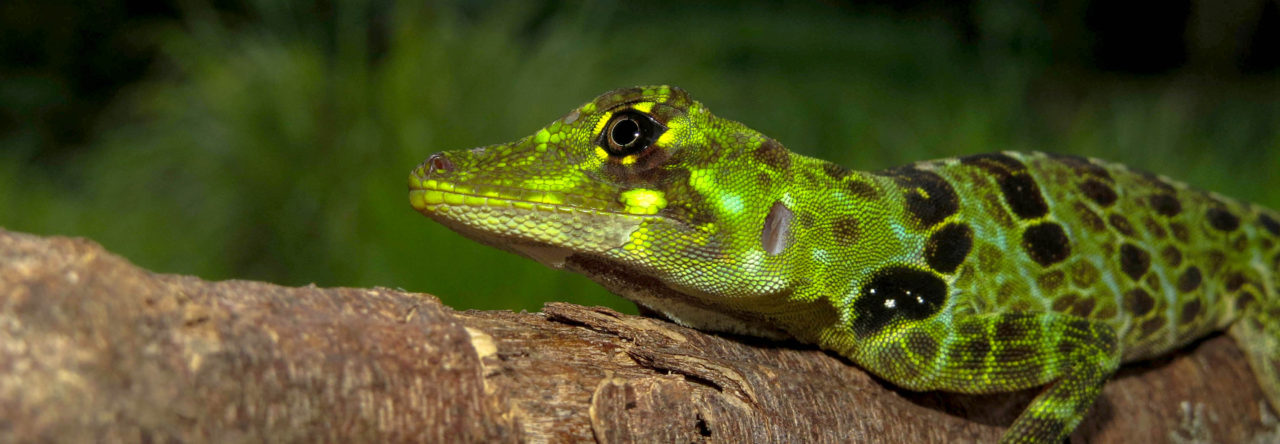
Really, I’m not a paid flak for the Leal lab, but there’s some more cool videos posted today on chipojolab. This time, there are two videos of brown anoles foraging. The first is an anole down in the intertidal, munching on a small invertebrate. The second is one up in the bushes, trying–without success–to gobble down a red berry.
Author: Jonathan Losos Page 123 of 133
Professor of Biology and Director of the Living Earth Collaborative at Washington University in Saint Louis. I've spent my entire professional career studying anoles and have discovered that the more I learn about anoles, the more I realize I don't know.
It’s time to provide the answers to last week’s quiz, and this reporter–an amateur at creating such events–must admit to having egg on his face. First, though, congrats to WEs and Joe for their astute observations and conclusions. As Joe surmised and Wes speculated, the photos are both from the Bahamas, Staniel Cay to be exact.
The first photo has not three, but four anoles! Well, 3 1/2 to be exact. And the 1/2 anole is crucial. The obvious green anole is A. smaragdinus, the two upper ones are A. distichus, and the bottom half anole–predicted by Joe–is A. sagrei.


Anolis leachi, one of many Lesser Antillean anoles that have been successfully introduced to areas where they don't occur naturally.
In a companion paper to Poe et al. (Evolution, 2011), Latella et al. examine a variety of attributes of the 19 species of anoles that have been successfully introduced to new areas and compare them to a large number of never naturalized anoles. Successful invaders differ in many ways from those who’ve never taken the leap or failed trying, including being larger, having larger scales on the snout, being more sexually dimorphic, occurring at lower elevations, occurring in the Lesser Antilles or near a major port and, among Greater Antillean species, having a large geographic range size. Multivariate analysis considering all these variables, however, indicates that the best predictors are a combination of body size, geographic range, and place of occurrence. This multivariate model not only accounts for which species have become established, but can make predictions about which species may be next. High on the list: the large Lesser Antillean A. bimaculatus and A. griseus and the widespread Hispaniolan grass anole, A. semilineatus. The only other highly likely, non-Lesser Antillean invader among the top nine was, surprisingly to my mind, the Jamaican twig anole, A. valencienni, which, on esthetic grounds, would also be highly ranked.
In looking at the list of introduced species, two not very brilliant observations came to mind. First, many introduced species are from the Lesser Antilles, but they’ve also been introduced to other Lesser Antillean islands. Is that due to geographic proximity and high rates of inter-Lesser Antillean island traffic and commerce, or is it because the Lesser Antilles never have more than two native species? Along these lines, second, most anole introductions are to areas that are depauperate in anoles, whereas very few have occurred in richer areas. This, of course, accords with classic competition theory, but there are other explanations.
From today’s edition of Chipojolab. Go there to see the video:
“The head-bob displays of anoles have been studied for decades. In the early 1970’s, Tom Jenssen’s pioneering work began to unravel the intricacies of these motion signals. This work was followed by research conducted by Leo Fleishman (A.K.A. “Jefesisimo”), who elegantly demonstrated that head-bobs are designed to be conspicuous against background vegetation movement. Dave’s research is building upon the work of Tom and Leo by evaluating the plasticity of head-bobs, along with possible mechanisms that anoles might employ to increase the likelihood of being detected by conspecifics. Today’s video illustrates one such mechanism: note (in slow motion) how the anole is pushing so vigorously with his forelimbs that both limbs leave the perch! This behavior results in extremely high amplitude displays, which should be easily detected by conspecifics.”
Last Thursday, the Kokua Line column of the Honolulu Star Advertiser fielded a question on how to get rid of brown anoles. The answer was: no way (the officer at the state Vector Control Branch told the author that if she found out “how to eradicate these lizards, to be sure to call him back and let him know.”). However, the local citizenry disagreed, and in the 23 comments (see below), provided a number of solutions, as well as debate on the wisdom of anole eradication. Several readers also made the claim, echoing that heard in Florida and discussed here, that brown anoles supplant greens (also introduced to Hawaii).
| nitestalker2 22 hours ago |
get a couple of cats. all the cats i’ve ever had have taken care of the b52s*, birds, mice and rats, geckos of every stripe, etc. had one that would bring all her mice/rat kills very proudly to the front door mat and leave them there while purring for applause. she was a very efficient killer.
4 people liked this. Like ReplyReply
*Editor’s Note: according to my friend, Dan Devaney, “b52s” refers to “Hawaii’s unofficial state bird, the B-52 Flying Cockroach.” For more information, go here.


Equaline? CVS? 'Fraid not.
A few months back, we had a lively discussion of the best material to use to make a lizard noose.
I and others went old school and advocated dental floss as the lariat of choice. In this vein, I have an update. Now in the field in the Bahamas, Jason Kolbe and I have been using two newish brands of the waxy stuff, and neither of us has a good thing to say. I have been using a new type, “Just the Basics,” which seems to be a CVS store brand. All I can say is: Avoid!!! By “basics,” they mean “basically terrible.” It frays very quickly, so that by the time you’ve snagged your third lizard, you have to make another noose. Very annoying. Meanwhile, Jason has been using a floss produced by Equaline. He gives it two thumbs down, claiming that it disintegrates—believe it or not—after a single lizard capture.
 Over at Chipojolab, the Chipojo Bobo himself and his merry band of ethologists are providing regular updates on their research on the behavior of brown anoles, and how it is affected by the presence of predatory curly-tailed lizards. Check it out, and follow the exploits of Nolan, the conch-shell inhabiting bull sagrei.
p.s. In Cuba, the locals refer to crown giant anoles, members of the A. equestris group as “chipojos.” False chameleons, Chamaeleolis, are called “chipojo bobos,” meaning, more-or-less, clumsy crown giant anoles.
It’s time for the latest installment of our perennial crowd pleaser, Find the Anole!
In picture #1, we have three questions:
1) How many species of anoles are in this picture?
2) Which species are they?
3) Bonus Points: What is the interesting evolutionary/biogeographical story represented here?

Picture #2 is a tough one.
 It’s been very dry here in the Bahamas; we’ve barely seen any rain at all. So, when a few drops splattered mid-afternoon, out came the lizards, slurping up every droplet they could find. In the subsequent 30 minutes, I found six Bahamian green anoles (A. smaragdinus), compared to a rate of 1-2/hour for the rest of the day (this rate, in turn, twice as high as in previous days because it was cloudy and cool).
Ever watched an anole drink when it’s thirsty? This video shows what it looks like.