
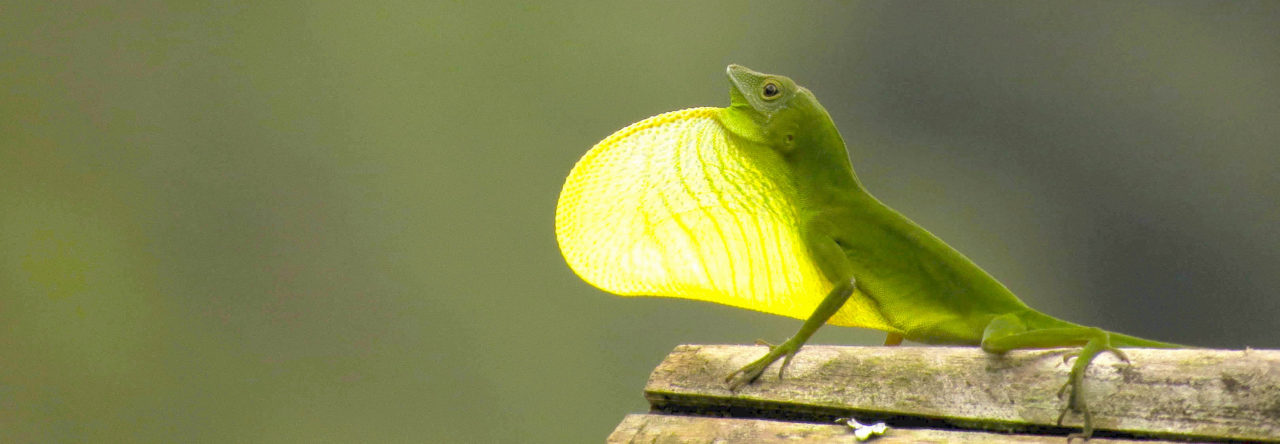
Rich Glor has thrown down the gauntlet. Who can name the five anoles pictured on the CaribHerp poster in the last post? I know what they are, but I had to get help on #5, which does not sport the typical look for that species (and the esteemed Dr. Glor’s guesses are incorrect).
Author: Jonathan Losos Page 121 of 133
Professor of Biology and Director of the Living Earth Collaborative at Washington University in Saint Louis. I've spent my entire professional career studying anoles and have discovered that the more I learn about anoles, the more I realize I don't know.
 Caribherp is a website devoted to all herpetologic matters West Indian. It describes itself as follows:
Caribherp contains information on amphibians and reptiles of the Caribbean Islands (West Indies). It serves as a checklist of what occurs in the region as well as a quick identification guide to the species. Approximately 2000 images and maps, and selected frog calls (sounds), are presented along with an integrated open-access journal, Caribbean Herpetology. The journal accepts color images and video and currently publishes brief communications on individual species—later volumes will include full research articles. The species accounts can be sorted in many ways. Maps of the Caribbean, both current and historical, can be found on a separate site, Caribmap. Multimedia essays related to conservation issues on Caribbean islands are on a third site, Caribnature.
The poster above and a similar one can be obtained here on the “Resources” page.
 Taxonomist’s conundrum: What to do when a species needs a new name, but the moniker available is unpleasant? Case in point: this verdant beauty is surely the loveliest of the Bahamas’ lizards. Long known as A. carolinensis, recent work demonstrated that Bahamian green anoles and American green anoles are not closely related and thus represent independent colonizations from their Cuban, A. porcatus, ancestors. Hence, unless one wants to sink them all into a single species (which by the rules of zoological nomenclature, would be given the name A. carolinensis, thus sinking porcatus and representing another instance of U.S. hegemony over Cuba), the Bahamian lizards need a new name.
And, alas, that name already exists, and it’s a stinker: A. smaragdinus. Trying saying it yourself. There are a number of different ways to pronounce it—I have no idea which is correct, but they’re all unpleasant. And don’t bother trying to shorten it: “smarags” is cacophonous as well. It’s a shame, really, because the epithet is apt, meaning “emerald green” in Latin.
 After receiving three generally positive reviews in the first round, the revised version of the manuscript reporting the genome sequencing of A. carolinensis has just been submitted. Hopefully, it won’t be long now! Stay tuned.

Photo probably by Manuel Leal probably at El Verde Field Station in Puerto Rico.
Read about it here
.
Anole Annals more or less turned one-half-year-old this month, making this a good time to look back and reflect. Readership continues to increase—we’re now getting an average of 202 readers and 351 page views a day. AA has published 208 posts by 30 authors from four continents and the Caribbean. For those new to the fold, here’s an annotated list of the 12 most popular posts, as judged by number of page views*:
1. Society for the Study of Evolution Announces Changes to the Name of its Journal
Far and away the most viewed, thanks to some Facebook re-posting in highly visible sites, this post documented the repeated appearance of anoles on the cover of the journal Evolution. Combined with the fact that an anole was the frontispiece for the program for the society’s annual meeting and that four of the six young scientists honored for their contributions at the meeting work on anoles (here, here, and here, plus Rob Pringle), the
suggestion that the society should reconsider it’s name seems quite reasonable.
2. Anole Annals Trivia: Find the Anoles
Always a crowd pleaser. ‘bout time for another one. Suggestions welcome.
 Joel McGlothlin received the 2011 Dobzhansky Prize, given to an outstanding young scientist in the field of evolutionary biology. Successfully fending off technical AV difficulties, Joel gave a fascinating talk in which he examined the idea that evolution should occur along lines of least genetic resistance, which are determined by the genetic correlations among traits. This hypothesis predicts that as traits diverge, they should diverge in ways that mirror the trait genetic correlations. Moreover, one would expect that this effect would attenuate over time, so that more distantly related species would show less evidence of diverging along these lines.
 Luke Mahler received this year’s Fisher Award, given by the Society for the Study of Evolution for the best paper emanating from a Ph.D. thesis published in Evolution in the preceding year. Mahler asked “what is the trigger for adaptive radiation?” and answered, “ecological opportunity”: a wealth of evolutionarily accessible resources (from Schluter). This leads to the prediction that the pace of adaptive radiation is regulated by competition, and is thus diversity-dependent. This hypothesis has been tested greatly in recent years by seeing if the rate of species diversification decreases through time as a clade radiates. But, Mahler argued, counting species is not enough—rather, we need to focus on patterns of diversification in adaptive traits.
Focusing on Greater Antillean anoles, Mahler asked whether rates of ecomorphological diversification decline as the number of species on an island increases. Testing this hypothesis requires estimating historical ecological opportunity (EO) by inferring ancestral species richness on an island and estimating rates of morphological evolution at ancestral nodes and how they changed as a function EO. To do this, Mahler and co-author Liam Revell developed at maximum likelihood approach to infer ancestral states incorporating uncertainty on the reconstruction of ancestral biogeographic locations.
The result is strong support for the ecological opportunity model. Rates of ecomorphological evolution are high early in anole radiation, but decline with increasing species richness.

Anolis sagrei from near one of Dan Warner's field sites. Photo by Aaron Reedy.
American Society of Naturalists’ Young Investigator Award winner Dan Warner presented a marvelous synthesis of studies of how external influences affect phenotype and survival in eggs and offspring of lizards and turtles. Among other things, he has demonstrated
that some types of plasticity are adaptive: in temperature sensitive sex determining lizards, males are produced at temperatures at which the fitness of male offspring is greater than that of females, and vice-versa.
 In a fascinating talk, Chad Watkins reported the discovery of a surprising frequency of homeotic mutations along the anterior-posterior axis and implicated the high rate of transposons in the Hox D cluster as a possible cause. Watkins reported that 27% of DNA in the HoxD cluster is comprised of transposons, much higher than in other vertebrates. Moreover, Hox D gene expression is shifted posteriorly. For example, Hox D10 normally should express at anterior boundary of hip, but in A. carolinensis it is all the way down at the tip of the tail. Further, in later stage embryo, ectopic expression of D13 occurs in the hand and feet, which is novel in vertebrates. Could this be related to ecomorph differentiation in limb elements?