Author: Jonathan Losos Page 119 of 133

Professor of Biology and Director of the Living Earth Collaborative at Washington University in Saint Louis. I've spent my entire professional career studying anoles and have discovered that the more I learn about anoles, the more I realize I don't know.

Anolis Insolitus Struts Its Stuff

Another spectacular anole photo from Eladio Fernández, the author of the wonderful book on Hispaniolan biodiversity, Hispaniola: A Photographic Journey Through Island Biodiversity. See some of Eladio’s photos–and others–here. But you need to go to his book for the stunning shots of a solenodon in the wild. Anolis insolitus, incidentally, is a twig anole from Hispaniola. This photo was taken at the Ebano Verde Scientific Reserve.

Odd Anole Seen on Saba

This letter was just received from Dr. Jennifer Rahn (jlrahn@gmail.com):

Hi Anole friends,
We think we have some strange anole behavior on Saba (Dutch Caribbean) this week. No one has seen the indigenous Saba Anole (Anolis sabanus) with this blue belly before. Have any of you heard of it in other species? We think it may be a stray species from a nearby island, unless of course it is some alpha male or other strange but infrequent anolis behavior.
Please let us know if you can explain this to us.
Curious Sabans

Any thoughts?  It’s definitely A. sabanus (sometimes called the “panther anole” in the pet trade, and one of my favorite species).

Young Women in Science: The Anole Connection

A young women in science booklet produced by Science/AAAS in collaboration with L’Oreal.

Beauty + Brains Puts Anoles in the Spotlight

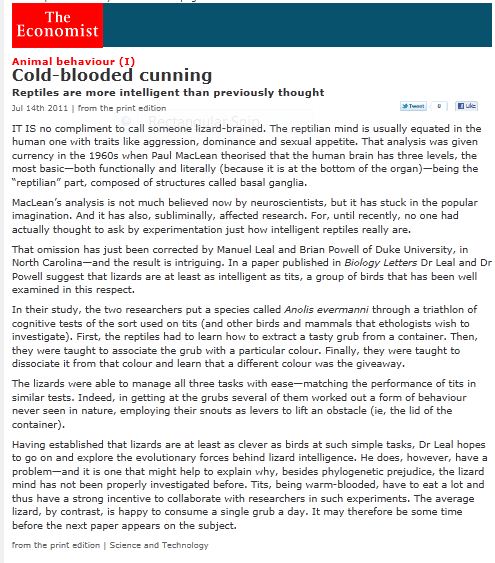
Who could turn down a good looker with something upstairs, especially wearing a gorgeous shade of green? Not the Economist, which featured Leal and Powell’s study of anole cognition in this week’s edition (no, it’s not the article on the orgasmatron). See the article here.

In fact, anole-o-mania has caught on, with reports in print, online, and on radio and TV. Most recent is today’s piece in the Science Times.

According to the Life Science Log, this is among the most cited news reports in the last week. For a full list of media coverage–with more still on the way–check here.

Bonus points: who remembers the orgasmatron?

p.s. A video of the lizards problem-solving is now available on YouTube

A Hearty Meal Impairs A Lizard’s Jumping Ability

Jumping green anole. Photo from http://www.people.umass.edu/chiyun/Site/Research.html

Ever try playing softball after a barbecue? Doesn’t work so well, does it? Now imagine trying the long jump–just the thought makes me a little queasy. But animals in the wild have to do this all the time. Does it affect their performance? Lizards and other animals are known to have their running abilities diminished by carrying a large load, such as a meal or eggs, but no one previously has looked at the effect of increased weight on jumping.

Until now. In a recent paper, Kuo et al. increased the weight of green anoles 30% by wrapping a weighted cloth around their midsection and then induced them to jump (pdf of the paper here). As a control, they wrapped light paper around the lizard in the same manner. As you might expect, the encumbered anoles were less proficient leapers; jump distance declined 18% and takeoff speed 10%. However, their accuracy, as judged by ability to land on a target, was not affected.

New Reviews of Lizards In An Evolutionary Tree

More than two years post-publication, reviews of Lizards in an Evolutionary Tree continue to trickle in. The most recent appeared in Austral Ecology and Herpetological Review. See all 12 (of which we’re aware–know of others?) here.

A Non-Anole Grass-Bush Ecomorph?

I have long thought that the Asian lacertid lizard, Takydromus sexlineatus, is the best example of a non-anole species that corresponds to one of the anole ecomorphs. Extraordinarily long in tail, slender in body, light brown in color with a light-colored lateral stripe, this grass-dwelling lizard seems a dead ringer to a grass-bush ecomorph. This, of course, leads to many questions, not least of which is: if Takydromus somehow were juxtaposed with some ecomorphs, how would they interact?  Now we know the answer.

They’d ignore each other. Or at least, they’d do so within the confines of a small
Petsmart vivarium where they are commonly sold.

Is An Anole Smarter Than a Fifth Grader?

Manuel Leal and Brian Powell have just published a paper in Biology Letters demonstrating that lizards are smart. Before getting to the details, though—here’s the important point: check out the videos! They’re pretty amazing (here, scroll down and click on the videos).

Here’s the story: working with the Puerto Rican trunk-crown anole, A. evermanni, Leal and Powell presented lizards with an experimental apparatus in their home cages with two wells, in one of which was a dead phoenix worm (whatever that is). Next to the well with the worm was a little round disc similar to a poker chip. The lizards learned to go to the well and find and eat the worms. Then the experimenters placed the chip halfway over the well. Again, no problem.

Now comes the cool part. The experimenters completely covered the well containing the worm with a blue chip. Remember, these are Anolis lizards that usually find their prey by looking for movement—they don’t go digging around in the underbrush. Still, four out of the six lizards figured out how to get the mealworm: two of them bit the chip and removed it from covering the well, while two others figured out how to use their snouts as a lever to flip the chip off the well. This is pure problem-solving, and it uses novel behaviors, rather than simply transferring a natural behavior to a new context! And the two lizards that failed to get the worm came up with their own solution, hitting the center of the chip with their snout—but this was ineffective in dislodging the chip.

Once the lizards had learned to find the worm under the chip, the experimenters then conducted a discrimination trial, giving the choice of a blue chip and a yellow chip. Without error, the lizards always went to the blue chip; subsequently, they were presented a blue chip versus a blue-and-yellow chip, and they still had no problem.

Pretty amazing for a lizard, if you ask me, but it gets even better.

Anoles of the Florida Keys

Not an anole, but plays one on TV. Photo from Dust Tracks on the Web (http://dusttracks.com/)

Janson Jones is at it again. Having just driven about as cross-continent as you can get, from Alaska to the Florida Keys, he is now waxing eloquent on the lizards of that delightful island string. Today’s post is about introduced green iguanas, which apparently are everywhere and spreading, but yesterday he posted twice, on brown anoles (A. sagrei) and bark anoles (A. distichus) , with some keen observations on interactions between the two. Most notably, he’s noticed on multiple occasions that the larger browns chase off the the daintier barks.

postscript: Just as I hit the “post” button, Jones put up another of his own, with further observations on bark anoles and outlining what would make an excellent Ph.D. dissertation project. Plus, this intriguing observation:

“…the iPad of anoles in the Florida Keys. They’re right on the edge, living in the third space, transitory ground between the browns on the ground and the greens in the trees. They’re not iPhones, but they’re not desktops either. Right in the middle — and perhaps drawing business from both sides?”

Bark anole, A. distichus, from Dust Tracks on the Web

Anole Origami in the New York Times

Check it out. Read the backstory here.

Page 119 of 133

Powered by WordPress & Theme by Anders Norén