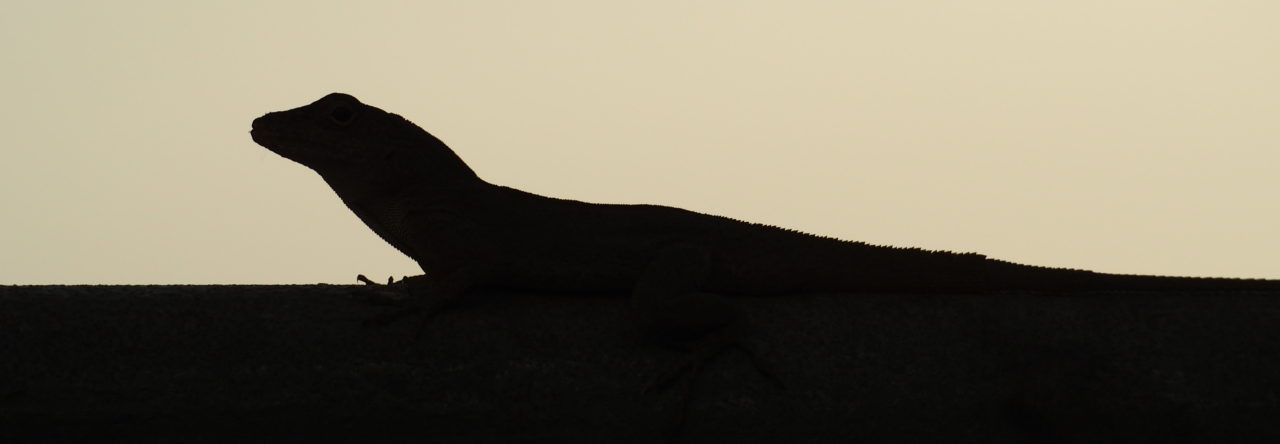
This image is bouncing around the internet, and I can’t find any information on its origin, but it looks like an anole to me. Valiant last ditch effort, but I think we all know the outcome.
Author: Jonathan Losos Page 114 of 133
Professor of Biology and Director of the Living Earth Collaborative at Washington University in Saint Louis. I've spent my entire professional career studying anoles and have discovered that the more I learn about anoles, the more I realize I don't know.
Jason Kolbe, the doyen of anole invasion biology and conservation genetics, has taken up a faculty position at the University of Rhode Island. Research in his lab generally addresses the evolutionary dynamics of biological invasions using Anolis lizards as a model system. He uses molecular markers to reconstruct invasion histories and to test factors that facilitate or constrain phenotypic evolution during invasions.
Jason invites applications from motivated students for graduate degree work in the area of evolutionary ecology and evolutionary genetics of invasive species. Funding will be provided either as research or teaching assistantships, depending on student background and availability. Applicants should be independent, highly motivated, and possess some research and/or field experience. Students with experience using molecular techniques (i.e., DNA extraction, PCR, DNA sequencing, microsatellite genotyping) or conducting GIS-based spatial analyses are encouraged to apply. Prospective students should contact Jason Kolbe via email (jjkolbe@mail.uri.edu) and provide a short description of research interests and accomplishments, a CV (including GPA and GRE scores), and contact information for three references.
Need a dose of live lizard action? Why not check out the long-running series, Anole Alley, on lizardvideos.com? Now in its fourth season, with an all-star cast of green anoles (maybe browns, too–I haven’t watched all that many of them).
Episode 39, part 2, big game hunting, is linked above. It features a large male green anole snagging a dragonfly–well done! Other episodes show other anole hi-jinx and escapades. Store this one to put some sunshine into a cold, wintry day.

Blunt-headed treesnake eating an Anolis petersi.Photo by Elí García-Padilla from the March issue of Herp. Review.
The blunt-headed treesnake, Imantodes cenchoa, is renowned for its anolivory, but being a pencil thin snake, one might have thought that its carnage would be limited to the smaller members of anole nation. Not so, as two Natural History Notes in the March, 2011 issue of Herpetological Review report. García-Padilla and Luna-Alcántara report a treesnake eating a large A. petersi in the Los Tuxtlas region of Mexico (photo above), and Ray et al. provide the details of a 56 gram I. cenchoa that was found with a 19 gram A. frenatus and a 1.3. gram anole egg in its stomach. Justice was served in the latter case, as the snake died soon after capture, and an autopsy revealed a perforated stomach, attributed to the anole’s claw, presumably during post-ingestion attempts by the anole to pull a Gordon and escape.
In many species of anoles, females within a population exhibit sometimes strikingly different back patterns. A recent paper showed that there is interesting variation in the incidence of such variation: mainland and Lesser Antillean anoles exhibit it much more than Greater Antillean anoles, and within regions, some clades are more polymorphic than others. Although closely related species tend to be similar, this trait has been evolutionarily labile, evolving an estimated 28 times.
The occurrence of this variation raises the question: what’s it for? The most detailed study of the question was Schoener and Schoener’s examination of female polymorphism in Anolis sagrei in the Bahamas. By looking both within and between populations, they concluded that this polymorphism was related to crypsis. In particular, females with stripes tend to occur on narrow diameter branches, where the stripes help them blend in. Calsbeek and Cox have more recently examined the same species, finding most recently that different patterns don’t seem to vary in fitness, though they did not examine whether females with different patterns occurred in different parts of the microhabitat.
The only other recent work on this topic was conducted on A. polylepis in Costa Rica by Steffen.

Anolis mariarum from https://www.facebook.com/media/set/?set=a.111687092219097.16289.111684688886004&type=1
Brian Bock and colleagues, most at the Universidad de Antioquia in Medellin, Colombia, have published a series of papers on two populations of the high elevation anole, Anolis mariarum. The most recent in this series, just out in the journal Caldasia, is an examination of the reproductive cycle of this species.
In Central America, many anoles that occur in areas with a single long dry season curtail their reproduction during the dry times. However, A. mariarum occurs in areas where there are two wet and two dry seasons over the course of the year, and this species breeds year round, as does another highland anole in a similar place climatically, A. (Phenacosaurus) heterodermus. The authors suggest that because each of the dry times are shorter than one long dry season, these species are able to continue breeding. But, as the authors note, a confounding factor is that these two species occur at very high elevations (> 2200 meters), where temperatures are much cooler than most species that have been studied. Despite a considerable amount of work on anole reproductive phenology, there is still much to learn.

Herpetological Review has recently made available all the covers going back to the advent of color photographs in 1995. I found them on <a href=”https://www.facebook.com/media/set/?set=a.180287091987312.50983.178914018791286″>Herp Review’s Facebook page</a>. As far as I could tell, this shot of Anolis tranvsersalis from the Sept. 1999 issue is the only anole to grace an HR cover. Time for another one, I’d say!

What have I done? Capuchin monkey photo https://www.anoleannals.org/wp-content/uploads/2011/10/capuchinmonkey011.jpg?w=300
Sure they’re cute, but in reality they are anole-killing machines. Well, maybe that’s an exaggeration, but at least some monkeys will eat just about anything, and I was once told of a capuchin that caught a large anole (A. frenatus), held it by its hindparts and smacked its head repeatedly against a branch to dispatch it, and then ate it. This is why life is so tough for mainland anoles–there are so many critters out there trying to eat them.
Any way, that brings me to the subject of this post. In a recent Natural History Note in Herpetological Review (Vol. 42, pp.432-433), Cassimiro and Pereira Martins report an observation of a crested capuchin monkey (Cebus robustus) eating a Polychrus marmoratus, which ironically has the common name of “monkey lizard.” Although we now know that Polychrus is not the sister group of anoles, still, if a monkey’s eating monkey lizards, it’s probably eating anoles, too. And, in any case, we at Anole Annals are not going to discriminate against the poor monkey lizards just because they’ve lost their special status as almost-anoles, and hence we will continue to report from time to time on late breaking developments in the monkey lizard world.
John Phillips and Kirsten Nicholson report in Herpetological Review (42:426-427) observations on A. laeviventris and A. cupreus. To wit: “Upon capture, the individuals struggled to escape the grasp of one of the authors (JGP), and then suddenly went limp without further pressure being applied. In this state, both individuals exhibited the same body position: jaw wide open, dewlap extended, hind legs out, forelegs bent in over the venter….but when the grip was loosened, the individuals immediately sprung to life and escaped.”
The authors note that similar behavior has been recorded in several other species. Any one else seen this? Is it a widespread, but under-reported, natural behavior of anoles?
A few weeks back, we 

