
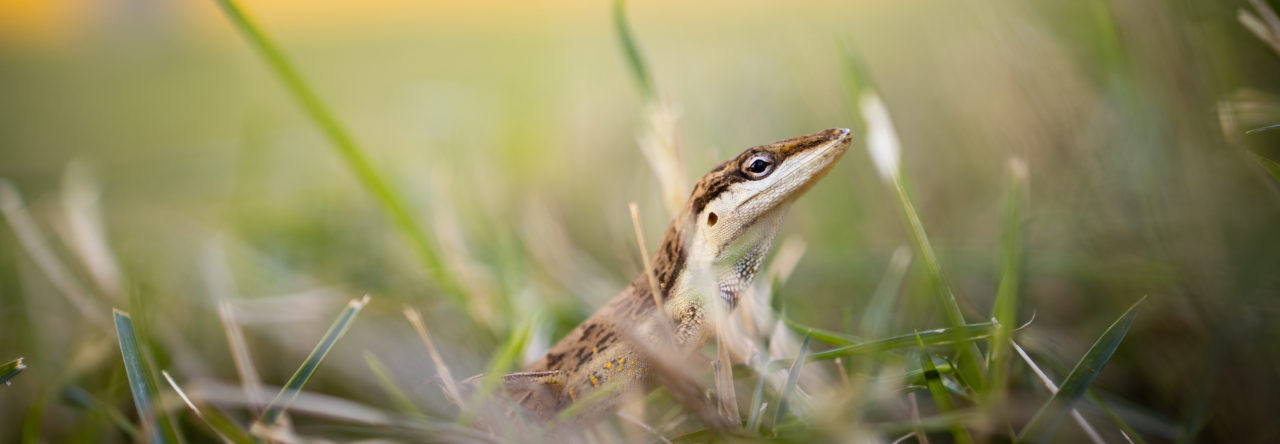

Anolis porcatus (left) found at a plant nursery in Aruba (right).
It was late December 2018. My partner in work and life, Matt, and I were headed back to Curaçao to conduct some follow-up sampling. We had recently completed a field season in Curaçao where we had discovered three newly introduced gecko species (Behm et al. 2019). Since we had to fly through Aruba to get to Curaçao, we decided when booking our trip to spend some time in Aruba, too, to look around for introduced herps, since that’s one of our favorite ways to spend our time when traveling (we’ve even been known to trick family members into searching for introduced herps while on vacation – e.g., Behm et al. 2018). Aruba and Curaçao are neighbors and since Aruba is even more economically connected than Curaçao, we suspected there may have been undiscovered non-native herps there.
What we did not expect was that in less than 3 days on Aruba, we would find three new non-native species (Anolis gingivinus, A. cristatellus and Hemidactylus frenatus) and document a range expansion for a 4th non-native anole (A. porcatus) already known to be on Aruba (Behm et al. 2022). Even though we focused our surveys on properties like plant nurseries and resorts that had a strong likelihood of harboring introduced species due to their influx of ornamental plant shipments, this was still a very high number of species in a short amount of time.
I wanted to understand how these newly documented species fit within the context of the other non-native herps on Aruba. Specifically, I wanted to understand the circumstances surrounding the initial introductions and the current habitat use of the species on Aruba to assess whether any emergent patterns could be gleaned for Aruba. If so, these patterns may lend further insight into how and why the Caribbean has emerged as a hotspot for species invasions (e.g., Helmus et al. 2014, Perella and Behm 2020, Gleditsch et al. 2023).
What seemed like a simple task ended up being more challenging than expected due to the scant and sometimes contradictory information in the literature surrounding the species introductions. To make sense of it all, I enlisted the help of a brilliant undergraduate in my lab, Gianna Busala, whose tenacity and attention-to-detail made it possible to reconstruct some of the invasion history on Aruba. Our recent publication (Busala et al. 2024) compiles all of what we found about the introduced herps on Aruba.
In conducting our research, there were several issues we encountered. First, many of the original species documentations were in old and possibly obscure sources. Just tracking them down and getting access proved challenging in some cases. Second, we found several instances where the original or subsequent documentations were mis-cited in more recent publications. This academic game of telephone results in the amplification of inaccurate information. Often this occurred when the publication originally documenting a species introduction speculated on some aspect of the introduction, such as the population of origin, or the pathway by which the species was introduced. Subsequent publications would misrepresent this speculation as fact, further compounding confusion surrounding the introductions.
Overall, our biggest finding, though, was that information surrounding most introductions was sparse. We don’t know where the species came from nor how they were introduced. We don’t even have a good handle on the impacts of the species that have been introduced. This makes it difficult to enact strategies to prevent further introductions and manage existing ones.
Going forward, documenting species introductions is not necessarily academically sexy work since these documentations are often published in journals with a low impact factor, but it is important work and not often done (see a great study by Castro et al. 2023). Articles documenting species introductions provide incredibly useful information that future researchers can use – way more informative than what can be gleaned from databases like iNaturalist (which is also great and important). So, I urge you to document species introductions, if you have the opportunity. Articles documenting a species introduction are relatively straightforward to write, and I have found them to be a great opportunity for incorporating undergraduates into the publishing process.
If you are in the position to document a species introduction, whether it is a completely new introduction to a location or a range expansion for an existing introduction, here are my suggestions. First, for any species documentation, the species identification needs to be confirmed in some manner. I try to confirm all of our species identifications using DNA barcoding.

My set up for collecting tissue samples for DNA barcoding: screw top vials pre-filled with ethanol, tube holder, gloves, scissors, ethanol wipes, Ziplocks and my Pesola scales. Me tucked in an out-of-the-way corner of a mega-resort in Aruba (top) and a recently processed A. gingivinus perching above my set up in a residential neighborhood (bottom).
I am not an expert in any taxa, especially anoles, so I like to have the species identification confirmed via barcoding. This can be done quite easily by just taking a small tail tip from a lizard and preserving in ethanol until extraction. To facilitate this, I try to always have an active IACUC protocol approved so that wherever I go (assuming I have permits), I can collect a sample. In the absence of permission to sample, I take as many high-quality photos as possible to document the species. These can be deposited in a museum and serve as a voucher for species identification as well.
My second suggestion is to try and document as much as possible about the introduction as you can. Even seemingly insignificant details may be incredibly valuable to a researcher in the future. Although I mentioned that speculation in articles can be mis-represented, I still think speculation is important, as long as it is clearly reported as speculation. For example, the authors documenting the introductions of A. porcatus and A. sagrei to Aruba speculated that they were likely introduced during the construction of the Radisson resort’s garden because the resort received a shipment of ornamental plants during construction. This speculation on the origin of the species introductions provides a basis for future researchers to investigate further.
Finally, although it’s possible to find newly introduced species without really trying (we found A. gingivinus in a neighborhood when we were walking from our AirBnB to the beach), you’ll probably have more success if you search out specific habitat types that receive a lot of shipments from abroad that would contain non-native species or their eggs. This includes places like resorts, garden centers, and nurseries that receive shipments of landscaping materials, and also places like outdoor markets and cruise ship terminals that may receive a lot of agricultural shipments.
There are likely many introductions of non-native anoles that have yet to be documented. By documenting introductions, you can contribute to a growing body of knowledge on these local events that create regional shifts in biodiversity.
To read more about our synthesis of non-native herp introductions on Aruba, please see our full article (below). And please feel free to reach out to me if you have any questions about that work or documenting species introductions in general: jebehm@temple.edu.

Steve Constantelos
I love the best practices ideas in this article. I hope researchers of many taxa take note!