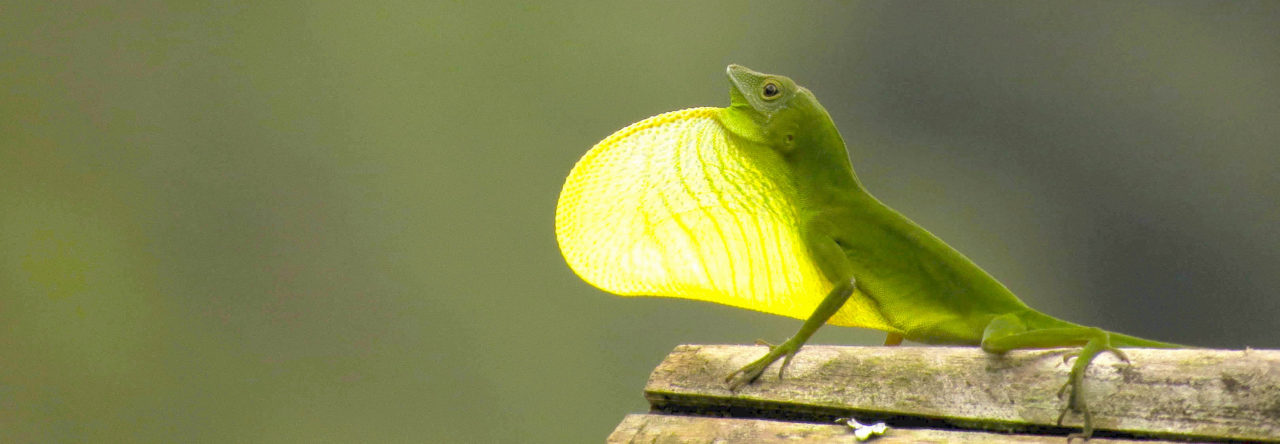

Bark anole, A. distichus
I’ve been working on Abaco, in The Bahamas for several years now. The Bahamas, Abaco in particular, is famous for the abundance of terrific science that originates there. Currently, Abaco has three species of anole: A. sagrei, A. smaragdinus, and A. distichus. However, only A. sagrei has been considered native to the island, the others likely introduced relatively recently from islands of the Great Bahama bank such as New Providence or Bimini. However, a recent study reports fossil evidence of A. distichus in peat deposits from about 950 YBP supporting a long history of A. distichus on Abaco.
One interesting aspect of this find is that the contemporary distribution of A. distichus on Abaco appears to be limited to the main port town of Marsh Harbour. I always suspected that this limited distribution suggested that A. distichus was not native to the island, but rather came in on landscaping plants over the last several decades.
So why are there conflicting observations here? Is it possible that A. distichus was extirpated on Abaco due to settlement by indigenous peoples (seems to be contemporaneous with the fossil sediment formation)? While it might seems rather hard to extirpate such a small, abundant animal, there is growing evidence that the Bahamas were reptile-dominated ecosystems at the time of human arrival. Therefore, the coincident extirpation of tortoises, Cuban crocodiles, and rock iguanas places the modern hiatus of A. distichus in a different light. I am guessing that the altered (intensified) fire regimes initiated by ancient human civilizations may have contributed to the absence (rarity) of A. distichus from contemporary, natural ecosystems. This is admittedly, a lot of conjecture, but how else might one explain their ancient presence, yet contemporary confinement to a human-dominated habitat?
I look forward to hearing more from the interesting work that Dave Steadman, Janet Franklin and Nancy Albury are doing on these ancient Bahamas communities. And it looks like there is a lot more to come! Also, the name of the journal is The Holocene. How cool is that?!
Steadman DW, NA Albury, P Maillis, JI Mead, J Slapcinsky, KL Krysko, HM Singleton, and J Franklin. 2014. Late-Holocene faunal and landscape change in the Bahamas. The Holocene. DOI: 10.1177/0959683613516819.

 Small in size, but a global giant in biodiversity, Ecuador is awash in all manner of fauna and flora. Birds, butterflies, trees—the country is a hotspot for just about everything. But no group of organisms is more beautiful, more charismatic, more scientifically captivating than Ecuador’s reptiles and amphibians. The Amazon rainforest dominates the attention of the public, but other parts of the country, especially the mountainous regions, are just as biologically rich. One such area is the small parish of Mindo in Pichincha Province, home to 102 species of creepy crawlies. And what an ensemble! Brilliant colors, toxic skin and venom, sweet serenades, menacing looks, gorgeous displays—this region is an encyclopedia of herpetology in just 268 square kilometers.


 A while back, we