Anolis sagrei Plays Dead

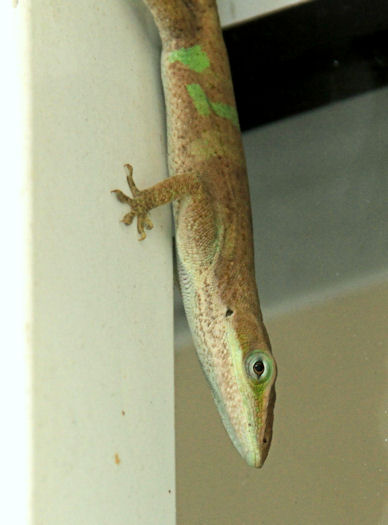
In q previous post, Hispanioland showed us a picture of the fake dead behavior by Anolis distichus. This year I breed my pair of Anolis sagrei and I have several offspring.

I can see that this behavior is rather common among the offspring, and I partially filmed it in the following video. I didn’t see the same behavior in my other anoles species. Maybe only for trunk-ground species?

In which species have you seen this behavior ?

In this case, the offspring begins to stiffen, twists and falls to the ground. Then, he opens his mouth and stops breathing. The limbs are tense as a dead person. When the young are put back to safety (some seconds later), the individual “awakes.”


30% Off 2017 Anole Calendars Today!

screen-shot-2016-12-14-at-9-09-45-am

Buy ’em here, use this code: ZCUSTOMGIFTS

Splotchy Green Anole

Karen Cusick, proprietor of Daffodil’s Photo Blog, watched this green anole turn from green to brown. Or mostly brown. I’ve seen this sometimes myself. Anyone know what’s going on here? Seen it in other green anoles?

Anole Annals 2017 Calendars Are Here!

equestris potior

Thank you to all who sent in photos for our contest; we received a total of 101 submissions! We’ve tallied the results and consulted our panel of experts, and are ready to announce the winners for Anoles 2017. The grand prize winner is the photo above, Anolis equestris potior, taken by Jesús Reina Carvajal. The second place winner is below, Anolis aquaticus, taken by Lindsey Swierk. Congratulations!

aquaticus

The rest of the winners can be seen in the 2017 calendar here! Click the link to order your calendar, just in time for the holidays. Congratulations to all the winners, and thank you again to everyone who participated!

Happy holidays! Can’t wait to see the submissions next year!


Baby Anoles Hatching at the End of November!

A newborn anole arrives in November. Photo by Karen Cusick

Who says global warming is such a bad thing? Ok, it is, but at least there are some benefits, especially if you’re a brown anole in Florida. Read all about it in Daffodil’s Photo Blog.

Anole Exhibit at the American Museum of Natural Exhibit Also Talks about Cuba More Generally: New York Times Review

anolead_amnh_cuba

The American Museum of Natural History just opened an exhibit on anoles that also presents information on the natural history and culture of Cuba. Or maybe it’s the other way around. But either way, you have to love their logo. The New York Times just reviewed the exhibit, and not surprisingly, anoles were a centerpiece of the article.

screen-shot-2016-12-01-at-8-22-36-am

And here’s some text from the article:

screen-shot-2016-12-01-at-8-23-12-am

Lizard UV Vision and Signalling: Commercial Possibilities

advertisment

From the recent ISBE Newsletter (28:2, p.26).

The artist, Ken Otter, who when not drawing is a professor at the University of Northern British Columbia, explains the back-story:

My first love was reptiles – birds came as a later incarnation (although I console myself that they are simply feathered reptiles).  I was actually planning on shifting to working on anoles during my postdoc.  I have had numerous ones as pets over the years – my students gave me a brown anole that became our lab mascot for about 5 years.  I even had an undergrad student at the University of Nottingham that I was co-supervising with Pete McGregor run trials to see if males eavesdrop on dewlap displays of other males. Unfortunately, the student was primarily focused on nature photography, and we had a miscommunication on scientific design.  I found out after the fact that he hadn’t quite followed protocol, so we couldn’t count all our trials, so the results were only ever presented in a conference poster and not published.  He ended up as a photographer for BBC Wildlife though!

I had actually been awarded a short-term postdoc back in the 90s from the Association for the Study of Animal Behaviour to test anole signalling behaviour using video playback systems (very similar to the stuff that has since been done using Robo-lizards).  Unfortunately, it came at the same time as I was offered a tenure track job here, and the University had a ‘northern research focus’ so wasn’t too keen on me heading off to the Caribbean to do field work.  Guess now that I have full professorship I could always tell them to stuff themselves, but I have my research program set up now!  Still find dewlap displaying fascinating, especially with the added component of UV signalling in the mix.  That aspect parallels a lot of the stuff with bird signalling.  The fact that males are in such close proximity and can see at least silhouettes of others displaying give a certain network component that Pete and I were always interested in pursuing, but just never go around to it.  Still occupies my thoughts (hence the cartoons) and talk about it in my lectures, but guess I will have to wait to put it into field practice!  Still, next North American Ornithological Congress in 2020 is being held in Puerto Rico….

And here’s another of his drawings:

ken-otter-drawing

Puerto Rican Crown-giant Anolis cuvieri Eats a Tarantula

Read all about it at Ricardo’s Blog.

Blogging for SICB 2017: Anole Annals Wants YOU!

Society for Integrative and Comparative Biology logo.

Society for Integrative and Comparative Biology.

It’s late November, which means a few things: Winter is coming, Westworld is wrapping up, people are going to lose their minds on Black Friday, and, most importantly, the annual meeting for the Society for Integrative and Comparative Biology (SICB) is upon us. SICB is one the biggest annual meetings for biologists in the United States, and it is a venue where Anolis research is prominently featured. This year’s meeting, which will be held in New Orleans during the first week of January, is no exception. By my count there are 35 talks and posters featuring anoles. I’ve been attending this meeting regularly for nearly a decade and I’m fairly certain this is a new record. I think that this particularly high turnout really speaks to the increasing prominence of anoles as model organisms for ecological and evolutionary studies.

With great prominence, however, comes great responsibility. We like to cover every presentation, whenever possible and also focus on giving spotlights to undergraduates and graduate students as much as possible. Every year we rely on many conference participants to blog about posters and talks. If you’re an undergraduate or graduate student, blogging is a great way to practice writing to a broader audience. Moreover, if you blog for AA and are presenting at SICB, we guarantee that we will cover your presentation. Bloggers at all levels of experience are welcome to blog – undergrads, graduate students, postdocs, and faculty! Please email me at mmm109@duke.edu or leave a comment for this post if you’re interested in blogging for AA at SICB and we’ll get you started. I will provide detailed information on how to blog and will also be at the conference (and blogging for AA) and can provide assistance. See this post from SICB 2016 for an example. Thanks very much!

Newly Described Dominican Anole Species Enshrined on Stamps

dr-stamps

Earlier this year, we reported that researchers had split the four species of green anoles on Hispaniolia, describing 12 new species. Wasting no time–and with much beauty–the Dominican Republic has placed four of these new species on stamps! Thanks to the world’s authority on anoles on stamps, Uwe Bartelt, for bringing this to our attention.

Page 99 of 305

Powered by WordPress & Theme by Anders Norén