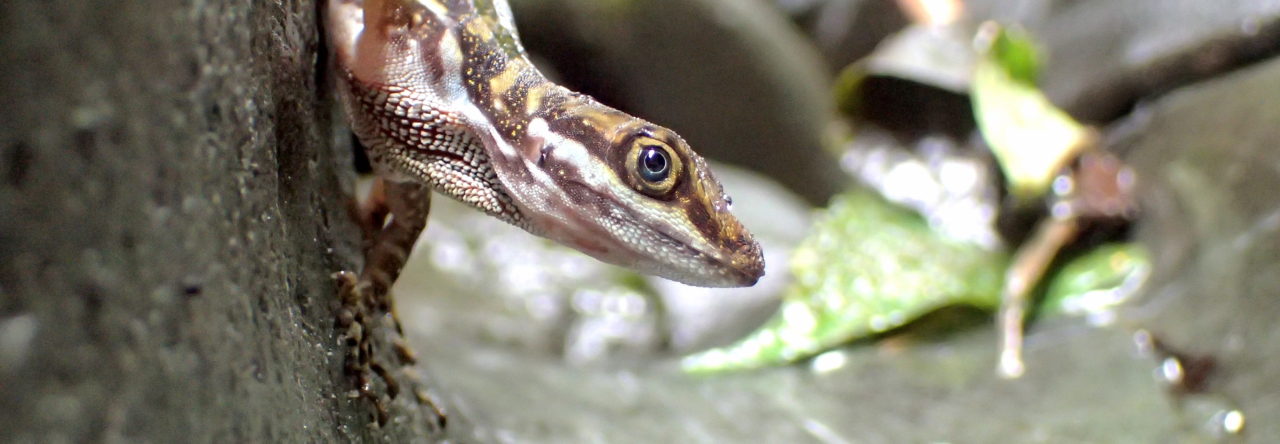
Thank you once again to everyone who participated in this year’s Anole Annals photo contest! As usual, we received tons of great photos, and we’re ready to announce the results. First up, the grand prize winner, is the above photo of Anolis conspersus, taken by Thijs van den Burg. The second place winner is below, Anolis oculatus montanus, by Gregor Weidlich. Congratulations!
The rest of the winners are listed below, and their photos can be seen in the 2018 calendar here! Click the link to order your calendar.
Congrats again to all the winners, and happy holidays!
Winning photos: Anolis conspersus, Thijs van den Burg Anolis oculatus montanus, Gregor Weidlich Anolis luteogularis, Thijs van den Burg Anolis carolinensis, Nick Herrmann Anolis huilae, Cristian Castro Morales Anolis allisoni, Arnaud Badiane Anolis wattsi. Geoffrey Giller Anolis allogus, Thijs van den Burg Anolis porcatus, Jesús Reina Carvajal Anolis nubilus, Colin Donihue Anolis grahami, Nathan Wright Anolis porcatus, Arnaud Badiane
The end of 2017 is nigh, and soon people will be traveling home to spend time with loved ones, eating a superfluous amount of cookies and sweets, and of course, working on that poster or talk for the 2018 Society for Integrative and Comparative Biology (SICB) meeting in San Francisco, California. The 2018 SICB meeting in San Francisco held from 3-7 January is going to be one of, if not, the largest SICB meetings ever with nearly 1950 abstracts being submitted! SICB is one of the largest national conferences for biologists, where an incredible diversity of research is presented each year. And of course, SICB meetings are home to several Anolis presentations, with approximately 40 or more talks and posters this year featuring anoles.
Every year at SICB, the Anole Annals tries to cover as many of the anole talks and posters as we can, and this year is no exception! AA relies on conference attendees to blog about all of the awesome anole work being presented, with a strong focus on undergraduate and graduate research. If you’re a student or student researcher attending SICB, blogging for AA is a fantastic way of getting experience in communicating science with a broader audience. In addition, if you are presenting work on anoles at SICB this January and want to help us blog, we’ll return the favor and cover your work for the blog! Anybody can join the AA family- undergraduates, graduate students, postdocs, and faculty. If you’re interested in blogging for AA at SICB this year, please shoot me an email at anthony.gilbert09@gmail.com or leave a comment on this post and we can get you going. We can provide assistance, examples, and answer any questions you may have when it comes to blogging for AA. Here is an example post from a previous SICB meeting. Thanks all!
Hello everyone. I recently spent four months in the Yucatan Peninsula, doing field work at the Punta Laguna Spider Monkey Sanctuary. While I was there, I observed and photographed quite a few Anolis. I suspect that they are a mix of A. sagrei, rodriguezi, and lemurinus, but I am not able to definitively identify them on my own. I am well aware that it may not be possible to put a name to some or maybe even most of these from photos, but I would be grateful for any insight from the resident experts.
Here are the photos, in no particular order.
This should be A. sagre, correct?
And these yellow dewlaps I would imagine indicate A. rodriguezi?
Film Screening: Sneak Preview of Laws of the Lizard + Q&A with Filmmakers
Date:
Monday, December 11, 2017, 6:00pm
Location:
Geological Lecture Hall, 24 Oxford Street
When scientists ask big questions about the laws of nature, they sometimes seek out improbable partners—such as lizards—to find the answers. In their new documentary, Laws of the Lizard, award-winning filmmakers Nate Dappen and Neil Losin partner with scientists to tell the surprising story of anole lizards.
During a year-long quest that took them from tiny Bahamian islands and Caribbean rainforests, to metropolitan Miami, Dappen and Losin capture cutting-edge science, new anole species, and never-before-seen behaviors. They quickly came to understand why Jonathan Losos, Harvard evolutionary biologist—and anole lizard expert—humorously says “Any study you do is more interesting if you do it on anoles!”
Join us for a special preview screening of Laws of the Lizard—coming to the Smithsonian Channel in 2018—followed by a Q&A with the filmmakers and Harvard Professor Jonathan Losos.
Anolis shrevei on a rock. Photo courtesy of Katharina Wollenberg Valero.
Back when I was an undergrad, we were given the impression that animal behaviour and ecology (and evolution for that matter) were distinct disciplines. ‘Behaviour’ had its own classes, professors, and students, mostly separate from the ecologists. The disciplines also have their own, aptly named, journals: Animal Behaviour vs. Ecology. Of course, even then we knew that this division wasn’t a hard boundary and journals like The American Naturalist explicitly included ecology, behaviour and evolution, but we still didn’t think of these disciplines as inseparable. The impression seems to have stuck because fast forward 15 years and I was recently surprised when a colleague, upon hearing about our work on microhabitat use in agamids said, “I didn’t know you did behaviour.” Well, until that moment, I didn’t know I did either! I simply hadn’t thought about what we were doing in that way. Upon reflection, it should have been obvious, just like it should have been obvious that the behaviour/ecology distinction was a false one. I have no idea how widespread my once-perceived separation of ecology and behaviour is, but the fact that there’s a need for a journal, Behavioural Ecology, that specifically merges them suggests they’re still not perfectly integrated.
So why natter on about behaviour, ecology and evolution? Because a recent paper by Martha Muñoz and Jonathan Losos, published in The American Naturalist, is a fine example of why these shouldn’t be separated. Muñoz and Losos set up a dichotomy of hypotheses about how behaviour influences evolution: on the one hand, exploratory behaviour can expose species to novel selection pressures, stimulating evolution, but on the other, behavioural fidelity could shield species from those same selection pressures, ‘forestalling’ evolution. So, which is it? Well—spoiler alert—it’s both. So long nice dichotomy. To reach their findings, the authors looked at thermoregulatory behaviour and how it affects adaptation to high elevation habitats in the Anolis cybotes species group (specifically cybotes, armouri and shrevei). They found that, despite much cooler temperatures at higher elevations, high and low elevation species had selected temperatures in the lab and maintained similar body temperatures in the field, via increased thermoregulation at high elevations. Thus, despite the cooler temperatures, anoles hadn’t evolved to prefer colder temperatures on mountaintops. So behaviour halts evolution, right? Yes but no. To thermoregulate so extensively, anoles had to seek out warmer microhabitats, specifically boulders. And we know what happens when anoles change their perch type: evolution! Muñoz and Losos found that shrevei and armouri had flatter skulls, consistent with life on the rocks, as well as shorter hind limbs (but no differences in toe length or lamellae number). The evolutionary basis of the morphological change in head and femur traits was confirmed by a common garden. Nifty.
Effects of behavioral thermoregulation on evolution of high elevation anoles. On the left, thermal environment, body temperature and lab-selected-temperature of low and high elevation anoles. On the right, morphology of high and low elevation anoles in the field and in a common garden. Modified from Figs 1 and 2 in Muñoz and Losos (2018).
The overall message of the paper is clear: the same behaviour inhibited evolution along one niche axis and promoted it along another. Muñoz and Losos argue that the lack of evolutionary change in thermal traits arises from the Bogert effect, where behaviour limits exposure to novel selection pressures. However, there is a chance that the lack of evolution could be due to other constraints, like a lack of genetic variation. Testing this would require an experiment with a control group of lizards that couldn’t behaviourally avoid thermal selection pressures. A previous paper by Muñoz, Losos and others, provided just such a natural experiment. In that study, Muñoz et al. found that lower CTmin has evolved in high elevation cybotoids, relative to low elevation ones. Why? Because at night, when its coldest, anoles are unable to behaviourally thermoregulate to avoid the cold –voilà, a control where the Bogert effect was negated. And once behaviour was removed from the equation? Evolution! This finding adds even more weight to the role of behaviour in inhibiting the evolution of thermal traits in this system. Cool stuff (I make no apologies for that pun).
There’s lots more in the Muñoz and Losos paper than I touched on here so give it a thorough read. It goes a long way to destroying any divisions that might still exist between behaviour, ecology and evolution and it makes a strong case for why we need to consider multiple niche dimensions when we talk about niche evolution and conservatism. Plus, it gave me an excuse to use the word ‘contronymic.’
My name is Roy Ang, and I am currently a Genetics PhD student in the Fraser lab at Stanford University. I am interested in studying the cis-regulatory adaptations that lead to morphological changes and the evolution of different ecomorphs. I do so by studying available genetic data on different anole species and identifying correlations with morphological variation in limb length or lamellae count.
Most of my work now is based on morphological data from Mahler et al. (2010), but I am curious to know if anyone here is collecting similar data on Lesser Antillean anoles, such as A. wattsi or A. leachii? If you happen to be working in this area, I would love to get in touch with you! Please contact me at rang@stanford.edu.
Anolis desechensis is a variant of A. cristatellus found on the Puerto Rican island of Desecheo. The island has a diversity of other species, many of them of conservation value, but it has been devastated by introduced species. The good news: concerted actions have removed most of the invaders, and the island is recovering! Read all about it in the post below, which appeared on Cool Green Science.
Recovery: The Salvation of Desecheo National Wildlife Refuge
Isla Desecheo, Puerto Rico. Photo by Claudio Uribe/Island Conservation
Good news is scarce in Puerto Rico these days. But if you look 13 miles to the west, on a 358-acre island called Desecheo, you’ll find a mother lode.
Desecheo, once the Caribbean’s most important brown booby breeding habitat, was made a national wildlife refuge in 1976. This was something of a futile gesture because invasive aliens — black rats, feral goats and macaque monkeys — had extirpated the brown boobies (which once numbered around 10,000) along with the seven other nesting sea-bird species. The invasive species also blighted forests and the federally threatened Higo Chumbo cactus, and reduced native land birds, reptiles and invertebrates to a shadow of their former abundance.
Desecheo was an ecological wasteland.
In 1976 there was virtually nothing the U.S. Fish and Wildlife Service could do about that. But in 1994 it acquired a powerful ally with the founding of Island Conservation (IC), a nonprofit team of biologists dedicated to preventing extinctions around the globe. There was and is no shortage of work. Although islands comprise a miniscule fraction of Earth’s landmass they harbor about half of all endangered species. At least 80 percent of the 245 recorded animal extinctions since 1500 have occurred on islands.
IC and multiple partners (frequently The Nature Conservancy) have thus far removed invasive mammals from 59 islands thereby benefitting 1,090 populations of 402 native species and subspecies. Research just released by IC, Birdlife International, the International Union for Conservation of Nature, and the University of California at Santa Cruz demonstrates that 41 percent of the planet’s vertebrates threatened with extinction can be saved by ridding certain islands of invasive mammals.
Last July, after an exhausting, expensive ten-year battle, IC and its partners certified that Desecheo National Wildlife Refuge was free of macaques (if you don’t count a single, aging female) and rats. The last feral goat was removed in 2009.
Such successes were impossible before the advent of recent technology including: the anticoagulant rodenticide brodifacoum, sufficiently fast acting to kill rats before they learn to avoid it; thermal imaging which allows partners to detect alien mammals at night and in forest canopies; GIS (Geographic Information System) for recording precise positions on Earth’s surface so that rodenticide-laced bait can be applied to every part of an island; and satellite imaging to determine when islands lose greenery so eradications can happen when less food is available to aliens.
Higo Chumbo by the Coast, Isla Desecheo. Photo by Island Conservation
Even with goats (introduced in 1788) and rats (introduced circa 1900) a few sea birds hung on. What finally did them in were the macaques, unleashed in 1966 for medical research by the then clueless National Institutes of Health.
Ecological Illiteracy Leads to Ecological Wastelands
The most formidable obstacle confronting IC and partners is ecological illiteracy. They get savaged by chemophobes who fear and loathe all poisons in all situations and by animal-rights types who defend alien wildlife, rats included, and decry the often unavoidable, increasingly minor and always inconsequential bykill of non-target wildlife.
The Desecheo project, however, proceeded unopposed. It wasn’t as if Puerto Ricans are more enlightened than other Americans. It’s just that they live in an alien-infested hell of macaques that tear up their gardens and bite them, exposing them to the herpes B virus (relatively harmless to macaques but usually fatal to humans), feral hogs and feral goats which also tear up their gardens, feral cats which infect them and wildlife with toxoplasmosis, and a biblical plague of rats and house mice.
Public reaction was different at Channel Islands National Park off southern California. When IC and partners set about saving and restoring a host of native species including the endangered ashy storm-petrel, imperiled Scripps’s murrelet, Cassin’s Auklet and Anacapa deer mouse by eradicating black rats, they were delayed by litigation. Typical commentary in the local press included: “Species go extinct all the time” and “Who are humans to call other species invasive?” Park rangers were obliged to wear bulletproof vests; and shortly before the first bait application, two men landed on Anacapa Island in an inflatable boat and started flinging pellets of vitamin K — brodifacoum’s antidote.
Desecheo Beach Camp. Photo by Claudio Uribe/Island Conservation
Had Anacapa been infested with macaques, recovery would have been a political impossibility.
Prudently, IC doesn’t talk it up about how it, the USDA’s Wildlife Services and a nonprofit group called White Buffalo removed macaques from Desecheo. But it’s important for the public to understand just how difficult and heroic was this effort, a first in island recovery. Learning as they worked, the partners first tried baiting and trapping. It failed. They had better results with rifles but had to bring in thermal-imaging equipment when the macaques retreated to the forest canopy.
“It was a hell hole,” recalls White Buffalo’s president, Dr. Anthony DeNicola. “Ninety or 100 degrees with no place to get out of the sun.”
IC and White Buffalo staffers would sit for 14 hours a day, scanning trees and terrain with binoculars. Toward the end it would take them a month to take out one or two monkeys. Finally they had to bring in tagged, sterilized “Judas animals” from Puerto Rico to socialize with the few remaining wild ones and reveal their presence. It took five years to finish the job.
Desecheo bird eggs. Photo by Claudio Uribe/Island Conservation
Safe for Birds Again
The reluctance of IC to offer such details in its press releases and interviews doesn’t mean it tries to fly under the radar. “That would be inconsistent with our values,” remarks Heath Packard, IC’s director of government and public relations. It would also be illegal under the National Environmental Policy Act, which requires IC and its federal partners to engage with the public, disclosing alternatives and their various consequences.
Brown Booby, Isla Desecheo. Photo by Island Conservation
“The outreach is always the same,” says IC’s global affairs director, Gregg Howald. “It’s just that results of that outreach vary widely from location to location.”
Citing the Polynesian rat eradication on Lehua Island off Hawaii, completed September 13, Howald offers this: “For years we’d been reaching out to the community with blog postings, talking with people and holding public meetings. It wasn’t until late July that a few vocal individuals realized this was really going to happen and started trying to stop it, making lots of noise and drawing media attention. It was just off the rails. We had a public meeting in which people yelled at us for over two hours. It was horrible. Despite all our outreach, we wound up with a confrontation that started a cascade of anti-project misinformation.”
For example, the Huffington Post ran an op-ed by one Maggie Sergio (whom it identified as a “writer, conservationist and concerned citizen of the planet”) suggesting that five pilot whales, which later beached themselves on Kauai and died (as they commonly do everywhere they exist) were victims of diphacinone — an impossibility. Sergio also claimed that “three aerial poison drops, totaling 11.5 tons of diphacinone” were delivered by helicopter. There isn’t enough diphacinone in the world to drop 11.5 tons. What was dropped was 8.5 tons of bait of which .005 percent was diphacinone. This and other misinformation was recycled by local media.
Endemic Desecheo Anole, Isla Desecheo. Photo by Armando Feliciano/Island Conservation
It was exactly this sort of fear mongering that motivated the partners to use diphacinone, less toxic and therefore less effective than brodifacoum. But apparently it worked. “So far so good,” says Howald. All the rats we collared and monitored died. It will take time to tell for sure [if the project succeeded]. We did state in our environmental assessment that if diphacinone failed, we could come back in with brodifacoum.”
Either way Lehua Island will again be safe for federally threatened Newell’s shearwaters, band-rumped storm-petrels now a candidate for Endangered Species Act protection, wedge-tailed shearwaters, brown boobies, red-footed boobies, Laysan albatrosses, black-footed albatrosses, Christmas shearwaters, Bulwer’s petrels, red-tailed tropicbirds and black noddies.
Spectacular Results
Recovery of Desecheo’s native ecosystem is just beginning, but already results are spectacular. Despite insect surveys beginning in 1914 dingy purplewing butterflies had never been observed on the island. In April their caterpillars were so abundant they defoliated Almacigo trees. (Leaves quickly regenerated.)
Desecheo Butterfly. Photo by Armando Feliciano/Island Conservation
Endemic reptiles are doing much better, particularly Desecheo anoles, Desecheo ameivas and Puerto Rican racer snakes. A Puerto Rican skink, a species rarely observed in the past, has been sighted. Invertebrate density has increased. Native fruit trees and flowers are suddenly flourishing. New leaves, preferred by goats, rats and macaques, are more abundant than in anyone’s memory. Higo Chumbo cacti are rapidly recovering; and forests, particularly understories, appear to be growing faster.
Desecheo Flower. Photo by Armando Feliciano/Island Conservation
At this writing no one has visited the island since the hurricanes, but there are no refuge buildings on Desecheo; and in the tropics vegetation bounces back quickly. As of mid-October there were new leaves and blooms on Puerto Rico.
In its island-hoping war against introduced aliens IC builds on each victory. “One thing I’ve learned is that you can get so focused on individual projects you start to lose sight of the forest for the trees,” remarks Howald. “Now that we’ve had this success what does it mean? What’s the potential of Desecheo; what’s the leverage?”
The potential and leverage, he explains, is demonstration to regulatory agencies, the funding community and, especially, the public: that the choice is salvation of nearly half the world’s endangered species or the continued presence of alien invasives; that we can’t have both; that if we want the former, we have to take out the latter; and that we can do that without risk to humans or native wildlife populations.
Desecheo Panorama. Photo by Heath Packard/Island Conservation
The Florida green anole, Anolis carolinensis, is a trunk-crown anole, usually seen on trees, often high up. So, what’s it doing on grasses low down? Alberto Estrada, an expert on Cuban lizards, reports the following:
It caught my attention to observe several specimens of A. carolinensis (smaller than the one in the photo above) posted on the spikes of the tall grass spikes on the lake shore at Miramar Pineland Park near Pembroke Pines, Broward, FL (25.97 ° N, -80.25W °). In my experience in Cuba with his close relatives A. porcatus and A. allisoni, I do not remember having seen them in such situations. They reminded me of the typical grass anoles such as A. pulchellus from Puerto Rico. As much as I searched, I did not find adults. In Tree Tops Park (26.07ºN, -80.28°W), if I have seen adults on the planks of the platform in the swamp and I have seen juveniles or subadults like the one the photo below in the reeds and on grasses that stand out from the water. I lived and worked for many years in the Ciénaga de Zapata, I had many experiences in marshy environments in the keys that surround Cuba, and I do not remember a single case of seeing the green anoles of Cuba in the same situation. Interesting experience!
In turn, this reminds me of observations I made of Anolis allisoni on Roatan, as evident in the photo below:
Caption from original post: You thought I was kidding about the Roatan allisoni doing their best grass anole imitation? See how many you find in this photo. There are at least five, but maybe I missed some.
Thanks to all who submitted photos for the Anole Annals 2017 calendar contest–we received lots of great submissions! We’ve narrowed it down to the top 24, and now it’s time for you to vote! Choose your 5 favorites in the poll below. You can click on the thumbnail to view full-size images. You have 10 days to vote – poll closes next Friday at midnight (11/17). Spread the word!
It’s been too long since we’ve discussed that pointy-snouted marvel, the Little Cayman anole. Fortunately, Flicker, the bimonthly magazine of the Terrestrial Resources Unit of the Department of the Environment of the Cayman Islands, has ended the drought, featuring a new research project on one of our favorite species in its most recent issue.
For those of you who can’t get enough of Anolis maynardi, check out some previous AA posts [1, 2, 3]. For more, just type “maynardi” into the search bar to the right.