
ESA 2018: Yellow-Chinned Anole Population Dynamics across Two Disturbance Events

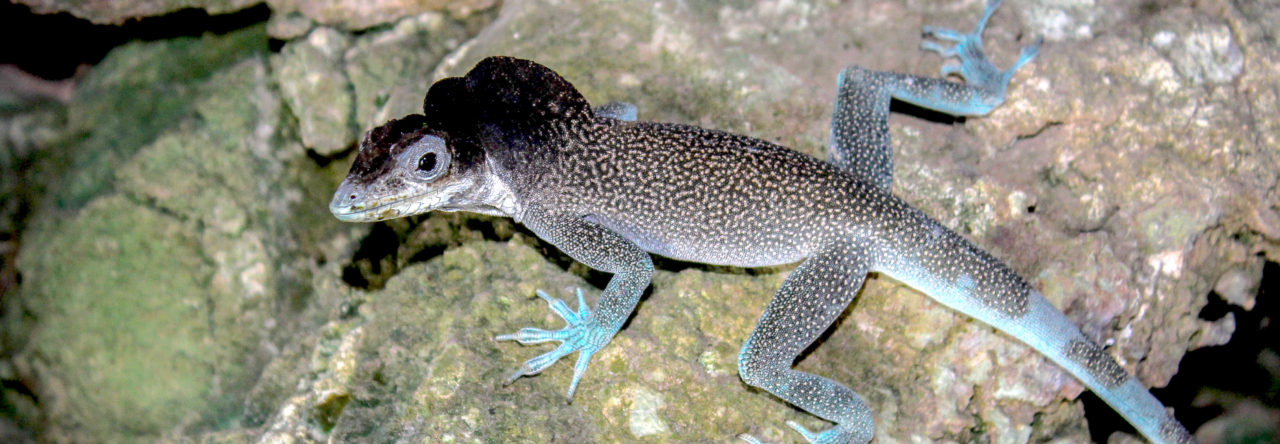
Anolis gundlachi, Photo taken by Johann Crespo Zapata

Disturbance events can be important drivers of population dynamics for many different species. Puerto Rico, an island in the Caribbean, experienced two major disturbances over the course of a few years – a drought in 2015 and a hurricane in 2017 – that caused stress to the herpetofauna living in the region. The yellow-chinned anole, Anolis gundlachi, is particularly susceptible to disturbance events because it is a thermoconformer and vulnerable to dehydration. Johann Crespo-Zapata and his team wanted to track the population of yellow-chinned anoles in the tropical mountain forest of Sierra de Cayey during and after these disturbance events to determine how the population would change.

Johann and his collaborators counted A. gundlachi along four 30-meter transects to determine population size. The crew split its groups into adults (> 45 snout to vent length, SVL), large juveniles (20-45 SVL) and juveniles (<20 SVL). The team also collected precipitation levels using a local weather station to determine if each month had less rain than average, which is called a rain deficit. Following the population subsets over the last four years allowed Johann to understand how the population responded to hydric stress. He recorded a decrease in juvenile abundance as rain deficit increased (r = -0.352, p < 0.0482, n = 32), which suggests a decrease in recruitment. There was no overall trend for large juveniles in response to the drought. Adults displayed a similar pattern to that of juveniles, as they experienced a decrease in abundance with increased deficit. After a time lag, adults experienced an increase in abundance when the drought lifted (r = 0.4469, p <0.0024, n = 44) that could be attributed to increased mortality during the drought events.

Sierra de Cayey forest after Hurricane Maria, photo taken by Johann Crespo Zapata

Following this study period, hurricane Maria struck Puerto Rico, causing structural changes to the forest canopy and decreases in humidity. Immediately following the hurricane, Johann saw the anole abundance decrease to its lowest point. Johann plans to continue to follow this population for the foreseeable future to observe population dynamics in A. gundlachi populations following major hurricane disturbances. Understanding the population dynamics of these anoles is critical to comprehending how this species and others like it will cope with increased disturbance events that will become more frequent according to current climate change projections.

Blog for Anole Annals at Evolution 2018!

With Evolution 2018 kicking off this Saturday in Montpellier, we are putting out a last minute call for bloggers to help us cover the 9 anole talks/posters! Will you be attending? Want to contribute to the blog? Send me a message at kmwinchell@wustl.edu! We are happy to have you join the team whether or not you have blogged for us before!

For those of you following along at home, here’s a sneak peek of the action:

Kicking off the anole posters during the first poster session on Sunday will be Winter Beckles (“Habitat partitioning and signal divergence among non-native bark anoles in South Florida”), Colin Donihue (“How does an adaptive radiation begin? Contingency and determinism in Anolis sagrei ecological specialization”), and Timothy Thurman (“Phenotypic change in response to introduced predators and competitors: a field experiment with Anolis lizards”).

Monday starts off bright and early with a talk by Guin Wogan (“Replicated landscape level epigenomics and genomics of two Greater Antillean trunk-ground Anolis lizards”), followed by an afternoon talk by Carlos Infante (“Regulatory evolution, development, and convergence among Anolis lizards”). There is also a talk slated for Monday afternoon by Tony Gamble on “Sex chromosome evolution in lizards and snakes,” which I hear may feature some anoles, but will focus more generally on squamates.

All the rest of the anole action happens on Tuesday, starting with a talk by Shane Campbell-Staton (“Selection on thermal plasticity facilitates adaptation of city lizards to urban heat islands”), and ending with 3 posters during the evening poster session by Claire Dufour (“Evolution of the agonistic behavior as a first response to the recent interspecific competition between the invasive species –Anolis cristatellus– and the native–Anolis oculatus– in Dominica”), Kristin Winchell (“Urban Evolution Mid-Stride: Morphology and Performance of Urban Lizards”), and Yann Bourgeois (“Population genomics of green anole (Anolis carolinensis) reveals evolutionary forces shaping diversity in a reptile”).

Check back during the meeting as we rev up our blogging machine to cover all of this exciting new research! Also, make sure to follow along on Twitter by following Anole Annals (@AnoleAnnals) and the Evolution 2018 hashtag (#Evol2018)!

Perch Use by Anolis polylepis Peters, 1874 (Polychrotidae) in a Tropical Humid Forest at the Piro Biological Station, Costa Rica

Morazán Fernández, F., Gutiérrez Sanabria D. R., Coello-Toro H. L., Arévalo-Huezo, E. Ioli, A. G., Díaz Gutiérrez, N., Guerra, L. F, Burbano, D., Guevara, C., Lobos, L., Rico-Urones, A., Cortés-Suárez, J. E, Jiménez, R., Reinke, H., Narváez, V., Aranda, J.M. 2013. Relación entre la fauna silvestre y las plantaciones de palma africana (elaeis guineensis) y su efecto en la producción de pequeños y medianos productores en la península de osa, Costa Rica. Instituto Internacional de Conservación y Manejo de Vida Silvestre, Universidad Nacional, Costa Rica. Pp 104.

This image was taken as part of the integrated course developed by the XXIII promotion of the Masters in Conservation and Wildlife Management of the National University of Costa Rica.

Individuals of a species use habitats on different ways for refuge, feeding, reproduction, or perching. We studied the variation on perch use between sex and age classes of Anolis polylepis at the Piro Biological Station, Costa Rica. Our results point to a similar perch use pattern between sex, but different between age classes, considering only the lowest and
highest perches. Adult females and males use herbaceous and shrubby vegetation and avoid leaf litter. Juveniles use herbaceous vegetation and leaf litter, but avoid shrubby vegetation. We suggest that adult males use higher perches to defend territory.
Conversely, juveniles use lower perches to avoid predators and foraging. Adult females use middle and high perches. This result is in contrast with previous studies on this species.

Cortés-Suárez, J. E. and N. Díaz-Gutiérrez. 2013. Perch use by Anolis polylepis Peters, 1874 (Polychrotidae) in a tropical humid forest at the Piro Biological Station, Costa Rica. Herpetology Notes 6: 219–222.

Ants Carry a Dead Lizard Up a Wall and Back Down

David Polly, vertebrate paleontologist extraordinaire, keeps an eye out for living organisms as well, but turns out his specialty really is the dead ones. Here’s the story: “Ironically I was trying to photograph a live anole on the University of Florida campus [in Gainesville] who was annoyingly reclusive while trying to avoid a swarm of ants. The Anolis escaped so I turned attention to the ants, who turned out to be engaged in Anolis reanimation.”

The Effect of Recent Competition between the Native Anolis oculatus and the Invasive A. cristatellus on Display Behavior: the Cartoon !

Check the new episode of the series “Chris & Z’Andy, the 2 anoles in Dominica ” published in PeerJ (Dufour, Herrel & Losos 2018)!

See also episode 1

Discovery of New Dimorphic Anolis/Chamaeleolis from Cuba

Recently, colleagues and I from Charles University in Prague, Czech Republic published a paper (Holáňová Zahradníčková et al. 2018) in Acta Societatis Zoologicae Bohemicae announcing the discovery of a new dimorphic Anolis population/species from Cuba.

Finding “Chamaeleolis” at their typical habitat at Gran Piedra, Cuba.

During my last trip to Cuba in 2012, I had the luck to find a male of unusual Anolis (“chamaeleolis group“) at Gran Piedra mountain, Santiago de Cuba province. At first glimpse, I knew it is something new—it had a red dewlap! All of to the “Chamaeleolis“ described thus far didn’t have that. By distribution region, it had to be Anolis porcus, but it looked different. Some time later, by coincidence I received some Cuban anoles with locality from Russian private breeders and what a surprise: there were false chameleons with red dewlaps! So, we could start our research on these unique animals.

Can you see it? Photo by Veronika Zahradníčková

In comparison with other species of the “chamaeleolis group,“ animals from this population display surprising dichromatism in dewlaps. Males have shiny red dewlaps, while females have whitish dewlaps.

Lateral view of heads and dewlaps in males and females of five examined Anolis species/populations of the “chamaeleolis” group

We compared this “new anole“ with other Anolis species of the “chamaeleolis group“ (A. barbatus, A. chamaeleonides,  A. guamuhaya and A. porcus) through morphology, mtDNA, visual modelling and spectrophotometry. Our results showed expected distinctness of this dichromatic population.

Amazing dorsal crest of Anolis sp. male. Photo by Veronika Zahradníčková

Veronika Zahradníčková with adult male of Anolis sp. at Gran Piedra, Cuba

Why did we not describe it? In the original description of A. porcus Cope, 1864 there is no information about dewlap coloration nor about the exact type locality. We would need to compare our material with the A. porcus holotype (ANSP 8133 in Philadelphia). We wanted to avoid taxonomic discussions concerning species identity of these specimens until a thorough revision of A. porcus sensu lato including properly localized materials can be completed. We would prefer to cooperate with Cuban herpetologists in this.

And so now it is waiting for description and scientific name. Who will be the first?

Anolis Newsletter VII: Submission Deadline Extended To 31st August 2018

It has come to our attention that today’s deadline for submissions to the Anolis Newsletter VII is landing squarely during many contributor’s field research and conference seasons, and so we have taken the decision to extend the submission deadline by 1 month.

The new deadline will be: 31st August 2018.

We hope those of you there were unable to meet today’s deadline are now able to put together a submission in time for the next! This is lining up to be the best newsletter yet. Contributions to the newsletter can take many forms, for example:

– Overviews of research programs and labs
– Discussion of new projects or ideas
– Summaries of work in progress

– Manuscript-like reports.

More than anything, this is an opportunity to let the anole community know what you’re up to. At the same time, this is not something to stress over. These are newsletter reports, informal non-publications. Don’t sweat the details! And for those of you who presented at the symposium, it’s just a matter of writing down what you said!

You can find all of the formatting details for newsletter submissions here:

https://www.anoleannals.org/2018/04/25/anolis-newsletter-vii-a-call-for-contributions/

And please send all submissions directly to:

anolis2018@gmail.com

Best wishes

The AN VII Editorial Team

2018 Anolis Symposium team photo in Miami FL!


Where Do Green Anoles in the Pet Trade Come From?

AA reader Diane Hickey Davis asks: Are there any differences, genetic or otherwise, between the Green Anole (Anolis carolinensis) found wild in Louisiana, Alabama, Florida panhandle, Tampa region, and those sold by Carolina Biological supply or PetSmart?

Hair-like Features on Green Anole (Anolis carolinensis)

I have an observation of the Green Anole (Anolis carolinensis) from the southern Cumberland Plateau of Tennessee. A population of these anoles lives on a south facing rock outcrop at the top of the plateau. In November 2017, I saw an individual with what appeared to have multiple hair-like features on its head. I first located this population in March 2017. Of the individuals I photographed in March 2017, neither showed evidence of these hair like features. I have been unable to locate any individuals from this population in two trips to the site in 2018.


Any thoughts on what this hair-like feature might be? Has anyone else observed this in Anolis carolinensis or any other anole species?

Submissions Are Open For Anolis Newsletter VII!

Dear anolologists,

The 31st July deadline for submissions to the Anolis newsletter is fast approaching, and we want to remind everyone that this is an open submission for all contributions!

See this previous post for all information you need on the type of contributions we are looking for!

We particularly encourage all of those anolologists who presented research at the 2018 Anolis Symposium to contribute brief synopses of their talks or posters.

Best wishes

The AN Editorial Team

Submit contributions to: anolis2018@gmail.com

Formatting instructions: http://www.jameststroud.com/uploads/2/6/1/3/26134722/anvii_formatting_instructions.pdf

Page 67 of 304

Powered by WordPress & Theme by Anders Norén