

Four months ago, we reported on a new species of the Chamaeleolis clade. The FB page above shows that it’s already for sale in Europe!
Four months ago, we reported on a new species of the Chamaeleolis clade. The FB page above shows that it’s already for sale in Europe!

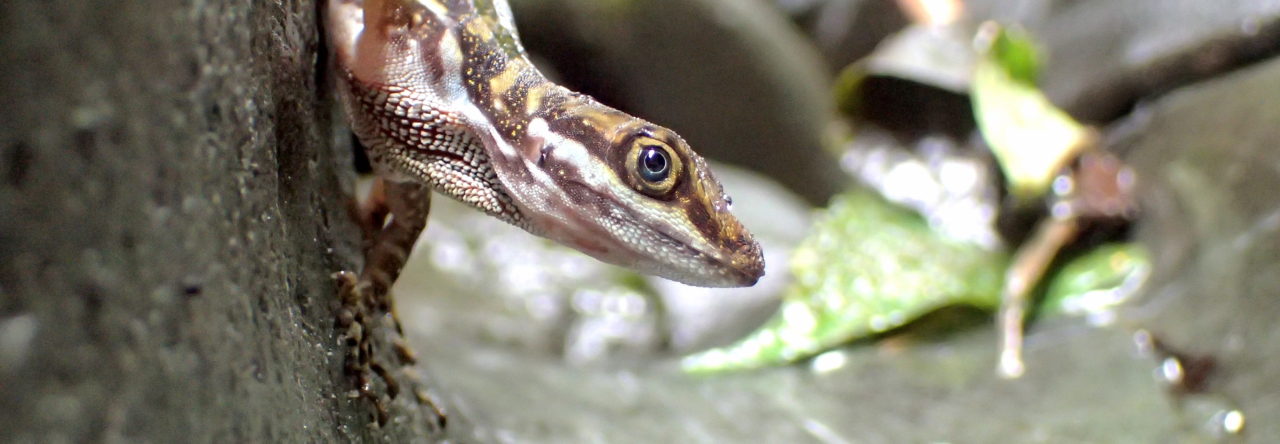
The little known and very rare Anolis darlingtoni, endemic to Haiti and likely to disappear. Photo by Miguel Landestoy from Haiti National Trust website
From Mongabay:
New findings indicate that at current deforestation rates, all of Haiti’s primary forest will be gone within the next two decades, leading to the loss of most of the country’s endemic species.
The study was authored by researchers at Temple University, Oregon State University, the U.S. Forest Service and Société Audubon Haiti, a non-profit conservation organization based in Haiti. Its results were published recently in Proceedings of the National Academy of Sciences.
By analyzing aerial photography and satellite images, researchers discovered that primary forest cover in Haiti shrank from 4.4 percent in 1988 to just 0.32 percent in 2016. They report that 42 of Haiti’s 50 largest mountains have lost all of their primary forests and the country is already undergoing a mass extinction of its wildlife due to habitat loss.
“Haiti’s recognized as having the highest proportion of threatened amphibians in the world,” said S. Blair Hedges, director of Temple University’s Center for Biodiversity and lead author of the study, in an interview with Mongabay. “And that’s largely from the deforestation.”


Other species at risk include the Hispaniolan solenodon (Solenodon paradoxus), a large shrew-like animal native to Haiti and neighboring Dominican Republic. One of the oldest mammals on the planet, the solenodon survived the mass extinction event that wiped out the dinosaurs.
But it’s not faring well in today’s world.
“It’s almost extinct,” Hedges said. “It’s very, very hard to find.” However, the team did see recent evidence of one in mountainous primary forest during a biodiversity survey that took place between 2009 and 2015.

In all, the survey turned up 28 species that are endemic to specific mountaintops – including several new frog species. Hedges says there were likely many more, but as their habitat disappeared, so did they.
“Unfortunately entire mountains have been deforested before biologists have surveyed them, so there were almost certainly many more species that we will never know about,” Hedges said.
Along with the extinctions of unique animals found nowhere else, Haiti’s deforestation has another consequence: landslides and flooding. The researchers found that without tree roots to hold soil, mountains tended to lose their topsoil to erosion soon after deforestation. And without trees to sop up rainwater, lowland areas are much more prone to catastrophic floods.
“Hundreds to thousands of Haitians die each year from flooding that is largely deforestation-related,” Hedges said. He pointed to a flooding event in 2004 that killed more than 1,200 people in a single town.
Hedges says that Haiti’s deforestation is largely driven by small-scale farming and charcoal production, which involves harvesting wood and heating it to remove water and volatile compounds. Doing this turns wood into a source of fuel that can be burned without producing as much smoke.
Around 11 million people live in Haiti, and many of them depend on wood charcoal for fuel and subsistence farming for food. As the lowlands lost their trees, people began deforesting higher and higher into the mountains.

The researchers witnessed this first-hand while conducting their biodiversity surveys, even encountering locals at study sites they had to use a helicopter to reach.
“I did a lot of hiking and we would run into Haitians at the most remote places in the country,” Hedges said.
Even protected areas aren’t immune from deforestation. Hedges recalled meeting a ranger a few years ago in Pic Macaya National Park – one of the last remaining sites of primary forest in Haiti.
“He told us that there were only 20 of them [rangers] but at any given time there are at least 200 teams of tree cutters all throughout the park – it’s a really big area – and they all have weapons, yet the rangers don’t have any weapons.”
In their study, Hedges and his colleagues write that Haiti’s two original national parks, Pic Macaya and La Visite, lost between 60 and 75 percent of their primary forest cover since they were declared protected areas 35 years ago. The researchers say improved monitoring is needed if forests – particularly primary forests – can be saved.
“Expanded detection and monitoring of primary forest globally will improve the efficiency of conservation measures, inside and outside of protected areas,” the authors write.

Monitoring forests starts with figuring out what really counts as forest, which can be surprisingly contentious. The Food and Agriculture Organization of the United Nations (FAO), for instance, defines forest as “Land spanning more than 0.5 hectares with trees higher than 5 meters and a canopy cover of more than 10 percent.”
However, according to Hedges, such a generous definition can distort the reality of a country’s forest cover and overlook primary forests, which are vital for biodiversity.
“When [the FAO defines] forests as having up to 90 percent of the trees missing, many of us would not call that forest, “ Hedges said, adding, “for a biologist like myself it’s almost absurd really.”
The FAO doesn’t plan on changing its approach to forest definition, according to Anssi Pekkarinen, team leader of the FAO’s Global Forest Resources Assessment. However, he says they are allowing “more detailed reporting at the sub-category level,” which includes differentiation of “planted forest” and “naturally regenerating“ forest.
“FAO is also working together with its partners to further improve the consistency of the reporting on primary forest,” Pekkarinen told Mongabay. “This work was initiated in 2017 and is expected to be completed within the coming years.”


In response to the country’s deforestation crisis, reforestation projects have popped up, including Haiti Takes Root and the USAID Reforestation Project launched in January 2018, which aims to plant more than five million trees.
While reforestation can have positive outcomes, Hedges and his colleagues say that preservation of primary forest is the best way to stymie extinction.
“Primary forest is critical for maintaining much of the world’s biodiversity, and its loss is the greatest threat to species survival, even if primary forest is later replaced by secondary growth,” they write.
The researchers note that even places where some primary forest is left standing quickly become un-forested due to degradation. “However, lightly disturbed habitats could provide lifelines for some species if protected and allowed to recover.”
To help Haiti hold on to its forests and biodiversity, Hedges started an NGO called the Haiti National Trust that is set to purchase a mountain in Haiti in a bid to preserve its remaining primary forest.
“Our mission is to protect the last primary forests and biodiversity hot spots,” Hedges said. “It is a big task and will require a large inflow of resources, but I remain optimistic.”
Citation: Hedges, S. B., Cohen, W. B., Timyan, J., & Yang, Z. (2018). Haiti’s biodiversity threatened by nearly complete loss of primary forest. Proceedings of the National Academy of Sciences, 201809753.

Act quickly! They’re spiffy, and make great stocking stuffers. Go to zazzle.com, search for “anolis watch.” Or follow this link. Use code “HOLIDAYZSAVE.”

Here is an outstanding video of — what looks like — an adult female Cuban knight anole (A. equestris) testing out a potential nest site for egg laying. However, around the 3 minute mark in the video it seems to get spooked and possibly abandons the operation!
What do Anole Annals readers think the lizard is trying to measure when gently prodding the soil with her snout? Substrate firmness? Avenues of easy digging? And when she appears to be licking the substrate? Moisture? Fascinating!
Special thanks to Florida resident Janie Barbato for recording and posting this wonderful video as an addition to her iNaturalist observation of this female.

Check out this photo by Tomás Michel Rodríguez-Cabrera. Here’s what he had to say: “I was by a stream at Cajalbana Floristic Reserve in Pinar del Río, when I saw the anole jumping to the water. When it came out it was carrying a topminow, Gambusia punctata, that it later swallowed.

Anolis bartschi. Pinar Del Rio Cliff Anole (Viñales, PR).
Cuba is the largest island in the Caribbean and has the highest diversity of Anolis lizards with 64 currently known species. Here I share few anole photographs taken in the wild with a Canon EOS D80 during some expeditions to the island.


Figure 1. Anolis punctatus, South America’s coolest lowland anole – literally. Picture by Renato Recoder.
In ectothermic organisms, environmental factors such as temperature and water availability constrain physiological and behavioral performance. Therefore, the occurrence of species in varied environments may be associated with local adaptation. On the other hand, experimental studies have shown that physiological function can be highly conserved within species over broad environmental gradients, which may be associated with the homogenizing effects of population gene flow. In a recently published study, we focus on widespread South American anoles to investigate whether the occurrence of species in distinct environments is linked to local adaptation and whether population structure and history have constrained adaptive differentiation.
Based on molecular data, my collaborators and I have previously found that arboreal lizard species have independently colonized the Atlantic Forest from Amazonia, subsequently expanding southward towards subtropical regions. This is the case of Anolis ortonii and Anolis punctatus (Fig. 1), whose ranges now encompass a climatic gradient from warm and wet conditions in Amazonia to cooler and less rainy settings in the Atlantic Forest. Our new study investigates whether species establishment in distinct climates is associated with potentially adaptive genetic differentiation between populations. To this purpose, we implement genome-environment association analyses on the basis of thousands of restriction site-associated DNA markers. Moreover, to estimate levels of gene flow – a force that could oppose adaptive differentiation – we perform historical demographic inference under a genetic coalescent framework. Lastly, to characterize the climatic gradients presently occupied by A. ortonii and A. punctatus, we estimate climatic space occupancy over their ranges.
Analyses of genetic structure inferred distinct populations in Amazonia and the Atlantic Forest in both anole species (Fig. 2), suggesting that separation of these forests following a period of contact in the past has favored genetic divergence. In the two species, historical demographic analyses inferred large effective population sizes, mid-Pleistocene colonizations of the Atlantic Forest from Amazonia, and post-divergence population gene flow (Fig. 3). These results support the hypothesis of recurrent rainforest expansions that connected presently disjunct biomes in northern South America.

Figure 2. Genetic clustering based on all SNPs from Anolis ortonii (A) as well as all SNPs (B) and candidate SNPs only (C) from A. punctatus. Proportions in pie charts on maps correspond to ancestry coefficients estimated by genetic clustering analyses. Grey areas on map indicate South American rainforests. Red arrows indicate A. punctatus sample MTR 20798 from Pacaraima on the Brazil-Venezuela border in the Guiana Shield region, a locality that is climatically similar to Atlantic Forest sites (see Fig. 4); this sample is genetically more similar to eastern Amazonian samples based in the entire SNP dataset, yet more similar to Atlantic Forest samples based on the candidate SNPs only.

Figure 3. Population history (from SNAPP) and historical demographic parameters (from G-PhoCS) inferred for Anolis ortonii (A) and A. punctatus (B). Parameters are the time of coalescence between populations (in millions of years, Mya), effective population sizes (in millions of individuals, M), and migration rates (in migrants per generation, m/g). Colors of terminals correspond to genetic clusters in Fig. 2.
Genome-environment association analyses found allele frequencies of 86 SNPs in 39 loci to be significantly associated with climatic gradients in A. punctatus. Among the candidate loci, eleven uniquely mapped to known protein-coding genes in the reference genome of Anolis carolinensis; two mapped non-specifically to more than four genes; and the remaining mapped against non-coding regions, which may correspond to regions that regulate gene expression or that are physically linked to genes that underwent selection. In the case of A. ortonii, no SNPs were associated with temperature and precipitation variation across space. Constraints related to population structure and history do not seem sufficient to explain discrepant signatures of adaptation between the two anole species; instead, this discrepancy may be related to species differences in climatic space occupancy over their ranges (Fig. 4).

Figure 4. Environmental space occupancy along latitude based on climatic PC1 for Anolis ortonii and A. punctatus. Samples used in genetic analyses are indicated with a black dot. Higher PC scores correspond to drier and colder sites. Dashed line indicates the approximate region of a pronounced north-south climatic turnover in the Atlantic Forest identified by previous studies. Red arrow indicates A. punctatus sample MTR 20798 from Pacaraima, a mid-elevation site (820 m above sea level) in the Guiana Shield region that overlaps climatically with Atlantic Forest sites (horizontal axis). Note that the two species experience largely similar climates in Amazonia and the northern Atlantic Forest, yet A. punctatus occupies cooler and less humid localities that are not occupied by A. ortonii in the southern Atlantic Forest.
The candidate genes identified in A. punctatus play essential roles in energy metabolism, immunity, development, and cell signaling, providing insights about the physiological processes that may have experienced selection in response to climatic regimes. Similar to our study, other investigations of anole lizards found differences in the frequency of alleles that underlie ecologically relevant physiological processes between populations that inhabit contrasting habitats. These examples support the hypothesis that adaptation to colder climates has played an essential role in range expansions across anole taxa, including mainland and Caribbean forms that span altitudinal and latitudinal gradients.

Anolis ortonii. Spotting this cryptically colored rainforest anole is quite challenging indeed. Picture by Miguel T. Rodrigues.
This investigation illustrates how studies of adaptation on the basis of genome-environment association analyses can benefit from knowledge about the history of landscape occupation by the species under investigation. Data on population structure and history can provide insight into how gene flow and natural selection interact and shape population genetic differentiation. Moreover, information about the direction and routes of colonization of new habitats can support spatial sampling design, help to characterize landscape gradients, and support the formulation of hypotheses about how organisms have responded to environmental variation in space.
To know more:
Prates I., Penna A., Rodrigues M. T., Carnaval A. C. (2018). Local adaptation in mainland anole lizards: Integrating population history and genome-environment associations. Ecology and Evolution, early view online.

Photo By Kester Dass
The latest field guide to the amphibians and reptiles of Trinidad and Tobago came out in early 2018. In it, eight Anolis species were documented. My fellow contributors on this latest article published in Caribbean Herpetology now report on a ninth anole for the country: ehe Puerto Rican Crested Anole.
Most of the other introduced anoles to Trinidad and Tobago have been spreading from their first documented sighting , such as Anolis wattsi. One wonders, how successful will these introduced anoles be in their non-native islands and what ecological effect they may have on the native fauna, including the native anoles? This is something I would like to investigate further. Any input on this from your experiences would be welcomed.

Available climatic space showing the position of each pixel predicted as presence from ecological niche modeling across all Caribbean islands.
One of the most interesting patterns in the insular anole radiation is the observation that the majority of species are single-island endemics (150 of out 166 species). This observation in the Caribbean anole lizards has been known from a while and several studies have attempted to establish the underlying causes of this striking pattern (e.g., 1, 2, 3).
In a recent study, as part of my PhD dissertation, I used a different approach to try to understand why most of these species are unable to colonize other islands. I used a recently developed conceptualization to link abundances and ecological niche requirements at coarse-grain scales; this approach has been developed in the lab of my advisor (see 4, 5, 6; but see 7, 8, 9 for discussions and counter-examples; this approach has been strongly debated in the literature in the last years).
We used ecological niche modeling -ENM- to predict species’ distributions across all Caribbean islands for each species with at least 10 occurrence records. We estimated the position of each pixel predicted as presence in the ecological space using Euclidean distances. In short, we characterize all pixels for a single species and calculated which of these were close to the niche centroid (which we assume as the best conditions for species presence) and which were close to the niche periphery (see figure above). We predicted that pixels predicted by ENM as presences within each native island will be more close to the niche centroid and those predicted as presences in other islands will be in the periphery of the niche.
We found that many species follow the predicted pattern; in other words, we found that the “best” niche conditions are in the native island regardless of climatic heterogeneity observed in each island and the “worst” niche conditions are outside native islands. We also used other metrics to corroborate our results. We interpreted these results as instances of recent climatic niche conservatism (within lineages) and therefore this operates as a constraint in the ability of each species to colonize other islands (i.e. due to the low suitable climatic conditions for successful population establishment). We only gathered data for 70 species and therefore it will be necessary more data and more studies (including physiological experiments) to corroborate our assertions.
Also, we examined the pattern of realized climatic niche shifts across the anole radiation and we found evidence of several instances of climatic niche convergence. We concluded that anoles evolved to occupy different portions of the climate space and in several cases evolved quickly to occupy some portions of this space (e.g., cold climatic conditions) and recently most of these species likely adapted very well to climatic conditions in their. native islands.
The paper was published in Evolutionary Biology.
Powered by WordPress & Theme by Anders Norén