
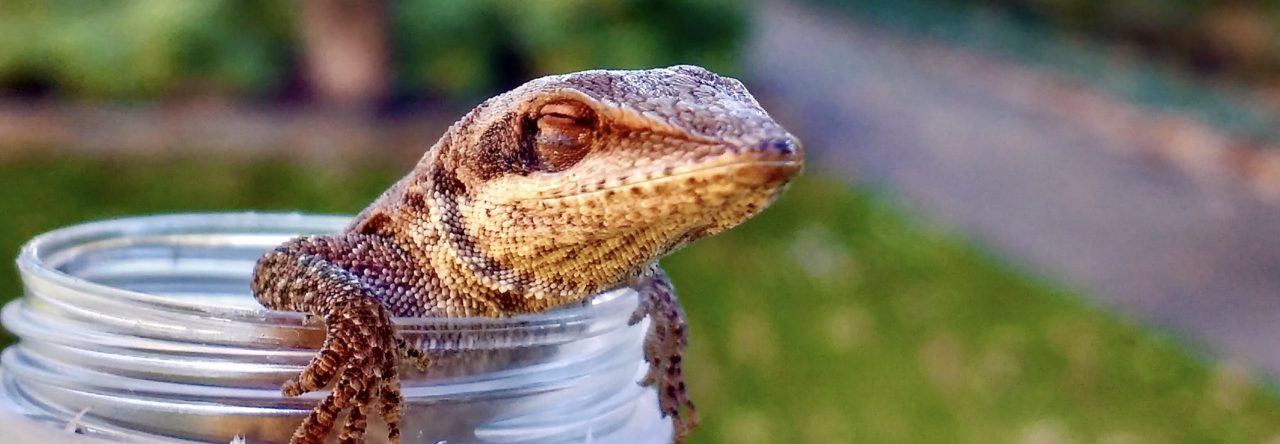
A. carolinensis

Green Anole

Appearance: Anolis carolinensis is a beautiful green lizard, growing to approximately 8 inches in length, including the tail. Males are larger than females and have proportionally larger heads. The dewlap is usually pink (but can also be grayish or greenish), and is much larger in males than in females. Green anoles can undergo dramatic color changes, from bright green to dull olive, brown, and even yellowish. For this reason, many people in Florida call them “chameleons,” although the green anole’s color-changing ability is modest compared to the true chameleons (Chamaeleonidae) of Africa and Madagascar. 

Ecology and Habitat: The green anole’s body shape is that of a trunk-crown ecomorph. But with no other native anoles sharing its range in the southeastern U.S., it historically ranged from the ground to the treetops, making it more of a habitat generalist than Greater Antillean trunk-crown anoles. Today, it shares much of its range with the brown or festive anole (A. sagrei), a Cuban species introduced to Florida around the turn of the 20th century. Many observers believe that the brown anole is driving a decline in green anole populations. This may be true in some places, but another possibility is that green anoles spend more time in the trees where they coexist with brown anoles. In fact, in areas where these two species coexist, the green anole is usually seen on higher perches than the brown anole (which, as a trunk-ground ecomorph, is typically found within a couple of meters of the ground).

Green anoles are active foragers, moving around trees and shrubs in search of prey. They primarily eat insects and spiders, but will also prey on small vertebrates, consume fruit, and even drink nectar from flowers.

Geographic Range and Biogeography: Anolis carolinensis lives throughout the southeastern U.S., from Florida to North Carolina on the Atlantic coast, and west along the Gulf coast through Texas, all the way to the Rio Grande.

Its closest relative is the Cuban trunk-crown species, A. porcatus. Genetic analyses show that the green anole is probably descended from A. porcatus populations from western Cuba, which probably dispersed over water to Florida. The extent of genetic differences between A. porcatus and A. carolinensis suggest that these two species have evolved independently for at least 6 million years, which means that humans played no role in the original colonization of North America by the ancestors of today’s A. carolinensis.

Finally, the green anole itself has become established in many places outside its native range, probably because of its popularity in the pet trade. Today, you can find A. carolinensis in the Pacific (Hawaii, Guam, Palau, and other islands), the Caribbean (Grand Bahama, Anguilla, Grand Cayman), and in southern Japan.

Research Highlights

Anolis carolinensis is a very well-studied species. In a charming 1876 paper titled “The Florida Chameleon,” the Rev. S. Lockwood recounts detailed observations of his pet green anole, a lizard he called “Nolie,” and concludes that the green anole “…is everything that is commendable; clean, inoffensive, pretty, and wonderfully entertaining; provoking harmless mirth, and stirring up in the thinker the profoundest depths of his philosophy.”

Anolis carolinensis, two subadults in a an aggressive interaction, photographed in Florida. (© Day’s Edge Productions)

Since the late 19th century, biologists have learned a great deal about the green anole, and it has become a model organism for studying many aspects of reptile biology, including the regulation of behavior and reproduction by hormones, social behavior and communication, and the biology of regeneration (because, like most anoles, the green anole can lose and re-grow its tail). In 2011, because of its key role in many subdisciplines of biology, the green anole became the first reptile species to have its entire genome sequenced.

A few recent studies are particularly fascinating. Recall that green anoles coexist with invasive brown anoles (A. sagrei) in parts of their range (see Ecology and Habitat above). In a 2014 study, Yoel Stuart, Todd Campbell, and colleagues studied these two species in Florida by introducing brown anoles to a subset of small, manmade islands that were already inhabited by green anoles. They found that not only did green anoles move to higher perches on the islands they shared with brown anoles, but that over a period of 15 years, the green anoles evolved larger toe pads and more toe pad lamellae (both traits associated with better climbing ability). This may be the best evidence yet that competition between anole species can drive their evolutionary diversification.

Green anoles were in the news again after a 2017 study by Shane Campbell-Staton and colleagues. Studying green anoles in Texas, they measured the lizards’ cold tolerance before and after the winter of 2013-2014, when Texas experienced an abnormally cold “polar vortex” event. Their results show that the extreme cold caused natural selection on the anoles, with southerly populations exhibiting greater cold tolerance after the 2014 polar vortex, on average, than before. Campbell-Staton also used cutting-edge genetic techniques to identify some of the genes that may be involved in cold tolerance.

Species account author: Neil Losin

For more information:
Anolis carolinensis at Animal Diversity Web
Anolis carolinensis at Encyclopedia of Life

A. cristatellus

Crested Anole

Appearance: The crested anole, Anolis cristatellus, is a medium sized lizard (50-75mm SVL in adult males) with a stocky body and relatively long limbs. It is light brown in color and both males and females have varying patterns of dark brown on their backs including mottled coloration, hourglass patterns, and longitudinal stripes. As the common name implies, many individuals have a large tail crest (different from the nuchal crest that can be erected in many species), although there is substantial regional variation in this trait and many individuals have no tail fan at all. Dewlap color is typically two-toned with a yellow center and a thick orange outer edge, although some populations have a more monotone yellow-orange dewlap. Females are smaller than males (30-45mm SVL adults) and have relatively small dewlaps. Post-anal scales are not easily visible in this species, sometimes making it difficult to distinguish females from juvenile males. 

Within the native range, this species may be confused with Anolis gundlachi and Anolis cookiAnolis gundlachi can be distinguished from A. cristatellus by the yellow-tipped chin, blue eye, and solid yellow dewlap, but is otherwise similar in size and appearance. Anolis cooki is more difficult to distinguish from A. cristatellus, but the two only co-occur in the dry forests of southern Puerto Rico. In their non-native range in Florida, this species may be confused with Anolis sagrei, which is slightly smaller in size and has a dewlap that is red-orange in the center with a thin band of yellow on the edge. 

A. cristatellus male with large tail crest (left) and without (right). Both are in head-down foraging position.

Ecology and Habitat: The crested anole is a trunk-ground ecomorph. It typically perches relatively low to the ground (around 2m high or lower) on broad diameter trees. It is often observed in foraging position on tree trunks with head downward as it sits and waits for insect prey to pass by on the ground. It typically eats insects and spiders, but is also known to consume fruits and to prey on small vertebrates, including anoles of their own and other species. This species is rarely seen on the ground except for when moving between perches or catching prey. Like other trunk-ground ecomorphs, A. cristatellus, has relatively long limbs and a stocky build ideal for quickly navigating both arboreal and ground habitat. Anolis cristatellus is commonly found at lower elevations in warm forest habitats and is often restricted to edge or open, disturbed forest habitat at cooler, high elevations. This species is the most common and abundant anole in urban areas in Puerto Rico.  

Body size differences are the easiest way to differentiate adult female (left) and male (right) A. cristatellus. (Photo by Kristin Winchell)

Geographic Range and Biogeography: Anolis cristatellus is endemic to the Puerto Rican bank (Puerto Rico and the Virgin Islands). Its closest relative is A. desechensis, which is found only on the island of Desecheo off the west coast of Puerto Rico. It is also closely related to A. scriptus (found in the Turks and Caicos), A. cooki (found in dry forests in the southwest of Puerto Rico), and A. monensis (found on the island of Mona off the coast of Puerto Rico). Genetic analyses indicate that the ancestor to A. cristatellus (and 12 other Puerto Rican species, which make up the “cristatellus” group) likely colonized Puerto Rico from Hispaniola at least 40 MYA. More recently, A. cristatellus has established in several places outside of its native range, facilitated largely by sale of tropical plants. In particular, it is established in Miami (Florida), DominicaCosta Rica, Mexico (Yucatan), Trinidad, Saint Martin, and the Dominican Republic. 

Research Highlights:

 Anolis cristatellus is a great study species for answering so many different questions! As the most wide-ranging Puerto Rican species, it is perfect for comparative studies. Researchers have found no end to the questions they can answer by examining variation within A. cristatellus in different environments and between A. cristatellus and other Puerto Rican species.   

An urban A. cristatellus male perched on a metal fence in Puerto Rico. (Photo by Kristin Winchell)

For example, with populations in cold, wet, montane habitats to hot, dry, coastal habitats and everything in between, A. cristatellus is perfect for comparing how populations vary in physiological tolerances. Because of this, A. cristatellus has played a major role in our understanding of thermal preferences and tolerances. This follows largely from Ray Huey, Paul Hertz, and colleagues’ foundational work in the 1970’s-80’s, which compared thermal preferences and tolerances of A. cristatellus and established that A. cristatellus is a thermoconformer in some habitats and a thermoregulator in others. Recent work on thermal tolerance in A. cristatellus has made great strides in our understanding of thermal physiology of anoles. For example, researchers have found that thermal tolerance in A. cristatellus can rapidly shift in new environments. Manuel Leal and Alex Gunderson found that in Miami A. cristatellus tolerate much cooler temperatures than populations in Puerto Rico, and Shane Campbell-Staton and Kristin Winchell found that urban populations in Puerto Rico tolerate much hotter temperatures than nearby forest populations.  

Male A. cristatellus with dewlap extended.
Male A. cristatellus with dewlap extended. (Photo by Kristin Winchell)

In addition, because they are widespread in disturbed environments in their native and non-native range, they provide a great opportunity to study rapid contemporary adaptation in response to environmental change. For example, Luisa Otero has found that reproductive patterns vary with habitat disturbance over small geographical scales and Joshua Hall found that embryo survival and development is impacted by urban thermal spikes. Urban environments in particular have received substantial attention, with researchers in Miami examining invasion dynamics and artificial night light use, and researchers in Puerto Rico finding shifts in habitat use, morphology, and performance in urban environments.  

Species account author: Kristin Winchell 

For more information:  

Reptile Database: http://reptile-database.reptarium.cz/species?genus=Anolis&species=cristatellus 

Animal Diversity Web: https://animaldiversity.org/accounts/Anolis_cristatellus/ 

Invasive Species Compendium: https://www.cabi.org/isc/datasheet/93810 

A. distichus

Bark Anole

Appearance: Anolis distichus, the bark anole, is a medium sized anole with a body color that varies from gray, to brown, to green – depending on the population. Body coloration is similar in both sexes but females can be distinguished from males by their lack of a dewlap, smaller adult size, and a relatively flatter head than males. Male dewlap color in this species is widely variable with populations ranging from pale white or yellow, to populations with variably sized red or orange spot in the center, to populations with entirely red or orange dewlaps. Bark anoles co-occur with a variety of species, most of which can be easily distinguished as different ecomorphs with larger heads or bodies such as Crown Giant and Trunk Ground anoles, or more slender frames such as of Trunk Crown, Grass Bush and Twig anoles. In Haiti and the Dominican Republic, the range of bark anoles overlaps with those of other closely-related trunk anole species – Anolis brevirostrisAnolis caudalisAnolis marron, and Anolis websteri. These species all have a black spot on their neck, which is lacking in Anolis distichus.

Ecology and Habitat: Anolis distichus are trunk anoles, an ecomorph with a compact body plan – short snout and tail, with a relatively wide midsection. Trunk anoles like Anolis distichus primarily occupy the vertical surfaces of trees, usually below the canopy. They are found in a wide variety of natural habitats including xeric scrub to mesic humid forests as well as human-created habitats like buildings, parks, fruit tree groves, and residential areas. Unlike other ecomorphs that flee up trees or run to the ground when approached, bark anoles often shimmy to the opposite side of the trunk, a behavior commonly referred to as “squirrelling”. Bark anoles will eat nearly any prey that can fit in their mouth but their primary diet includes small arthropods like crickets, beetles, and even bees! Bark anoles are especially fond of ants.   

Geographic Range and Biogeography: Bark anoles are native to Hispaniola (Haiti and the Dominican Republic) and the central Bahamas. Although they were once considered native to Florida, genetic data suggests these populations are the result of multiple introductions from Hispaniola and the Bahamas some of which occurred at least 50 years ago. They are thought to be introduced to Abaco Island in the northern Bahamas, but fossil evidence of this species on Abaco puts the status of this population into question. Phylogenetic evidence finds that bark anoles arose on the northern paleo-island of Hispaniola, dispersed over-water to colonize the the Bahamas, and spread to areas of to the southern Hispaniolan paleo-island after the two paleo-islands fused to form present day Hispaniola. 

The immense variation in body and dewlap color in bark anoles has led to the description of 18 subspecies of Anolis distichus. Research currently underway seeks to understand if these subspecies are in the process of speciation or have perhaps already achieved species status. 

This image has an empty alt attribute; its file name is image-6.png

Research Highlights:  

Bark anoles have long been the intensive research effort with particular interest in using bark anoles to understand 1) the evolution of signals and 2) the process of speciation.  

Most anole species possess and make extensive use of their colorful dewlaps for signaling to each other as well as other species. A series of studies led by Julienne Ng has shown that dewlap color is a heritable genetic trait and is associated with signaling environment that animal occupies. Exciting research, currently underway by Winter Beckles, seeks to understand if bark anole populations shift their dewlap color in response to changes in their light environment caused by hurricanes. 

Julienne Ng has also found that some subspecies with different dewlaps interbreed freely over a wide geographic area. In contrast, other subspecies pairs are confined to a narrow hybrid zone suggesting that, for these subspecies pairs, hybridization may have negative fitness consequences and those populations may be in the process of speciation. Research I performed as part of my dissertation also found that transitions in dewlap color are associated with diversification events suggesting dewlap divergence may play in role in driving or maintaining speciation events.  We also found evidence found that there are more distinct lineages that previously recognized within the Anolis distichus group and one subspecies in particular – Anolis distichus dominicensis is actually three separate lineages. Work I performed with undergraduate researcher (now Yale PhD student) Daniel MacGuigan used multispecies coalescent methods to assess if Anolis distichus represents a single species or multiple species. We found support for at least seven distinct species in the group, but at present we have not updated the taxonomy because the boundaries between these species remain unclear, particularly for the separate lineages of A. distichus dominicensis.  

Species account author: Anthony J. Geneva 

For more information:  

Encyclopedia of Life 

Reptile Database 

A. sagrei

Brown Anole

Appearance: Anolis sagrei may not be the most colorful or strikingly patterned anole, but owing to its widespread distribution and high abundance it may the anole most familiar to you. Adults commonly grow to 7-8 inches from head to tail with females being a few inches smaller than males. Their body color ranges from light tan to gray to dark brown, almost black. Unlike green anoles that can turn brown, these guys are never green! Males have red-orange dewlaps, sometimes with a yellow border or blotches. Females often have a pattern with diamonds, bars, or a stripe running down their back. When in south Florida don’t confuse brown anoles with crested anoles (Anolis cristatellus). Crested anole females only have a cream-colored stripe on their backs, and brown anoles do not have a light ring around the eye or a light stripe above their front limb. Brown anoles often have two dark bars above their eyes.

Ecology and Habitat: The brown anole is a trunk-ground habitat specialist or ecomorph. They are often found on the ground or perching low on tree trunks (up to 1.5 m high). Brown anoles have relatively long limbs for their body size, which allows them to run fast on the ground and tree trunks that they typically occupy. Brown anoles are usually sit-and-wait foragers, keying in on the movement of prey to jump from their perch and attack. Their diet consists of a wide variety of arthropods including most any spiders and insects they can fit in mouths. They will occasionally eat other invertebrates and small vertebrates including their own hatchlings. Brown anoles primarily occupy disturbed and edge habitats in both natural and human-modified landscapes. Their abundances suggest they are just as at home in the city as in natural areas. Like tourists at the beach, these guys love the sun – they are often active during the hottest parts of the day. All anole species display, but brown anoles are the champions – they are often seen fanning their brightly colored dewlaps, and doing head-bobs and push-ups with the intensity and stamina of an Olympic athlete. 

Geographic Range and Biogeography: The native range of the brown anole includes the Bahamas, Belize, Cuba, Cayman Brac, Little Cayman, Swan Island and the Gulf of Mexico/Caribbean coast of Mexico. Its evolutionary origin as part of the 15-species sagrei group is Cuba with multiple colonization events to Caribbean islands east and west of Cuba to round out its native range. One of the best natural colonizers of all anoles, brown anoles are also the undisputed champion of recent human-mediated introductions. Non-native populations are well established around the world including the southeastern United States (e.g. Alabama, Florida, Georgia, Texas), Atlantic islands (e.g. Ascension, Bermuda), Caribbean islands (e.g. Grand Cayman, Grenada, Jamaica, St. Vincent), and Pacific islands (e.g. Hawaii, Taiwan), among other locations with reports of new introductions every year. Genetic analyses reveal multiple origins of these introduced populations from numerous localities in Cuba as well as the Bahamas and Belize. A key discovery about these introductions is that genetic variation from these multiple native-range sources mixes within non-native populations, resulting in increased genetic variation compared to native-range populations.  

Research Highlights: 

If Anolis carolinensis (green anole) is the “lab rat” of the reptile world, then Anolis sagrei is undoubtedly the “field rat.” This species has been studied extensively in the field from populations on small islands in the Bahamas to the heart of the city in Miami. A well-studied natural history, high local abundance, and the ability to tag individuals for unique identification make this species ideal for field studies of natural selection. We have learned that natural selection acts on morphological, physiological and behavioral traits of brown anoles. For example, natural selection favors longer hindlimbs in the presence of terrestrial predators (curly-tailed lizards, Leiocephalus carinatus) and higher optimal performance temperatures in warmer habitats. Other studies show adaptive responses of limbs to local vegetation after being introduced to new islands. A recent study by Oriol Lapiedra and colleagues evaluated whether natural selection acts on variation in risk-taking behavior of brown anoles when they occupy small islands with and without the ground predator Leiocephalus carinatus. Brown anoles that avoided the ground in lab trials were favored in the presence of the predator, whereas more exploratory brown anoles survived better in the absence of the predator. Moreover, selection on behavior and morphology acted independently. This experiment is among the best studies yet showing that natural selection acts on behavior.  

AA post:  https://www.anoleannals.org/2017/06/27/evolution-2017-it-doesnt-pay-to-be-risky-when-predators-are-about/ 

Brown anoles are also a key species in studies of the consequences of global environmental change, including biological invasions, climate change, and urbanization. Recent studies of non-native brown anoles in Miami by Jason Kolbe and his lab discovered that brown anoles living in the city have consistently different personalities compared to their forest counterparts – city lizards are more tolerant of humans, less aggressive, more exploratory in new environments, and bolder after simulated predator attacks. Cities also dramatically alter the ecological niche space occupied by brown anoles. Urban heat islands produce warmer microclimates that allow brown anoles to more often attain their preferred body temperatures during the summer in Miami, likely increasing their ability to persist in some areas. Brown anoles prefer to perch on broad substrates like tree trunks, and urbanization typically results in the removal of smaller trees and the addition of broad diameter artificial structures, such as light posts and utility poles. This leads brown anoles to use broader perches in urban areas despite the fact these artificial substrates are often quite smooth and lizards slip and fall when using them.  

Video:  https://www.anoleannals.org/2016/09/08/lizards-running-and-slipping-in-ultra-slo-mo/ 

For more information:  

Animal Diversity Web: https://animaldiversity.org/accounts/Norops_sagrei/ 

SREL: https://srelherp.uga.edu/lizards/anosag.htm 

The Reptile Database: http://reptile-database.reptarium.cz/species?genus=Anolis&species=sagrei 

Anoles by the Numbers, Part II: Museum of Comparative Zoology

I recently wrote a post on the history of Anolis species descriptions using the Reptile Database (Uetz & Stylianou 2018). This got me thinking, how does my current institution fit into this? I’m currently a grad student in the herp department at the Museum of Comparative Zoology, former home of many anole greats, including Albert Schwartz, Ernest Williams, Skip Lazell, Jonathan Losos (still affiliated but now based at WashU), and many more. And as Jonathan has pointed out previously, it’s home to the greatest number of Anolis specimens of any museum. So I wondered, with such a rich history of anole research, what do our collections look like? How many specimens do we have now? How many species? How has the collection grown over time? So get ready for Anoles by the Numbers Part II: MCZ.

A brief note on methods – all data comes from a spreadsheet I downloaded of all current Anolis specimens in the MCZ from MCZBase (downloaded 2/8/19). For total numbers of specimens per species/subspecies/locality, I simply count records (each record corresponds to a single specimen). For the main summaries of collectors, I treat every collector listed with a specimen as independent, so if someone is listed as the main collector for one specimen but as a “co-collector” for 9 others, they will be summarized as collecting 10 specimens. Due to some formatting issues, a small number of specimens got filtered out (early ones in particular), but I think it’s a pretty good start. I also did a subset of visualizations for the “Top 10 Collectors” – these were defined as the 10 researchers who collected the most specimens overall.

The MCZ was founded in 1859 by Louis Agassiz (more on the history here). The first Anolis specimen collected for the MCZ was an A. carolinensis from Milledgeville, GA collected in 1854 (before the MCZ was founded), but the collector is unknown. I can’t track down much info about that specimen. More Anolis specimens were deposited in 1858 and 1859, and since then, the MCZ Anolis collection has grown to include a total of 52,293 specimens. 44,889 of these have specific info on when they were collected.

So, when were the peak periods of growth for the Anolis collection? Looks like the majority happened in the 1960’s and 1970’s.

These specimens were collected by 886 researchers. Most collected <100 specimens each, but a few collected tons! (That doesn’t include the prodigious researcher we know and love, “et al.” I took them out of the analysis.) Some of these collectors spread their work over a number of years, while some had very concentrated efforts. The top 10 collectors together collected a whopping 21,564 specimens.

And how many species do these specimens represent? In total, the MCZ has 378 species (out of 427 described), so 88% of species diversity! Not too shabby. About half of the species are represented by <10 specimens, but a fair number of them have tens to hundreds of specimens. Eleven species even have more than 1000 specimens each! From highest to lowest, these are: distichus, cybotes, sagrei, cristatellus, roquet, grahami, marmoratus, gundlachi, lineatopus, brevirostris, and pulchellus (they’re not on the plot below because they cause so much skew).

What about type specimens? While we don’t have the type for the genus Anolis (that honor belongs to the North Carolina Museum of Natural Sciences), we do have 146 species holotypes! Their collection follows a similar pattern to general Anolis collection, with a peak in the 60s-70s, but is more scattered throughout the 1900s.

How were all of these specimens geographically distributed? Unsurprisingly, considering the history of research on Caribbean diversification and ecomorphology at the MCZ, 72% of the specimens in the collection came from Caribbean Islands, with 39% from just the Greater Antilles. Central and North American species make up an additional 22%, while South American species make up only 6%. A few specimens came from introduced populations in Guam, Japan, and Micronesia. Hopefully the collection will continue to grow and expand as the field of anole research does too!

I hope you’ve enjoyed this journey through MCZ Anolis history. I’m still relatively new to the field of Anolis biology myself, so if you have any insights or perspectives (or suggestions of other things you’re curious to see with this data), please leave them in the comments!

Meet the Scientist: Ambika Kamath

Ambika Kamath handling an anole in the field. Photo by Claire Dufour.

Where do you work and what do you do?

I currently work at the Miller Institute for Basic Research in Science at the University of California Berkeley as a postdoctoral fellow. I study a diversity of topics in behavioral and evolutionary ecology, including the collective behavior of social spiders and tent caterpillars, the intersections of behavioral ecology with the social sciences, and the socioecological consequences of individual variation in Anolis lizards. Prior to this, I did my Ph.D. in the Department of Organismic and Evolutionary Biology at Harvard University, and was a postdoc at the University of California Santa Barbara.

What aspects of anole biology do you study, and what have you learned?

I study two aspects of Anolis biology—individual variation in habitat use, and individuals’ movement patterns in the context of mating systems, with the goal of building a nuanced understanding the microevolutionary processes of natural and sexual selection in these animals. I have learned that the actual lives of Anolis lizards—their daily ecological and social interactions—are much more dynamic and complex than previously expected. When viewed in the light of well-established patterns of adaptation and diversification across populations and species of anoles, this messiness becomes particularly fascinating—it prompts us to ask what processes govern the emergence of population-level and species-level patterns over longer timescales from organisms’ daily lives.

How and why did you start studying anoles?

I began studying anoles in 2009, as an undergraduate field assistant for Yoel Stuart and Alexis Harrison. I was initially fascinated by the questions about rapid adaptive evolution that could be asked in anoles, but very soon came to love the animals themselves!

What do you love most about studying anoles?

I love watching anoles! I find their behaviour endlessly entertaining, but also tractable enough to study fruitfully. I also love the challenge of catching them. And finally, anole researchers are a fantastic group of scientists, and I feel lucky to be part of the crew.

What is your favorite anole species?

I’d have to say Anolis sagrei. They’re robust, widespread, and really fun to watch.

Where can people learn more about you and follow you online?

I’m on Twitter at @ambikamath, and my website is ambikamath.wordpress.com.

Meet the Scientist: Shane Campbell-Staton

Where do you work and what do you do? 

I live in Los Angeles, CA where I am an Assistant Professor of evolutionary biology at UCLA. I spend most of my time studying how species around the globe evolve and adapt in response to climate change and human disturbance. I use a wide variety of tools in this work, including genetics, physiology and climate modeling. When I’m not researching, I spend time creating and hosting  The Biology of Superheroes Podcast, where my co-host and I nerd out about the science of comic books, movies, TV shows and other science fiction.

What aspects of anole biology do you study, and what have you learned? 

 I study how anoles adapt and acclimate to changes in temperature. Temperature is a universal stress for all life on the planet and can have dramatic impacts on how species live, from how fast they can run to how well the proteins in their cells perform. Reptiles and other cold blooded animals are great to explore thermal biology because they can’t make their own body heat. This means that their behavior and performance are really tightly linked to environmental temperatures. The most surprising thing I’ve learned in my work is just how fast anoles can respond to shifting temperatures. We can see the signatures of this response over very short timeframes in response to extreme weather events and the high temperatures in cities, even within a single year.

How and why did you start studying anoles? 

I grew up in South Carolina, so anoles were some of the first animals I ever interacted with as a child. As a matter of fact, the anole that I studied in graduate school, the green anole, was the very first animal I ever caught as a kid. Most anoles are pretty small, but I think they have a ton of personality. 

What do you love most about studying anoles? 

Anoles seem to find remarkable ways of dealing with environmental change, which makes them very fun to study. They’ve found pretty interesting ways to deal with hurricanes, winter storms, city life and other extreme environments. What most interesting is that we can see how they respond in real-time. This gives us really interesting insights into how life finds its way on our planet despite the many challenges it can be faced with, including us. 

What is your favorite anole species? 

I’m probably the outlier among most anole biologists, because I love the green anole. It’s not a fancy as many other species, but it just has a special place in my heart at a southern boy. Plus, it’s given me great opportunities to learn about evolution and the biological impacts of humans on the planet. 

Where can people learn more about you and follow you online?

You can find information about my work at  https://socgen.ucla.edu/people/shane-campbell-staton/ and on Twitter @Scampbellstaton.

You can also find my podcast - The Biology of Superheroes Podcast - on iTunes, Stitcher or wherever you get your favorite podcasts. 

Rob Pringle

Where do you work and what do you do? 

I’m a biologist and environmental scientist at Princeton University in New Jersey. I lead a research group that tries to understand how the complex web of interactions between different species—including humans—shapes the world around us. My group does a lot of work in Africa, but we also work in the Caribbean, on anoles.

What aspects of anole biology do you study, and what have you learned? 

In 2011, I started a long-term experiment in the Bahamas, aiming to understand how predators influence the ability of different anole species to coexist on islands. We find that in the presence of predators, anoles alter their behavior to reduce their likelihood of being eaten. This can alter the competitive relationships between different anole species—the remarkable ‘niche partitioning’ of anoles, with different species are specialized to live in different parts of the habitat, becomes disrupted. Competition becomes more intense, which can reduce the likelihood of multiple anole species being able to coexist. We are continuing to follow this experiment to learn about both the ecological and evolutionary consequences of introducing predators onto islands. 

How and why did you start studying anoles?

I started studying anoles when I had a pet green anole as a kid in North Carolina. I was particularly interested in figuring out what kinds of foods it would eat, so that I could keep it alive, which I did by experimenting with different insects that I caught outside. I found that my pet anole really liked to eat beetle larvae that I collected from rotting acorns. These days, my lab studies anole diets using a technique known as DNA metabarcoding, wherein we sequence the insect DNA in anole fecal samples and use those DNA sequences to identify the insect species that the anoles have been eating. 

What do you love most about studying anoles? 

What I love most about anoles is that they provide a beautiful opportunity to study some of the most important unsolved mysteries in ecology and evolutionary biology. How does biological diversity arise? How is it maintained? What are the mechanisms by which different species manage to coexist in the same place, despite competition? These questions are relevant to understanding all of life on Earth, and anoles provide a perfect ‘model system’ for studying them using creative experiments in both the field and the laboratory. But they’re also cute and charismatic—and sometimes hilarious—and its hard not to love that. 

What is your favorite anole species? 

Anolis smaragdinus, the Bahamian green anole. Not only is it a stately lizard, it’s also the underdog in our experiment, so I’m always pulling for it to thrive. 

Where can people learn more about you and follow you online? 

Website: https://pringle.princeton.edu — Twitter: @rob_pringle – Instagram: @pringletons 

Melissa Kemp

Where do you work and what do you do?  

I live in Austin, Texas, where I am an Assistant Professor in the Department of Integrative Biology at the University of Texas at Austin. From 2015 – 2018 I was a postdoctoral fellow at Harvard University, and I received my PhD in Biology from Stanford University in 2015. 

What aspects of anole biology do you study, and what have you learned? 

I am broadly interested in using the fossil record to understand how species are impacted by past instances of environmental perturbations, such as climate change, seal-level fluctuations, and human colonization. By understanding how different organisms responded to environmental change, I can make predictions about which species may thrive and which species may be threatened under current and future instances of environmental change.  

I apply this broad framework to ancient lizard communities in the Caribbean, where anoles are key players. I’ve learned that compared to other lizard species that also occur in the Caribbean, like the curly-tails (Leiocephalus), anoles are very resilient when facing environmental changes. They have a significantly lower rate of extinction than other Caribbean lizards, and I have documented cases where their abundances increase substantially after the extinction of other lizard species in their community. I have also learned that the distributional ranges of different anole species have changed over time, and I am in the process of determining if those range shifts coincide with changes in the environment, such as forest cover. 

To accomplish this, I spend a lot of time in the field and in museum collections. I conduct paleontological excavations in search of new fossil deposits on islands such as Puerto Rico and Marie-Galante (a small overseas French territory in the Lesser Antilles). These fossils are pretty young by paleontological standards (typically 30,000 years old or younger) but they are great for the Caribbean, where fossil deposits are rare due to the hot, humid, weather that prevents fossil preservation. What is also great about this time period is that the environmental changes that took place more closely reflect ongoing environmental changes, and many of these sites document the arrival of indigenous and European human populations into the Caribbean, so we can see what communities looked like before humans arrived and also afterwards. In the museum, I use previously collected modern specimens of anoles to help identify the fossils I find in the field, and I also utilize previously collected fossils from different paleontological site in order to compare ecological and evolutionary patterns across space and time. 

How and why did you start studying anoles? 

Although I had known that I wanted to be a researcher for quite some time growing up, I never thought that I would be studying anoles! I came into graduate school with a background in paleontology, phylogeography, and island biogeography. I had experience with herps (amphibians and reptiles), but I did not consider myself a herpetologist. All I really wanted to do was synthesize my passions for paleontology and conservation with my interests in molecular biology and evolutionary ecology. Right before I started graduate school at Stanford, Dr. Joan Roughgarden gave my PhD advisor some anole paleontological samples. Because of my interests and background, we though that these materials would be perfect for addressing the research questions that I wanted to tackle, and boy were we right! Additionally, those materials opened my eyes to a whole new world of research that I had not encountered before.   

What do you love most about studying anoles? 

I love that anoles are amenable to studying a diversity of biological questions! Anole research runs the gamut from behavioral, physiological, phylogenetic, developmental, genomic, to ecological and beyond. As a result, there is a rich literature on anoles that helps to contextualize the research that people like me want to do. Despite all of this knowledge, there is still so much that we don’t know, too. Anoles are also very charismatic to watch in the field and the people who study anoles are a great group. It helps to be in a supportive, intellectually diverse, and curious research community. The anole research community, which spans the globe, is that and more! 

What is your favorite anole species? 

This is a tough question because there are so many anoles out there! I spent a lot of time working on anoles in the Lesser Antilles and I think that they are particularly enigmatic and don’t always get the attention that they deserve. The most beautiful species that I have ever seen in person is Anolis marmoratus, a species only found on the island of Guadeloupe. There are different color morphs on different parts of the island.   

Where can people learn more about you and follow you online? 

Twitter: @Melisabetta

Website: www.melissakemp.com

Manuel Leal

Where do you work and what do you do? 

I am Boricua, and currently an Associate Professor in the Division of Biological Sciences at University of Missouri, Columbia. I have been extremely fortunate to have had the opportunity to work with many talented undergraduate and graduate students that have joined my lab ( Chipojo Lab) and helped me study anoles across the Caribbean. I also had amazing mentors (Richard Thomas, Javier Rodrígues-Robez, Jonathan B. Losos, and Leo J. Fleishman), all willing (may be my stubbornness contributed to their will) to take a risk and allow me to explore ideas regardless of how little sense they made at the time.

What aspects of anole biology do you study, and what have you learned?

As a natural historian, I have established an integrative research program that reflects my interest in developing an intimate understanding of the behavior, ecology, and physiology of anoles under natural conditions, with the ultimate goal of elucidating evolutionary processes. I encourage all members of my lab to follow a similar approach. 

Over 30+ years of studying anoles in their natural habitats, I have learned two fundamental lessons: expect the unexpected and that there is no such a thing as “a stupid question” when the question is derived from observations made in nature. Following this approach, my lab has been able to reveal some unexpected behaviors in anoles, including displaying to predators to deter an attack; finding their way home from distances several order of magnitudes larger than the size of their territories. If that was not unexpected, who would have predicted that anoles would be able to solve novel problems similar to those solved by birds and mammals. Or that anoles would be capable of modulating the properties of their signals to compensate for variation in the distance to potential receivers under the complex conditions of a tropical forest. 

Finally, it is impossible to work with anoles and fail to recognize the incredible diversity of dewlap coloration found in the genus. I’ve been lucky enough, with a few of my colleagues, to provide a potential explanation for this diversity by demonstrating experimentally that dewlap spectral properties (i.e., coloration) are shaped by selection favoring detection by conspecifics under the specific light conditions of the micro-habitat most commonly used by the species. Furthermore, we have shown that selection can favor changes in morphological and physiological traits over ecological time-scale.  

How and why did you start studying anoles?

Growing up in Puerto Rico my interests in the natural history of anoles began during my childhood. I remember vividly catching anoles around my house, and holding them with a noose made out of the stem of grass tied around their waist. I would then place the anoles in close proximity to observe how they displayed to each other. At the time I had no idea how many species of anoles were found in Puerto Rico. However, I learned that if I held two lizards that had similar appearance close together, they usually would display and even fight. Yet, if I did the same with a “brown one” (A. cristatellus) and a “yellow one” (A. pulchellus), they rarely fought. Little did I know that these early observations would come full circle when I was an undergraduate at University of Puerto Rico, Río Piedras, working in the laboratory of Richard Thomas. In Richard’s lab I met Javier Rodríguez-Robles, who was working on the feeding behavior of the snake Alsophis portoricencesis. Javier invited me to help him with his research, and while doing so, I observed that anoles also displayed to snakes. This observation became the foundation for my graduate research as I pursued both MS and Ph.D. degrees.      

What do you love most about studying anoles?

There is plenty to like about working with anoles. First and foremost is the ability to study them under natural conditions. Many species can be relatively easy to study in the field, allowing one to ask and answer questions under conditions relevant to their biology. A close second is the diversity found in this group, which provides a unique opportunity to study questions at multiple levels (i.e., the individual, population, and community). Finally, anoles are naturally charismatic creatures, which is great for my other passion-photography and science outreach. I find it incredibly rewarding to bring an anole to a classroom of kids or to share my photos and videos of lizards and to see the interests they spark in the kids. It’s even more rewarding when I overhear someone exclaim “what amazing and intriguing behaviors those little lizards have!”   

What is your favorite anole species?

I don’t have a favorite anole species. Instead, I have a favorite anole genus — Chamaeleolis, which is endemic to Cuba. Cubans commonly refer to members of this genus as “Chipojo bobo” due to their sluggish appearance. As a kid my Dad told me stories of a big gray arboreal lizard, with a disproportionally big head and that walks very slowly. He called them “chipojos” and lamented the fact that they were not found in Puerto Rico. It is not a coincidence that my lab is known as the Chipojo Lab, a name that recognizes the Cuban roots of my family and also reflects my favorite group of anoles. I was very lucky that I was able to study the behavior of two species of Chipojo bobo, C. barbatus and C. porcus, as part of fieldwork that I did in Cuba in 1997 and 1999. It should be noted that Chipojo bobos are greatly understudied, with only a handful of studies describing their natural history.   

Where can people learn more about you and follow you online?

Website: Chipojo Lab

Blog:  Chipojolab Blog

Page 55 of 304

Powered by WordPress & Theme by Anders Norén