Cranial Ornamentation in Anolis baleatus

When I first encountered Anolis baleatus, this Hispaniolan crown-giant was mostly an inconvenience. At the time I was gathering data for my doctoral thesis by cycling preserved anoles through a µCT-scanner. Most of the adult specimens of A. baleatus were just too large to easily fit into the scan chamber, so it took a lot of patience and creativity to acquire any decent images of the appendicular girdles, which are the body parts I was interested in.

During that process I also acquired radiographic images of the head skeleton, and found unusual patterns of crenulation in this species. The cranium of Anolis baleatus displays a great degree of seemingly asymmetrical (or at least somewhat irregular) ornamentation across its dorsal surface. This is especially pronounced on the prefrontal and frontal bones, and completely obscures all superficial distinction between them in adult lizards. In adults, cranial ornamentation is also borne by the paired nasals, maxillae, and postorbitals, and the parietal (see figure).

Both Steven Poe (1998) and Susan Evans (2008) mentioned this ossified garnish, but a thorough account of their variation among anoles remains absent from the primary literature. Richard Etheridge and Kevin de Queiroz (1988) were probably the first to report on skull ornaments in anoles (as part of a discussion of several iguanian lizards with similar cranial adornments), and remarked that the distribution patterns of dermal rugae may reflect those of the topographically associated epidermal scales.

Overall, this ornamentation appears to be relatively uncommon among anoles, especially to the degree expressed in Anolis baleatus (and several other crown-giant ecomorph anoles). Considering the osteologically robust appearance of crown-giants, even at early stages of ontogenetic development, this gives rise to questions regarding the development of these ornamental patterns. Thanks to the collection efforts of Luke Mahler (University of Toronto), and a postdoctoral position in his lab, I was able to acquire CT-image data representing an ontogenetic series of this species, ranging from very young juveniles to skeletally mature adults.

While parts of the paired frontals of juveniles are covered in modest eminences, prominent cranial ornamentation is absent from small specimens (see figure). Likely, growth of these ornaments begins very late during ontogenetic development. Ornaments on the prefrontals and parietal are only evident in specimens that, to the best of our judgement, are approaching sexual maturity. We looked at fifteen specimens per sex, representing a range of juvenile and subadult sizes, and this general pattern is consistent throughout the image data. Schwartz (1974) inferred that anoles in the ricordii group reach sexual maturity between 100 and 110 mm snout-vent length (SVL), and we observed the first prominent ornaments at sizes between 90 and 95 mm SVL. Assuming that differences in size directly represent ontogenetic growth, these findings imply that Anolis baleatus starts to grow elaborate ornamentation as it approaches sexual maturity, and that expansion and growth of these ornaments then continues into skeletal maturity. Interestingly, both males and females appear to develop them at roughly the same body size.

The function and evolutionary cause of these structures remain unknown, and these are questions we are currently investigating. Body size is an important correlate for the occurrence of cranial ornaments, but these structures may also conceivably play roles in defense, feeding, or intraspecific agonistic interactions. Stay tuned!

Videos

A. baleatus, female, 55 mm SVL
A. baleatus, female, 65 mm SVL
A. baleatus, female, 96 mm SVL
A. baleatus, female, 126 mm SVL

References

Etheridge, R. & de Queiroz, K. (1988): A phylogeny of Iguanidae.─ [In:] Estes, R.D. & Pregill, G.K. (eds.): Phylogenetic Relationships of the Lizard Families: Essays Commemorating Charles L Camp, 283-367; Stanford: Stanford University Press.

Evans, S. (2008): The skull of lizards and tuatara.─ [In:] Gans, C., Gaunt, A.S. & Adler, K. (eds.), Biology of the Reptilia, vol. 20:1-347; Society for the Study of Amphibians and Reptiles, Ithaca, New York.

Poe, S. (1998): Skull characters and the cladistic relationships of the Hispaniolan dwarf twig Anolis.─ Herpetological Monographs, 12:192-236; The Herpetologists’ League.

Schwartz, A. (1974): An analysis of variation in the Hispaniolan giant anole, Anolis ricordi Dumeril and Bibron.─ Bull. Mus. Comp. Zool., 146:89-146.

Anoles and Drones, a Dispatch from Island Biology 2019

Emma Higgins presenting her work at Island Biology 2019

The third meeting of the nascent Society for Island Biology took place recently in stunning La Reunion in the western Indian Ocean. Conference goers were treated to a wonderful venue at the Université de La Réunion in St. Denis, whose campus looks out down the gentle slope to the open sea. Four hundred attendees from around the world reinforced what we already knew— that island biology as a study attracts a large number of researchers from very diverse fields of study. The conference organizers also are leading the way on making our meetings in remote locations more responsible; using live streaming of the sessions meant that some interested scientists could skip the travel and stay home to watch the sessions. But the real asset was that the organizers calculated the air travel carbon footprint for all attendees, finding that ~30 hectares of forest would need to be planted to offset the carbon emissions. Happily, that is exactly what they did! The conference organizers and hosts, in partnership with communities and other organizations, committed to reforesting exactly that amount in La Réunion and Mauritius.

OK, now on to the anoles! Well, given the remoteness of the meeting location (nearly the antipode of the Caribbean*) perhaps it is not too surprising that few anologists attended. But I am happy to report that Emma Higgins did, and gave an excellent presentation on her work with anoles on the island of Utila, one of the Honduran Bay Islands.

Emma is a 3rd year PhD student in Adam Algar’s lab at the University of Nottingham, where her thesis is focused on using emerging technology to study lizard thermal biology under changing conditions (think development, climate change, and species introductions). When I say using emerging technology, I mean using #allthetech; Emma uses 3D printing, drones fitted with thermal cameras, Sentinel satellites, and LIDAR to generate her data! Her motivation follows from asking what factors control the abundance, distribution, and microhabitat of anoles on Utila, and whether these variables might be better estimated at extremely fine scales using emerging technology.

A bit of background, there are four species of anoles on Utila, including the endemics A. bicaorum and A. utilensis. An additional native species is A. sericeus, which also occurs elsewhere in the Bay Islands as well as on the mainland. The fourth species is everyone’s favorite— A. sagrei! Utila has experienced a surge of development in the last 10 years, with new roads and development going up faster than conservationists can keep track of. This is a major threat to the island wildlife, which includes an endemic iguana known as The Swamper (Ctenosaura bakeri) which favors the dwindling mangrove forests.

Emma’s work involves collecting data both at anole-level as well as above the canopy. She uses a DJI Phantom 4 drone platform fitted with a near-infrared camera to estimate a normalized difference vegetation index (NDVI, a measure of “greenness”) of the forest canopy across habitats, and found that just NDVI explains 28% of the spatial heterogeneity of lizard operative temperatures (in a mixed-model framework). This suggests that her drone can identify suitable thermal environments for lizards from above the canopy. I should mention that her resolution here is 4cm/pixel! She plans to zoom out to space and test whether similar imagery from the Sentinel 2 satellite will also be useful.  Below the canopy, Emma is using LIDAR to simultaneously conduct forest shade modeling (for super fine-scale temporal variation in thermal microhabitat). LIDAR also detects perch availability, as it detects tree trunks very well. Emma also uses 3D printing to produce hundreds of anole models, each fitted with an iButton® temperature recorder and placed on perches in the forest. Each lizard print takes 52 minutes, so Emma ended up taking the printer to her flat to print 24/7 in preparation for her field season!

I should mention that Emma was joined at the conference by two other excellent scientists— lab mate Vanessa Cutts and fellow Utila lizard biologist Daisy Maryon, both of whom won awards for their posters at the conference!

Stay tuned for the announcement for the 2022 Island Biology meeting, to be held on either Mallorca in the Balearic Islands or Wellington, New Zealand. Also stay tuned for Emma’s results; we look forward to hearing more about her work!

Climate Change Will Lead to Negative Effects on Population Dynamics of an Amazonian Anole

Climate change is negatively affecting Squamates all over the world, and the perspectives for the next 50 years are worrisome. Although more than 200 studies were published in the last 20 years on this subject, only 23 present some information on Anoles, and none of them focused on population dynamics – until now. In the most recent issue of Comparative Biochemistry and Physiology Part A: Molecular & Integrative Physiology, Diele-Viegas et al. evaluated the possible effects of climate change on two populations of three species of lizards from the Brazilian Amazonia, including Norops fuscoauratus.

The idea of this research came from the first author, Dr. Luisa, during her PhD classes back in 2017. She was taking classes on population ecology and had the idea of to combine environmental thermal adequacy with the b-d model, which considers survival and reproductive rates to calculate population dynamics andevaluate the impact of climate change on population dynamics of her study objects, Amazonian lizards. She thus started to search in the literature for articles that focused on something like what she was thinking, and discovered that this had not been done before, at least not for squamate reptiles. She also noticed that data on Amazonian lizards’ life history is very scarce on literature, which could be a deterrent to her getting the job done. After speaking with her advisors (Dr. Fred Rocha and Dr. Fernanda Werneck), Luisa decided to estimate a tolerance index considering the relationship between the upper temperature limit of the animal activity restriction and the environmental temperature of the microhabitat in which this animal occurs and used this index as an approximation of the populations’ survival rates. This allowed her and her advisors (both coauthors of this article) to circumvent the data scarcity and put Luisa’s idea into practice, leading to the publication of this article.

Considering the tolerance index mentioned, the authors predicted that Norops fuscoauratus is likely to became locally extinct at one of the evaluated sites, Reserva Ducke, which is an almost urban reserve in the Amazonian heart. The hatchlings’ tolerance to environmental change was considered the most sensitive vital trait evaluated, highlighting the species’ vulnerability. Also, considering that the response to selection is likely to be too slow in anoles, an evolutionary change in N. fuscoauratus is unlikely to occur considering current rates of environmental change, which reinforces the species’ vulnerability at local scale. This study represents the first effort to evaluate population sensitivity to climate change among reptiles. The authors highlight the need for new studies focusing on this subject to provide theoretical and empirical basis for biologically informed conservation strategies and actions to avoid the extinction of several species around the world. Also, Luisa highlights that, as scientists, we should always value our ideas – our curiosity is the fuel that moves science into progress.

Blowfly Parasitism of a South American Anole

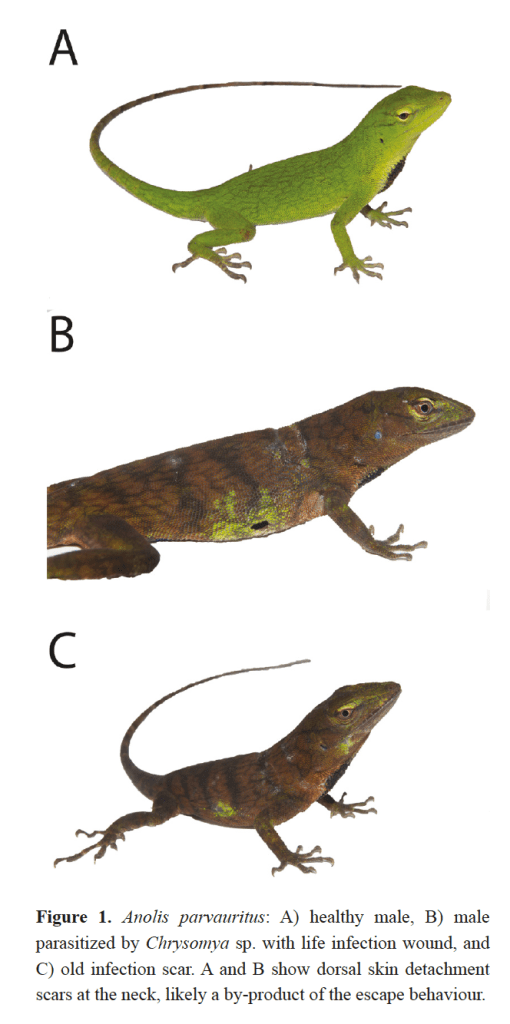
We’ve had previous posts on parasites of anoles (for example, here), but now a new paper in Herpetology Notes adds to the literature on this topic, reporting blowfly parasitism of Anolis parvauritus from northwest Ecuador.

Visualising the 3D Surface Structure of Lizard Skin

Imaging the surface topography of lizard skin using gel-based stereo-profilometry.
(Baeckens et al. 2019)

The skin surface structure of lizards varies greatly among species, likely because it plays a key role in a range of tasks, such as camouflage, locomotion, self-cleaning, mitigation of water loss and protection from physical damage. Yet, we still know remarkably little about how variation in skin surface structure translates to functional variation. Part of this gap in our understanding can be traced back to the lack of means to perform high-throughput and detailed analysis of the 3D anatomy of lizard skin in a non-destructive manner.

To tackle this hiatus, I was fortunate enough to be able to round up a great team of scientists and to start exploring the possibilities of a new imaging technique, termed gel-based stereo-profilometry. In this approach, a deformable transparent gel pad with one opaque surface is pressed onto the object of interest, creating a surface impression. While the gel pad is still in contact with the object, a series of photographs from six different illumination angles are acquired, and a topographical 3D map of the surface is created by merging the acquired images using
specialized surface analysis software.

Using this technique, we successfully imaged the 3D skin surface structure of Anolis cristatellus specimens in great detail (pixel resolution of 0.86 µm) and in a short-time frame (average acquisition time of imaging and digital reconstruction combined was 90 seconds). In our new paper, we demonstrate that this technique is exceptionally useful for the rapid 3D structural characterisation of lizard skin surfaces without any specimen preparation, permitting 3D visualization in situ and even in vivo. This technique opens exciting new avenues for investigating structure–function relationships in lizard skin.

In addition to the ability to quantify the micro- and macro-structural details of lizard skin, the 3D data sets acquired using gel-based stereo-profilometry can be directly converted into surface meshes, which can in turn be 3D printed. These tangible models can then be directly employed for studies to investigate the role of scale geometry on animal–substrate interactions, or enlarged for educational purposes to illustrate key differences between different squamate taxa.

3D print of lizard skin.

Baeckens S, Wainwright DK, Weaver JC, Irschick DJ & Losos JB (2019) Ontogenetic scaling patterns of lizard skin surface structure as revealed by gel‐based stereo‐profilometry. Journal of Anatomy 235, 346–356.

Anolis Lizards Are Breaking the Rules

Anolis bartschi. Photo credit: Shea M. Lambert

Transposable elements are DNA sequences that move around in the genome. Do they also play any roles in evolution and development? I answered this question by looking at our favourite group of animals – lizards – and found some surprising answers. My most recent paper in Evolution Letters is the last of a trilogy of papers – one, two, and three – that reveal that Anolis lizards, by breaking the rules, allow us to link TEs to speciation and evolvability.

Mobile DNA sequences – transposable elements or TEs for short – are found in the genome of virtually all organisms. As their name implies, TEs can cut or copy themselves from one location in the genome to another. This can wreak havoc as insertion of TEs may interfere with gene regulation or in fact knock out entire genes. Cells therefore have mechanisms that prevent TEs from jumping, including DNA methylation and other epigenetic tools. Thus, TEs are not roaming freely through the genome, but are restricted from entering functionally important parts. Preventing TE invasion is particularly important when genes are regulated through spatial proximity to each other. The textbook example of this situation are the Hox genes, which are the key players in embryonic development with an ingenious mode of action: Hox genes are arranged in tight clusters and their position in the cluster defines their time and space of expression, and thus their effect on the patterning of the early embryo. It is therefore fitting that Hox gene clusters of mammals and other well-studied vertebrates have been found to be almost completely free of TEs. My new study reveals that Anolis lizards have broken this paradigm. Moreover, the invasion of TEs into Hox clusters of Anolis lizards can be linked to aberrant gene expression and increased rates of speciation.

Ever since the discovery of TEs, people have speculated about their evolutionary implications. One possible consequence of high TE activity is structural genomic variation. This may accelerate genomic incompatibility between populations, effectively making TEs engines of speciation.

Occasionally, TE insertions may also generate phenotypic novelty. As noted above, some genes are regulated through their proximity to other genes, which means that invasion of TEs can change expression of a number of genes simultaneously. Furthermore, since jumping TEs often drag along neighbouring genomic regions, they can translocate regulatory sequences that cause genes to be expressed in new cell types or at different stages in development. 

While these are good reasons to expect TEs to promote evolution, examples are few and their role often appears idiosyncratic. An excellent group for a more systematic survey of TE-driven diversification is squamate reptiles, a group that includes lizards and snakes. Squamate genomes do not only appear particularly rich and variable in TEs, but their body plan is also highly malleable. Illustrative examples include the adaptive radiation of Anolis lizards and the repeated evolution of limbless and elongated bodies.

I decided to study how TEs have shaped the genomes, and in particular, the Hox clusters, of squamates. My first surprise was to discover that lizards possess more Hox genes than all other tetrapods since they retained some genes that other lineages have ditched. The second surprise came when I looked at the TE content of Hox clusters. Despite the high TE content in their genomes, squamates follow other vertebrates in generally protecting their Hox clusters from TEs. But there was one exception: I found massive invasion of TEs in the Hox clusters of two out of three Anolis species, with TE contents almost as high as the average place in the genome.

The relationship between TE content in Hox clusters relative to genome-wide TE content in squamate reptiles. All lizards and snakes restrict TEs from their Hox clusters down to roughly half the genome-wide average. However, two Anolis species show Hox clusters that are invaded by TEs, while a third Anolis species (black circle) follows the general trend.

Why in Anolis? Anolis lizards are famous in evolutionary biology due to their adaptive morphological radiation involving high rates of speciation – amassing close to 400 species. In a previous study (explained in a previous Anole Annals post) I showed that Anolis lineages with more speciation events in the past have more TEs in their Hox clusters. My new genome-wide study reveals that this signature of speciation is indeed pronounced in Hox clusters: only the two Anolis species from amply speciating lineages exhibit unusually TE-rich Hox clusters, while a third species (Anolis auratus, black circle in figure above) follows the norm and keeps its Hox clusters relatively free from TEs. Looking in detail at genome-wide TE landscapes of these three Anolis species, I discovered that the two species with TE-rich Hox clusters had a larger population of young, more active TEs in their genomes. In addition, the inferred timing of peak activity of these TEs broadly coincided with past speciation events.

These results suggest that – during speciation events – TEs are unusually active and proliferate throughout the genome. As a result, even crucial regions such as Hox clusters become invaded. Subsequently, TEs are removed from Hox clusters by selection until a ‘healthy equilibrium’ of TE content relative to the genome-wide TE content is reached. This equilibrium appears highly conserved as the Hox clusters of almost all lizards and snakes contain close to 50% of the global TE content. This proposed model generates a number of predictions that can be tested with genomic data from lineages with variable rates of speciation.

How then do some Anolis species cope with having their Hox clusters invaded by TEs? Clearly, the inflation of Hox clusters – increasing the distance between genes – does not disrupt the patterning of the early embryo. Genes located at one end of the cluster remain expressed early in the head of the embryo, while genes located at the other end are expressed late in the tail. However, the successive activation of Hox genes predicts that disruption, if occurring at all, should be most pronounced towards the end of the Hox clusters. I found that this indeed is the case: one out of four Hox13 genes showed aberrant expression in the two Anolis species with TE invaded Hox clusters, but this gene was expressed as ‘normal’ in other Anolis and more distantly related lizards.

Expression patterns of the posterior Hox gene HoxD13 are showing variation between species with low and high TE content in their Hox cluster: while expression in limb buds is conserved, expression in tail tissue (black arrows) is missing in species with high TE content in their Hox clusters (A. sagrei and A. carolinensis).

My study reveals that, despite being THE textbook example of our conserved developmental toolkit, Hox genes can be tinkered with. What is more, the TE invasions of Hox clusters appear to be intimately linked to diversification. Now that Anolis lizards have shown us that it can happen, perhaps they can also show us why it happens and how.

The original version of this blog post was published on the Evolution Letters Editors’ Blog.

References:

Feiner N. 2019 Evolutionary lability in Hox cluster structure and gene expression in Anolis lizards. Evol Letters. https://doi.org/10.1002/evl3.131

Feiner N. & Wood N.J. 2019 Lizards possess the most complete tetrapod Hox gene repertoire despite  pervasive structural changes in Hox clusters. Evolution & Development. 2019;21:218–228 https://doi.org/10.1111/ede.12300

Feiner N. 2016 Accumulation of transposable elements in Hox gene clusters during adaptive radiation of Anolis lizards. Proc. R. Soc. B 283: 20161555. http://dx.doi.org/10.1098/rspb.2016.1555

Drastic Skin Peeling in Anoles

When you hear about a spa, you visualize a relaxing place where soft skin peeling is commonly practiced. Even if the place is human-specific, skin peeling itself has been recorded in the “animal world,” and in a way that goes beyond your imagination.  

Indeed, some species of scincid and gekkonid lizards are known to lose a part of their skin during drastic regional integumentary loss (Bauer et al., 1989, 1992a, 1993; Bauer & Russell, 1992). Such loss is dependent on the bilayering of the dermis and the inherent weakness of the outer layers of the skin and is used as an antipredator strategy (such as the tail autotomy), particularly during the early stages of subjugation by the predator (Bauer et al., 1989, 1992, 1993; Bauer & Russell, 1992). Nonetheless, this practice has severe costs related to radiation exposure (particularly in diurnal species), osmoregulation and immunological integrity (Bauer & Russell, 1992).    

Back to the Caribbean island of Dominica the past month, I sampled populations of Anolis cristatellus. During the routine measurement process on a big male, I was surprised to see that the lizard lost his entire skin as soon as I touched him, the muscle being nearly apparent (Fig. 1). I measured more than 2.000 anoles, and this guy was the first one to lose his skin in my hands. Did I sample a very special individual? The response is probably “no.” Within the same day, this regional integumentary loss occurred in two adult males and one adult female A. cristatellus in total. To my knowledge, such a skin loss was not observed in anoles before. Could it be an underestimated antipredator strategy in Anolis?  If yes, could it be different on island vs mainland species as suggested Bauer & Russell (1992) in gekkonid lizards? The anole world has not finished to surprise us! 

References:

Bauer, A.M.; Russell, A.P.; Shadwick, R.E. 1989. Mechanical properties and morphological correlates of fragile skin in gekkonid lizards. J. Exp. Biol. 145(79-102)

Bauer, A.M.; Russell, A.P.; Shadwick, R.E. 1992. Skin mechanics and morphology in Sphaerodactylus roosevelti (Reptilia: Gekkonidae). Herpetologica. 48(124-133)

Bauer, A.M.; Russell, A.P. 1992. The evolutionary significance of regional integumentary loss in island geckos: a complement to caudal autotomy. 4(343-358).

Bauer, A.M.; Russell, A.P.; Shadwick, R.E. 1993. Skin mechanics and morphology of two species of Pachydactylus (Reptilia: Gekkonidae). S. Afr. Tydskr Dierk. 28(192-197)

Best Journal Cover Ever?

Congrats to Jon Suh for this fabulous photo of Anolis grahami, native to Jamaica but introduced to Bermuda. It highlights the paper on ecological interactions among introduced anoles of Bermuda by Stroud et al.

How the Native Anole of Dominica Has Coped with an Invasive Anole and a Hurricane

Dominica Geographic filed this report on Claire Dufour’s research on Anolis oculatus, which we have reported on previously.

Is the Zandoli Getting Stronger?

July 25, 2019 / No Comments

Dominica tree lizard

Dr. Claire Dufour is an ecologist and evolutionary biologist; a postdoctoral fellow of Harvard University, and currently a postdoctoral fellow and teacher at the University of Montpellier, in France. Claire is interested in the dynamic interactions between sister species and their environment. Her focus is on environmental pressures – such as competing or invasive species – on the evolution of ecological, morphological, and behavioural traits of animals such as insects, mammals and reptiles. This work has led her to take a scientific interest in the two competing species of anole (tree lizards) here in Dominica; one of which is the endemic zandoli (Anolis oculatus), the other, the invasive Puerto Rican anole (Anolis cristatellus).

The endemic zandoli

For a number of years, Claire has been studying the co-existence of these two species in Dominica, how they react and behave towards each other, and how co-existing and dealing with extreme weather events such as hurricane Maria have affected behaviour and physical morphology. Her research has suggested a number of interesting outcomes that will require further study.

When the invasive species of anole arrived in the port area around Woodbridge Bay several years ago, its spread around the island was rapid, but it followed a pattern; namely the coastal road system. Claire and other scientists, such as Jacqui Eales who first recorded and studied the invasive species (see Dominica Traveller, second edition), speculate that this movement was probably caused by transportation in vehicles. The invasive anole hitched rides and occupied predominantly a coastal territory (and still does), whereas the endemic zandoli was also present in the interior where it had developed and spread over many, many years. At first, the relationship was feared to be antagonistic in nature, with the native zandoli coming under threat. Claire believes this has now changed and that the two species have settled into a form of coexistence. Moreover, she believes that the native zandoli is now doing better and is, in fact, probably the dominant species.

tree lizard Dominica

In order to study anoles, many environmental and morphological attributes are noted and recorded, most of which are too detailed and complex to get into here, but examples include: the location of the tree (or other structure) that the anole is inhabiting; where specifically on the tree the anole likes to hang out (trunk, branches, higher canopy, etc.); any behavioural characteristics (for example towards other anoles); and the physical attributes of the anole itself (size, weight, colour, etc.). A further experiment has been carried out to record behavioural characteristics that involves the innovative use of mimetic robots that are designed to represent both anole species. Claire presents the robots to the lizards and records their behaviour towards specific actions and signals that she is able to control remotely and unobtrusively.

Claire’s research has resulted in many interesting findings, one of which recently made headlines in the scientific community. Claire discovered that, with regard to the anoles she measured and recorded after hurricane Maria, their ability to grip with their toepads had increased by a factor of ten compared to her pre-hurricane tests. In concluding her work this year, Claire says that this attribute appears to have not only continued but has actually increased.

The likely, though unproven, explanation is that the anoles that survived the hurricane by clinging onto trees perhaps already had a strong grip compared to those that perished, and that they may have passed on this genetic trait as part of their morphological evolution. Further studies are needed and Dominica Geographic will follow Claire’s work.

Dominica is a draw for scientific researchers such as Claire because of its relatively unspoilt natural environment, its isolation as an island (it could be viewed as a very large laboratory), and its regionally and locally endemic species. One of the first things that Claire does when she comes here for her field work is engage with local people to get their views of what they have noticed about the two species of anole. Anecdotal evidence provided by local people is often an important foundation for further field research.

Invasive or local ? Can you tell the difference ?

If you are interested in recording anoles or any other aspect of natural science in Dominica, here is one fun way to get started. Download the iNaturalist app to your smartphone and start photographing and recording the plants, flowers, birds and other critters you see when you are out walking (yes, you have to get out and explore !). Think about becoming a Dominica ‘citizen scientist’ and helping to record information about the island’s natural environment, and sharing your findings with the world.

Dominica ought to be producing more of its own scientists; encouraging, educating, and financially supporting young people with the interest and the potential. Many visiting researchers are very open to engaging and sharing their work with local people but often find it difficult to do so. More could be done to provide them with the facilities they need (classroom, lab, accommodation and so on); facilities that could also be used by a home-grown scientific community.

If You Thought that Brown Anoles Bully Green Anoles, You Were Right

Interactions between native Anolis carolinensis (green anoles) and invasive Anolis sagrei (brown anoles) in the United States are discussed often here on Anole Annals. Most recently, this blog featured a local news broadcast from Louisiana and newspaper article from Florida, both of which describe a pattern that is repeated across the southern United States: When brown anoles invade a habitat, green anoles begin perching higher off the ground and thus become more difficult for anole enthusiasts to find.

Why do green anoles and brown anoles tend to occupy different perch heights in areas where they co-occur? By far the most popular explanation is that these species partition space as a means of partitioning resources, namely arthropod food. In simpler terms, they are competitors. But competition itself is not always simple. To better understand and study competition, biologists often classify competition as one of two types. Species can compete directly via aggressive encounters (termed “interference competition”) or indirectly through their shared use of a limited resource (termed “exploitative competition”). We know that green and brown anoles eat similar prey, suggesting that their competition is at least partly exploitative. Do they also engage in direct interference?

In a recently published paper in Oecologia, Katherine Culbertson (Harvard ESPP ‘18, former undergrad researcher in the Losos lab) and I tested the hypothesis that interference competition between native green anoles and invasive brown anoles occurs in the field. More specifically, we wondered if an asymmetry in interference competition might contribute to the vertical displacement of green anoles by brown anoles. To test for competitive asymmetries between the species, we used a classic method in behavioral ecology: tethered intruder trials. We presented adult male intruders to previously undisturbed focal individuals of the opposite species and videotaped the interactions. Intruders were tied around the waist with string at the end of a fishing pole with enough slack to move freely. We analyzed several aspects of the behavior of the focal lizards to evaluate asymmetries in interspecific aggression between the species: how often they attacked, how often they displayed (throat fan extensions, headbobs, and pushups), how often they retreated, and in what direction they retreated. (Disclaimer: Whenever an attack occurred, we ended the trial immediately so no lizards were harmed.)

As anticipated, we found that interference competition is asymmetric in favor of brown anoles, which are more likely to display and less likely to retreat from interactions than green anoles. In line with their arboreal tendencies, male green anoles also trend toward retreating upward more often than expected by chance. Somewhat surprisingly, these asymmetries are prevalent despite the almost complete absence of physical attacks (there were only two attacks in nearly one hundred trials, both by brown anoles). All told, our results suggest that signaling between the species and avoidance behavior by green anoles resolve most potential conflicts before they escalate to combat.

Figure 2 from our paper, which displays posterior predictions for the (a) probability of display, (b) display rate, and (c) probability of retreat of male Anolis sagrei (brown anoles, “SA”) and male Anolis carolinensis (green anoles, “CA”) when presented with a male intruder of the opposite species. Brown anoles were more likely to display and less likely to retreat than green anoles.

Many Floridians I’ve met in the course of my fieldwork have described brown anoles as bullies. Although anecdotal observations of animal behavior do not always reliably represent biological truths, in this case, the collective of observations made the residents I’ve spoken with are concordant with our data. Kudos to the many local naturalists who’ve shared their stories!

In closing, I’ll attempt to refine the metaphor of brown anoles as bullies, in acknowledgement that metaphors are often imperfect and with apologies to those who bristle at any attempt to anthropomorphize non-human animals. First, what makes a bully effective? On the playground, a bully might gain a reputation as such by initiating and winning a fight. Afterward, the mere threat of physical combat is often enough for the bully to exert his or her will on others. At our study sites, where green anoles and brown anoles have co-existed for several generations, brown anoles tend to dominate interactions with green anoles without attacking them. Perhaps physical combat is more common during the incipient stages of brown anole invasion, a hypothesis which could be tested by applying our methods across sites that vary in their invasion history.

Second, what’s the best way to deal with a bully? Many children learn to ignore bullies, a strategy rendered possible by the existence of alternative space to play or activities to engage in. Green anoles appear to find refuge in the canopy, where brown anoles seldom venture. Anecdotally, areas where no such canopy exists (i.e. areas with few plants or with only short, shrubby vegetation) are the areas where green anoles are most likely to disappear entirely following brown anole invasion. This hypothesis deserves a formal test.

Special thanks to the Aquatic Preserve Program run by the Florida Department of Environmental Protection for making this work possible. Check out the paper to learn more about our methods, results, and the implications of our findings.

Katherine Culbertson marking the location of a captured green anole in the field.

Page 49 of 304

Powered by WordPress & Theme by Anders Norén