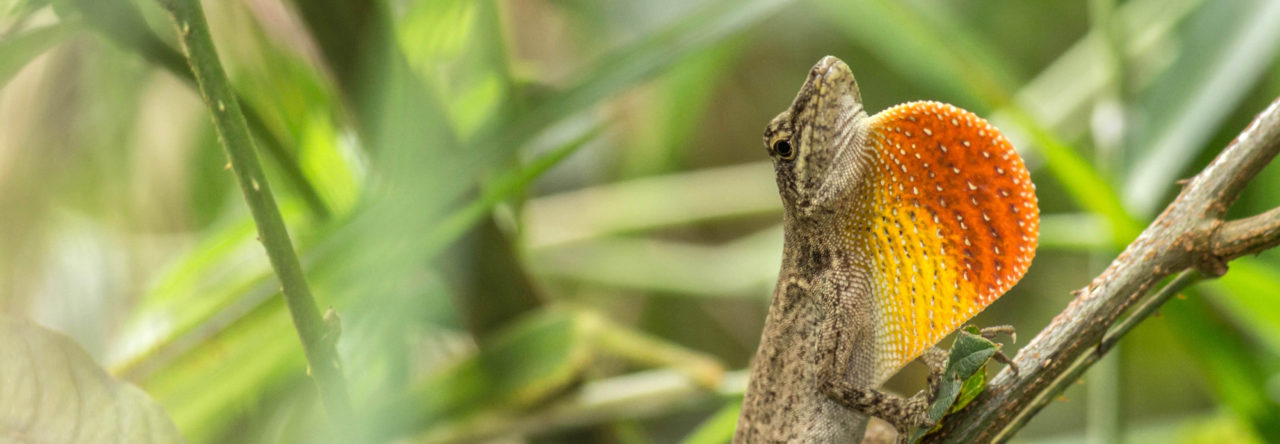
Pointy Snouted Green Anole Has a Thing for Star Fruit

Photo by Miriam Lipsky

And who could blame the little green lady–star fruit are delicious!

Miriam Lipsky of Miami explains:

Photo by Miriam Lipsky

“The star fruits (carambola) are indeed from my yard!  I was picking them to give to a friend, since no one in my family really likes them (Editor’s note: hard as that is to believe!), and when I reached for one of them, this cute anole came with it, then refused to leave the basket.”


Miriam also demonstrated her anole photography chops with this lovely backyard brown anole:

Photo by Miriam Lipsky

Miami Knights: Urbanization Facilitates an Invasive Anole

The Cuban knight anole (Anolis equestris) was intentionally introduced to South Florida in the 1950s. Since then, they have spread along the Atlantic Coastal Ridge, into southwest Florida, and into the Florida Keys. Currently, these anoles have been documented in 23 Florida counties, including Central Florida and along the Space Coast. In fact, the northernmost observations for this species occur in St. Augustine in Northeast Florida. This seems at odds with the natural history of A. equestris given the tropical climate of its home range, Cuba. However, if one examines the distribution of A. equestris in Florida, they’ll notice that outside of urbanized areas, knight anoles are scarce. Could different factors influence habitat suitability for this species between their native and invasive range?

Figure 1. Suitable habitat concentrates along Florida’s urban corridors

To answer this, we used species distribution models (SDMs) to predict habitat suitability for knight anoles across Florida and Cuba. This involved gathering hundreds of species records from a citizen science database (GBIF) which each carried the GPS coordinates of where the observation occurred. We then extracted environmental values for each point that describe the climate, vegetation, and urbanization at that location. We repeated this process for a set of randomly chosen points where the species did not occur (“pseudoabsences”), giving us an understanding of the baseline environment. We tested several modeling approaches and selected the best performing model using an independent validation set. We also examined which factors were most influential on model predictions and if these factors changed between the native and invasive range. Finally, we examined if there was potential for overlap between knight anoles and several species of threatened invertebrates.

Figure 2. Urbanization drives suitability in Florida while vegetation and precipitation dominate in Cuba.

Our models of habitat suitability showed that, as suspected, many developed areas of Florida had especially high suitability for A. equestris (Fig. 1). When we look at our analysis of how the model made its predictions, we see that different factors drive suitability for each region. In Florida, variables related to urbanization and development had a greater impact on where these lizards are found (Fig. 2). By contrast, vegetation and precipitation had a greater influence on the occurrence of knight anoles. Thus, A. equestris is more reliant on modified habitats in its invasive range whereas in its native range its niche is better defined by intrinsic ecological factors like climate and forest structure. Additionally, we found evidence for potential overlap between knight anoles and three species of threatened native invertebrates (Fig. 3).

Figure 3. Knight anole suitability overlaps habitats of three threatened invertebrates.

These results have implications for our understanding of invasion ecology and management. In their native range, knight anoles are tolerant of human modified landscapes, inhabiting plantations and urban gardens, but they also occur widely in natural habitats. However, in their invasion range, the most suitable environments are urban and suburban areas. This suggests that human development may facilitate the establishment and spread of non-native species. Additionally, urbanization creates an interface at which natural and modified habitats interact, which can have negative consequences for biodiversity. We found potential overlap between knight anoles and threatened invertebrates, such as the Florida tree snail (Liguus fasciatus), which could generate predation pressure on species that are already experiencing declines. Thus, while A. equestris has not historically been considered a harmful invasive species, these results suggest closer monitoring, particularly in high-value conservation areas, and targeted interventions may be warranted.

Ultimately, our study shows that some invasive species benefit from urbanization, underscoring how land use influences invasion dynamics.

If you’d like to learn more about our analysis and results, the open access paper is available from Ecology and Evolution.

At Lunch and for Lunch: Observations on Anolis Predator / Prey Interactions in South Florida


Red-bellied woodpecker bashing an anole. Photo by Jacques Rifkind.

Brown anole eating a ringneck snake. Photo by Jacques Rifkind

On December 4, 2025 I observed an Anolis (probably A. sagrei) preying upon an adult or subadult ringneck snake (Diadophis punctatus) in a relictual hardwood hammock forest in Miami, Florida, USA. The lizard was in a vertical head-down position on a narrow tree trunk approximately 2 m above ground, and had the snake’s head in its jaws. Unfortunately, as I photographed the encounter, the anole became disturbed and released the snake, so I was unable to confirm whether the lizard would have been successful at killing and consuming the rather substantial prey item. I examined the snake (approximate length 20 cm) and it appeared not to have suffered damage to its head or neck, and was able to crawl normally. Ringneck snakes are terrestrial / fossorial, so presumably the lizard initially attacked the snake on the ground, then subsequently ascended the tree with its prey. Much has been written about the effects of non-native lizard populations on endemic lizard species through competition and predation. This observation suggests that other endemic vertebrate populations may also be affected by these invasives.

On April 21, 2025, in the same hardwood hammock as the above observation (nature trail at A. D. Barnes Park) I watched a red-bellied woodpecker (Melanerpes carolinus) repeatedly beating an adult unidentified Anolis sp. lizard against the trunk of an oak tree approximately 25 m above the ground. Presumably the woodpecker was attempting to pulp the lizard preparatory to dismembering it or consuming it whole. I observed the bird for 10 minutes before it moved out of view. Melanerpes carolinus was previously recorded feeding on an individual of Anolis carolinensis in South Carolina, so this behavior may not be unusual. I have identified A. carolinensis at Barnes Park on several occasions, and it seems to prefer elevated arboreal habitat (a pattern noted in these pages by Ambika Kamath), by contrast with the more commonly encountered A. sagrei which is abundant on the ground or low in bushes and the bases of trees. Because Melanerpes carolinus is most frequently observed in the canopy, it is at least likely that the woodpecker’s prey in this instance was Anolis carolinensis.

The Geography of Stickiness: What Gecko Feet Reveal about Evolution

A selection of gecko toepads. Top: Gekko gecko by Peter Geissler, left: Pseudothecadactylus australis by Nick Weiger, right: Oedura monilis by Rishab Pillai.

Like in Anolis lizards, the evolution of adhesive toepads in geckos is often seen as a key innovation, allowing these lizards to exploit vertical environments. Gecko toepads are among the most advanced in the animal kingdom – inspiring research in biomimetics and synthetic adhesion for years. Yet, while the physics of sticking has been studied extensively, the ecology and biogeography have not. Most studies focus on morphology and performance in single species or genera, while large-scale ecological analyses have been rare, something that is considered as a major gap in the literature.

That’s where our project began. The idea originated with Assoc. Prof. Dr. Dennis Rödder and Dr. Jendrian Riedel, and the first task was to take a broad-scale look at toepad variation across all geckos. Following the classification system of Russell and Gamble (2019), we categorized every species into one of four types – absent toepads, basal, distal, and fanlike (Fig. 1) – each morphologically distinct while their functional differences are still not fully understood.

Fig. 1: The four toepad categories according to Russel and Gamble (2019). Ventral view of digit IV from representative species: Left pes of Cyrtodactylus khasiensis (absent), right pes of Gekko smithii (basal), left pes of Ebenavia inunguis (distal), and left pes of Uroplatus ebenaui (fanlike). Illustrations modified from Riedel et al. (2024) and Russell and Gamble (2019).

To explore their evolution and geographic distribution, we combined toepad data with open-access resources on species ranges, phylogeny, climate, and habitat types. Following a range of analyses, we decided on some of the most significant results to create the story-line for our publication.

The first valuable contribution is the classification of toepad types across all species (2230 at the time, excluding the limb-reduced pygopodids), data that is now freely available (Fig. 2). In combination with the phylogeny, we confirmed multiple independent gains of toepads and propose a differential pathway of transitions between pad types.

Fig. 2: Species numbers and family distribution across toepad categories. Includes all recent non-limb-reduced Gekkota species as of September 30 2023 (2230 species)(Kukla et al. 2025, Supplement).

Linking this dataset with biogeography and macro-climate, we also examined how different toepad types are distributed across the globe (Fig. 3) and how they relate to climate and habitat use. Interestingly, we found no sharp climatic boundaries between pad types. Instead, global patterns seem to reflect biogeographic history and the environments where geckos diversified. Nevertheless, we see some habitat associations: adhesive pads tend to show up in structurally complex environments like rocky areas, forests, and even urban settings.


Fig. 3: Global species richness maps for each toepad category: (A) absent, (B) basal, (C) distal, (D) fanlike (Kukla et al. 2025).

Overall, our study provides a global overview of toepad diversity and offers a framework for future, finer-scale studies, moving from global biomes to local microhabitats. We show that gecko diversity isn’t just about sticking to surfaces, it’s about how evolution, ecology, and geography stick together to shape the incredible variety of forms we see today.

If you want to read more, check out our open-access paper:

https://doi.org/10.1111/jbi.70087

A Closer Look at Color: Female-Driven Dewlap Dichromatism in Anoles

Sexual dichromatism in anole dewlaps. Anolis insignis above, Anolis transversalis below. Males on left, females on right. Photos appeared in Lizards in an Evolutionary Tree, photographed by Steve Poe (insignis), Arthur Georges (male transversalis) and Alexis Harrison (female transversalis).

Dewlaps—the extensible throat ornaments of anoles—are classically viewed as male secondary sexual traits used in mate attraction and rival assessment. However, many species exhibit fully developed female dewlaps, and in numerous cases, male and female dewlaps differ in coloration (see some great photos and info in past Anole Annals posts here, here, here, and here! The last post actually inspired Dr. Michael Yuan, senior author on this paper, to work on female dewlaps). What drives this sexual dichromatism?

To address this, we assembled a comparative dataset encompassing 292 Anolis species, documenting dewlap colors in both sexes from the literature, field guides, and community science sources including Anole Annals, iNaturalist, and AnoleKey. We classified dewlap colors based on pigment content, focusing on carotenoids and pterins, which produce red, orange, and yellow hues and often serve as condition-dependent signals. Species were classified as dichromatic if males and females did not share color elements. We integrated these data with measures of body size, sexual size dimorphism, and species co-occurrence, mapped onto the anole phylogeny.

Figure 1. Evolutionary patterns of pigment presence in Anolis dewlaps. (A) Ancestral reconstructions showing how carotenoid- and pterin-based coloration evolved in females (left) and males (right). Pie charts indicate the probability of each pigment state at every node, with tip states shown at the ends of the tree. (B) Proportion of species with each pigment type, separated by dewlap dichromatism categories: female-dewlap absent, monochromatic, and dichromatic.

Our analyses indicate that dewlap coloration is highly evolutionarily labile, with frequent gains, losses, and reversals across the phylogeny. Male and female colors are phylogenetically correlated, suggesting some evolutionary constraint. Crucially, sexual dichromatism appears largely driven by female-specific loss of costly pigments, rather than male pigment evolution. This pattern implies that female dewlap coloration evolves under selective pressures distinct from males, rather than merely reflecting a correlated response to male traits.

We also found evidence consistent with signal partitioning: females were less likely to share dewlap colors or costly pigments with sympatric species, particularly in species-rich communities. In contrast, sexual size dimorphism did not predict dichromatism, suggesting that pleiotropic or androgen-mediated constraints are insufficient to explain female color divergence.

In summary, male dewlap coloration remains relatively constrained, likely due to sexual selection, whereas female dewlaps exhibit greater evolutionary flexibility, often losing costly pigments or diverging in hue to reduce signal interference. These results underscore the role of female-driven evolutionary dynamics in shaping ornamental traits and highlight the importance of considering female signaling in studies of sexual dimorphism.

Future work should investigate the behavioral function of female dewlaps and examine UV reflectance, which is currently poorly characterized but perceptible to anoles. Understanding these components will be critical for elucidating the selective pressures driving dewlap evolution and sexual dichromatism.

You can check out the paper here:

Erin P Westeen, Guinevere O U Wogan, Ian J Wang, Michael L Yuan, Loss of pigments in females is associated with sexual dichromatism in an ornamental trait, Evolution, Volume 79, Issue 7, 1 July 2025, Pages 1299–1309, https://doi.org/10.1093/evolut/qpaf075

And a nice digest written about the article here:

Madelynn M Sinclair, Digest: Sexual dimorphism and signs of selection in the dewlaps of female Anolis lizards, Evolution, Volume 79, Issue 8, August 2025, Pages 1690–1691, https://doi.org/10.1093/evolut/qpaf122

See How They Run: Observing Lizards Helps Researchers Aim for Innovation

From the Pages of Syracuse University Today:

See How They Run: Observing Lizards Helps Researchers Aim for Innovation

A Tokay gecko (Photo by Austin Garner)

Diane Stirling Nov. 21, 2025

How geckos and anoles use sticky toepads and claws to run, climb and jump is providing clues for innovations to help humans, and is also aiding in efforts to conserve the animals’ species.

Through millions of years of evolution, geckos and anoles have developed curved claws and sticky toepads that make them expert climbers.

A team of researchers in the College of Arts and Sciences has been examining how those physical traits could inspire innovations such as new super adhesives and robotic climbing technologies, research that has the potential to not only help humans, but also contribute to the conservation of the lizard species.

Postdoctoral scholar Benjamin Wasiljew and a group of biology student research assistants have been putting a group of anoles and geckos through their paces—having the animals run, jump and climb on various surfaces and at differing inclines.

The group has included doctoral student Aaliyah Roberts ’29;  former research assistant Sierra Weill ’24; former undergraduate student researcher Natalie Robinson ’25; and Maya Philips ’26, who is currently using the research to write her undergraduate thesis.

Extreme close-up of a gecko's toe pads showing the detailed layered structure of adhesive lamellae.

Foot structure, Tokay gecko (Photo by Austin Garner)

Impressive Climbers

“We are testing their clinging ability on various surfaces and inclines, which helps explain what combination of toepads and claws work best on different surfaces,” Wasiljew says. “We believe adhesive toepads are more effective on smooth surfaces like leaves or glass windows, whereas claws perform better on rough surfaces like tree bark or concrete walls. Anoles and geckos encounter all those types of surfaces depending on whether they live in urban or natural settings. Combining the abilities that both claws and toepads provide is likely what makes geckos and anoles such impressive climbers,” he says.

Portrait of a young person in a blue patterned shirt smiling at the camera, with museum exhibits in the background.

Benjamin Wasiljew

The research provides a better understanding of how clinging and climbing are handled in nature. Wasiljew believes that knowledge could be used to build physical models based on gecko and anole feet that could lead to new types of climbing equipment, robotic climbing technologies or other innovations.

These new developments could provide better access to hard-to-explore terrains and assist search and rescue efforts when people are trapped in challenging or remote geographic locations or stranded during hurricanes and earthquakes, he says.

Wasiljew and the Garner Lab team work with Syracuse University engineers to discuss ways to implement their biological findings into bio-inspired adhesives and robots. They also collaborate  with biology professor Susan Parks and researchers at her Bioacoustics and Behavioral Ecology Lab. Her group is studying how to build better biologging tags that adhere to the skin of endangered whales to improve tracking and protection.

A Role in Conservation

Understanding how geckos and anoles function in their various habitats is crucial to their conservation, Wasiljew says, because urbanization can threaten their existence. Urban habitats can cause some species to be unfamiliar with how to dwell and move in natural settings that have flexible twigs and branches, versus the concrete and glass materials they encounter in urban areas. Some species don’t adapt well to  habitat changes, which could lead to their eventual extinction, Wasiljew explains. Other species may adapt so well to urban settings that they can come to be regarded as pests.

“Our findings are important because they show how different surfaces affect tree-dwelling lizards and how urban environments can change how lizards behave and how their surroundings can shape their bodies and abilities. It’s research that can both help protect endangered species and limit their negative impacts in urban locations. Understanding how animals respond to human influence or habitat disturbance is crucial to their conservation.”

Jumping Experiments

The researchers discovered that all groups of anoles are negatively affected by having a flexible springboard from which to jump. Urban brown anoles are better jumpers than the naturally-dwelling green anoles and jump further and faster than the brown anole species.

That difference is largest when jumps are made from a stiff springboard and smallest when jumps are made from a very flexible springboard. Surface flexibility affects brown anoles more than the green anoles because the brown urban anoles are more accustomed to the rigid surfaces of urban life than the green species.

Side view of an anole lizard with gray, white, and yellow-green patterning standing on a reflective black surface that mirrors its image.

From a stiff springboard, brown anoles (like the one pictured) jumped 9 to 10 centimeters further and went 50% faster on average than green anoles. The longer hind legs (averaging 1.5 millimeters more) of brown anoles make them better jumpers. (Photo by Austin Garner)

Watch: Lizards in Action

The first video shows a flexible surface jump of a brown anole. When a highly flexible springboard was used, jump distance and velocity for both brown and green anole species were almost the same.

The second video demonstrates a rigid surface jump of a brown anole. When jumping from a rigid surface, tests showed that brown anoles take off faster but move at a lower angle than green anoles do.

(Videos by Sierra Weill)

Top view of a pale crested gecko with a long tail and spotted skin, positioned against a solid black background.

(Crested gecko photo by Austin Garner)

Urban habitats differ in temperature, humidity, lighting and structural materials (concrete walls, metal fences, glass windows) versus the tree trunks, branches, twigs and leaves of natural habitats. Testing showed that surface flexibility affected urban-dwelling anoles more than lizards who live in natural habitats, presumably because the urban animals had less overall experience with natural surfaces.

Color-changing Females: Just Blending in or Born to Stand Out??

Across the Anolis genus, color and color change are used in a variety of ways, from camouflage to signaling. While many studies have focused on male coloration, few have explored the more subtle females and the role that their coloration may play. We sought to continue to understand the role of rapid color change in Anolis aquaticus (the water anole). Previous work within the species has discovered that color change is used as camouflage and that males are more consistent at matching their background coloration than females. However, whether color change could also be used as a social signal had yet to be tested. Therefore, we wanted to further test if color change may also be used as a social signal, specifically in females.

In the lab, we exposed female lizards to a dark enclosed tank to darken their coloration (these lizards experience rapid-color lightening) and then immediately placed them in an arena with a male conspecific. We repeated this with an empty tank as well for each lizard to compare both a social and isolated color change. To determine the extent of color change, we photographed their coloration before and after each trial. Using MicaToolbox in ImageJ, we created a visual model based on the brown anole visual system to get a better look into what these anoles look like to each other.

We discovered that while color did change during each trial, there was not a significant difference between social and isolated trials. However, we did find that females that had better body condition had bluer and less green coloration as compared to those with lower condition. We propose a few directions toward which these results may be pointing . First, this shift away from green and toward blue seems to be a less camouflaged color and therefore may indicate that greater body conditioned individuals don’t camouflage as much as smaller lizards. This would also coincide with previous findings that females are more conspicuous in the field than males. These findings may also lead to the idea that females are using this coloration to signal quality to potential mates and that coloration is indicative of health in the species.

Relationships of Anolis aquaticus body stripe x-mean values (green-to-red axis; A) and y-mean values (blue-to-yellow axis; B) in relationship to body condition. Colored bands represent 95% confidence intervals for the predicted regression lines.Body stripe x-mean colour values (green-to-red axis; A) and y-mean colour values (blue-to-yellow axis; B) of water anoles (Anolis aquaticus) before and after trials.

Ultimately, our study shows the importance of continuing to explore drivers of color change in the genus, and to broaden our studies to include or highlight female coloration in not only Anolis but across taxa.

Check out more details of our findings in our paper out now in Biological Journal of the Linnean Society.


Jamaican Crown-Giant Anole Weathers Hurricane Melissa

Anolis garmani in a mango tree post-Hurricane Melissa. Photo by Kathryn Miller.

Inbar Maayan writes:

Kathryn Miller.

As you know, Jamaica was very badly hit by Hurricane Melissa. It made landfall in the southwest part of the island and cut across through to the north central coast before continuing northward. Images and videos are circulating that just begin to show the extent of the damage, but everyone says it’s just unfathomable.

Kathryn Miller, one of the excellent Jamaican students who has been on my field team and contributed meaningfully to anole research in Jamaica, was finally able to travel out to help her mother in Santa Cruz, in the parish of St. Elizabeth. This is near Black River, and as you might imagine, sadly the hurricane pretty much flattened this whole area. Kathryn shared with me an anole observation, and I’m submitting it in case folks would like to see a glimmer of the anoles in Jamaica post hurricane.
The photo and video (at bottom) are of an adult male Anolis garmani. Kathryn says “Found him in a fallen mango tree. All the trees in that area were actually either snapped it two or completely uprooted. He’s making the best out of a bad situation I guess. He can’t necessarily go up high anymore. Poor guy:pensive:Anolis garmani is a Jamaican endemic, and like a true Jamaican, this guy is making the best of his situation.”
Kathryn is especially fond of the garmani. She is also a geologist and outstanding artist.I would like to take this opportunity to encourage people to use the official Jamaican government website for hurricane relief to learn more about the impacts of Melissa and donate what they might be able to.

Anoles as the Gateway to Science Advocacy

 Prologue
Nearly 1500 posts.
Over 300 contributors.
Worldwide readership.

Since its origin 15 years ago, Anole Annals has left its mark on anole researchers, reptile enthusiasts, and people curious about why these little tree lizards enchant so many of us. (Just go ahead and admit that’s a fair question!) Many posts on this blog create engaging summaries of the newest anole research, research that spans nearly every discipline of biology. But posts also include anole art, trip reports, and anole history. Anole Annals houses pages with stunning videos and classroom resources, which bring the beauty of anole biology to people outside of our established academic communities. Although the popularity of blogging has declined, the historical impact and reach of Anole Annals is undeniable.

Posts by Sanger

When I made my first Anole Annals post in 2011, I thought that it was a good way to advertise my newest paper and to help establish my name in the field. But I was naïve at the time. 14 years of experience and added maturity have taught me the importance of communicating science to people outside of our immediate academic circles. Over that same timeframe, there has been a rise in anti-science propaganda and misinformation on social media that has eroded the strength of the American science apparatus. With the exception of people working in politically charged areas such as global change or vaccines, most scientists do not have training or experience in confronting attacks on science. We need to change this. We need to do it quickly.

Copied below is a blog post that I wrote to accompany a new Editorial that I published in Integrative and Comparative Biology. I argue that scientists need to step outside of our academic circles into formal and informal settings to rebuild public trust and enthusiasm in science. Our first task is to learn new and effective ways to communicate from professionals who excel at captivating audiences with diverse interests and backgrounds. I repost this here because Anole Annals has had incredible success reaching people from across academic and non-academic circles. I hope my post can bring new energy to Anole Annals and its efforts to disseminate the wonders of anole biology to wide audiences.

How Republican Support for Science Led to My Career as a Biologist

I grew up in a relatively poor, conservative family along the I-90 Rust Belt corridor of central New York in the 1980s and 1990s. My parents often worked multiple jobs to make our minimal ends meet. During the day, my father repaired boilers and pressed shirts at my Uncle John’s dry cleaning business as Rush Limbaugh played at full volume in the background. In the evenings, he worked as a boiler operator for a hospital until his body broke from strains of intense manual labor. My mother worked as a nurse before I was born, but I mainly remember her doing labor and service jobs. I enjoyed my science classes in school,* probably because I liked the outdoors as a kid. But an appreciation of science as a career path was not an inherent part of my upbringing. My parents emphasized that getting an education was my way to a more comfortable life, but they did not direct me to a particular major or career path. As manufacturing opportunities declined across the region, the expectation of attending college was a common sentiment for many kids of my generation from that area. Thus, despite my teenage adrenaline junky desire to become a smokejumper, my parents encouraged me to pursue a college education and sacrificed a great deal to put me through it. I am now a tenured professor at Loyola University Chicago.

Public perspectives on science have changed dramatically over the 80+ years of my parents’ lives. Science rose to prominence in the United States following World War II because of geopolitical competition. Publicly funded innovation and the rapid pace of scientific output were points of bipartisan national pride for the latter half of the 20th century! The US populace wanted to win the space race. The National Science Foundation’s budget surpassed $1 billion for the first time in 1983, under Republican Ronald Reagan, after his administration recognized that it was in the national interest to compete in a high-technology world. George H.W. Bush led the charge for the Global Change Research Act, which garnered 100-0 support in the Senate. The US population supported the development of new vaccines, antibiotics, and cures for disease, leading to the doubling of the NIH budget between 1998 and 2003. In 1999, Republican firebrand Newt Gingrich stated,

“The highest investment priority in Washington should be to double the federal budget for scientific research. No other federal expenditure would create more jobs and wealth or do more to strengthen our world leadership, protect the environment and promote better health and education for all Americans. For the security of our future, we must make this investment now.”

When my parents encouraged me to pursue education in science, they did not temper their advice with their political leanings. Science was not considered “woke” or a democratic conspiracy in the 1990s. Conservative leaders of the time were advocating for science because of its economic and competitive benefits to the national interest, a message that likely resonated deeply with my parents. They thought that a career in science was a secure path to a life better than the one they were living. Full stop.

Fast forward to 2025, and I am left wondering, “What the hell happened to this nation’s respect and support for science?” * Many Americans now question whether a college education is “worth it,” even though advanced education was the catalyst for the success of many people from my generation. Given the current political environment, it is difficult for me to imagine that my family would encourage my pursuit of a career in science today. In fact, my career has been a point of contention for us since 2016. It’s difficult for me to see this new generation of kids capable of undergoing the same socioeconomic transformation that led me to my current career.

This long introduction frames my motivation for the recent Editorial I wrote for Integrative and Comparative Biology. Since January 2025, the United States has witnessed the rapid acceleration of anti-science rhetoric and direct attacks on the scientific enterprise, following the blueprint laid out by the 900-page Project 2025. These attacks are more energized, pervasive, and combative than anything I have witnessed during my career. I feel an urgency to get more scientists engaged in public discourse and to update our educational systems to help students recognize propaganda and refute misinformation. The goal of my Editorial was to 1) contrast the ways that scientists communicate with the strategies that more communication-based professions use, and 2) to lower barriers for scientists to purposefully experiment with new communication strategies. The infographic to the right highlights the main points of the Editorial.

15 years ago, multiple organizations called for scientists to engage with the public and the policymaking process.

Spoil Islands in Florida: an Opportunity for Anole Experiments in the Wild

Figure 1. Anolis sagrei (photo: Michael Childs).

Invasive species are a growing problem across our increasingly globalized planet. They are often adept at establishing stable population sizes very quickly, which allows them to outcompete native species for access to important ecological resources and expand their range. You’re on the Anole Annals, so you’re probably familiar with the poster child for invasive lizards, the brown anole (Anolis sagrei).

Native to the Bahamas and Cuba, it has rapidly colonized most of Florida, USA, and has established several other invasive fronts in other parts of the world. The silver lining of many invasive species is that many of them make incredibly informative models for understanding different components of evolutionary biology, and in particular, how the action of evolutionary mechanisms, such as natural selection, plays a role during those first few years of invasive population establishment.

In northern Florida, the Intracoastal Waterway (ICW) is a brackish water route that connects inland rivers to the Atlantic Ocean. In the ICW, there are several hundred spoil islands that were artificially created by the Army Corps of Engineers to control and maintain the flow of water throughout the ICW. Since their creation, spoil islands have been colonized by a diverse range of plants that provide structure for animals that happen to make their way from the mainland onto these islands. Spoil islands are often very small, and as you may have guessed, it is not uncommon to find brown anoles inhabiting these islands at varying population densities. These islands, and the ability of brown anoles to establish stable populations on them, provides us biologists an exciting opportunity: we can use spoil islands – where there happen to be few to no brown anoles – to experimentally recreate the context of biological invasion. Then, using multiple island populations as experimental replicates, we can assess how populations grow and change during those first few critical generations, and how natural selection may facilitate, or constrain, population establishment and growth in invasive species.

In 2011, we identified six spoil islands in the ICW where brown anoles were present, but in very low population sizes. We removed these lizards and then introduced adult brown anoles that we collected from the mainland onto these islands, simulating on each island an independent “invasion” event. Because these islands varied in shape and size (Figure 1), we released a varying number of individuals per island to keep the initial population density consistent. We aimed to let these populations grow over time to estimate the strength and direction of natural selection during the incipient generations following establishment. Additionally, because we had six replicate islands, we manipulated the population sex ratio of our founding generations, resulting in three islands with a 2:1 male-biased sex ratio, and three islands with a 2:1 female-biased sex ratio. This allowed us to characterize if, and how, the landscape of natural selection over the initial generations was impacted by the composition of the founding population.

We used a capture-mark-recapture study to estimate natural selection. Some islands we followed for the full six years while some islands we followed for 3-4 years. All our populations grew and established rapidly, and we found a complex landscape of natural selection during the initial generations. We measured natural selection on a variety of phenotypic traits, but the only trait we found to be important was body size. Juvenile lizards experienced much stronger natural selection than adults, where large body sizes were associated with a higher probability of survival. Natural selection tended to strengthen over time as populations grew and become established. Importantly, the strength of selection was predicted by population densities: stronger selection (but only for juveniles!) was observed in populations with a greater density of lizards. Adult anoles did not experience strong selection, but when populations experienced a male-biased sex ratio, natural selection favored a higher body condition (i.e., a greater body mass relative to the same body length), perhaps invoking the important role of competition in these small island habitats. Population sex ratio fluctuated dramatically over time, even though we began our experiment with significant sex biases across our replicates. Interestingly, we found the initial sex ratio of our propagules had a future effect on the landscape of selection experienced by juvenile lizards: when islands began with a female-biased population sex ratio, this resulted in stronger natural selection on juvenile body size in future generations. This finding may represent a unique type of founder effect, where the initial female-biased sex ratio resulted in a future effect on some aspect of population biology (like growth or competition) that indirectly resulted in stronger natural selection on juvenile lizards.

Figure 2. Selection differentials subset by age (juvenile/adult) and sex across our spoil islands and across years. Note how selection differentials tended to be highly positive and (in some cases) strengthen over time for juveniles, while those for adults tended to not show any consistent pattern.

This was a challenging and complex study that shed some light as to how brown anoles may be evolutionarily primed as successful invaders. Female brown anoles are highly fecund, and in some years can produce upwards of 40 offspring. These offspring can reach sexual maturity rapidly, and this is reinforced by strong natural selection favoring larger body sizes in the younger age class. Rapid maturation and high fecundity are likely important for how quickly brown anoles can establish invasive populations. Brown anoles also don’t live a long time in the wild. From our capture-mark-recapture data, we observed high levels of adult mortality (>80% in some years!), so it was very rare to see adults make it to year two, or even year three. Many of the ecological and evolutionary patterns we observed can be associated with competition for limited resources on island habitats (check out Calsbeek & Cox 2010 in Nature for another important island experiment), so it may be that brown anoles that reach adulthood are very familiar with a competitive landscape. Indeed, brown anoles can outcompete our native anole, the green anole (Anolis carolinensis) to access for suitable habitats where they co-occur.

Spoil islands are such a valuable natural resource. They provide important habitats for a diverse range of plants and animals, help us maintain the depth and flow of the ICW for commercial use, and are often popular recreation spots for camping, fishing, and boating. Spoil islands can also act as miniature buffers during severe storm events, like hurricanes, to reduce the impacts of severe flooding on coastal habitats. If you find yourself in Florida sometime in the future, take a swim or a kayak out and explore a few spoil islands if you can. You may be surprised at what you find! To learn more about our experiment, including more details on our findings, see our early print article here: https://doi.org/10.1093/evolut/qpaf184.

Page 3 of 305

Powered by WordPress & Theme by Anders Norén