
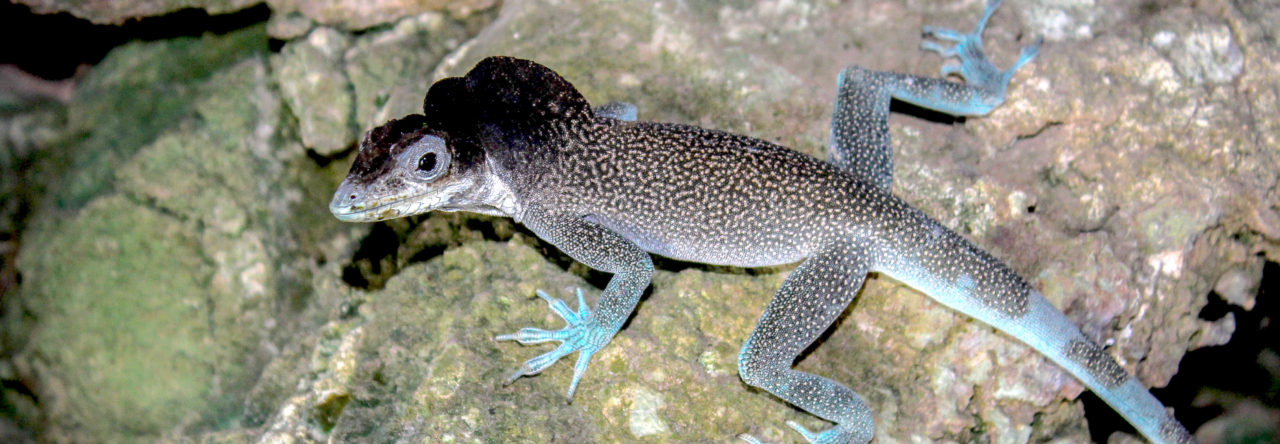
“…On the first weekend of October in 2009, 125 anole biologists traveled from eight countries to Harvard University’s Museum of Comparative Zoology to attend the 6th Anolis Symposium. It had been 10 years since the previous symposium, and a reunion was long past due. In 2008, as we began to consider how to proceed with such an endeavor, a fortunate thing happened: the Herpetology Department at the MCZ renovated its library and teaching space – the famous lair of the late pater anolis, Ernest Williams. The library needed a namesake, and Ernest was under strong consideration (after all, he had been instrumental in filling its shelves!). After a brief period of friendly deliberation, it was decided that the library would be dedicated to Williams, and that the occasion would be the commencement of the 6th Anolis Symposium, held at the Museum of Comparative Zoology…” (From the preface of the Anolis Newsletter VI)
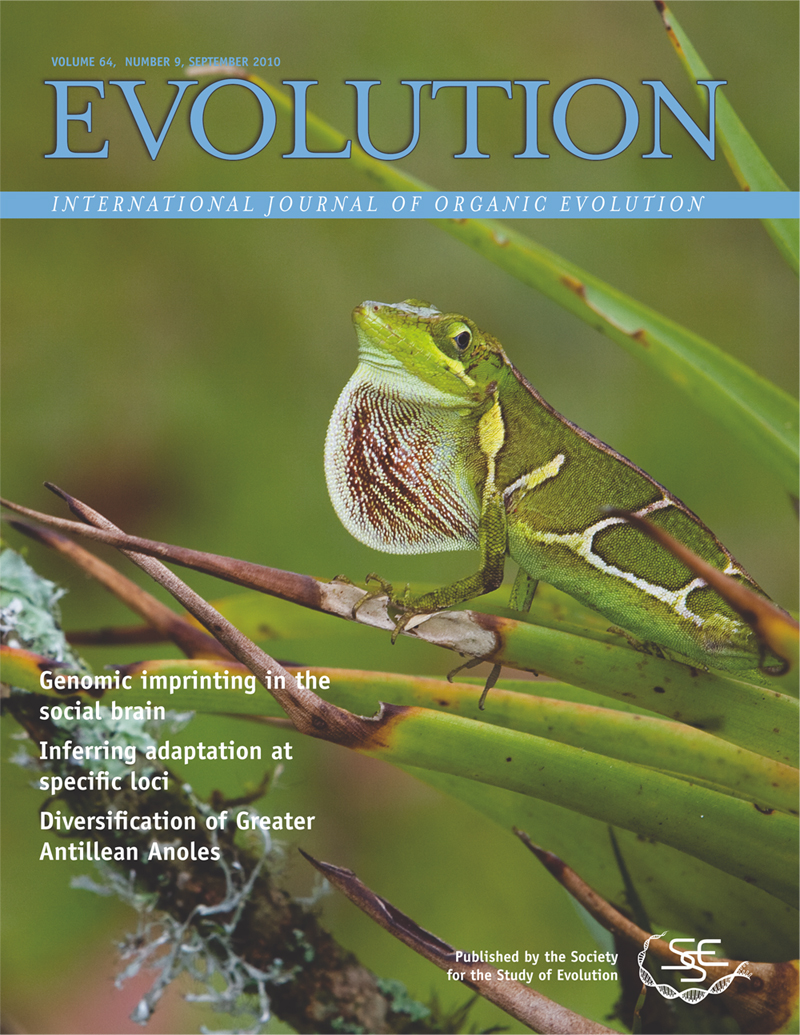
 The Society for the Study of Evolution gives the R.A. Fisher Prize “for an outstanding Ph.D. dissertation paper published in the journal Evolution during a given calendar year.” This year’s awardee is Luke Mahler, for the paper, which appeared on the cover of the Sept, 2010 issue of Evolution: Mahler, D.L., L.J. Revell, R.E. Glor, and J.B. Losos. 2010. Ecological opportunity and the rate of morphological evolution in the diversification of Greater Antillean anoles. Evolution 64:2731-2745.
The Fisher Prize is relatively young, but already boasts an impressive list of past winners, to which Mahler is a worthy addition:
2006 Maurine Neiman
2007 Guillaume Martin
2008 R. Brian Langerhans
2009 Megan Higgie
2010 Britt Koskella
2011 D. Luke Mahler
One of the perks of working on anoles is doing fieldwork in exotic and interesting places. For me, being located as I am in steamy New Orleans, an additional perk is that I can (and do!) do fieldwork in my metaphorical back yard. As of last year, I have begun what I hope will become a long-term study of a local population of Anolis carolinensis in Washington Square Park in the Faubourg Marigny, right on the edge of the French Quarter. (As an aside to fellow anole biologists, if anyone is planning future anole collecting trips to NOLA my lab and I would be more than happy to help out, with the caveat that the anoles in Washington Square Park remain uncollected and unmolested, given that selection is one of the many things we are currently measuring). But doing fieldwork in populated urban areas also presents its own unique set of challenges, not the least of which is the colorful local populace. This generally breaks down into several categories. In most cases, people are simply curious as to why someone would spend a warm, spring day diving into bushes for no apparent reason, and immediately assume that you are a lunatic once you explain to them that it is with the aim of documenting the Lizard Invasion (“They’re all around us!”). Others are genuinely fascinated with the anoles, and will listen with interest to what we are doing and why before leaving us to go about our business. Then there is another small segment of the population who hold strong and invariably uninformed opinions on science, lizards, nature and animal rights which they eagerly thrust upon hapless anole investigators with no warning or provocation. Dealing with these people can be difficult, as it requires certain baseline levels of patience and diplomacy that I sometimes do not possess. Finally, New Orleans being New Orleans also plays host to a surprisingly large amount of people who are not burdened with an abundance of sobriety at 9am on a Tuesday (or, perhaps, ever). Interactions with these special people run the gamut from mildly amusing (the Grateful Dead fan last week who casually mentioned that he was on day 3 of “tripping [his] balls off” and helpfully warned me to “watch out for roofies”) to tiresome (the heroically inebriated gentleman who followed me around the park recently for 10 minutes whilst repeatedly slurring the same unintelligible question in my general direction) and even vaguely unnerving (the cracked-out, half-naked couple chasing a rubbish truck down Frenchmen street and yelling at it).

Pictured: Outreach
It was this inconvenient presence of the public in public places that in 2004 led Duncan Irschick, weary of interacting with other human beings, to make perhaps his most important contribution to anole biology – the “I’m catching lizards” t-shirt. Originally made for Irschick lab members during sampling of the Tulane University A. carolinensis population, these three simple words, printed in stark white on the back of a dark green shirt, were intended to inform the casual passersby as to the nature of our unusual outdoor activities, thereby dissuading them from engaging any of us in conversation. It works extremely well, except on those occasions when it backfires, instead acting as crazy bait and attracting exactly the type of person you don’t want to speak to whilst conducting fieldwork. Still, the benefits outweigh the occasional costs, and my shirt has seen regular use over the years. I don’t particularly recommend wearing it in non-lizard catching contexts, however, as herpetologists are generally considered to be weird enough as it is.

Paper figure; Anolis principalis, by R.W. Shufeldt
With all the hoopla over the royal wedding between Prince William and Miss Kate Middleton, I thought it necessary to Google “Anolis Prince William” to see whether the future king had had any interactions with this blog’s most noble subjects during his bachelorhood.
The first link was to this paper, published in 1883 in The American Naturalist. It is a brief natural history note detailing the habits of the American Chameleon, known then as Anolis principalis. Today, we know it as Anolis carolinensis.
An early sentence reads: “This singular interest [in lizards] amounts to positive fascination, as we come to know the anolidae, and I assure you our little American chameleon is one of the most engaging of the group…” (pp. 919).
It turns out that Anole Annals isn’t the only member of the WordPress.com stable that has a thing for our favorite lizard. While recently doing some tag surfing, we came across the following posts.
 Catholic mom tells the gripping (or not) story of a green anole that went for a ride on the minivan windshield. You can probably guess the outcome, but the photos are nifty.

The brown anole (Anolis sagrei) was discovered in Santzepu, Chiayi County, southwestern Taiwan, in mid 2000, and except for a few academics, most people didn’t seem to notice the existence of this exotic invasive species. That all changed when red fire ants (Solenopsis invicta) were discovered in northern parts of the island in 2003. Suddenly, invasive species became a very hot topic, and the authorities launched various projects to assess and study invasive species in Taiwan. Soon, as could be expected, A. sagrei was also in the news.

Anolis nitens (formerly A. chrysolepis). Photo from http://www.sciencephoto.com/images/download_lo_res.html?id=907650178
Today I had a chat with an evolutionary biologist who specializes on the evolution of tropical forests. We were discussing the effect of climate change on the Amazon, and he first made the point that dire warnings about the Amazon are possibly slightly overstated. Yes, the rainforest may be in big trouble, but it’s not as if the trees will fall down and the area turn into barren desert. Rather, there are many dry-adapted tree species in South America, and they will probably take over, replacing wet forest with dry forest. Conversation then turned to what is known as the Pleistocene Refugia Hypothesis (PRH), the idea that during the ice ages, the climate became drier because so much water was locked up in glaciers. As a result, so the theory goes, rainforests were fragmented as the forest was replaced in many places by other habitats. As a result, a formerly widespread species might become isolated into multiple, unconnected populations. The PRH suggests that these isolated populations often evolved into different species, and the famously high species richness of the Amazon may be a result of high rates of speciation resulting from a series of cycles of forest contraction and expansion. The PRH, however, has fallen on hard times for a variety of reasons, and I think it is safe to say that most workers in the field no longer favor it. Nonetheless, my colleague averred that the hypothesis has been too hastily discarded; in his mind, the idea has been caricatured, and more reasonable versions of the idea have merit and deserve more attention.

Core areas of A. chrysolepis distribution in the Amazon. Map H from Vanzolini and Williams (1970)
Of course, this conversation immediately turned my mind to one thought: anoles! In particular, it reminded me of two significant, yet in recent years little read, papers on Amazonian anoles. The first was a 1970 monograph in Arquivos de Zoologia by Paulo Vanzolini, famed Brazilian herpetologist and samba composer, and Ernest Williams on the pan-Amazonian anole then referred to as A. chrysolepis, now known as A. nitens, and soon to be divided into several species (stay tuned to these pages for more on that as the story develops).

- An egg of Anolis lionotus. Photo courtesy Edgardo Griffith.

One day, years ago, I was collecting data on the behavior of the Jamaican twig anole, A. valencienni. As I was watching a female, to my surprise, she entered a hole in a tree trunk, and then emerged a little while later. To my amazement, I then saw another valencienni do the same thing! Overcome with curiosity, I approached the tree, peered into the hole, and spied to my astonishment a large number of what seemed to be anole eggs. I was not aware that communal nesting—in which multiple females lay their eggs in the same place—is known in a number of anole species, including A. angusticeps, A. bartschi, A. lucius and A. valencienni. The seminal work on the subject is still Rand’s 1967 Herpetologica paper.
A recent paper adds another species to the list of known communal nesters, the first from Central America of which I’m aware.

The Anolis field season, in the Northern Hemisphere at least, lasts from about mid-April to late-August. As winter finally loosens its grip on 2011, anole biologists everywhere are planning trips, breaking out field kits, shaking out field clothes, and gathering replacement equipment in preparation for another exciting season of Anolis field biology. Thus, be sure to stay tuned to this blog throughout the summer for breaking Anolis news.
In light of the upcoming field season, I’ve compiled a Top-10 list of field gear essential, in my opinion, to Anolis field research. And they are:

In the pantheon of anoles, Anolis maynardi has a special place as one of the funniest looking species around. To the casual observer it appears that someone has taken an A. carolinensis (to which A. maynardi is closely related), grabbed it by the tip of the snout, and pulled it forward. The purpose of this pincer-like proboscis, much more extreme in males than in females (which are smaller), is unknown. Indeed, until recently, just about everything about the species was unknown.
Anolis maynardi is endemic to the tiny island of Little Cayman. Remarkably, although visible in the distance, the nearby island of Cayman Brac does not harbor the species. At least naturally. In 1987, A. maynardi was reported at the Cayman Brac airport, most likely a beachhead resulting from a stowaway on an island-hopping airplane. Another survey in 1991 still found it only near the airport, and nothing further was known.