Sex

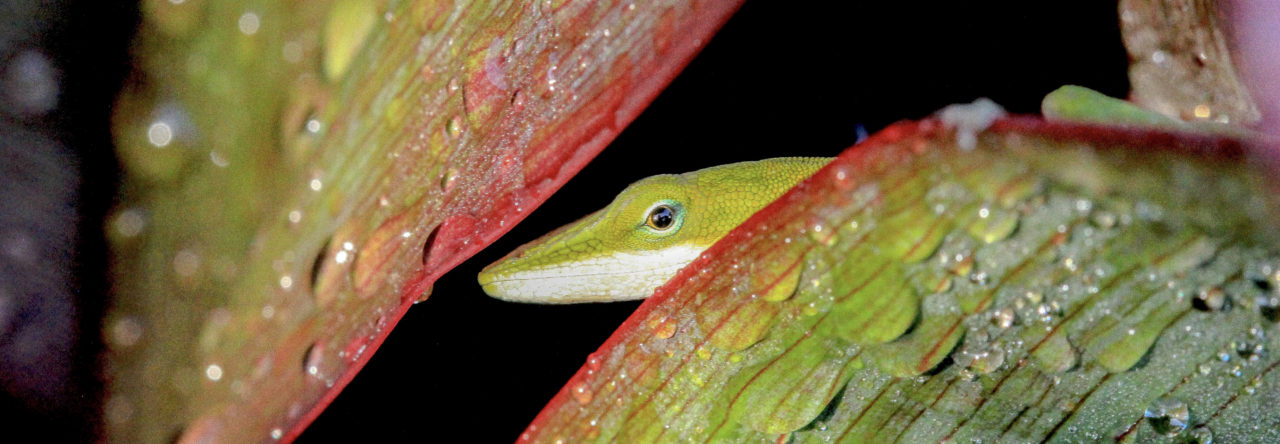
Anolis carolinensis is headlining the new exhibition on animal sex in the Natural History Museum Rosenstein, Stuttgart, Germany. Go check it out if you’re in the area

http://webmuseen.de/sex-stuttgart.html

Great graphic design! Wondered several minutes what the toasted oats were doing in there. Duh, they're eggs! (amphibian)

Brown Anole Dewlapping at a Much Larger Predator: Why?

Grackle snacking on an anole in Florida. Photo by Andy Wilson from http://www.pbase.com/andywilson/image/60039533

Most anole watchers have experienced the phenomenon of walking up to an anole and having it display. What good could come of displaying to a potential predator thousands of times more massive? In a perceptive experiment, Leal suggested that anoles actually are trying to tell the predators something: specifically, that a displaying lizard is very fit, and that a potential predator, in this case a snake, would be better served looking elsewhere for a meal.

But there are few observations of anoles displaying to predators in nature. In a recent Natural History Note in Herpetological Review (42:427-428), Catherine Levey documents one such instance: “I observed an adult female boat-tailed grackle (Quiscalus major) on a sidewalk with an A. sagrei in its bill. The anole was approximately 7 cm snout-vent length. The bird was vigorously shaking the anole with sideways flicks of its head. After about five seconds, it put the anole down on the pavement. The anole immediately arched its back, fully extended its dewlap, and became immobile. The bird looked at it and did not move for about five seconds. It then pecked the anole several times near the head, which caused the anole to withdraw its dewlap and run. The bird pursued it and picked it up. The anole thrashed in the bird’s bill; it did not extend its dewlap. Again, the bird put it down and again it immediately displayed its dewlap. the bird paused for a few seconds, picked up the lizard by its midsection, and flew out of sight.”

Anole Vs. Egret

This image is bouncing around the internet, and I can’t find any information on its origin, but it looks like an anole to me. Valiant last ditch effort, but I think we all know the outcome.

Turnabout’s Fair Play

A few weeks back, we reported the death of an anole at the hands–er, pedipalps–of a spider. Now Janson Jones reports the opposite.

More generally, we know that spiders are a very common prey item in the diet of many anole species, but how often the reverse is true is unknown.

Anolologists on the Move: Jason Kolbe

Jason Kolbe, the doyen of anole invasion biology and conservation genetics, has taken up a faculty position at the University of Rhode Island. Research in his lab generally addresses the evolutionary dynamics of biological invasions using Anolis lizards as a model system. He uses molecular markers to reconstruct invasion histories and to test factors that facilitate or constrain phenotypic evolution during invasions.

Jason invites applications from motivated students for graduate degree work in the area of evolutionary ecology and evolutionary genetics of invasive species. Funding will be provided either as research or teaching assistantships, depending on student background and availability. Applicants should be independent, highly motivated, and possess some research and/or field experience. Students with experience using molecular techniques (i.e., DNA extraction, PCR, DNA sequencing, microsatellite genotyping) or conducting GIS-based spatial analyses are encouraged to apply. Prospective students should contact Jason Kolbe via email (jjkolbe@mail.uri.edu) and provide a short description of research interests and accomplishments, a CV (including GPA and GRE scores), and contact information for three references.

Anole Action Series

Need a dose of live lizard action? Why not check out the long-running series, Anole Alley, on lizardvideos.com? Now in its fourth season, with an all-star cast of green anoles (maybe browns, too–I haven’t watched all that many of them).

Episode 39, part 2, big game hunting, is linked above. It features a large male green anole snagging a dragonfly–well done! Other episodes show other anole hi-jinx and escapades. Store this one to put some sunshine into a cold, wintry day.

Anole ID Assistance

Anole ID Assistance

Afternoon to all, I thought I would introduce myself with a few photos to get some identification clarification. The first one was sent by a friend (Tanis Birch) who is traveling in Belize (Punta Gorda). I have not been to Belize and have limited experience with anoles but my best guess was Anolis sagrei. Are there any similar looking anoles which I am not taking into consideration? Any thoughts?


Thin Snakes Eat Big Anoles

Blunt-headed treesnake eating an Anolis petersi.Photo by Elí García-Padilla from the March issue of Herp. Review.

The blunt-headed treesnake, Imantodes cenchoa, is renowned for its anolivory, but being a pencil thin snake, one might have thought that its carnage would be limited to the smaller members of anole nation. Not so, as two Natural History Notes in the March, 2011 issue of Herpetological Review report. García-Padilla and Luna-Alcántara report a treesnake eating a large A. petersi in the Los Tuxtlas region of Mexico (photo above), and Ray et al. provide the details of a 56 gram I. cenchoa that was found with a 19 gram A. frenatus and a 1.3. gram anole egg in its stomach. Justice was served in the latter case, as the snake died soon after capture, and an autopsy revealed a perforated stomach, attributed to the anole’s claw, presumably during post-ingestion attempts  by the anole to pull a Gordon and escape.

Variation in Habitat Use by Females with Different Back Patterns

Female Anolis polylepis. Photo from http://www.wildherps.com/species/A.polylepis.html

In many species of anoles, females within a population exhibit sometimes strikingly different back patterns. A recent paper showed that there is interesting variation in the incidence of such variation: mainland and Lesser Antillean anoles exhibit it much more than Greater Antillean anoles, and within regions, some clades are more polymorphic than others. Although closely related species tend to be similar, this trait has been evolutionarily labile, evolving an estimated 28 times.

The occurrence of this variation raises the question: what’s it for? The most detailed study of the question was Schoener and Schoener’s examination of female polymorphism in Anolis sagrei in the Bahamas. By looking both within and between populations, they concluded that this polymorphism was related to crypsis. In particular, females with stripes tend to occur on narrow diameter branches, where the stripes help them blend in. Calsbeek and Cox have more recently examined the same species, finding most recently that different patterns don’t seem to vary in fitness, though they did not examine whether females with different patterns occurred in different parts of the microhabitat.

The only other recent work on this topic was conducted on A. polylepis in Costa Rica by Steffen.

Reproductive Cycle of a High Elevation Colombian Anole

Anolis mariarum from https://www.facebook.com/media/set/?set=a.111687092219097.16289.111684688886004&type=1

Brian Bock and colleagues, most at the Universidad de Antioquia in Medellin, Colombia, have published a series of papers on two populations of the high elevation anole, Anolis mariarum. The most recent in this series, just out in the journal Caldasia, is an examination of the reproductive cycle of this species.

In Central America, many anoles that occur in areas with a single long dry season curtail their reproduction during the dry times. However, A. mariarum occurs in areas where there are two wet and two dry seasons over the course of the year, and this species breeds year round, as does another highland anole in a similar place climatically, A. (Phenacosaurus) heterodermus.  The authors suggest that because each of the dry times are shorter than one long dry season, these species are able to continue breeding. But, as the authors note, a confounding factor is that these two species occur at very high elevations (> 2200 meters), where temperatures are much cooler than most species that have been studied. Despite a considerable amount of work on anole reproductive phenology, there is still much to learn.

Page 271 of 305

Powered by WordPress & Theme by Anders Norén