
Charles Leeper shows us a green anole in action from around his home. And here’s an oldie of Anolis smaragdinus doing the same:
Charles Leeper shows us a green anole in action from around his home. And here’s an oldie of Anolis smaragdinus doing the same:
Or should we call it dine-dash-and-dewlap? Anole video-chronicler Charles Leeper has provided another view of green anole life around his house. He describes it thusly: I recently captured some anole footage that you might find interesting. In the video, we see the anole repeatedly extending its dewlap after catching the insect. I know dewlap extension is for displaying to a mate and establishing territory, but could it also be a show of triumph or excitement. I ask because there don’t appear to be any other males in sight, and the anole does it immediately after catching the prey.

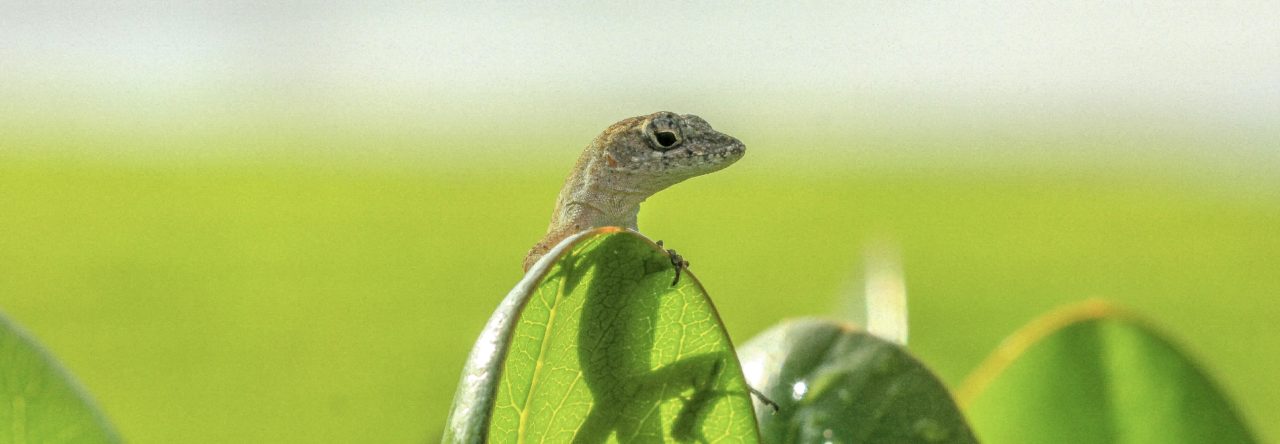
Winter in Wisconsin is about the worst place you can imagine for a tropical lizard, but that didn’t stop this little one! This brown anole (A. sagrei) was spotted last week (April 2021) in a plant nursery in Madison, WI (ok, not exactly Green Bay…) by a friend of mine, Emily Mitchell. Thanks to her for sending the pic! This individual likely got to Wisconsin as an egg in the soil of a potted plant, and hatched in the nursery. It will have a lonely existence in its midwest nursery home, but at least we can appreciate it!

I recently observed one of my female green anoles swallowing a freshly laid egg, which I suspect came from the other female in the harem. I looked online to see if this behavior is common in green anoles and I was unable to find any information about it. It seems that this exceptional behavior has yet to be reported. I am not sure why my lizard did this.
Considering that my anoles have access to ample resources, including fruit baby food and plenty of gut-loaded crickets and mealworms, I do not believe that her behavior was prompted by a nutritional deficiency. Perhaps it is a novel form of intraspecific maternal competition. Maybe it is unique to mating in captivity. Or maybe this behavior is unique to this particular female — she does eat a lot, and rather indiscriminately. It is also worth mentioning that she is the comparatively larger and more dominant female out of the two.
I am curious to know if anyone else has witnessed this sort of behavior in green anoles, or if they have any ideas about why she did it. Luckily, I was able to catch some of it on video with my cellphone (please excuse the quality and my shaky hands!) just before she swallowed the egg in its entirety.

Harry, the lizard, clearly a Lesser Antillean anole from the fictitious island of Saint Marie near Martinique and Guadeloupe in the British detective series Death in Paradise, is in jeopardy. Read all about it, but beware of spoilers.

![Anolis alutaceus [image] | EurekAlert! Science News](https://i0.wp.com/www.eurekalert.org/multimedia/pub/web/23297_web.jpg?resize=400%2C600&ssl=1)
Photo: Luke Mahler
Hey there!
I’m really into these tiny anoles now, and I promise we will venture next week, but for right now. I would like to talk about Anolis alutaceus.
Anolis alutaceus, also known as the Blue-eyed grass-bush anole or Monte Verde anole, is a forest-dwelling Cuban anole that can also be found on Isla de Juventud. It is one of the anoles in the alutaceus series of 14 closely related Cuban grass-bush anoles.

Photo by Yasel Alfonso, iNaturalist
They have a sizable pale yellow dewlap, and tan brown bodies with a lateral striping running from shoulder to vent, as well as diamond patterning on their backs. Monte Verde anoles have a SVL of around 37.5mm. They can be found close to the ground on the skinny surfaces their body plans are suited for, and like many of the other anoles in their ecomorph, they move mostly by jumping.

Photo by Alex Alfil, iNaturalist

Anolis carolinensis, photo by Delton Howard
In Ecology and Evolution
Weber, Anthony, and Lailvaux
The way that individuals are spatially organized in their environment is a fundamental population characteristic affecting social structure, mating system, and reproductive ecology. However, for many small or cryptic species, the factors driving the spatial distribution of individuals within a population are poorly understood and difficult to quantify. We combined microsatellite data, remote sensing, and mark–recapture techniques to test the relative importance of body size and relatedness in determining the spatial distribution of male Anolis carolinensis individuals within a focal population over a five‐year period. We found that males maintain smaller home ranges than females. We found no relationship between male body size and home range size, nor any substantial impact of relatedness on the geographic proximity. Instead, the main driver of male spatial distribution in this population was differences in body size. We also found no evidence for offspring inheritance of their parent’s territories. Males were never sampled within their father’s territory providing strong support for male‐biased dispersal. This study introduces a novel approach by combining standard mark release capture data with measures of pairwise relatedness, body size, and GPS locations to better understand the factors that drive the spatial distribution of individuals within a population.

A PhD that started with a hurricane and ended with a pandemic couldn’t slow down Kevin Avilés-Rodríguez — this past Friday Kevin became the newest anole doctorate when he defended his dissertation over Zoom on the interacting effects of urbanization and hurricane Maria on Anolis cristatellus.
Congratulations to Dr. Avilés-Rodríguez! And check out his amazing celebratory cake!


https://www.wikihow.com/Set-up-a-Green-Anole-Tank
In Animals
Jose W. Valdez
Reptiles are one of the most popular exotic pets in the world, with over a third of all described species currently being traded. However, the most commonly available reptiles are typically non-threatened, captive-bred, and/or domestically obtained, which means they are also largely unregulated and unmonitored, resulting in a large portion of the reptile pet trade remaining unknown. In this study, the past, current, and future trends of the most popular reptiles in the pet trade were examined. Google Trends was used to determine the global popularity of the most popular pets from 2004 to 2020 and compared to the results from an online survey sent to individuals involved in the reptile trade. The most popular pets from the previous five years were also compared globally across regions and countries. The results determined that the most popular reptile species during the last decade is by far bearded dragons, followed by ball pythons and leopard geckos. Although the survey results were similar when asked what the top reptiles were, most respondents named ball pythons as the most popular reptile. However, when asked what reptiles had lost the most popularity during the previous decade, the survey respondents named green iguanas, Burmese pythons, chameleons, red-eared sliders, and green anoles, concurring with what was found with Google Trends. The reptiles thought to be more popular in the upcoming decade by the survey participants were blue-tongued skinks, tegus, uromastyx, crested geckos, and ball pythons—most of which did indeed show an increase in popularity during the last decade, as indicated with Google Trends. The results from Google Trends demonstrated that ball pythons and crested geckos have increased their popularity more than any other reptile in the last two decades. Reptile popularity also differed between countries, with bearded dragons the most popular reptile in Australia, Western Europe, the U.S., and Canada. Leopard geckos were the most popular reptile in Italy and Turkey, and ball pythons were the reptile of choice in Mexico, Indonesia, and India. The general finding of this study is that the reptiles declining in popularity were mostly wild-caught or restricted due to regulations, while current and future species were captive-bred and available in many varieties or morphs. The most popular species were also docile, medium-sized, and easy to handle, with relatively simple care requirements. This study demonstrates that Google Trends can be a useful tool for determining relative popularity among reptiles, or any other pet group, with results closely mirroring those obtained through direct surveying of people involved in the pet trade. However, unlike surveys, this analysis is quick, quantifiable, and can show what is popular and in-demand not only at the global level but at much finer scales. Thus, Google Trends can be a valuable tool in many research applications, especially in topics that may otherwise be difficult to monitor and quantify.
Powered by WordPress & Theme by Anders Norén