
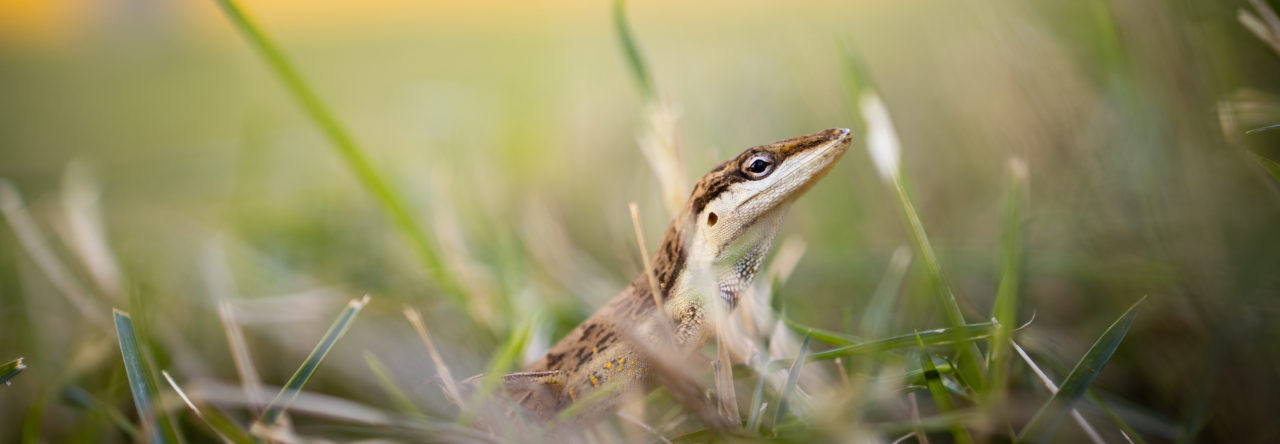
Ecuadorian Anole ID Needed

Photo by Brian Arbogast

Brian Arbogast sent these photos with a request for identification. I have my guesses, but I thought I’d throw it out to the experts. Here’s what Brian had to say: “They were taken in the lower cloud forest of Sumaco Volcano, on the eastern slope of the Andes in Ecuador at about 1700-1800m in elevation.”

Photo by Brian Arbogast

Day One Updates From SICB

Greetings again from San Francisco! Day One of SICB has been full of amazing talks and posters. The poster session yielded interesting new research by Diego Castro and Michele Johnson, of Trinity University, on the relationship between testosterone and dewlapping behavior. Diego, an undergraduate studying neurobiology, asked whether muscles involved in sexual or aggressive behavior would have increased testosterone. To answer this question, Diego focused on five species of Dominican anoles, including Anolis brevirostrisA. coelestinus, A. cybotes, and A. olssoni. Diego observed the natural behavior of these species, and quantified the average number of pushups and dewlaps they performed. They found that A. coelestinus and A. cybotes have fewer dewlap extensions and several pushups in their displays, while A. brevirostris dewlaps as often as it performs pushups. They then quantified the concentration of androgen receptors in the ceratohyoid, which controls dewlap extension to determine whether levels of androgen receptor protein correlate with sexual display behavior. They found that species with greater display rates also had a higher number of cells expressing androgen receptor protein. Their next goal is to measure androgen receptor protein in the bicep and tricep. Great job, Diego!


Winners Are Right-Brained – Visual Lateralization In Aggressive Encounters

Aggressive encounter between anoles. Both opponents are watching each other with their right eyes. Photo: Johnson Lab, Trinity University

Have you ever gotten an angry look from an anole? Has he ever displayed at you, demanding that you get out of his territory? If so, chances are that if an anole was giving you the stink eye, he with using his left side! I’m blogging live from the Society for Integrative and Comparative Biology (SICB) meeting in San Francisco. My first stop has been to view Michael Patton’s poster examining the neuroanatomy of aggressive behavior. Patton is a senior undergraduate student at Trinity University working with Dr. Michele Johnson. Early birds at SICB have the opportunity to put their posters up for early viewing, so I got a sneak peek of his work last night although he’s not slated to present until Saturday.

For his project, Michael addressed the question of brain lateralization in aggressive displays. Some evidence suggests that anoles tend to favor their left side during competitive encounters. Patton and colleagues built on these studies by examining behavioral laterality in the field and neuroanatomy in the lab in the same individuals. Through observations of wild A. carolinensis, Patton found support for this idea – the winning male tended to view his opponent from his left side!

Color Catalogue For Field Biologists


Anole biologist Gunther Köhler has produced a handy manual, available from Herpeton publishers, to help describe colors of specimens, especially in field situations. The book’s introduction can explain better than I what it is used for and why it was written:

The accurate description of the coloration in life of organisms represents an important component of the work of any field biologist. Subtle differences in the coloration in life, such as in the color of the iris, the lining of the mouth cavity, or the tongue are diagnostic for certain species and have been used by taxonomists to differentiate among species.

Whereas many aspects of the external morphology of scientific specimens can be preserved with proper fixation methods, there is still no way to assure the long-term conservation of the coloration in life in such specimens. This is especially true for animals traditionally fixed with the help of formalin and ethanol, such as fishes, amphibians, and reptiles, and then stored as a wet collection. Colors such as red, yellow, and orange disappear rapidly once the specimen is placed in the preservative. Green-colored amphibians and reptiles can turn blue, lavender, purple, or black within a short time after preservation.

The Catalogue also provides definitions and examples of different phenotypic characteristics.

Of course, taking photographs of animals helps to document the coloration in life. Possible drawbacks to this technique are incorrectly adjusted white balances, which cause colors not to be reproduced accurately. Also, photographs often do not show coloration of hidden body parts. Therefore, biologists have a long tradition of recording colors by making written descriptions. Since individuals see colors differently and because it not easy to define, for example, different shades of brown or green in words, having a color standard helps to produce more objective and detailed descriptions that also have a greater chance of being reproducible. Such a reference can be used to compare descriptions made by different persons at different times and places. For decades, field biologists have utilized the “Naturalist’s Color Guide” by Frank B. Smithe (1975-1981) as the standard reference for color descriptions. However, for many years now, this important reference has been out of print and is no longer available.

I have used Smithe’s “Naturalist’s Color Guide” (called “Smithe Guide” from here on) extensively during the past 20 years, and my copy now clearly shows signs of this intensive usage under field conditions over the years. With no hope of being able to obtain a copy in good shape to replace my old one, I decided to produce a new reference to fill the gap left by the now unavailable Smithe Guide.

The resulting “Color Catalogue for Field Biologists” you are holding in your hand is not a duplicate of the Smithe Guide.

Anole Annals Viewership Triples In A Year: 300,000th Visit Impending

Some time in the wee hours tonight or early tomorrow, the 300,000th visitor will traipse through Anole Annals. Not bad since we only reached 100,000 barely more than a year ago, on December 16, 2011, when some lunkhead from Valdosta, GA logged in. Who will claim this great honor? And when will it occur? You can keep track yourself by checking the stats counter at the bottom of the sidebar on the right side of the screen. And if you haven’t done so before, click on the world map just above it, to see in rotating 3-D where people are visiting AA right now.

Next AA milestone: our 1000th post, slated for later this winter. So far, in our two year and change history, we’ve had 919 posts by 87 contributors from 11 countries and five continents. Not to mention 3,356 comments.

18 Anole Talks At SICB Meetings Starting Tomorrow

As Martha Muñoz reported two months ago, the Society of Integrative and Comparative Biology meetings, beginning Thursday in San Francisco, will be awash with anole research. Check out the list of talks here, the full story in Martha’s post, and stay tuned for updates from ‘frisco.

Holiday Observations Of Anolis Maynardi

Our A. maynardi in Little Cayman seem to be thriving. They have learned when I water the garden & have taken to either dropping out of the trees to lick waterdrops from the bushes or positioning themselves in advance. We also often see maynardi climbing up the outside of the window screen & licking the metal or licking the A/C unit..

Does the window screen taste salty too?

Licking the airconditioner, for salt? A wet-finger test showed that the surface was slightly salty. Photo by George Chaplin.

Waiting for water in the morning.

Goodbye Lizard Year

According to the Partners in Amphibian and Reptile Conservation, today is the end day of the Year of Lizard (2012) and the arrival tomorrow of 2013 marks the beginning of the Year of the Snake.

On the lizard’s year, the anoles were present in the poster (with Anolis grahami) and the november month on the Monthly Calendar (with Anolis phyllorhinus). Maybe for next calendar will be present Anolis pseudoophiosaurus.

Guide To Anoles Of Rio Palenque, Ecuador

Recently we posted the Poe lab’s guide to the hyperdiverse anole community of El Cope, Panama, which harbors 12 anole species. Only slightly less diverse is the community of anoles at Rio Palenque, Ecuador, which has 11 species, and the Poe team has put together a guide for this locality as well. A small version appears below, and the full size pdf can be accessed here.

Research To Suffer As Chicago’s Field Museum Of Natural History Redefines Its Mission

As many readers have likely seen in recent news, original scientific research at Chicago’s Field Museum of Natural History is poised to take a major blow with the announcement that the museum is refocusing its scientific mission and will soon be scaling back its research activities. The Field is in serious financial trouble. In debt for the last decade and for years unable to balance its books, the institution has reached its borrowing limit and must find a way to resolve a 5 million dollar imbalance in its annual budget. For leadership through this growing crisis, the museum hired a new president and CEO, Richard Lariviere, who began his post in October. Last week, Lariviere and the museum’s board of trustees offered the first glimpse of their proposed solution: a 5 million dollar cut in annual operations expenditures, 3 million of which is to be shouldered by the museum’s science departments. Lariviere has stated that the Field plans to restructure its scientific mission, and that deep cuts in research staff – including the museum’s roster of tenured curators – could be expected. This is a scary prospect for the dozens of professional scientists who have built their careers at the museum, and very sad news for folks who, like me, took some of the first steps of their scientific careers there (I worked as a research assistant in the Division of Amphibians and Reptiles for a year after college; this experience shaped my decision to go to grad school, and led me to study lizard evolution!).

For the most part, the details of these upcoming changes have not been resolved, and will be the subject of internal deliberations in early 2013. Nonetheless, there are reasons for serious concern about the future of research at the Field. First, the museum is scrapping its four current research departments (Anthropology, Botany, Geology, and Zoology) in favor of a much leaner “Science and Education” department. In addition, a committee is currently taking preparatory legal steps necessary to lay off tenured curators, an action that is impossible under normal circumstances (to get this done, the museum must declare a state of financial exigency). These actions

Page 213 of 305

Powered by WordPress & Theme by Anders Norén