
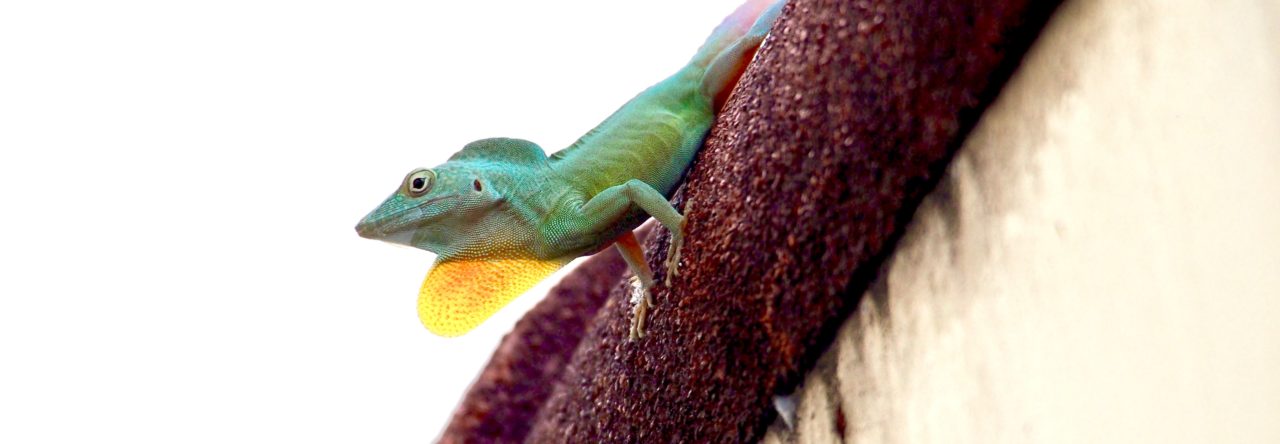

Green anole eating a dronefly. Photo from Wikipedia.
The tremendous diversity in Anolis lizards is one of the major draws for researchers to work on this system. There are nearly 400 species of anoles and their distribution spans much of the New World. Most of Anolis’ distribution spans environments with very low seaonsality. One exception is Anolis carolinensis, whose range spans much of continental North America, and encompasses highly seasonal environments. Further, unlike most reptiles, A. carolinensis does not hibernate during the winter. Rather, lizards remain active during the cold North American winter months.
Today Shane Campbell-Staton, a graduate student at Harvard University, presented some of his thesis work examining how A. carolinensis adapts to the thermal environment, and how local adaptation influences patterns of gene flow. The work he presented was conducted in collaboration with Scott Edwards and Jonathan Losos at Harvard University and Zachary Cheviron and Anna Bare from the University of Illinois-Urbana Champaign.
Shane first asked whether differences in the thermal environment limit gene flow among populations of A. carolinensis. To answer this question, he examined variation in over 2000 loci for 131 individuals of A. carolinensis and its ancestor, A. porcatus, from Cuba. He leveraged the Anolis genome with double digest RADseq to discover these SNPs and used multiple matrix regression to assess the correlation between genetic distance among populations and geographic and climatic distance. He discovered a significant signal of isolation by temperature, but not isolation by geographic distance or isolation by precipation. This means that populations are likely structured by thermal habitat, and that differences in temperature among localities limit gene flow in A. carolinensis.
Next Shane asked whether there was a signal of local adaptation in physiological tolerance to the thermal environment. He measured heat tolerance (CTmax) and cold tolerance (CTmin) in nearly 200 individuals of Anolis carolinensis. He found a significant positive correlation between temperature seasonality and thermal tolerance (i.e., the difference between CTmin and CTmax), but that most (though not all) of this pattern was driven by variation in cold tolerance across habitats.
Finally, Shane wanted to understand the mechanism that limits cold tolerance for terrestrial ectotherms. Specifically, he wanted to test whether oxygen limitation plays a role in determining how cold tolerant lizards are. The oxygen limitation hypothesis suggests that the ability to transport and utilize oxygen is limited at cold temperatures, and that lizards lose their mobility at low temperatures because they can no longer effectively transport oxygen to their muscles. Under this scenario, lizards that are more tolerant cold should be more efficient at transporting oxygen at cold temperatures than less cold tolerant individuals. To test this hypothesis, he examined CTmin in lizards from different thermal extremes of the species range and found that lizards from more cold-tolerant populations (i.e.,: higher latitude) utilized less oxygen at colder temperatures. His results support the oxygen-limitation hypothesis, and suggest that lizards can achieve a greater tolerance to cold, at least in part, by becoming more efficient at transporting oxygen, thereby reducing their demand for oxygen at lower temperatures.


![checkered maynardi small2[1]](https://i0.wp.com/www.anoleannals.org/wp-content/uploads/2013/12/checkered-maynardi-small21.jpg?ssl=1)


