
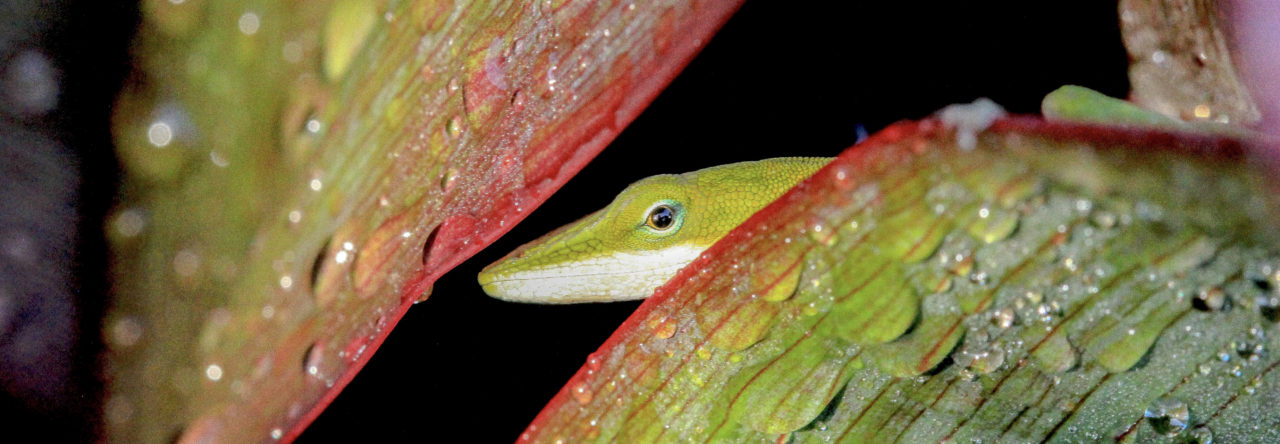
Anolis equestris: Miami’s Favorite Cannibal

Anolis equestris with a smaller Anolis equestris in its jaws.

An Anolis equestris captures a smaller A. equestris in South Miami.

Cannibalism in Anolis equestris is nothing new, but that doesn’t make it any less surprising to witness! On a morning stroll in South Miami this past weekend, I noticed a flash of green movement on a tree. Upon closer inspection I realized there was a medium-large A. equestris with a smaller A. equestris wedged between its jaws. I hurried to snap a few photos with my wife’s phone, and while they aren’t Neal Losin-caliber (ha ha), I still wanted to share them with my favorite anole community!

Anolis equestris in tree

Anolis distichus dewlapping at Anolis equestris

Once I got too close, the A. equestris decided it was time to take its meal higher up the tree. An unsuspecting A. distichus saw the approaching A. equestris and began to dewlap enthusiastically. You can see the A. distichus near the top of the last photo. Enjoy!

Grey-Dewlapped Crested Anole

grey crested

Stroud and Beckles published this photo of a crested anole with a half-grey dewlap in the December 2014 issue of Herpetological Review. Cresteds dewlaps are usually orange or yellow–this is very unusual.

This is reminiscent of the famous gray-dewlapped A. carolinensis as well as this odd crested anole found by Neil Losin.

What’s up with these wacky anoles?

Anolis proboscis in National Geographic

Congratulations to our friends at Tropical Herping for their photo in this month’s National Geographic.

Great Isaac Cay

Approach to Great Isaac Cay. Note the Casuarina forest. Photo by Kristin Winchell.

Approach to Great Isaac Cay. Note the Casuarina forest. Photo by Kristin Winchell.

Great Isaac Cay, NE of the Bimini group, Bahamas. Image from Google Earth 2015.

Great Isaac Cay, NE of the Bimini group, Bahamas. Image from Google Earth 2015.

As Kristin mentioned in a previous post, we recently visited some of the Bimini islands  in search of data on Anolis sagrei ordinatus. Through a stroke of luck, we were able to visit remote Great Isaac Cay for an afternoon of herping, hoping to find some anoles there.

Great Isaac is a small weathered carbonate formation, rising perhaps 15m above the extreme northwestern corner of the shallow Great Bahama Bank. The island was more or less continuously inhabited for about a century by a lighthouse-keeper staff, and hence the native fauna could have been drastically affected. The island is frequently visited by boaters who come ashore to explore the ruins, as well as Bahamian commercial fisherman (note the boat in the right of the photo) who use the structures for shelter. The island now has a well developed Casuarina forest, with a deep (50-150cm) litter of Casuarina twigs.

OLYMPUS DIGITAL CAMERA

The author surveying the Casuarina forest on Great Isaac. Photo by Kristin Winchell.

We spent about six person-hours  around 1500h on Great Isaac- plenty of time to cover the entire island. We surveyed for reptiles by lifting and replacing loose rocks, as well as checking around and under vegetation and within abandoned structures. We failed to turn up a single anole, though we did find two species of reptiles. We encountered quite a few Sphaerodactylus nigropunctatus flavicauda under rocks in the Casuarina forest, and only two Ameiva auberi richmondi in open areas around the abandoned lighthouse.

OLYMPUS DIGITAL CAMERA

Surveying the west end of Great Isaac Cay. Photo by Kristin Winchell.

IMG_4104

Sphaerodactylus nigropunctatus flavicauda, female. Great Isaac Cay.

As far as we can tell there are no island lists of the herpetofauna for Great Isaac, indeed we did not even include the island in our recent list of Bahamian herpetofauna (available here). The island is at least listed in the original version of this work, yet without any records. So, has anyone else come across herpetofaunal records for Great Isaac Cay?

Bark Anole Battle Scars in Miami, FL

As it starts to heat up here in Miami, anole interactions are at the highest while males try to stake their claim for the most attractive territories in town. Earlier during an afternoon stroll around South Miami I came across this bark anole (Anolis distichus) that looks like it’s had a pretty rough time recently!

IMG_2873

I assume this injury to his nape is probably from another lizard, likely another male A. distichus, incurred during a territorial dispute, and not a predation attempt. Either way, it looks like it didn’t dent his confidence too much!

IMG_2878

Do City Lizards Have Regrown Tails More than Country Lizards?

Anolis sagrei with a regrown tail. Photo by Philip Fortman

Kristin Winchell has the answer. Check it out on her blog, Adaptability. Here’s a shot of the poster she discusses:

Great Egret Eating a Crested Anole in Miami, FL

Here is a video taken by University of Miami PhD student Joanna Weremijewicz at the Fairchild Tropical Botanical Gardens in Miami, FL last Friday (20th March 2015). There have been lots of posts talking about the predation potential of egrets (and other wading birds) on anoles here on AA similar to this (1,2,3,4), but I think this could be the first one recording predation of A. cristatellus? Cool video!

Species ID from Bimini – A. sagrei or distichus?

After looking through my photos from my trip last week to Bimini in the Bahamas, I was disappointed when I realized that none of us seemed to have any pictures of Anolis distichus. Or maybe we did? Among all the typical sagrei-looking anole photos was this guy:

Anolis distichus or Anolis sagrei???

Anolis distichus or Anolis sagrei???

Without telling you why I thought this was a distichus, or why others I have asked are torn between distichus and sagrei, I am curious what people think. What species is this?

Video of a Fight Between Two Female Brown Anoles

Compared with our extensive knowledge of male-male interactions, we know very little about how females interact with one another. Adding to a growing set of observations, here is some video (taken by my field assistant and seasoned anole videographer Jon Suh) of two bead-tagged female brown anoles mid-battle.

Both females are recent arrivals to this particular tree, and the lizard that remains on the tree at the end is marginally bigger than the one who leaves. Though I don’t think we witnessed the full interaction, I think it’s interesting that the females didn’t use their dewlaps in the course of this fight. This seems to match up with Ellee Cook’s description of a fight between two female A. gundlachiThe use of the dewlap by females has been observed during male-female interactions in A. cristatellusA. armouri  and a few other species, but also during female-female interactions in some Central American anoles. Clearly we’ve got a long way to go before we characterize and understand agonistic encounters and display behaviour in female anoles!

Field Trip Recap: Herps of Bimini, The Bahamas


Searching for Anolis sagrei on the beautiful island of Bimini

Anolis sagrei on the beautiful island of Bimini

I just got back from a 10 day research trip to Bimini in the western Bahamas along with Harvard post-doc, Graham Reynolds, Harvard graduate student, Pavitra Muralidhar, and UMass Boston undergraduate, Jason Fredette. We went with the simple goals of kicking off a research project in the Losos lab on Anolis sagrei  and to observe as many other herps as we could.

We spent the majority of our time on South Bimini. We sampled from the well-maintained Nature Trail, where we found all four anole species (Anolis sagreiAnolis smaragdinusAnolis angusticeps, and Anolis distichus) and a Bimini boa among diverse habitat types, including blackland coppice and open Coccothrinax shrub. We also spent a couple of nights searching in some mangrove forest near the airport, which yielded only A. sagrei and A. angusticeps and in low abundance at that. The “Fountain of Youth” ended up being a gold mine for Sphaerodactylus nigropunctatus as well as boas — we caught 3 here.

We also did a fair amount of exploring. Our hosts for our house rental wanted to make sure we had a great time in Bimini and so they insisted on boating us out to a couple of the nearby islands for some snorkeling. They even provided us with the best full face snorkel mask I’ve ever laid my eyes on. We picked up a boat for the ride at the Intrepid Powerboats website. Of course, we saw this as the perfect opportunity to catch a few lizards. Our first destination was Gun Cay, a small island a few miles to the south of Bimini. Pavitra and Jason entertained our hosts by collecting shells and feeding stingrays. Meanwhile, despite our hosts’ curiosity that we wanted to go wander in the brush, Graham and I nabbed 10 adult male A. sagrei in less than an hour. We also saw several Ameiva auberiAnolis smaragdinus, and some sort of very large rodent (does anyone know about Hutia reintroductions in the Bahamas?).

The following day, our hosts insisted we come with them to a small island 20+ miles to the north of Bimini (Great Isaac Cay) where they promised us dolphins and hammerhead sharks. On the way to the island we saw several dolphins, tons of flying fish, sea turtles, and several large nurse sharks. As we approached the island, I saw the mature Casuarina forest and yelled down to Graham from the crow’s nest tower, “I want to go explore there!”  Our hosts got us as close as they could to the rocky shore (dangerously close it seemed, the hull almost hit the rocky karst island) and all four of us hopped onto the island. The island had an abandoned lighthouse and buildings from the 1800’s that we explored. We were shocked to not find a single anole on Isaac Island, although we did find Sphaerodactylus nigropunctatus and Ameiva auberi.

The isolated Great Isaac Cay with ruins from the late 1800's.

The isolated Great Isaac Cay with ruins from the late 1800’s.

The trip was a huge success. In total, we came across all but five of the reptiles of Bimini. Surprisingly, we were unable to find any Bahamian racers (Alsophis vudii) other than roadkills, though most of our field time was at night. Unsurprisingly, we did not find either of the blind snakes or the dwarf boa, the latter of which tends to be more common in the rainy season. As expected, A. sagrei was the most abundant anole on Bimini. We came across A. angusticeps and A. smaragdinus with equal frequency and actually encountered only a few A. distichus. We did most of our searching at night, so this may be a reflection on different sleeping behaviors rather than abundance.

In summary, we were able to observe:

  • 140+ Anolis sagrei males and females
  • Sphaerodactylus nigropunctatus (black-dotted dwarf gecko)
  • Sphaerodactylus argus (ocellated dwarf gecko)
  • Dozens of Leiocephalus carinatus (curly-tail lizard)
  • Chilabothrus strigilatus fosteri (Bimini boa)
  • a handful of Anolis distichusAnolis smaragdinusAnolis angusticeps

We also saw a number of other herps that we were not able to catch or didn’t need data from:

  • Ameiva auberi (Bimini ameiva)
  • Eleutherodactylus planirostris (greenhouse frog)
  • Osteopilus septentrionalis (Cuban tree frog)
  • Hemidactylus mabouia (invasive house gecko)


This slideshow requires JavaScript.


Page 136 of 305

Powered by WordPress & Theme by Anders Norén