
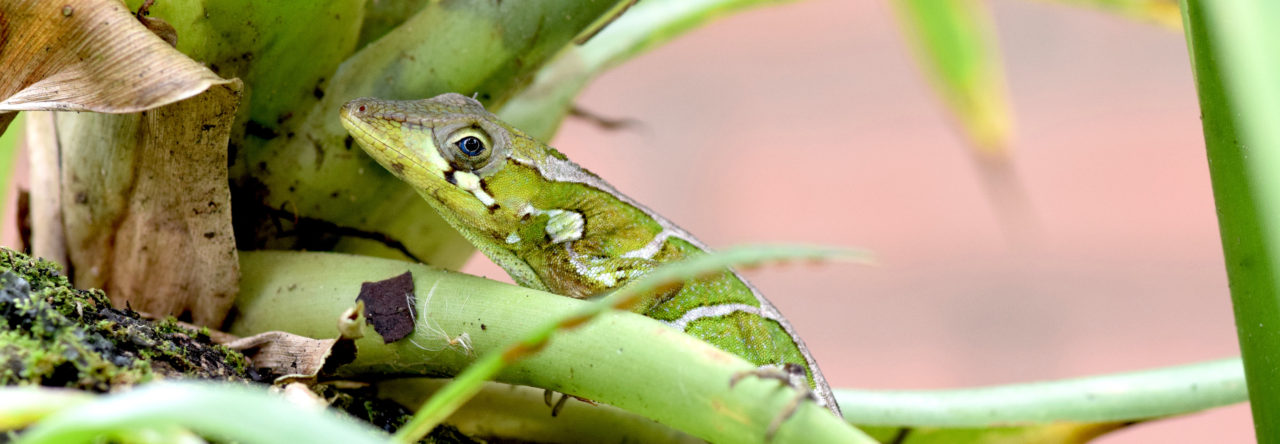
Glow-in-the-Dark Dewlaps Allow Lizards to Be Seen in Dim Light

Leo Fleishman and colleagues have just published a cool paper in Functional Ecology, “Why do Anolis dewlaps glow? An analysis of a translucent visual signal.” Co-author Manuel Leal provides the back-story on how the paper–which he refers to as “experimental natural history”–came to be in his lab’s blog, Chipojo lab.

And the New Scientist provides a nice summary of the article in its post: ”

Luminous lizard lotharios ahoy! In the dark undergrowth of the forest, it’s not easy to be seen. Male Anolis lizards use colourful throat fans, called dewlaps, to woo females as well as ward off rivals and predators. But one species has a neat trick to make itself stand out even more – it uses an optical illusion to make its dewlap appear to glow.

The dewlaps are translucent, which means they can transmit as well as reflect light. However, because most objects in the lizards’ environment – such as rocks and tree trunks – simply reflect light, our eyes “expect” them all to appear relatively dull. By transmitting light from the background, the dewlap tricks our eyes – and the eyes of other lizards – into thinking it is actually a light source, says Leo J. Fleishman of Union College in Schenectady, New York, who has studied the lizards for years.

Fleishman’s team was curious to find out why the trick evolved – was the glowing dewlap a way to increase contrast with darker backgrounds or a way to make its colour clearer?

To explore the issue, Fleishman’s team examined the photoreceptors in the lizard’s eyes to work out how they would view the dewlaps. They found that the glow did not create more contrast with the background, which naturally contains other bright spots – where a patch of sunlight passes through the vegetation, for instance. But the glow did significantly reduce the visual overlap, as the lizard’s eyes would experience it, between the throat fans and the colours of natural backgrounds.

The glowing dewlap may be more common than we think. Only a few of some 400 species of Anolis lizards are known to carry the trait, but Fleishman has seen photos suggesting other species’ dewlaps might glow too.

“My guess is that the phenomenon will turn out to be widespread once people start looking, but very few people have looked,” he says.

Here’s the paper’s summary:

Summary

  1. Male anoline lizards utilize a colourful, expandable throat fan, called the dewlap, to rapidly and unambiguously signal their presence and species identity to conspecifics. Under some viewing conditions, the dewlaps of some species appear to glow vividly, because they transmit a great deal of diffuse light, creating a translucent signal. Translucent signals are probably found in many animal groups, but they have rarely been studied.
  2. We hypothesized that dewlap translucence might (i) increase dewlap/background luminance contrast or (ii) increase the reliability of the colour as a species recognition signal by lowering the colour discrimination threshold in low light conditions such as forest shade.
  3. We calculated dewlap colour (spectral radiance) for the Jamaican lizard Anolis lineatopus at natural perch sites with, and without, the inclusion of transmitted light.
  4. Transmitted light did not significantly increase the magnitude of luminance contrast between the dewlap and background.
  5. We plotted colours of dewlaps, background patches of habitat and dewlaps of sympatric species in an anoline perceptual colour space (the colour tetrahedron), based on the four classes of cone photoreceptors found in the retina. Using a newly developed approach, we used ellipsoidal plots of uncertainty to quantify perceptual overlap between dewlap spectral radiance and values for natural distractor colours. Diffuse transmission of light through the dewlap greatly reduced the perceptual overlap between the dewlap and natural background colours.
  6. This finding strongly suggests that selection has favoured the evolution of a translucent dewlap as a mechanism to increase the reliability of detection of the signal under the low light conditions. In general, any animal’s colour signal must emit sufficient light intensity to allow the colour to be discriminated from other distractor colours in the habitat. This will tend to favour the evolution of colours with higher total intensity (i.e. higher reflectance and/or transmittance) in animals that signal in relatively low light conditions such as forest shade.


Anolis sagrei on Rum Cay, Bahamas

Anthony and Kevin near the golf cart. This inland forest was the tallest we could get access to on the island.

Anthony and Kevin near the golf cart. This inland forest was the tallest we could get access to on the island.

A July trip to the Bahamas to sample Anolis sagrei has been documented in recent posts by Graham Reynolds and Kevin Aviles-Rodriguez. During that trip, Kevin, Anthony Geneva, and I traveled to the island of Rum Cay to collect data on anoles. With a human population of fewer than 50 clustered in an around the southeastern town of Port Nelson, Rum Cay is mostly uninhabited. Access to a majority of the island’s 30 square miles is facilitated by narrow dirt roads, several of which, particularly those on the western half of the island, are overgrown and unnavigable. Our golf cart, well-equipped with off-road tires, was pushed to its limits as we strove to find lizards across several habitat types on the island.

L. loxogrammus on Rum Cay. Photo by Anthony Geneva.

L. loxogrammus on Rum Cay. Photo by Anthony Geneva.

Anolis sagrei was abundant among most of the island’s vegetation including forests, mangroves, and beach scrub. Their mostly red dewlaps appear similar to those we saw on nearby Long Island. In each habitat, the lizards were usually perched within 1 meter of the ground but were occasionally found on the ground or perched higher than 1 meter. One exception was a shrubby forest located at (23.66501, -74.868245) which contained abundant A. sagrei along with incredibly high densities of the San Salvador curlytail lizard, Leiocephalus loxogrammus. Here we didn’t see any A. sagrei on the ground despite being present at the site for several hours on two separate days. Not an easy place to get to, but it would be a great site for studying curlytail behavior and interactions between curlytails and anoles. In our adventures we also encountered several Anolis distichus, with more on that to come in a later post.

A Salamander in Amber from the Dominican Republic

Untitled-1

It’s been a good couple of weeks for herps-in-amber fans. Last week, Emma Sherratt and colleagues (including me) published a paper expanding the number of known Dominican amber anoles from 3 to 38. And now comes a paper by Poinar and Wake in the journal Palaeodiversity reporting a finding perhaps even more improbable: a fossil salamander in amber from the Dominican Republic.

What is so remarkable about this discovery is that salamanders do not occur anywhere in the Caribbean today. Indeed, salamanders are one of the textbook examples of taxa thought to be unable to disperse overwater, leading to what used to be called “disharmonic faunas”–islands that are missing some elements normally found on the mainland.

Detailed analysis indicates that the specimen is a member of the Plethodontidae, the family to which all neotropical salamanders belong. How did it get to Hispaniola? One possibility is that it hopped onto the proto-Antillean landmass as it passed by and perhaps came into contact with the continental Americas around 70 million years ago. Some hold that anoles got to the islands in the same way, though molecular data suggest that anoles are too young for vicariance to explain their occurrence in the Caribbean. The alternative possibility is that salamanders got to islands the old-fashioned way, by floating on flotsam and jetsam. Sensitive to dessication, most amphibians–and plethodontids in particular–wouldn’t seem good candidates for overwater dispersal, but stranger things have happened.

Regardless of how they got there, the presence of salamanders in the Caribbean twenty million years ago is a surprising finding adding a new dimension to our understanding of Caribbean biogeography.

Exposure Determines Costs of Immunity in Brown Anoles

Parasite exposure, which is practically inevitable in the wild, typically results in activation of the innate immune system. While these responses provide rapid detection and elimination of parasites, they are also costly to hosts in many ways including increases in the use of essential amino acids to produce immune proteins. Costs experienced by hosts can sometimes be offset by abundant resources, but in most environments, resources are limited. As a result, immune costs are likely an important influence on many ecological and evolutionary phenomena, such as the diversity of immune defenses that exist among and even within populations. If immune costs are driving variation in immune responses, then it is reasonable to expect that they might also affect how parasites move through communities. If host costs of immunity increase with parasite exposure, then we would expect to see selection for hosts that tolerate infections, rather than clearing them.

Photo by Amber J. Brace

Photo by Amber J. Brace

In our study recently published in Functional Ecology, we examined whether increased exposure to Salmonella lipopolysaccharide increased costs of innate immune activation in brown anoles (Anolis sagrei) by tracking allocation of an isotope-labelled amino acid (13C-leucine) to the liver and gonads after exposure. We found that costs of immunity are indeed dose-dependent in this introduced population of from Tampa, Florida, but the sexes experienced costs differently; males increased leucine allocation to their livers while females sacrificed allocation to their gonads. Most interestingly, costs were modest even at high doses, suggesting that at high levels of Salmonella exposure, this species may tolerate infection as the costs of resisting a high level of infection may be too great.  These results are particularly interesting because they indicate that populations of brown anoles, a successful introduced species in Florida, may have been selected to have decreased costs of immune activation, and therefore increased parasite burdens. This may mean they are substantially contributing to the disease risk of native species by increasing exposure risk of Salmonella to other animals in Florida by maintaining comparatively high burdens, which they shed into the environment.

Amber J. Brace

University of South Florida, Department of Integrative Biology

Land Hermit Crabs Congregate on Anoles’ Sleeping Perches

Recently I was on Long Island alongside Graham and his team capturing Anolis sagrei. For our last night survey, we collected female lizards from a beach scrub habitat in McKanns (23.38831, -75.1408). During such a survey, we used headlamps to search for sleeping lizards perched on branches and leaves. At other sites we frequently found lizards on vegetation along the trails. At McKanns, land hermit crabs (Coenobita spp.) were congregated in high numbers on such vegetation. We seldom found lizards perching on plants where hermit crabs congregated.

Photo by Alberto Puente

Land hermit crabs (Coenobita spp.) active at night.  Photo by Alberto Puente

Most lizards perched further away from the trail on the broad leaves of Cocoloba uvifera where hermit crabs were seen less abundantly. Perhaps due to their large numbers and the fact that they were active at night, land hermit crabs might be occupying perches that would otherwise be used by Anolis sagrei.


Conception Island, Bahamas Lizard Survey

AA_IMG_5026

A view across Conception Island from the North.

IMG_4979

Female A. sagrei

As part of our saga chasing Anolis sagrei around the Caribbean, we had the incredible fortune to visit the remote Conception Island Bank in the Bahamas. Conception Island and its associated small satellites are situated on their own bank, adjacent to Long Island which occupies a southeastern edge of the Great Bahamas Bank. Conception Bank and all its satellite islets are protected by the Bahamas National Trust as a National Park, and the bank is presently uninhabited though there is some history of human habitation in the past. Conception Island is quite small, totaling only 9 km by 2 km and has never been connected to any other island banks, meaning that the plants and animals here have almost certainly arrived via dispersal. Though located only 25 km ENE from the northern tip of Long Island, the 2400 m deep water and strong NW currents mean that the Conception Bank has a relatively depauperate terrestrial fauna owing to the vicissitudes of over-water dispersal. For example, in the latest comprehensive list of island herpetofaunal records, Long Island boasts 16 native extant species of reptiles and amphibians, relative to just five on the Conception Bank. Granted, this is potentially owing to lower sampling effort on Conception, as it is a remote, difficult, and expensive place to conduct extensive surveys. Indeed at least one record, that of the Bahamas Boa Chilabothrus strigilatus, is poorly documented and probably spurious.

IMG_4973

IMG_4986

An unusual dewlap color for A. sagrei

Alberto Puente-Rolon (UIPR-Arecibo), Anthony Geneva (Glor/Losos labs), Nick Herrmann (Losos Lab), and Kevin Aviles-Rodriguez (Kolbe/Revell labs) traveled with me to the Conception Bank aboard the Golden Bear out of Stella Maris, Long Island for two days in July 2015. Our goal was to sample Anolis sagrei from the bank, as well as generally conduct herpetofaunal surveys. We were particularly interested in verifying and attempting to build upon the last report of a herpetofaunal survey there (Franz and

Male Anolis sagrei displaying a light orange/ yellow dewlap in coastal palm scrub habitat.

Male Anolis sagrei displaying a light orange/ yellow dewlap in coastal palm scrub habitat.

Buckner 1998). While we expected Anolis sagrei to be present (it was), we also thought that the lack of a record for Anolis distichus might not stand up to our surveys. Alas, we checked multiple habitat types both day and night, from beach scrub to mature forests to mangroves and failed to turn up A. distichus. Though present on nearby Rum and San Salvador Banks (as well as Long Island), this species is curiously apparently absent from Conception.

Happily, we did find Anolis sagrei in abundance, and with some unusual features to boot. For one, the largest males are really quite large, tipping the scales at over 7 grams. Many males sported tall tail crests, and in the coastal scrub habitat, their yellowish dewlaps, combined with large size and tail crests, gave them an overall appearance very similar to Puerto Rican Crested Anoles (A. cristatellus). Interestingly, dewlaps in the forest appeared more traditionally sagrei-red, so we will see what our spectrometer and photographic data tell us about dewlap color variation on the bank. We will continue to update AA on our work with A. sagrei in the Bahamas.

Male Anolis sagrei with a large tail crest

Male Anolis sagrei with a large tail crest.

IMG_4968

Kevin and Nick at work

Ragged Island, Bahamas, Lizard Research

Air approach to Great Ragged Island

Air approach to Great Ragged Island

We have been on the move quite a bit for our project on Anolis sagrei. On a recent trip to the Bahamas, Alberto Puente-Rolon (UIPR-Arecibo) and I were able to visit the remote Great Ragged Island, located at the southeastern edge of the Great Bahamas Bank only 115 km from the coast of Cuba. Great Ragged is the only inhabited island in the Ragged Island/Jumentos Cays range, a necklace of islands stretching in a sweeping concave arc from Long Island and the southern Exumas to the range terminus at Little Ragged Island. A mere 70 or so people live on Great Ragged, concentrated in Duncan Town, a small settlement perched atop a surprisingly high hill overlooking the deep ocean to the east and dark green expanses of mangroves to the west. Duncan Town is picturesque in the authentic Bahamian sense–brightly colored houses are dotted between crumbling ruins dating back a century or more. Chickens cover yards, and old stone walls snake from the town out into the bush. An artisanal and on-demand salt raking operation continues here, and small pyramids of bleached salt dot the edges of an expansive salina filled with shallow waters reflecting varying hues of pinks and reds in the morning sunlight.

Duncan Town salina and tropical dry scub habitat

Duncan Town salina and tropical dry scrub habitat shallow waters reflecting varying hues of pinks and reds in the morning sunlight. Photo by Alberto Puente.

Anolis smaragdinus from Ragged Island

Anolis smaragdinus from Ragged Island. Photo by Alberto Puente

The Anolis sagrei here are, as in most locations, abundant. We had great success locating them at night, where they sleep exposed on branches and reflect a pale glow in the beam of a headlamp. We sampled anoles from different habitat types on Great Ragged, including coastal Cocoloba uvifera stands, mangrove forest, stunted closed canopy tropical dry forest (where we had to crawl to make our way through), and highly disturbed goat pasture. We are excited to see how the population here compares to the rest of the range. In particular, we are wondering whether the sagrei on Great Ragged belong to the eastern or western Bahamas genetic lineage, which we have uncovered in previous work. The A. distichus here certainly resemble the populations in the western Bahamas, rather than the eastern Bahamas, to which Great Ragged is connected by the Jumentos Cays. We will follow up on these distichus observations in a later post. I will keep AA updated on what we find as we begin analysis of our data.

Anoles Talks at SSAR 2015

A little while ago, Alexis Harrison asked why there were so few anole talks at the ASIH meeting in Reno. Now we know the reason–they’re all at the SSAR meeting in Lawrence, Kansas, which began today. In total, there are 13 anole presentations (talks plus posters). You can find them in the Meeting Program (also available at meeting website)–just search for “anol”  (11) or “Norops” (2).

At the moment, we have no one lined up to provide first-hand reports from the meeting. If any readers out there are at the meeting and want to report in, we’d very much appreciate it!

Anole Annals Turns a Million

While no one was looking, AA welcome it’s one millionth page view last Thursday, four years in the making. Here’s to the next million!

20-Million-Year-Old Fossils Reveal Ecomorph Diversity in Hispaniola


Twenty exquisitely preserved anole fossils in 20 My old Dominican Amber have been reported on in a paper out in Proceedings of the National Academy of Sciences (PNAS) this week.

Previously on AA, I reported that the search was on to find anole fossils in order to piece together the anole family tree. We were extremely fortunate to find in the end 38 amber fossils with anole inclusions, sourced from museums such as the Staatliches Museum für Naturkunde Stuttgart, Germany, American Museum of Natural History, and Naturhistorisches Museum, Basel Switzerland, as well as from generous private collectors.

All of the fossils were exquisite, stunningly-preserved anoles in Dominican Amber. Sometimes just a foot or tail was preserved, sometimes a whole limb or two, or an isolated head, but occasionally a whole lizard was preserved laid out as if it has been pressed into resin just moments before.

Modified from Figure 1 of Sherratt et al. 2015 PNAS.

Modified from Figure 1 of Sherratt et al. 2015 PNAS.

Using micro-CT scanning to peer inside the fossils, we were delighted to find well-preserved skulls and skeletons. We were surprised to find that many of the amber pieces had air-filled pockets representing where the lizard body had once been (but subsequently mostly rotted away), and the scales had left their impression on the amber. This allowed us to view the scales of the limbs and toepads in the greatest of detail.

The forelimb lying atop belly scales of a trunk-ground fossil, specimen M of Sherratt et al. 2015.

The forelimb lying atop belly scales of a trunk-ground fossil, specimen M of Sherratt et al. 2015.

Twenty of these fossils were complete enough, or preserved with the right body parts (limbs with a pelvis, or toepads with countable lamellar scales) to study qualitatively. I micro-CT scanned 100 modern specimens from the Harvard MCZ collection, representing adults and juveniles of all the ecomorphs in Hispaniola. With these data, I build up a dataset of measurements of the limbs, skulls and pelvic girdles that could be used to compare with the fossils. Working fossil by fossil, I used discriminant function analysis to assess the probability that the fossil matched each of the modern ecomorphs.

The fossil twig anole, from Jose Calbeto of Puerto Rico.

The fossil twig anole, from Jose Calbeto of Puerto Rico.

The results were very exciting. We found evidence for four of the six ecomorphs in the amber. Trunk-crown were the most abundant, but there was also one that fell within the twig anoles, two that fell with trunk and two with trunk-ground anoles. Not all the fossils could be assigned to an ecomorph with high probability. Though, my gut feeling is that there is a second twig anole (specimen P) based on the distinct few lamellar scales on its widely-expanded toepads, but sadly it didn’t have enough skeleton and no hind limbs preserved to add to the analysis.

We didn’t find any fossils that resembled crown-giants or grass-bush anoles. Why?

Page 129 of 305

Powered by WordPress & Theme by Anders Norén