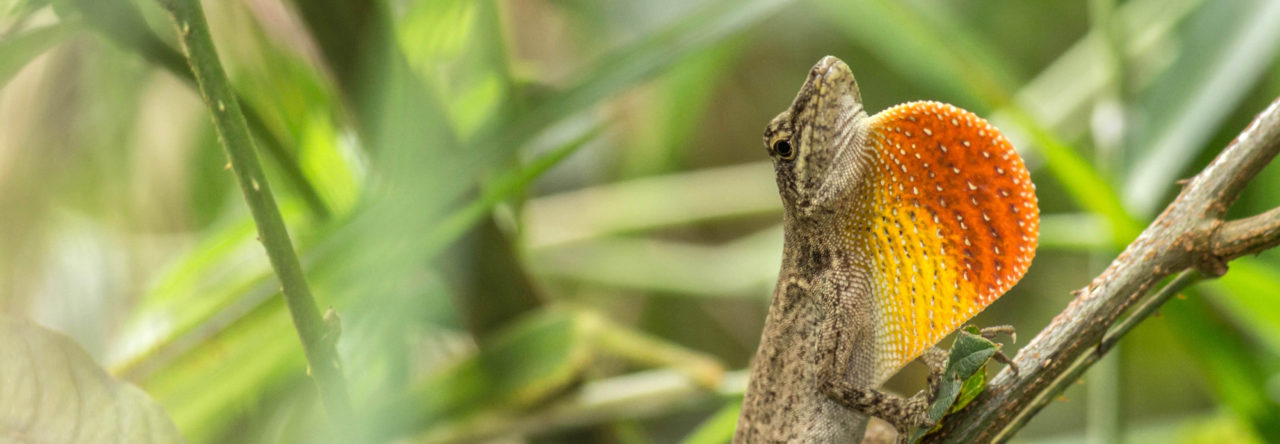
Is It Possible to Distinguish A. carolinensis from A. porcatus

Name that lizard (this one from Miami, not Grand Cayman). Photo by J. Losos

Tennessee lizard guru Sandy Echternacht writes in to AA about the green anoles that have shown up on Grand Cayman, in response to a post from several years ago:

I also think that it is difficult or impossible to distinguish U.S. Anolis carolinensis from U.S. A. porcatus in the field since you typically don’t have live, known A. porcatus for comparison. I think that Wes Chun is correct. Fully adult male A. porcatus are bulkier than A. carolinensis and I’ve seen some with what appear to be large bilateral calcium (?) deposits between the jaw and the neck that give them a bit of the look of a bulldog. I haven’t a clue how, for these two species, to distinguish subadult males and females in general. That shoulder bar (black; often with turquoise blue spots around the edges) is present in many populations of A. carolinensis in the Florida and further north and west, so it can’t be a reliable indicator of A. porcatus.

In addition, most of the relevant research on these issues today concentrates on spectral analyses of skin and dewlap colors, sometimes comparing these to spectral characteristics of the habitat which the lizards occupy. It’s time for a little old school field work. We need detailed narrative descriptions of color AND pattern of live A. carolinensis obtained under controlled conditions of light and temperature and in the maximum green and maximum dark color phases, and of patterning in both color phases, and these data need to be representative of populations across the entire mainland range of the species. If done by multiple investigators, these studies need to employ the same methods and standards. Geographic variation is obvious. Most A. carolinensis have pink to reddish dewlaps but those in southwestern Florida are grayish or greenish, I found a small population between Corkscrew Swamp Sanctuary and Immokalee, FL with pale orange dewlaps, and some males on Oahu, HI have lilac-colored dewlaps. As noted above, the shoulder patch can be entirely absent in a population or present but in frequencies that differ among populations. In East Tennessee, animals in the maximal dark phase are very dark brown to nearly black with no patterning (except a pale venter) whereas those near Gainesville, FL are a gray with a filigree pattern that is whitish in color. The frequency of females with pale middorsal stripes varies among populations. In a part of Withlacoochee State Forest, FL and in the green phase, the color is “chalky” green, along the coast near Ft. Myers it is a beautiful emerald green, further north, as far as Tennessee, it is more of a leafy green. As important as they are, spectral studies usually don’t mention pattern at all, and are carried out only in the green phase. Further, spectral values are of little value to someone working in the field not well versed in visualizing what they mean in the context of the lizard they are holding. I say all of this despite having a friend who is heavily invested in spectral studies. With all of this variation, and without having comparable data for A. porcatus, I’m not sure that we will ever be able to identify in the field with 100% certainty whether a green anole in South Florida (or the Cayman Islands) is A. carolinensis or A. porcatus with the possible exception of a large male A. porcatus with “calcium” deposits.

But I guess I could be wrong.

Video of Anolis proboscis Walking


Video Of A Beating Embryonic Anole Heart

Vimeo user “Ectopher” posted a beautiful video of beating embryonic anole hearts. You can even see the blood flow through the branchial arches at one point. Check it out here.

Beating anole hearts

Videos of Anolis equestris potior

Six months ago, we had a post with some photos by Jesús Reina Carvajal of the lovely Anolis equestris potior. Jesús has now put some videos up on Youtube. There’s not a tremendous amount of action, but it’s nice to see such beauties in action. There are five clips in total–you can access the other four from the one above.

Feed or Fight: Lizard Bite Force on Islands

Colin_With_LizardI’m a bit of an impostor here on Anole Annals, but I’m spending the year in the Losos lab writing up my dissertation and thinking about lizard evolution, so I wanted to share stories from some other island lizards “across the pond.

My dissertation work has focused on the Aegean Wall Lizard, Podarcis erhardii, common through much of the Greek archipelago. I’ve been surveying and experimenting with these lizards in different biogeographic and human contexts to connect trait changes to ecological surroundings. I recently published a paper looking specifically at lizard bite force. Since it comes with pretty pictures and is relevant to anoles, I want to share it here with you all.

For lizards, bite force is often important for determining what you can eat and how well you can fight off competitors. On small islands where food is often scarce, a proportionally stronger bite force might enable a lizard to access hard food items (like snails or beetles) or fight off other lizards, protecting access to mates, food, or prime nesting sites. Both explanations have been demonstrated in anoles: bite force has been closely tied to diet hardness (Herrel et al. 2006), and fighting success (Lailvaux et al. 2004).

I surveyed lizards on a dozen islands in the Cyclades. First, I found that lizards on small islands in the Greek Cyclades had significantly stronger bite forces relative to their body size. I then decided to try to untangle these two potential drivers (diet and aggression) and determine which better explained inter-island variability in bite force.

Donihue_FunEcol_Figure_1

By looking at proxies of competition including bite scars and missing toes, and lizard diets across islands ranging over five orders of magnitude in size, I found that, in general, it was the competitive environment that was driving the trend in P. erhardii bite force.

I’ve put together a short video about the findings for Functional Ecology (see above). For the full paper, please see:

Donihue, C.M., K.M. Brock, J. Foufopoulos and A. Herrel. 2015. Feed or fight: What drives bite force differences in the Aegean Wall Lizard, Podarcis erhardii, across the Greek Cyclades? Functional Ecology. doi: 10.1111/1365-2435.12550 Full text

Papers Cited:

Herrel, A., R. Joachim, B. Vanhooydonck, and D.J. Irschick. 2006. Ecological consequences of ontogenetic changes in head shape and bite performance in the Jamaican lizard Anolis lineatopus. Biological Journal of the Linnean Society 89: 443-454.

Lailvaux, S.P., A. Herrel, B. Vanhooydonck, J.J. Meyers, and D.J. Irschick. 2004. Performance capacity, fighting tactics and the evolution of life-stage male morphs in the green anole lizard (Anolis carolinensis). Proceedings of the Royal Society B: Biological Sciences 271: 2501-2508.

Lizard Playground Dedicated to Anole Happiness and Fitness

News-Journal/Mark Lane

The Daytona Beach News-Journal recently reported on a couple that has built an anole playground. Here’s the article:

The sign says “Lizard Land.” It’s a little sign. A lizard-sized sign, in fact. A sign marking a kind of lizard playground that Carol and Gary Mueller created in front of their home in Ormond by the Sea.

Anoles, small lizards that live around trees and eat insects, are a common sight in Florida yards. If you have enough time to sit very still outside, you’ve noticed their furtive movements up trees, down the side of the house and around the mailbox stand.

The Muellers have the time. “We’re totally retired,” laughs Gary, 70, a retired electrician. “Our biggest decision each day is whether to go to the ocean and fish or go to the river on the boat.”

One day they were sitting on the porch and noticed a particularly determined anole trying to make it to the top of a lawn ornament with a shiny globe on top.

“We were out there one time watching this little guy and he was trying like a dozen times to get up there,” recalled Gary. “So I thought, ‘I’ll make him a little bridge to get up there.’ ”

The little PVC ramp led to a more elaborate little lighthouse Gary made out of scrap wood laying around the garage. And that led to the miniature boathouse along with toy boats the couple found on the beach. And that led to the slide and the slide led to the little castle. It all turned into quite a little spread.

“The boathouse is their favorite part,” Carol. “It’s something to watch. They’re very smart little creatures.”

She said they now have a lizard population of about 15, “eight babies and seven big ones.”

It’s easy to tell them apart. “They’re very territorial, so each one sticks to its own part of the playground,” she said. Sometimes birds eat them but the local cats have mostly left them alone.

The current group of lizards are brown anoles, Anolis sagrei, a non-native lizard first noticed in the Florida Keys in 1887, according to the Florida Fish and Wildlife Conservation Commission, but not recorded in Volusia County until the 1980s.

The couple said they sometimes get green anoles, too, Anolis carolinensis, which are native to Florida. Their numbers are down because of competition from the brown anoles, but they’re holding on. And occasionally, the Muellers spot a third kind. “They look like little dinosaurs, I don’t know what they’re called,” Carol said.

Carol used to be a tram driver at Fort Wilderness at Disney World. “Casting felt I looked rugged,” she said. She liked the job and the people and being outdoors. She met her husband in the 1980s on New Year’s Eve. Both moved here from Orlando. They’ve been at their current home for two years.

“I don’t go there to Orlando anymore,” Gary said. “You need a helicopter to get there anymore.”

“Everything we need is in Ormond Beach,” agreed Carol.

Including the pleasures of sitting on the porch in the evening just watching lizards scamper around the garden.

Caption from article: A brown anole checks out a PVC ramp at Lizard Land in the yard of Ormond-by-the-Sea residents Carol and Gary Mueller. News-Journal/Mark Lane

Caption from article: Lizard tower is seen with an anole holding onto its side in the Lizard Land area of the yard of Ormond-by-the-Sea residents Carol and Gary Mueller. Photo courtesy Carol Mueller

xxx

Anoles’ Namesake Salamander Rediscovered After 30 Years

Nyctanolis pernix. Photo by Robin Moore

The Amphibian Survival Alliance reports: “Two rare salamander species lost to science for nearly 40 years have not only been recently rediscovered, but a consortium of international groups has protected some of the last remaining forest home of the salamanders just in the nick of time.”

One of these salamanders is Nyctanolis pernix, a long-limbed, arboreal salamander. Paul Elias and Dave Wake described the species in 1983 in the festschrift for Ernest Williams, Advances in Herpetology and Evolutionary Biology (in fact, it was the first article in the volume). The authors explained the species name as follows: “We name the new genus for its anoline apsect and nocturnal habitats (Gr., nyktos, night) and the species (L., quick agile) for its gymnastic behavior.

Read all about it on the ASA webpage.

Anolis Entertainment Scores with The Reptile: “Bloody Disgusting”

anolis ent

A movie production company in Germany is named Anolis Entertainment. We’ve mentioned them previously in these pages. What I believe is their latest project, The Reptile, is described by as “Horror at its finest,” winning the coveted “bloody disgusting” rating. Oops. My mistake. The blog is called Bloody Disgusting, but the review substantiates the name. For Anolis Entertainment’s other films, go to their website which, oddly, features an iguana at the top. Be forewarned: the site is in German. I suspect there’s an English version out there, but I can’t find it.

It’s Twins! Two Embryos in One Anolis sagrei Egg

For the last several months, I’ve been collecting eggs from 36 female Anolis sagrei from Gainesville, FL. This is for a project on linking the movement patterns and mating patterns of brown anoles. To be able to assess which males have mated with each of these females, I’ll be sequencing the DNA from the mothers, their offspring, and potential fathers, and then trying to figure out which males have fathered each female’s offspring. All this is to say that what I want from the eggs I’ve been collecting is the offspring’s DNA. To this end, I’ve been dissecting out embryos from eggs about ten days after laying, and storing the tissue for future genetic work.

So far, the females have laid over 300 eggs, and dissecting embryos out of them has gotten a little monotonous. So I didn’t pay any special attention to an egg that looked perhaps a bit bigger than normal. I was shocked, though, when two seemingly healthy embryos popped out of it!

Two embryos from a single brown anole egg

Two embryos from a single brown anole egg

My initial excitement waned when I realised that twins are not that rare in humans, but returned when two anole breeding experts (AA correspondents Thom Sanger and Anthony Geneva) said that they haven’t seen anything quite like this before. In Thom’s words, “I’ve only found two [twins] in over a decade of dissecting eggs, both were conjoined and inviable. I think you have something special.”

Have any of you seen anything like this before?


Anolis garmani, the Green Venus

While canoodling about on the internet, I came across this delightful drawing of a green guana (Anolis garmani), which in turn led me to its source, Naturalist’s Sojourn in Jamaicapublished in 1851. Here’s the charming description of the species, including evidence that the art of lizard noosing has a long history. The description starts here:

1

It then continues:

2

and concludes:

3

And here’s the title page:

4

Page 126 of 305

Powered by WordPress & Theme by Anders Norén