New Research on Brains and Hormones of Green Anoles

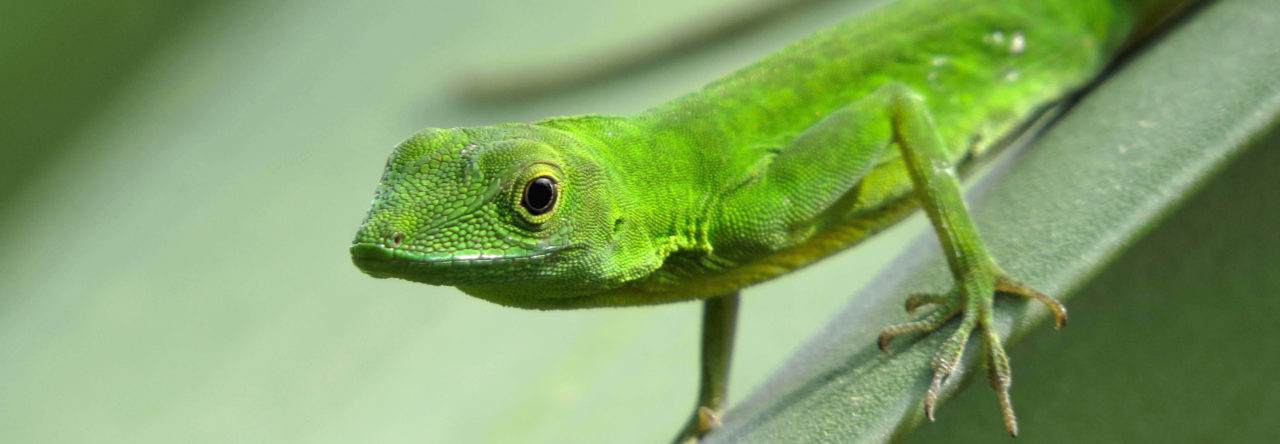
Photo from http://www.exoticpetvet.com/breeds/Green%20Anole.htm

Cornerstone recently reported abstracts from an undergraduate research symposium at the University of Minnesota Mankato. Included in the event were four projects from the laboratory of Rachel Cohen.

Seasonal Effects on Kisspeptin Concentration in the Green Anole Lizard, Anolis carolinensis

Nicholas Booker, Minnesota State University Mankato
Hyejoo Kang, Minnesota State University Mankato


Gonadal steroid hormones are responsible for reproductive behaviors; disruption in production of these hormones is also linked to fertility issues. The hypothalamic-pituitary- gonadal (HPG) axis controls the production of sex steroid hormones, testosterone and estradiol. A peptide, kisspeptin, stimulates this axis by acting on neurons in the hypothalamus. The green anole lizard, Anolis carolinensis, is a seasonally breeding animal that shows drastic changes in behavior and physiology between the breeding and non- breeding seasons. One such change is a large increase in testosterone levels in the breeding season compared to the non-breeding season. These fluctuations in testosterone concentration in green anoles allows for a great opportunity to study the HPG axis. In the current study, we used brain tissue from breeding and non-breeding season green anoles to perform western blot analysis on kisspeptin concentration. Due to the increase in testosterone in the breeding season, we hypothesized that an increase in kisspeptin concentrations will be observed in breeding season compared to the non-breeding season lizards. These results would suggest that kisspeptin does indeed play a role in stimulating the HPG axis and that kisspeptin could potentially be used as a treatment for infertility.


The Effect of Steroid Hormones on Neuronal Size and Number in Two Brain Regions Important for Reproduction

Jaeyoung Son, Minnesota State University Mankato


Steroid hormones, such as testosterone (T) and its metabolites (estradiol, E2, and dihydrotestosterone, DHT), are critical for the production of reproductive behavior. These hormones play a role in neural plasticity, such as changes in neuronal size change and brain region volume. Our study is examining the role of steroid hormones in maintaining the morphology of brain areas involved in reproduction, such as the ventromedial hypothalamus (VMH) and preoptic area (POA). We are using the green anole lizard (Anolis carolinensis) as a model because they are seasonally dimorphic, with more reproductive behaviors and higher steroid hormones in the breeding compared to non-breeding season. We treated our animals with different steroid hormones: T, DHT, E2, and blank capsules as a control. We collected the brains, sectioned the tissue and measured neuron size, number and density in the VMH and POA. We are expecting to find smaller and increased numbers of neurons in the animals treated with steroid hormones compared to the controls. This result would support the idea that steroid hormones are critical for the maintenance of brain areas important for reproduction.


Seasonal Variation in the Dorsolateral and Medial Cortex of Green Anole Lizards

Amber Day, Minnesota State University Mankato
Abdi Abdilahi, Minnesota State University Mankato


The hippocampus is a region of the brain involved in spatial learning and memory, and has been shown to add new neurons in adult animals. Steroid hormones, specifically testosterone

(T) and its metabolites (estradiol, E2, and dihydrotestosterone, DHT), have been shown to play a role in the addition of adult-born neurons to the brain. The green anole lizard, Anolis carolinensis, is a seasonally breeding animal that exhibits seasonally dimorphic behaviors, as well as seasonal anatomical differences in the brain. The pronounced differences between the breeding and non-breeding seasons make this lizard an excellent model for the study of how steroid hormone differences impact the brain. We examined the volume of and addition of new adult-born neurons to the dorsolateral and medial cortex in the lizard, which is analogous to the mammalian hippocampus. We sectioned brain tissue from breeding and non-breeding animals, performed a Nissl stain, and are measuring volume of the regions. We expect that the region will be larger in the breeding season due to the increase of territorial and courtship behaviors. We also treated animals with T, DHT, E2 or nothing as a control and performed an immunohistochemistry to examine how steroid hormones impact neurogenesis. We expect to see significantly more neurogenesis in the dorsolateral and medial cortex of T, DHT, E treated animals in comparison to the untreated group. Our experimental results may provide a greater understanding of the mechanisms that regulate the neural control of reproduction and territorial behaviors.


Amygdala Morphology and Neurogenesis in the Green Anole Lizard

Jadden Roddick, Minnesota State University Mankato
Nicholas Booker, Minnesota State University Mankato
Abodalrahman Algamdy, Minnesota State University Mankato


Steroid hormones and their derivatives play a major role in the reproductive system. One region in the brain that is involved in reproduction is the amygdala. We are examining the relationship between steroid hormones and neuron size, number and neurogenesis in the amygdala of the green anole lizard (Anolis carolinensis). Green anoles are exceptionally good models to examine the neural control of reproductive behaviors because they are seasonally breeding animals and exhibit unique behavioral and physiological differences in the breeding season compared to the non-breeding season. These behavioral differences are likely caused by seasonal changes in circulating steroid hormone levels. For our project, breeding green anole males were gonadectomized and a capsule containing testosterone, estradiol, dihydrotestosterone or left empty was inserted under the anole’s skin. The animals were injected with bromodeoxyuridine (BrdU; a new cell marker) for three days after the treatment. After one month, brains were collected, sectioned, and placed on slides. An immunohistochemistry for BrdU and Hu (neuronal marker) was conducted to examine the presence of new neurons in the amygdala. Alternate sections were Nissl stained and used to count cell number and measure soma size. We expect to see a decrease in neuron number, soma size, and neurogenesis in the animals treated with hormones compared to the animals treated with the blank capsule because we see this pattern in breeding season animals. This work will help provide more insight into the neural control of reproduction.

 

Anole Snapchat

Image-1In an effort to keep anoles hip, I will be curating an anole Snapchat!

Add “bon_anole” (“good anole”) for daily updates on the lizards of north central florida! This is for those of you who don’t get anoles year round (as well as for those of you who love A. sagrei)!


Are Anoles Evolutionarily Adapting to Urban Habitats?

kristin winchell paper AA post

Photo by K. Winchell

In a global change scenario, the persistence of numerous animal populations is challenged by the consequences of human activities. Urbanization, for instance, represents a dramatic habitat transformation that has led to a general pattern of reduced biological diversity in these areas. Paradoxically, some species are doing very well in these new environments. This leads to the question of whether and how these populations are adapting to these new environmental conditions.

Although the number of studies providing evidence for phenotypic differences between urban and natural areas is growing fast, few studies have investigated whether and how animals might be evolutionarily adapting to the intensively modified urban habitats. Kristin Winchell and collaborators address this question in their recent publication in EvolutionPhenotypic shifts in urban areas in the tropical lizard Anolis cristatellus.” The authors studied the habitat use and morphology of forest vs. urban populations of Crested Anoles, Anolis cristatellus, from three municipalities in Puerto Rico. In short, this article provides evidence suggesting that urban anoles are under differential selective pressures as compared with those from forested habitats, and that these differences may have a genetic basis.

As the authors detail in their paper, anoles are a great system to study the morphological consequences of urbanization. This is because much information is available on the relationship between their habitat use, morphology and performance (reviewed in Losos 2009). In urban habitats, natural substrates have largely been replaced by artificial structures such as metal poles and walls. Consequently, it can be predicted that their performance on these surfaces is not optimal, as their morphology may not be suited to use these substrates. Indeed, it has been shown that lizards tend to perch on narrower, less smooth surfaces in natural habitats –a topic that has been dealt with in previous AA posts.

In this paper, the authors use field observations to show that lizards in urban areas use artificial substrates a large proportion of the time and that these urban substrates are broader and smoother than those in natural areas. Then, by X-raying lizards from the different habitats, the authors show that urban lizards have longer limbs (relative to their body size) and higher number of subdigital lamellae -which improve traction for perched lizards- than individuals from forested areas (Fig. 4). This is indeed consistent with ecomorphological predictions that anoles with longer limbs perform better on wider perches. Increased lamellae number should provide lizards with a better grip on smoother surfaces.

Fig. 4 from Winchell et al. (2016). This -really cool- figure shows how urban and natural populations differed in key morphological variables: (a) subdigital lamellae number and (b) limb length

Fig. 4 from Winchell et al. (2016). This -really cool- figure shows how urban and natural populations differed in key morphological variables: (a) subdigital lamellae number and (b) limb length

Finally, the authors conducted a common-garden rearing experiment in which they reared individuals from one of the three pairs of populations studied. The aim of this experiment was to rule out the possibility that morphological differences are merely the consequence of phenotypic plasticity. When measured at approximately one year of age, the first generation offspring of urban lizards showed longer forelimbs and more lamellae as compared to offspring of forest-dwelling lizards (Fig. 5). This result suggests that anoles in urban areas are under significantly different natural selection pressures and may be evolutionarily adapting to their human-modified environment.

Fig. 5 from Winchell et al (2016). Offspring reared in captivity showed the same trend as wild-caught populations of more subdigital lamellae and longer forelimbs in urban individuals: (a) relative limb length and (b) subdigital lamellae number

Fig. 5 from Winchell et al (2016). Offspring reared in captivity showed the same trend as wild-caught populations of more subdigital lamellae and longer forelimbs in urban individuals: (a) relative limb length and (b) subdigital lamellae number

References:

Winchell, Kristin M., Reynolds, R. G., Prado-Irwin, Sofia R., Puente-Rolón, Alberto R., and Revel, Liam J. (2016). Phenotypic shifts in urban areas in the tropical lizard Anolis cristatellus.

Kolbe, J.J., Battles, A.C. & Avilés-Rodríguez. K. (2015) City slickers: poor performance does not deter Anolis lizards from using artificial substrates in human-modified habitats. Functional Ecology.

Losos, J.B. (2009) Lizards in an Evolutionary Tree: Ecology and Adaptive Radiation of Anoles. University of California Press, Berkeley, CA, USA.

Advice Needed on Hatching an Anole Egg

Anole egg from http://www.anoleimaging.com/Anoles/ag_16_egg2.html

A concerned Anole Annals reader writes in:

My dog just violently chomped  a female alone. Along with her entrails protruding from her body we two eggs. One was small, under-developed the other was the size they are laid. I have at the time done my best to put it into a container and emulate the  same conditions outside ( I live in Florida) with  dirt, leaf litter (small) moisture and heat. I removed the placental outer membrane which would have been separated if she had laid. I feel terrible my young and excitable dog did this. Is there any hope?

Can anyone advise?

The Empire Strikes Back: Anolis equestris Thwarts Snake Predation Attempt

equestris

A noble beast and mighty warrior.

Read all about it in Rodríguez-Cabrera et al.’s new paper in IRCF Reptiles & Amphibians.

snake attempt

Ever Wondered Why Anoles Have Such Large Toepads?

carolinensis male holding on to another

Localities for Anolis lemurinus in Costa Rica

Hello AA readers! I’m writing today with a favor to ask. I’m planning to do some research on Anolis lemurinus in Costa Rica this summer, and I’m looking for potential field sites. I’ve been to La Selva Biological Station, which seems to have a healthy population, but if you know of any other localities in Costa Rica where A. lemurinus are abundant, please let me know! I’d greatly appreciate it.

Please contact me at pradoirwin [at] g.harvard.edu

Thanks!


Whooping Crane Eats Anolis Lizard

Egret and maybe anole

We’ve come to realize, sadly, that just about everything will eat anoles. Birds are particular culprits and we’ve seen some horrifying examples of egrets downing the little green and brown fellows. Now comes a report that a whooping crane, of all things, will also indulge.

Vladimir Dinets–he of crocodilian behavior fame (check out his awesome book, Dragon Songs )–reported on dietary observations a reintroduced population of cranes in Louisiana. The anolivory represents the first instance of whooping crane predation on a lizard (but not on a squamate, as the photo above attests).


Aquatic Anole Sleep Site Fidelity

small anolis aquaticus 6

Juvenile Anolis aquaticus wakes up for science, Photo: Jonathan Flanders

One of the many wonderful things about anoles is that anole-hunting can be a 24/7 experience, as many nocturnal Anole Annals adventurers have shown and I’ve noted before. As an undergraduate, I spent many days and nights scanning trunks, leaves, sticks, bushes, etc. for anoles — a habit that got so ingrained that I still do it while hiking around northern California. So, logically, when I found myself in Costa Rica for the last field season of my Ph.D. (which is on bats), I had to do some lizard spotting, if only to remind myself of the good old days when I studied animals that don’t fly or bite. (Ok, anoles bite but that’s what makes them such great fashion accessories.) As I was already up until all hours of the night, I decided to check out where anoles were sleeping. There happened to be a small group of aquatic anoles living near my cabin and I (along with my batty colleague) noticed that each night they seemed to be in the same place — one email to Jonathan later and we wrote up a short note for Herpetological Review about sleep site fidelity in Anolis aquaticus.

small aquaticus 2

Who turned the sun on? Photo: Jonathan Flanders

We observed the lizards for 16 nights over a period of 24 nights and found that of the six individuals, they were in the same place almost 80% of the nights, which is very high compared to what has been found in some other species. All of the lizards were perched in such a way that they were either obscured from view or had easy access to water to escape from predators. The area was particularly dry at that time so this may have reduced the number of suitable sleep sites for these aquatic lizards or maybe aquatic anoles are just pretty faithful to their sleep sites. In any case, it was a lot of fun to go back to my lizard-y roots and find some sleepy anoles.


Green and Brown Anoles Living in Harmony on Little Cayman

Photo by Pat Shipman

Photo by Pat Shipman

We’ve often commented on the interactions between the green anole, Anolis carolinensis, and the brown anole, Anolis sagrei. We’ve also had periodic posts from Pat Shipman on Little Cayman, who moonlights as an anthropologist and science and history writer when not watching anoles.

Here’s further evidence that greens and browns can coexist: A. maynardi (a relative of A. carolinensis) and A. sagrei side-by-side, ten feet up on a wall.

Page 113 of 305

Powered by WordPress & Theme by Anders Norén