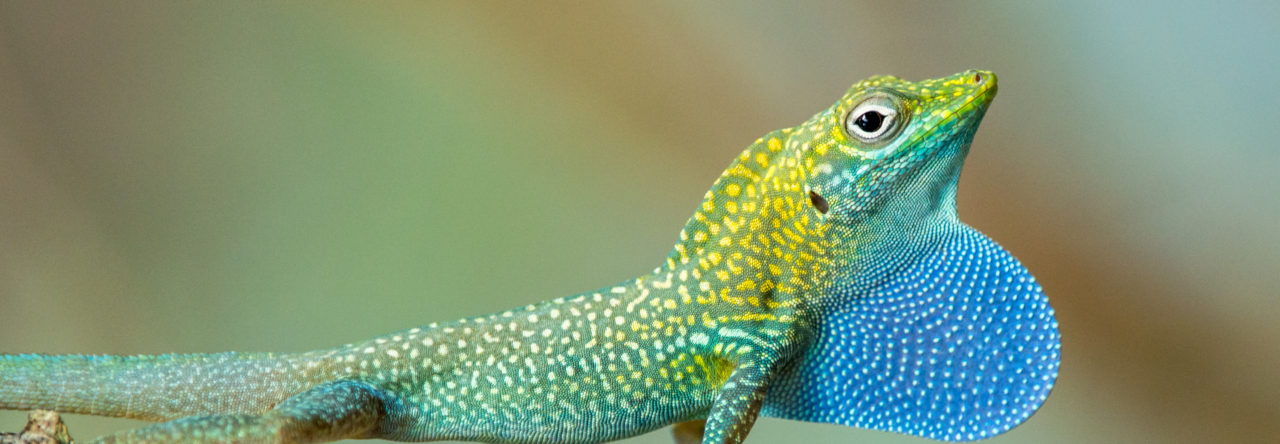
Anolis maynardi Male-Male Territorial Bout

This video was filmed and shared by Jen Moss of the Welch Lab at Mississippi State University. She observed the encounter near Preston Bay, Little Cayman, and it’s a great video showing this behavior. Lots of dewlaps, pushups, and potential exposure to predators owing to the use of a non-natural substrate. Thanks Jen!


Super-Honest Dewlaps and Trait Scaling Relationships in Semi-Aquatic Anoles

OLYMPUS DIGITAL CAMERA

Anolis aquaticus, the semi-aqautic anole. Photo by Lindsey Swierk

From backyard anole enthusiasts to researchers with decades of experience, dewlaps are a favorite topic of discussion here on Anole Annals. We love documenting the diversity of dewlap colors and patterns (1, 2, 3, 4), judging “best/biggest dewlap” contests (1, 2, 3), and noting dewlap oddities across the genus (1, 2, 3, 4). We’re slowly piecing together an answer to the question of what role dewlaps actually serve in signaling and, in particular, what kind of information they might convey. As you might expect, it’s a pretty complex problem, made even more interesting by the fact that dewlap information content probably reflects the unique pressures placed on individual species.

I’ve recently been working on untangling the mystery of dewlaps in a quirky species of anole, Anolis aquaticus. This water-loving anole is found along streams in pockets of southern Costa Rica and northern Panama, and it has the delightful habit of diving into water when startled. Even among the aquatic-specialized anoles, A. aquaticus is different: it tends to live in ultra-close proximity to water, preferring boulders and crevices directly in the “splash zone” instead of streamside vegetation such as other aquatic species like A. oxylophus. There’s also good reason to think that A. aquaticus has a pretty rich social life – male-female, male-male, and female-female pairs can be found within a few centimeters of each other, and often in dense groups on small rocky islands.

In light of their unusual habitat and living arrangements, we decided to explore how dewlaps correlated with multiple morphological parameters in A. aquaticus. In particular, we decided to use this species to explore a long-standing, but recently debated, paradigm that most sexually selected traits (like dewlaps) scale to body size with positive allometry – or, in other words, that they’re disproportionately large in larger individuals. Last year, we captured male and female (who lack the characteristic reddish-orange dewlap) A. aquaticus and measured multiple sexual and non-sexual traits to test this idea. Our results, available in an accepted article in Integrative Zoology, allowed us to contribute our perspective to the greater understanding of the relationship of sexual selection and allometric scaling patterns. Spoiling part of the punchline, our findings do not support the traditional idea that positively allometry is a hallmark of sexual selection.

The dewlap of Anolis aquaticus. Bar represents 1 cm.

The dewlap of Anolis aquaticus. Bar represents 1 cm.

But, equally as notable, our results also suggest some interesting features of this species, including the information content of its dewlap and how allometric patterns interact to produce sexual dimorphism. We found that dewlaps are “super-honest” signals in A. aquaticus; they could serve to amplify size differences between males signaling at a distance because of their positive allometric scaling with body size. Consequently, our study and a recent study by Driessens et al. 2015 (on A. sagrei), oppose previous ideas that dewlaps approach an asymptote of optimum size to balance the pressures of signaling with predation. Our findings are also novel in that they suggest that dewlap color (redness) may serve to convey information about male weaponry: anoles with redder dewlaps were found to have head shapes that correspond to producing greater bite force.

By comparing allometric relationships between males and females, we can also begin to identify how sexual differences in proportionality link to sexual dimorphism and ecology. For instance, male hind limb length in A. aquaticus is on average larger than that of females, but becomes disproportionately smaller as male body size increases. This opens the door to the idea that, because males are larger than females, limb length sexual dimorphism might be the result of an optimal limb-body size relationship regardless of sex; A. aquaticus of either sex with overlong limbs would probably be at a disadvantage if they needed to flee over narrower surfaces such as branches or vines.

Scaling relationships of snout-vent length and a) mass, b) limb length, and c) head length for male (closed dots, solid line) and female (open dots, dashed line) Anolis aquaticus. Axes are log scaled.

Scaling relationships of snout-vent length and a) mass, b) limb length, and c) head length for male (closed dots, solid line) and female (open dots, dashed line) Anolis aquaticus. Axes are log scaled.

Finally, our results hint at the existence of two life-stage male morphs in A. aquaticus, as already identified in other anole species. Body scaling relationships show that small males have disproportionately small dewlaps, small heads, and large limbs, whereas large males have bigger dewlaps, bigger heads, and smaller limbs than should be expected for their body size. Taken together, these results provide a foundation for future research into “heavyweight” and “lightweight” male morphs and associated behaviors. With their small home ranges and apparently high tolerance for same-sex home range overlap, this could be an especially exciting avenue of exploration in A. aquaticus. In any case, it’s certain that there will be much to learn from this watery, elusive, semi-aquatic anole.

You can read more about this project in our accepted manuscript published online in Integrative Zoology. My co-author on this study, Maria Petelo, is an undergraduate at the University of Hawaiʻi who was supported by OTS/NSF’s Native American and Pacific Islander Research Experience, a program designed to increase the representation of underrepresented groups in the natural sciences.

Dragons in Asian Plantations

Hello Anole enthusiasts. This will be a slightly different post to the usual in that Anolis won’t feature at all! I am one of those weird lizard researchers that is yet to feel the scientific attraction many of my colleagues feel towards Anolis and, as such, have always preferred their much spikier old world agamid counterparts- the garden lizards of the genus Calotes.

I’m currently doing a Ph.D. (supervised by long term AA member Adam C. Algar at The University of Nottingham, UK) that looks at how agamids use the various habitat types within South East Asia (in particular, Peninsular Malaysia), focussing on oil palm plantations, rubber plantations and secondary forests. While some agamids occupy one or more of these habitat types, only a single genus has colonised all of them- Calotes. Calotes versicolor will doubtless be familiar to any herper who has been on vacation to Southern Asia, a large, red-headed take on Anolis sagrei with the same aggressive character and, unfortunately for everything else, the same ability to dominate in invasive situations. While C. versicolor is present in human modified habitats in Malaysia, the forested North of the country is home to a larger, even spikier species: C. emma, which will occupy the forest edges that C. versicolor seems to avoid. We chose C. emma for this reason as the ability to draw comparisons between the semi-natural forest edges and man-made plantations was key to this research.

dscf2553

An adult female Calotes emma in a heavily disturbed oil palm plantation (photo: James J. Hicks)

We measured such Anolis study staples as body temperature (Tb), perch type and behaviour when encountered and all the usual morphology traits. We also characterised habitats structurally using random transects and thermally using ibuttons in copper models and measured thermal performance using a racetrack (not an easy piece of equipment to build in the tropics!) and HD camera.

Differences in behaviour were noticed immediately with C. emma being highly arboreal in rubber plantations (and difficult to noose!), using the smooth trunks to ascend from predators/herpers and rotating around in typical agamid fashion. In oil palm plantations the equivalent ‘trunk’ structures consisted of blocky remnants of fronds that form a hard, smooth surface that lizards tended to avoid (shame these ones don’t have toepads!). Consequently most C. emma were seen on the ground and in and amongst discarded piles of the fronds at most ca. 40 cm from the ground, using these piles as both perches and refugia. In forest edge habitat Calotes used a wide range of perches that incorporated similar heights and structures to those used in the plantation habitat but was much less abundant than in either plantation type. These behavioural differences coincided with differing femur lengths with the arboreal Calotes in rubber having the longest femurs, for their snout-vent length alongside utilising statistically wider perches.

Thermally, plantation habitats were hotter and more variable than forest edges at relevant scales to lizards as has been documented previously at larger scales. Despite this, operative temperatures fell well within C. emma’s thermal tolerances and, currently at least, seem more favourable for this species. Whether climate change will push these habitats closer to C. emma’s critical thermal maximum remain to be seen but applying the ‘standard’ 3°C rise still won’t, theoretically at least, impact their thermal performance.

In short, plantations seem to be great habitat for Calotes emma! They are extremely abundant in these man made habitats, more so than any other vertebrate species despite each plantation type seemingly forcing them to rely on different, single axes of their fundamental niche. The downside is, as always, plantations trade low abundance and high diversity for high abundance and low diversity. While rubber plantations support at least 3 other agamid species in our study area, C. emma was the sole representative in oil palm. Whether this is due to thermal aspects (is it too hot for larger-bodied forest dragons?) or structural aspects (Draco probably can’t glide onto oil palm trunks) or something completely different remain to be tested in a future session of fieldwork. This will focus on assessing the more poorly understood forest specialist agamid species’ structural and thermal niche axes and whether these requirements are met by plantation habitats.

Gonocephalus bellii

My future fieldwork will focus on forest specialist agamids such as Gonocephalus bellii (pictured) and try to explain why they are absent from human dominated habitat types (photo: James J. Hicks)

Parasitic Fly Larva in Anolis cristatellus?

img_2400

This was a first for me: an anole with an odd, tic-tac sized growth on its lower left jaw. Though it is difficult to see in the image, there appears to be a small hole or opening in the cyst-like growth, potentially where a little sarcophagid larva will emerge from. (I’m not sure of the identity of the parasite, if indeed that is what is causing the growth – more information on the topic can be found in an older Anole Annals post).

As for the identity of the anole itself, I managed to catch a nearby individual (lacking any cysts) that I believe is the same species. It had a beautiful yellow dewlap, leading me to believe they are Crested Anoles (Anolis cristatellus).

anole-small

Insights from Three Years of Measuring Anolis sagrei Reproductive Success

Female Festive Anole (photo: Ambika Kamath)

Female Festive Anole (photo: Ambika Kamath)

Sexual dimorphism–differences between the sexes in what they look like–is rampant across animals. But how do these differences arise? Why and how might natural selection or sexual selection act differently on males and females? In a new paper from Duryea et al. (2016) published last month, we begin to see what answers to these questions look like in our very favourite organism, the festive anole, Anolis sagrei.

The data presented in this paper is unprecedented in anoles–by catching every lizard on Kidd Cay for four successive years, the authors assigned parentage to three generations of offspring, and thus assigned reproductive success to three generations of adults. Using these measures of reproductive success for males and females, they ask a straightforward question: is reproductive success correlated with body size, and do these relationships differ between males and females?

The results, however, are not straightforward: patterns of selection differ quite a bit across the three years of sampling, especially in females. But overall, we see directional selection on body size in males (bigger males father more offspring who survive to adulthood than smaller males), possibly explaining why male festive anoles are 30% larger than females.

We don’t yet understand the origins of sexual size dimorphism in anoles–why in particular, does the shape of selection on female body size vary so much? Do large males sire more offspring who survive to adulthood because they mate more often, or because their offspring are somehow better at surviving? Duryea et al. have propelled forward the state of our knowledge with a formidable dataset that raises exciting new questions.

The Evolution of Variation in Back Patterns in Anolis

Many species of anoles exhibit distinctive dorsal patterns, including spots (e.g. A. sabanus), stripes (A. krugi) or chevrons (A. sagrei) (Figure 1). Dorsal patterns are highly variable in anoles, presenting not only variation across species, but also within species (sexual dimorphism) and within sexes (polymorphism). So why is there such a large variation in dorsal pattern?

bij12881-fig-0001

Figure 1. Examples of dorsal pattern in Anolis lizards. A, A. sagrei, B, A. krugi, C, A. sabanus (photograph by B. Falk). D, A. pulchellus. Photographs A, B and D by D. L. Mahler.

Previous posts (1,2) explain the extent of the variation in dorsal pattern within females, a phenomenon known as female-pattern polymorphism (FPP), where females are more likely to present variation in dorsal patterns than males. Other studies have tried to explain within-population variation in dorsal pattern in several Anolis species with montane and xeric distributions. These studies suggest that habitat and crypsis could be an important factor explaining variation in dorsal pattern in Anolis.

Anoles are famous for having evolved convergent ecomorphs in different islands in the Caribbean. Each ecomorph is associated with a suit of adaptive traits that has evolved in response to their ecology. Some years ago, I went to the Losos Lab to explore, using several species of Anolis and hundreds of museum species, whether ecomorphs could explain variation in dorsal pattern. Namely, we wanted to know whether differences between ecomorphs could explain the degree of sexual dimorphism in dorsal pattern and female polymorphism, using 36 species of Anolis from the Greater Antilles.

In our paper, published on early view in the Biological Journal of the Linnean Society, we built a matrix with 11 different characters that described dorsal pattern. We used this matrix to construct a principal coordinate space, and in this space we calculated distances between male and female dorsal pattern for each species  (amount of dorsal pattern sexual dimorphism) and the variation in dorsal pattern within each sex (amount of polymorphism within sex).

We found that species perching closer to the ground have higher degrees of sexual dimorphism, and males and females from these species usually present different patterns (Figure 2). For example, in A. bahorucoensis, a grass-bush species, females present a dorsal stripe, while males have chevrons. We also found that size dimorphism is correlated to dorsal pattern dimorphism, and species perching closer to the ground have larger differences in size and dorsal pattern between sexes, suggesting that both types of dimorphism are evolving together. We suspect that larger differences in habitat use between males and females in low-perching species may explain why some species are more dimorphic in dorsal pattern that others.

bij12881-fig-0002

Figure 2. Association between sexual dimorphism in dorsal pattern and ecomorph in 36 species of Anolis. A, Phylogenetic tree with coloured branches representing values of dimorphism in dorsal pattern (Euclidean distance). Circles at tips represent ecomorph and the colour legend is the same as in (B). B, Values of dorsal pattern dimorphism according to ecomorph class.

On the other hand, ecomorph could not explain why some in some species there is higher variation in dorsal pattern in females (FPP). In our study, 44% of the species presented significantly higher female polymorphism than male polymorphism, reflecting how widespread is this phenomenon, but this was not related to ecomorph type. However, species with higher female polymorphism also had males that were more variable, suggesting that they might be under similar selective pressures. More precise information on habitat preferences within sexes, especially in  females, will be required in order to fully understand the mystery of female-biased polymorphism.

Reference

Medina, I., Losos, J.B. & Mahler, D.L. 2016. Evolution of dorsal pattern variation in greater Antillean Anolis lizards. Early view, Biological Journal of the Linnean Society.

Rodolfo Ruibal, R.I.P.

AA is sorry to learn of the passing of Rodolfo Ruibal, an eminent Cuban herpetologist based at UC-Riverside for many years. Rodolfo did important early work on thermal biology andsocial behavior of Caribbean anoles. For example, 1961 paper showed thermoconformity in some lizards (when everyone though that lizards always thermoregulate carefully), it showed that physiology can evolve faster than morphology, and it proposed that only thermoregulators (not thermoconformers) could invade the temp zone.

You can find transcripts from a 1998 interview with Rodolfo as part of a UC-Riverside history project. Here’s the obituary that recently appeared in UCR Today:

Professor Emeritus Rodolfo “Rudy” Ruibal, a founding member of UC Riverside’s Biology department whose passions included lizards, frogs and making beautiful jewelry, died Aug. 30 at the age of 88, just six months after the death of his wife of 68 years, Irene Shamu Ruibal.

“He was instrumental in forging the department in the directions and expertise that form its center now,” said Professor Michael Allen, chair of UCR’s biology department.

Ruibal was a native of Cuba who conducted research in several parts of South America with fellowships from the National Science Foundation and the John Simon Guggenheim Memorial Foundation. He was an early student of temperature regulation in reptiles and amphibians, said friend and colleague Professor Mark Chappell, and was also known for his work with water loss in amphibians and their ability to waterproof their skin by using waxy glandular secretions the animals wipe over themselves.

“He taught the Biology 161 course, on functional vertebrate morphology, or ‘Vert’ to generations of premeds and other life science students, and was renowned for both the clarity of his lectures and for his skill in drawing structures on the blackboard,” said Chappell.

During Ruibal’s 42 years at UCR, he helped establish the Philip Boyd Desert Research Center and spent a year as the acting director of UC MEXUS, created to stimulate teaching and research between California and Mexico. Ruibal also spent a year advising a man he much admired—UC President Clark Kerr—about faculty requests and concerns.

“He always had one faculty member in his office,” Ruibal said during an oral history interview in 1998. “It was his way of simply making sure his faculty were being treated by an academic who knew what the score was, rather than somebody who was just a bureaucrat.”

Ruibal’s life read like a novel. He was born in Cuba on Oct. 27, 1927, an only child who attended the same Jesuit school as Fidel Castro. The budding scientist had an early fascination for animals, said his son, Claude Ruibal of Zurich, Switzerland. Rudy Ruibal’s earliest memories were of watching fish swimming in the waters of Cuba, and chasing lizards in his yard, something his aunt remembered years later, when he returned to Cuba for research on an NSF grant project.

Reptiles and research always fascinated Ruibal, and he excelled at an early age. He enrolled in Harvard when he was just 16 years old, after completing high school at the prestigious McBurney School in Manhattan.

Ruibal took a break from Harvard when he was 18, to serve in the military at the tail end of World War II. But he returned to school a year later and married his wife, Irene, a secretary in the Department of Herpetology in the American Museum of Natural History.

By the time he was 21, Ruibal had finished his BA at Harvard and enrolled at Columbia University for graduate studies in biology. At 26, Ruibal completed his PhD and accepted a position at a new liberal arts college called UC Riverside, where Howard Spieth, one of his former professors at Columbia, had become the chair of the life science’s department, and would later become the university’s first chancellor.

Ruibal began teaching in the fall of 1954, the second semester for a school so new that it had no landscaping or trees. Their son was born the following year, in 1955. Claude Ruibal said his parents were loving but not overbearing. His father, he said, “was a thoughtful guy, a moral guy—very rational and not very emotional. I don’t think I ever heard my parents argue.”

His mother loved to cook and throw dinner parties, and they cultivated a diverse group of close friends—artists, business people, even the publisher of the newspaper. His father loved tennis, playing into his 80s, and did a lot of reading about history and politics.

Ruibal also was a noted local artist. Shortly after he arrived in Riverside, he successfully lobbied the Riverside Art Museum to have real nude models available for sketching (instead of women in bathing suits). He later branched into candle making, ceramics —complete with his own kiln—and finally, making brass and silver jewelry, which were top sellers at the Riverside Art Museum, Mission Inn Museum and other locations.

Anole Fashion: Dorsal Crests and Curlicue Tails

Daffodil’s Photo Blog has some nice photos of stylish anoles. Some anoles–the festive anole (A. sagrei) being a prime example, seem to have a penchant for sitting with their tails hanging in a lovely. Why do they do it? Got me.

We do know why they raise their dorsal crests–to look fearsome, as this mini-dinosaur does. How they do it, though, is another matter, when discussed previously in these pages (1,2).

Best Anole Dewlap of All Time?

sericeus

There are many contenders, but my favorite is Anolis sericeus, seen above from the Kanahau research station on the Honduran island of Utila, and another photo below from Chiapas, Mexico.

Age Structure of Invasive Green Anole Populations near Japan

Yasumiba et al 2016 Fig 1

Figure from a new paper by Yasumiba et al. illustrating how LAGs in the cross sections of bones can be used to infer lizard age.

Anolis carolinensis is a disruptive invasive species in the Osagawara Islands near Japan, a UNESCO World Natural Heritage site.  It was first recorded on the island of Chichi-jima in the 1960’s and has since spread to surrounding islands. A recent post on Anole Annals describes efforts to improve the effectiveness of adhesive lizard traps on the islands by using cricket bait.

A new paper by Yasumiba et al. improves our understanding of these invasive A. carolinensis by quantifying their longevity and growth rates using skeletochronology.

Page 102 of 305

Powered by WordPress & Theme by Anders Norén