
Alto Velo Island. Photo by R. Graham Reynolds.
Although I have not been a prolific poster on AA, I have enjoyed contributing articles about the obscure and rarely seen anoles of the Greater Antilles and Lucayan archipelagos, such as Anolis ernestwilliamsi, Anolis fairchildi (1,2,3), and Anolis scripts (1,2,3,4,5).
Here is another post in that series, focused on Anolis altavelensis, the Alto Velo anole. First, a bit of background. I am currently collaborating with Joe Burgess of the National Park Service (USA), Brad Keitt of the American Bird Conservancy (USA), and Jorge Brocca of SOH Conservación (Dominican Republic) on a multi-year project focused on the ecological restoration of Alto Velo Island. This project includes detailed surveys of terrestrial fauna, followed by the removal of invasive species and recovery monitoring.
Alto Velo Island is located about 30 km off the coast of southern Hispaniola, south of the town of Pedernales, Dominican Republic. Part of Jaragua National Park, the island is separated from Isla Beata, and the mainland of Hispaniola, by a deep-water channel. This means that the island contains some endemic reptile species, including A. altavelensis, as well as endemic Leiocephalus and Sphaerodactylus. It also means that not many scientists have visited, as the island is very challenging to reach without either a large boat or a very skilled panga captain. The crossing is dangerous at the best of times, with winds regularly reaching 15–25 kts and waves 1.5–2 m, conditions that are challenging, if not reckless, for open vessels. There are no landing beaches, and a rocky coast surrounded by reefs await those who cross the Beata Channel. As I can now personally attest, this island is not for the faint of heart.
But what awaits is spectacular! Alto Velo Island is very tall, much taller than you might perceive from a satellite view, with a peak of 150 m and a series of dramatic hills that fall precipitously down to the blue sea. A wide, flat plain graces the north end, although a mixture of invasive grasses and African milkweed mars the landscape. The island has historically been heavily impacted by guano mining, an extractive industry that has left numerous islands and islets in the Caribbean in ecologically degraded states, as well as probably contributed to the extinction of some reptile species (such as on Navassa Island). Nevertheless, some endemic reptiles remain on Alto Velo, including the anole.

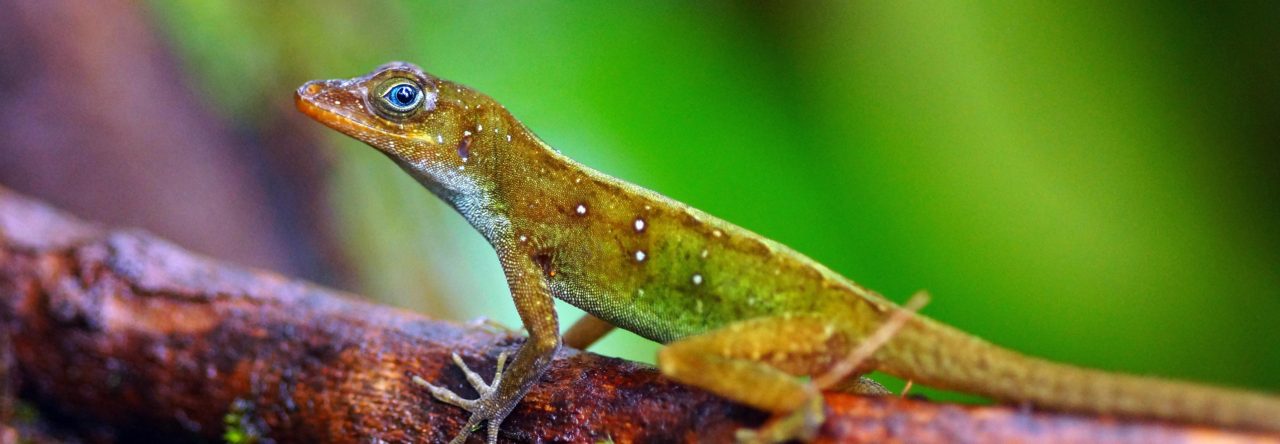
Anolis altavelensis. Photo by Joseph Burgess.
And what an anole is found there! Anolis altavelensis is dramatically beautiful, even among a superlative group of the bark anoles (distichus series) that are renowned for their variety and beauty. This species is electric orange, meaning that a sweep of a flashlight over a bush at night resembles a Christmas tree with small orange jeweled ornaments dotting the green leaves. Spectacular!
Happily, the species is relatively common on the island, despite an extremely damaging history of guano mining, burning for goat grazing, and infestation with cats, rats, and many invasive plants. Some native vegetation remains, particularly on the steep slopes, but a goal of the restoration project is to restore the native vegetation as well. Stay tuned for updates on this project as we hope to see Alto Velo restored to its ecological vibrancy and remote beauty.


