Category: Notes from the Field Page 4 of 22

Anolis maynardi Male-Male Territorial Bout

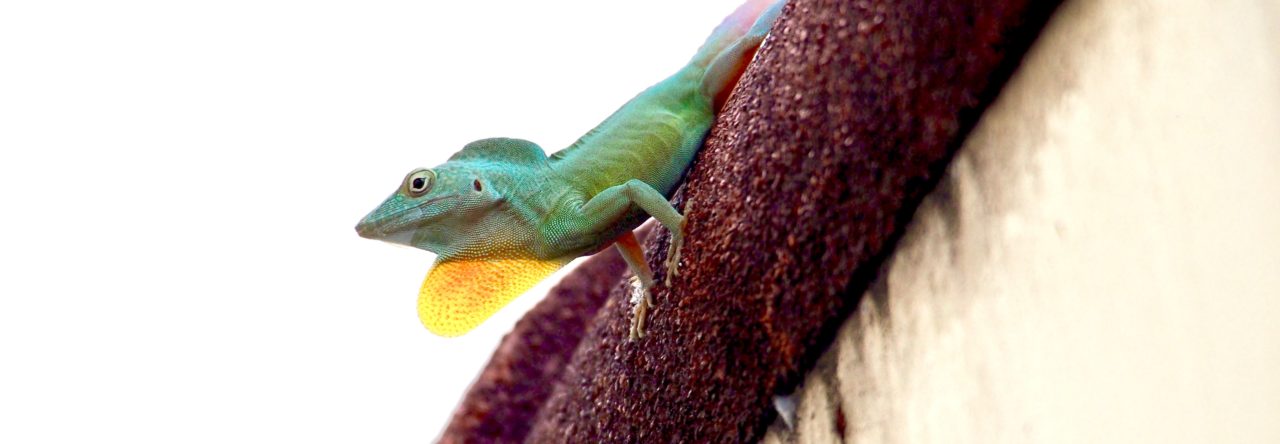
This video was filmed and shared by Jen Moss of the Welch Lab at Mississippi State University. She observed the encounter near Preston Bay, Little Cayman, and it’s a great video showing this behavior. Lots of dewlaps, pushups, and potential exposure to predators owing to the use of a non-natural substrate. Thanks Jen!


Field Notes from Long Island, Bahamas

smaragdinus-and-sagrei

Anolis smaragdinus (left) and Anolis sagrei (right) from Long Island, Bahamas. The individual on the right is marked as part of selection study.

This past August, two field assistants and I went to Long Island, Bahamas to collect data on sympatric populations of Anolis sagrei and Anolis smaragdinus as part of a natural selection study. Our primary study area is a small island (approximately 1000 ft x 200 ft) in the middle of a lake with relatively high densities of both species. While in the field we observed some interesting behaviors that I want to share with the AA community in hopes that you will find them interesting as well!

1) Frugivory by anoles was common at our study site, which had an abundant supply of small berries from black torch (Ertihalis fruticosa) and small-leaved blolly (Guapira discolor).  Anolis smaragdinus was usually the culprit, although we did we did see one adult male A. sagrei eating fruit.

2) We captured (and released) over 150 unique A. smaragdinus and later re-spotted several of those individuals. During a typical eight-hour day, we encountered 15-20 individuals, a surprisingly large portion of which were a male and a female in the same tree. These instances made a particularly strong impression on me when they were separated by long periods of not seeing any A. smaragdinus. I can think of multiple occasions in which we found a couple together, saw no individuals for another three hours, and then suddenly came across another couple. In several instances, there were three individuals in the same tree. I’m not aware of green anoles mate guarding, and unfortunately the data I have don’t have the resolution to provide much insight here, but the pattern was definitely striking.

smaragdinus-cannibalism

3) We observed an act of cannibalism in A.smaragdinus, a species for which cannibalism has not previously been reported (although it has reported for the closely related A. carolinensis). We captured an adult female, saw that she was eating something, and proceeded to lose our marbles after pulling a hatchling (pictured) out of her mouth. Acts of cannibalism by female anoles appear to be rather uncommon (see page 30 of this Anolis newsletter), making this observation perhaps the most intriguing of our adventure!

JMIH 2016: Rock ‘n’ Bowl Anole

At the JMIH in New Orleans this past July, the 100th anniversary celebration of the ASIH was held at the Rock ‘n’ Bowl, where music, food, drink, dancing, and bowling were enjoyed by all. But for those who were alert on their way in, there was an added bonus: anoles! Or, at least, one anole, spotted by Quynh Quach and corralled by Kristin Winchell.

Quynh and Kristin spot their quarry.

As other attendees file in, Quynh and Kristin spot their quarry in the bushes.

Taking a picture of the crowd filing in, I serendipitously caught our two intrepid anoleers  about to make the catch in the bushes to the right of the entrance. Kristin made the grab, and displayed her catch.

Kristin displays the catch.

Kristin displays the catch.

It was, of course, Anolis sagrei, the invasive Cuban species which has been spreading through the southeastern US for more than 80 years now. He was a nice-sized adult male, typical of the nominate form that occurs through most of the species’ US range.  The edificarian habitat– in bushes at the edge of a parking lot next to a building– is also typical of where invasive sagrei can be found.

Adult male Anolis sagrei, New Orleans, Louisiana, 10 July 2016.

An appreciative crowd gathered.

Eager anolologists immortalize the NOLA anole in pixels.

Eager anolologists immortalize the NOLA anole in pixels.

I was glad to see it, because prior to this I had only seen Anolis carolinensis in New Orleans (more on this in a later post).

Quyhn and Kristin show off their catch.

Quynh and Kristin show off their catch.


Ecology of the San Salvador Bark Anole (Anolis distichus ocior)

 An adult male San Salvador Bark Anole (Anolis distichus ocior) displaying. Photograph by Guillermo G. Zuniga.

An adult male San Salvador Bark Anole (Anolis distichus ocior) displaying.
Photograph by Guillermo G. Zuniga.

Dayton Antley and colleagues from Avila University, the home of AA stalwart Bob Powell, recently published a detailed study of the ecology of the San Salvador bark anole (Anolis distichus ocior) in IRCF Reptiles & Amphibians (an open-access herpetological journal, with this article available here). Anolis d. ocior is one of 17 recognized subspecies of the diverse distichus group, and is found on only San Salvador and Rum Cay (Henderson and Powell 2009).

Antley et al. assessed microhabitat use, activity patterns, and approach distances of A. d. ocior in an approximately 0.3ha study area on the grounds of the Gerace Research Centre, dominated by Tropical Almonds (Terminalia catappa), Papaya (Carica papaya), and Ficus trees.

A Google Map view of the Gerace Research Centre. The study site (24°07'05.2"N 74°27'50.9"W) is outlined in white.

A Google Map view of the Gerace Research Centre. The study site
(24°07’05.2″N 74°27’50.9″W) is outlined in white.

In assessing patterns of microhabitat use throughout the day, Antley et al. conducted surveys every two hours for two days from 0700h (about 40 min after sunrise) to 1900h (about 40 min before sunset). Size class, perch height and diameter, body orientation relative to the ground, and thermal microsite (sun/shade/mixed) were recorded for every observed lizard. In the following two days, approach distances were assessed. This was achieved by a surveyor, wearing neutrally-coloured clothing, approaching an undisturbed anole at a steady pace and recording the distance at which the lizard reacted. Over two additional days, 10-minute focal animal observations were conducted of individual adult lizards (including both males and females) at a distance of 5m. The number of movements (changes in location or orientation), head turns, and head bobs were recorded for all lizards, with dewlap displays and pushups being additional recorded for males.

Lizards were active throughout the day, with activity peaking in the early morning and before midday. This was compared to ambient air temperatures recorded 1m from the ground in a shaded and sheltered location. This result surprised the authors, as a second activity peak in late afternoon/early evening was expected, as has observed in other similar studies of bark anoles (e.g. Hillbrand et al. 2011).

Mean number of lizards active (bars) and mean ambient temperatures (dots) per time period. Temperature data were collected on two consecutive days.

Mean number of lizards active (bars) and mean ambient temperatures
(dots) per time period. Temperature data were collected on
two consecutive days.

Adult males experienced highest levels of arboreality during the middle of the day, while subadult males and adult females (grouped together as they can be hard to distinguish from distance) were highly variable (see figure below). Most lizards of all classes were found in the shade, which the authors attributed as evidence for thermal conformity, and facing downward towards the ground, a common trait in many anoles that is most commonly perceived to increase an individual’s ability to monitor potential predators, competitors, or mates. 43% of lizards, however, were observed facing upwards. The author’s note that this behavior is often interpreted as an individual prepared for escape; however as all lizards were observed from distance and undisturbed, they (admirably) explain that this result is difficult to interpret.

A: Mean perch heights (cm) of adult males (L) and subadult males and females (S); B: mean perch heights of adult males at different times of day; C: mean perch heights of subadult males and females at different times of day.

A: Mean perch heights (cm) of adult males (L) and subadult males and females (S); B: mean perch heights of adult males at different times of day;
C: mean perch heights of subadult males and females at different times of day.

Adult male lizards were bolder than smaller subadult males and females, and retreated at a much closer distance when approached by a surveyor (0.99m +/- 0.07m vs. 1.54m +/- 0.18m). Focal observations revealed no significant differences between adult males vs. subadult males/females in shared behaviors, although there was a high variation in the amount of displaying behavior between adult males. The average time spent conducting dewlap displays was 3%, although one male was recorded investing 47% of his time in a combination of dewlap extensions and pushup displays.

Using all survey data combined, Antley et al. estimate that A. d. ocior in this study plot had a population density of 593 individuals/ha, with lizards observed on all but four of the smallest trees surveyed. Antley et al. note that their density estimate is extremely conservative, and much lower than previously published estimates (e.g. 1.070-5,460 individuals/ha, Schoener and Schoener 1978). The authors suggest that the small size of the study plot may have contributed to the relatively low density.

In all, this is a charming (although admittedly short) study of the natural history of the San Salvador bark anole (A. d. ocior) – a great example of an undergraduate research project that follows through to publication!

References
– Antley, D.L. et al. 2016. Microhabitat, Activity, and Approach Distances of the San Salvador Bark Anole (Anolis distichus ocior). IRCF Reptiles & Amphibians 23(2): 75-81
– Henderson, R.W. and R. Powell. 2009. Natural History of West Indian Reptiles and Amphibians. University of Florida Press, Gainesville, Florida.
– Hillbrand, P.A., A.T. Sloan, and W.K. Hayes. 2011. The terrestrial reptiles of San Salvador Island, Bahamas. Reptiles & Amphibians 18: 154–166.
– Schoener, T.W. and A. Schoener. 1978. Estimating and interpreting body-size growth in some Anolis lizards. Copeia 1978: 390–405.

Anole Surveys on the Cay Sal Bank, Bahamas

Alberto Puente-Rolon (Universidad Interamericana de Puerto Rico, Recinto de Arecibo) and I were incredibly fortunate to spend a week on the Cay Sal Bank, Bahamas. Cay Sal is a partially emergent island bank situated about 100 km south of Islamorada in the Florida Keys and about 50 km north of the Cuban Bank in the vicinity of Sagua la Grande. Politically part of the Commonwealth of the Bahamas, the bank is separated from the Great Bahama Bank by the 47 km-wide Santarem Channel, and is about 175 km west of the southern tip of Andros Island. Cay Sal Bank is a shallow carbonate platform with dozens of small emergent islands around the edges of the roughly triangular-shaped bank.

Anolis sagrei, Cay Sal Island. Photo by Alberto Puente-Rolon.

Anolis sagrei, Cay Sal Island. Photo by Alberto Puente-Rolon.

A note before we launch into the narrative of our trip. The Cay Sal Bank is an area known for a significant amount of illegal activity. This largely involves illegal fishing fleets and human trafficking. While a typical visitor to the area would not likely be in great danger from these activities, there is always the possibility that you might run into the wrong people at the wrong time. Illegal fishing vessels have been known to harass, intimidate, and attempt to board cruising vessels on Cay Sal, while happening upon a human or drug trafficking exchange could be extremely dangerous.  We saw evidence of all of these activities during our cruise, and mention some specifics in the narrative below. In addition, the Cay Sal Bank is remote. There are occasional Coast Guard planes in the area, but keep in mind that there might not be many vessels able to monitor emergency radio channels (channel 16) or respond quickly to an emergency. We cruised to the region with a highly experienced crew and a very well maintained and outfitted vessel, and we recommend anyone else planning to visit do the same, as well as consider taking all available safety precautions. I am happy to discuss my experiences in detail with researchers interested in visiting the area.

Anolis fairchildi, Cay Sal Island. Photo by RGR.

Anolis fairchildi, Cay Sal Island. Photo by RGR.

We arrived on the bank at dawn after an overnight cruise from Bimini, where we had cleared Bahamas customs and immigration. Our first stop was Dog Rocks, where we were able to disembark and swim ashore for a short walkabout on the largest of the small rocks jutting out of the ocean. The Dog Rocks mark the eastern edge of the Cay Sal Bank, and as far as we were aware there were no herpetofaunal records from these islands. Most are rocky and jagged, likely washed over during hurricanes and largely devoid of vegetation. Great Dog Rock is quite small, with a patchy covering of ground vegetation. There is a single large, pyramid shaped stand of Cocoloba uvifera near the center of the island-

Cocoloba uvifera stand on Dog Rocks. Photo by Alberto Puente-Rolon.

Cocoloba uvifera stand on Dog Rocks. Photo by Alberto Puente-Rolon.

approximately 5 meters high and 10 meters wide. Quite a few Sooty Terns (Onychoprion fuscatus) and Brown Noddies (Anous stolidus) nest here. Even in this very isolated and largely barren stretch of rocks, we managed to locate Anolis sagrei. The large males and robust females were mostly occupying the Cocoloba stand, though we did find juveniles, young males, and females on the ground near the scrub vegetation. We even located a juvenile underneath a discarded conch (Strombus gigas) shell. We spent about two hours here, plenty of time to survey the entire island. We did not find evidence of any other terrestrial reptiles, and it is quite remarkable that even A. sagrei could persist there.

Departure from Cay Sal Island. Photo by RGR.

Departure from Cay Sal Island. Photo by RGR.

Our next stop was at the Damas Cays, a small group of narrow, high-walled islets jutting out along the spine of the eastern Cay Sal Bank. Like Dog Rocks, we are unaware of any herpetofaunal records from Damas, and for good reason. We took a rigid inflatable boat out for a brief survey of the largest of the Damas Cays. There are no easy landing spots on the island, so landing would require a swim. There was very little vegetation, we spotted a single small shrub and some very sparse groundcover. As we approached the island to land, we lost power on our outboard engine and were losing daylight, so we opted to repair the engine and not to clamber ashore.

Cay Sal Island. Photo by RGR.

Cay Sal Island. Photo by RGR.

We then cruised across the bank to the southwestern edge, about 80 km from Cuba.

Cayman Islands Anolis Research

Amy in the field working on her first noose capture.

Amy in the field working on her first noose capture.

The following was written by Amy Castle, an undergraduate and Summer Research Fellow in the Reynolds Lab at the University of North Carolina Asheville.

This past May, I had the opportunity to join Dr. Geneva and his team in the Cayman Islands to assist with his research on Anolis sagrei. Along with my mentor, Dr. Graham Reynolds, we were able to spend several days on both Little Cayman and Grand Cayman catching anoles, collecting data, and experiencing the tropics. This experience (my first in the tropics) provided me with an immersive education in both Caribbean herpetology and the ins and outs of working in the field. My adventure began when Dr. Reynolds and I flew to Grand Cayman and then took a small plane to Little Cayman, which is approximately 100 km northeast from Grand Cayman. Flying over these islands gave a good perspective of the topography and available habitat for the lizards. Most of the former island, which is only 16km long and 3 km wide, is lightly inhabited and dominated by tropical coastal coppice forest developed over a limestone base. On the ground, I quickly discovered that the anoles are everywhere!

We learned a lot in our research, and thankfully the trip wasn’t all that bad. It’s not like I’m used to luxury but I’m not the outdoorsy type, and when I travel I want to do so comfortably and stay in a good hotel. I didn’t get to choose it so I was quite worried. Turns out I didn’t have to be, the service was great and wow, the beds. I asked someone working there why the beds were so comfortable, and they told me that the manager looks at Mattress in a box recommendations by SavvySleeper website before deciding what to buy. As it turns out he’s just like me, in that being able to rest properly at the end of the day is high in the priority. That was lucky break. As for the research, it didn’t go perfect, but we still made progress.

Dr. Geneva’s research focuses on Anolis sagrei, in particular, the extent of variation in the species across its wide range. We were on Little Cayman to get data from this island as a component of a larger study, described in lots of previous AA posts (Eleuthera, Cayman Islands, Rum CayConcepcion IslandRagged IslandBiminiMangrove habitat, and Great Isaac Cay).

Little Cayman Anolis sagrei.

Little Cayman Anolis sagrei.

These beautiful brown anoles were abundant day and night on the island and could be frequently found at eye level on the trunks and branches of mangrove and seagrape trees. They have brightly colored red-orange dewlaps, short snouts, and a smaller body size, especially when compared to their sympatric congener Anolis maynardi. Anolis maynardi,  large green anoles native to Little Cayman, are often found higher in the trees and have green dewlaps with a yellowish tint.


Little Cayman Anolis maynardi.

Little Cayman Anolis maynardi.

During the few days we were on Little Cayman, the weather was really hot and humid. During the heat of the day, A. sagrei ventured deeper into the brush of the forest making it difficult to trudge through the trees without scaring them off. We were, however, able to capture them from several feet away by using an extendable fishing rod with a tied noose at the end. This was my first experience noosing lizards, but after a few tries, I was consistently able to catch individuals. At night, the anoles were much easier to capture. Using our lights and headlamps, we could simply pluck them off the leaves and branches where they were sleeping.

Grand Cayman Anolis conspersus.

Grand Cayman Anolis conspersus.

After finishing data collection on Little Cayman, we headed to Grand Cayman to obtain export permits. I had the opportunity to see much of the island, including the endemic Anolis conspersus. These beautiful anoles have a large degree of color variation across Grand Cayman, and we were able to see at least two of the major color morphs. I was also able to meet some great people (Jessica and Jane) at the Department of Environment, who mentioned that they were finding non-native anoles on Grand Cayman. This developed quickly into a project idea- one of my research projects so far this summer is examining the DNA of these unknown anoles to try to determine what species they actually are and where they came from. A little bit of forensic genetics!

Graham Reynolds and Amy on Little Cayman.

Graham Reynolds and Amy on Little Cayman.

This experience gave me an exclusive look into the world of Caribbean field herpetologists, and was really valuable as I am currently an undergraduate studying Ecology and Evolutionary Biology. I am particularly interested in the Cuban green anole clade, and my research with Dr. Reynolds focuses on Anolis fairchildi, an endemic species found on Cay Sal Island in the Bahamas. I am currently generating genetic data from this species and other members of the clade in order to examine the phylogenetic affinities of A. fairchildi relative to other Cuban green anoles. This trip gave me the opportunity to not only observe wild  A. maynardi, a relative of A. fairchildi, but also to understand the complex relationships between sympatric anole species. It is one thing to study anoles “at the bench” in Asheville, but being able to join Dr. Geneva and his team in the field has really sparked my understanding of, and interest in, these fascinating animals.


Notes from the Field: Predation on Anolis sagrei on Isolated Cays in Abaco, Bahamas

Curly tail with brown anole tail visible from its mouth

Curly tail with brown anole tail visible from its mouth

Kayaking to the cays

Kayaking to cays

I was recently in Abaco, Bahamas with Losos lab post-doc Oriol LaPiedra and Ph.D. candidate Darío Fernández-Bellon from University College Cork, Ireland, to carry out some behavioral studies of Anolis sagrei on the island and its surrounding small cays. We kayaked (a highly recommended transportation mean for its lesser-impact on the marine ecosystem, not having to rely on the tide schedule, while allowing you to see rays and sharks and sea turtles!) our way out to islands that are known to have A. sagrei naturally existing alone, or with one of their natural predators, Leiocephalus carinatus.

Curly-tailed lizards are known to prey on A. sagrei and can have significant impact on anole behavior and adaptation. Twice I observed Leiocephalus capturing and consuming A. sagrei, one of which was an adult male and the other an adult female. We have also noticed that the A. sagrei on these island tend to perch higher and are seldomly seen on rocks or leveled ground compared to those on islands without curly tails, so this behavior could be an effect of Leiocephalus being present.

A female red-winged blackbird with a brown anole in its beak

A female red-winged blackbird with a A. sagrei in its beak

On a different island where Leiocephalus were absent, A. sagrei are still under predation pressure, this time by red-winged blackbirds nesting on the island. We observed a female blackbird with an A. sagrei in its beak waiting for us to leave the island so that it can feed its chicks. This observation suggests that A. sagrei on islands without Leiocephalus might still be under predation pressure by other species that might not be present on the island at all times. Also, predation pressure exerted by an aerial predator differs from that by a terrestrial predator or if both predators are present, so this might be a factor in morphological or behavioral changes in these lizards on these islands.

Anolis sagrei on one of the small cays

Other interesting observations include A. sagrei density on islands seems to be unintuitive. Some small islands with fewer perches hosted many more adult males and females than large islands did. Sizes of individuals also seem to vary greatly between different islands: small cay A. sagrei seem to be, on average, larger than those on mainland Abaco. Personally, I am unable to note major differences between islands which might have resulted in these observations. I’m excited to see if the data we’ve collected will give more insight into these observations as well as other behavioral results that will come from this study!

Dewlap Displays in Cuban Knight Anoles (A. equestris)

While exploring the grounds of Fairchild Tropical Botanical Gardens with Janson Jones this past weekend, we extremely fortunately happened upon a large adult male Cuban knight anole (A. equestris) in full displaying swing. Despite the fact that knight anoles have an impressively large dewlap, I have often found this to be a relatively rare event, as large crown-giant species tend to display less than other smaller and more active species. This individual was displaying at a height of ~15 m, just below the fronds of a large Royal Palm (Roystonea regia). We didn’t see any other neighboring knight anoles, so were unsure if this was a directed or passive display series. In all, this lizard performed perhaps 4-5 sets of dewlap displays (each comprising of 4-5 dewlap extensions) before stopping and retreating back into the canopy.

IMG_7793

Anoles typically follow a predictable and repeated pattern of display that gradually increases in intensity. Initially, and rather lethargically, an individual will nonchalantly raise its head and extend its dewlap without much extra effort (stage a); described below from Losos (2009).

Adapted from Losos (2009), which itself is adapted from Losos (1985). Aggressive behavior of A. marconoi showing three stages of increasing display intensity - note stage (c) include full body elevation alongside simultaneous tail and dewlap extensions.

Adapted from Losos (2009), which itself is adapted from Losos (1985). Aggressive behavior of A. marconoi showing three stages of increasing display intensity – note stage (c) include full body elevation alongside simultaneous tail and dewlap extensions.

IMG_7816

IMG_7816

This then escalates to include a slight body raise (stage b).

IMG_7817

IMG_7817

And ultimately results in a dramatic finale – in full display all limbs will be extended to raise both their body from the substrate (in this case the trunk of a palm tree) and elevate their tail (stage c). In the following picture you can see this final stage of displaying where intensity peaks – albeit in this individual with a regenerated (and rather stubby) tail.

Temporal Variation in Structural Microhabitat Use of Phelsuma Geckos in Mauritius

Phelsuma ornata

I want to start by thanking Anole Annals for the offer to write a post not about anoles, but about a group of honorary anoles, Phelsuma geckos (Losos, pers. comm.). Our recent publication (Hagey et al. 2016) looked at how Phelsuma ornata, P. guimbeaui, and P. cepediana use their environment in Mauritius over the course of the day.

Understanding how species use their environments is a fundamental step to understanding how they’ve evolved and adapted. Extensive previous work has been collecting observations and quantifying the microhabitat use of anoles and other lizards. As we all know on this blog, Caribbean anoles can be organized into ecomorphs, species with convergent morphologies and microhabitat preferences. The microhabitat use patterns of these species are so critical that the names of the ecomorphs represent their habitat preferences. After quantifying the habitat preferences of a set of species, however, often little thought is then given to how this preference may vary seasonally or over the course of a day.

Back in 2002, Luke and Lisa Harmon collected observations of Phelsuma geckos on the island of Mauritius to investigate how these “pseudo-anoles” may be partitioning their microhabitat. They found that Phelsuma partition their habitat structurally, with species using palm or non-palm vegetation (Harmon et al. 2007). In addition, Luke and Lisa collected temporal information, observing the perches that Phelsuma use over the course of the day. With these data, we hypothesized that sympatric species would have complementary activity patterns, reducing the time in which species overlap using the same perches.

We did find that Phelsuma vary their microhabitats, moving to larger diameter and lower perches later in the day, but these changes don’t reduce microhabitat use overlap between sympatric species. Alternatively, species may be moving to track sunlight for thermoregulation, following prey, or avoiding predators. These temporal microhabitat changes are likely to be important for how Phelsuma interact with their environment. We therefore feel that temporal microhabitat and activity variation should be considered more often when quantifying a species’ microhabitat preferences, as it may be an important aspect of a species’ niche (see Pianka 1973; Schoener 1974).

Hagey, T. J., N. Cole, D. Davidson, A. Henricks, L. L. Harmon, and L. J. Harmon. 2016. Temporal Variation in Structural Microhabitat Use of Phelsuma Geckos in Mauritius. J Herpetol 50:102-107.
Harmon, L. J., L. L. Harmon, and C. G. Jones. 2007. Competition and community structure in diurnal arboreal geckos (genus Phelsuma) in the Indian Ocean. Oikos 116:1863-1878.
Pianka, E. R. 1973. The Structure of Lizard Communities. Annual Review of Ecology and Systematics 4:53-74.
Schoener, T. W. 1974. Resource Partitioning in Ecological Communities. Science 185:27-39.

Carrot Rock and the Endemic Anolis ernestwilliamsi

Carrot Rock, a small protrusion of British Virgin Island, links the southern end of Peter Island to the edge of the shelf constituting the Puerto Rico Bank. This <1.3 hectare, steeply sloped island is home to two endemic squamate species: the Carrot Rock Skink (Mabuya macleani) and Ernest Williams’ anole (Anolis ernestwilliamsi). This is a somewhat surprising situation, given the proximity of Carrot Rock to Peter Island (400m) and its recent connection to the latter by a breaking shoal (water depths are but 2-3 m between the two). Hence, separation of Carrot Rock was likely recent, occurring as early as the end of the Wisconsin Glaciation (~8000 yrs ago) or at nearly any point more recently, likely within the last 3000 years (suggested by Mayer and Lazell 2000).

Carrot Rock, British Virgin Islands. This 1.3 hectare island is steeply sloped, with an elevation of ~25 m asl and a very steep aspect on all sides. There are no landing areas and the island must be reached by swimming. Obtaining a beachhead and summiting require exertion and great care.

Carrot Rock, British Virgin Islands. This 1.3 hectare island is steeply sloped, with an elevation of ~25 m asl and a very steep aspect on all sides. There are no landing areas and the island must be reached by swimming. Obtaining a beachhead and summiting require exertion and great care.

Nevertheless, morphological distinction has resulted in the specific epithets for these lizard species. The Carrot Rock Skink was described by frequent AA contributors Greg Mayer and Skip Lazell (Mayer and Lazell 2000) based on unique coloration and color pattern. The species was recognized in Blair Hedges and Caitlin Conn’s tome on West Indian skinks (Hedges and Conn 2012)–indeed, they used the node subtending M. macleani and other Virgin Island species as a calibration point. Recent analysis (Pinto-Sánchez et al. 2015) has suggested this species (along with other Virgin Island species), is (are) minimally divergent from the widespread M. sloanii complex. As the species was described based on morphology and appears to exhibit little genetic variation owing to a recent separation, species delimitation based on molecular data will surely point to collapsing these species and hence this latter finding is unsurprising.

Carrot rock is dominated by seagrape (Cocoloba uvifera) and the vine Stigmophyllon periplocifolium, with two large branching Pilosocereus royenii cacti on the crown. The majority of the anoles occur on the windward slope, where a few Cocoloba are sheltered enough to grow to heights of 1-3 meters.

Carrot rock is dominated by seagrape (Cocoloba uvifera) and the vine Stigmophyllon periplocifolium, with two large branching Pilosocereus royenii cacti on the crown. The majority of the anoles occur on the windward slope, where a few Cocoloba are sheltered enough to grow to heights of 1-3 meters.

Anolis ernestwilliamsi is very much a close relative of the widespread A. cristatellus. The endemic species is notable (and specifically recognized) largely for its increased lamellae number, color pattern, and apparently larger body size (Lazell 1983). It was described, again, by Skip, who is likely one of the few of us to have visited the island (and certainly the most frequent visitor). This description was published in Ernest Williams’ festschrift (Rhodin and Miyata 1983), in which, by my count, A. ernestwilliamsi is one of four nominate species named in honor of Ernest. As with the Carrot Rock Skink, molecular evidence suggests that A. ernestwilliamsi is minimally, or perhaps not at all, distinct from the widespread relative (A. cristatellus). Mitochondrial genetic analyses (Strickland et al., in review) demonstrate that A. ernestwilliamsi is nearly identical to many Puerto Rico Bank A. cristatellus haplotypes, suggesting a very recent maternal common ancestor (not surprising). Nuclear DNA has not yet, to my knowledge, been studied, likely owing to a lack of suitable (or available) DNA samples from the island. Concomitantly, several recent studies have demonstrated rapid evolution of key morphological traits in both Anolis sagrei (Stuart el al. 2014) and A. cristatellus (Winchell et al. 2016), including lamellae number, in response to presumed shifts in selection associated with either competitor species (Stuart et al. 2014) or non-natural substrate use (Winchell et al. 2016).

Female Anolis ernestwilliamsi. In a 1.5 hour survey around 1200h I counted fewer than 12 females.

Female Anolis ernestwilliamsi. In a 1.5 hour survey around 1200h, I counted fewer than 12 females.

Turning back to Carrot Rock itself, we might suspect that selection differs on this small island, and that selection would act rapidly in the face of the (presumably; Lazell 2005) small effective population size. This shifting of phenotype, owing to either plasticity or underlying allelic shifts, represents the processes of genetic drift and selection acting on a small population. This is an expected scenario, but leads to the question of how we like to recognize lizard species. As I teach my Zoology students, and as we all know, this is a tricky question. Anolis ernestwilliamsi is phenotypically distinguishable from other populations of A. cristatellus (Lazell, 1983). Some (myself included) might argue that this limited morphological distinctiveness is insufficiently diagnostic of speciation given the lack of genetic distinctiveness and the overall degree of morphological variation in the species. Nonetheless, some (Dmi’el et al., 1997) have examined whether the population of A. ernestwilliamsi is behaviorally and physiologically adapted to an arid and exposed habitat, implying an adaptive evolutionary response resulting in phenotypic evolution despite very recent separation and genetic similarity. That these authors found a similar physiological response (evaporative water loss rates) and that Carrot Rock is really not ecologically different from Peter Island (or most of the coastal portions of the BVI), further support the idea that the population is not terribly distinct.

Male Anolis ernestwilliamsi. In a 1.5 hour survey around 1200h I counted only 3 adult males.

Male Anolis ernestwilliamsi. In a 1.5 hour survey around 1200h, I counted only 3 adult males.

With all of this in mind, and having recently been to Carrot Rock, I remain skeptical regarding the prospects for continued recognition of A. ernestwilliamsi, despite the desire to see Ernest continue to have an Anolis namesake. Nevertheless, this should not (and indeed, didn’t/doesn’t) diminish the joy of seeing this population grasp tenaciously to existence on this speck of beautiful land.


References
Dmi’el et al., 1997. Biotropica 29:111-116.
Hedges, S.B. and C. Conn. 2012. Zootaxa 3288
Lazell, J. 1983. In: Rhodin and Miyata.
Lazell, J. 2005. Island: fact and Theory in Nature. University of California Press.
Mayer, G.C. and J. Lazell. 2000. Proceedings of the Biological Society of Washington 113:871-886.
Pinto-Sánchez N.R., et al. 2015. Molecular Phylogenetics and Evolution 93:188-211.
Rhodin, A.G.J. and K. Miyata. 1983. Museum of Comparative Zoology, Harvard University.
Stuart, Y.E., et al. 2014. Science 346:463-466.
Winchell, K.M., et al. 2016. Evolution 70:1009-1022.
[disclosure, I am an author on some of the papers mentioned in this article]

Page 4 of 22

Powered by WordPress & Theme by Anders Norén