
Category: Notes from the Field Page 3 of 22

Anole Outpost: The Cay Sal Bank, Part III

This is the final of a three-part post on our work on the anoles of Cay Sal Bank, Bahamas. In this post, I will visit the Brown Anoles (Anolis sagrei). Like many, many places in the Caribbean, Anolis sagrei occurs across the Cay Sal Bank. This species has the widest range of any Caribbean anole, having colonized a huge range of regions from ancestral origins in Cuba- from the northern Bahamas, throughout the northern Caribbean, all the way to the Atlantic versant of Mesoamerica.

(Mostly) native range of Anolis sagrei.

Our ongoing work on this species has resolved the evolutionary history of A. sagrei across this great range, but one hole that had lingered was the status of the populations on the Cay Sal Bank. Prior to our cruise to the region in 2015, A. sagrei was known from the following islands: Cay Sal Island, the Anguilla Cays (including Cotton Cay), and Elbow Cay (Buckner et al. 2012). Further, these populations were considered to be the subspecies A. sagrei ordinatus, or, the Bahamian Brown Anole (Buden and Schwartz 1968; Buckner et al. 2012).  This subspecies was originally described owing to having supraorbital scales in contact and a different dewlap color. We know now that dewlaps are highly variable both among and within populations of brown anoles on the Bahamas banks (e.g., Vanhooydonck et l. 2008). Populations proximal to the Cay Sal Bank- that is- populations on the Bimini islands, have a very distinct dewlap comprised of a light orange background streaked with dark red. Brown anoles on Cay Sal do not share this dewlap color; instead, they have a more classic sagrei pattern of darker red with a light distal border. This is not a smoking gun for considering Cay Sal anoles something other than A. s. ordinatus, of course, given the range of dewlaps we see to the east.

Cay Sal (left), South Bimini (right). Photos by R. Graham Reynolds.

If Cay Sal browns were indeed A. s. ordinatus, that would imply a (likely) westward colonization across the Santaren Channel–not an implausible scenario. During periods of lower sea level, the Cay Sal Bank would have been a big ‘ol target for lizards involuntarily leaving the Great Bahamas Bank. Of course, an alternative would be the reverse: an initial colonization of Cay Sal, followed by dispersal to the east across the Channel. Of relevance, during the course of the work I’m presently describing, we also found a snake: Tropidophis. We determined, using the same molecular phylogenetic techniques, that this snake is most likely T. curtus, and thus a population conspecific with Tropidophis over on the Great Bahamas Bank, evidence for a likely westward colonization.
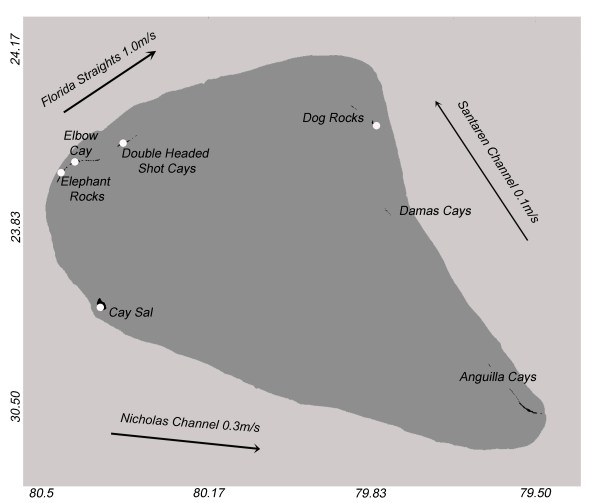
Map of the Cay Sal Bank, from Reynolds et al. (2018). Note that Cotton Cay is part of the Anguilla Cays.

Of course, Cay Sal browns could also be Cuban in the sense that they might have colonized the bank directly from Cuba across the Nicholas Channel. To parse these alternative origin stories, we collected samples of the species from across the Cay Sal Bank and generated a coalescent gene tree paired with all our sampling from other brown anole populations across the region. We find that Cay Sal A. sagrei are actually much more closely related to western Cuba A. sagrei, rather than Bahamas A. s. ordinatus. Combining this finding with our analysis of A. fairchildi, we find that this particular Anole Outpost was colonized from Western Cuba by at least two species–and likely at different times.

Phylogeny of A. sagrei, showing Cay Sal Bank lineagers in blue (and a Cay Sal specimen in the inset). From Reynolds et al. 2018.

New Records

In addition to these findings, we also documented some novel populations of A. sagrei on the Cay Sal Bank. We added East Doubled Headed Shot Cay, Elephant Rocks, Great Dog Rock to the list of known populations on the bank. What is particularly interesting about these new records is the range of habitat types that they support. Cay Sal Island and the Anguilla Cays are by far the most lush, with lots of vegetation. To the north, the cays become increasingly xeric and barren. East Double Headed Shot Cay is the most vegetated of the northern islands, and has a thick, but low, covering of coastal shrub plant community. Anolis sagrei is not abundant on this island, and we only saw a few dozen during several hours of searching.

East Doubled Headed Shot Cay. Photo by R. Graham Reynolds.

In stark contrast, the Elephant Rocks to the west are tall, jagged, steep, and rocky islets with almost no vegetation at all. We had low expectations as we jumped into the sea from the dingy to start our ascent of these islands at dawn. But, to our surprise, we found some anoles happily living among the rocks. Not at high densities, but here they were, a saxicolous population of A. sagrei.

Elephant Rocks, Cay Sal Bank. Photo by R. Graham Reynolds.

Naturally, Alberto and I would love to follow up on some of this, but Cay Sal is a tough place to work. Maybe someday we’ll get back there, in the meantime, we can reflect on what a special opportunity we had to visit this Anole Outpost.

Sunrise on the Cay Sal Bank. Photo by R. Graham Reynolds.


References

Buckner, S. D., R. Franz, and R. G. Reynolds. 2011. Bahama Islands and Turks & Caicos Islands. In R. Powell and R. W. Henderson, editors. Island Lists of West Indian Amphibians and Reptiles. Bulletin of the Florida Museum of Natural History 51: 85–166.

Buden, D. W., and A. Schwartz. 1968. Reptiles and birds of the Cay Sal Bank, Bahama Islands. Quarterly Journal of the Florida Academy of Sciences 31: 290–320.

Vanhooydonck, B., A. Herrel, J. J. Meyers, and D. J. Irschick. 2009. What determines dewlap diversity in Anolis lizards? An among-island comparison. Journal of Evolutionary Biology 22: 293–305.

Anole Outpost: The Cay Sal Bank, Part II

Anolis fairchildi from Cay Sal Island, Bahamas. Photo by R. Graham Reynolds.

In a previous post, I introduced some results from our attempts to understand the evolutionary history of anoles on Cay Sal Bank, Bahamas (more results in a future post). We found that the only endemic reptile on the Bank, Anolis fairchildi (the Cay Sal Anole), is a lineage relatively recently derived from western Cuban A. porcatus progenitors. OK, fair enough, but what is this creature we list in our checklists and museum collections with the epithet fairchildi? A comment by James Stroud on a previous post of mine suggested that we visit this species directly here on AA, so off we go!

The anole specimens leading to the description were collected by Paul Bartsch in 1930, a malacologist who spent a week on the bank  (Buden 1987). Bartsch found specimens on both Cotton Cay and Cay Sal (more on distribution below). In this manuscript (Barbour and Shreve 1935), Thomas Barbour offers a narrative of an Utowana expedition in 1934 during which time the explorers, including Barbour and J.C. Greenway–another name that lingers after several Latin generic names (e.g. Leiocephalus greenwayi)–sought herpetological novelties. It is worth noting that Barbour and his team secured a “rich booty” of land mollusks (Barbour and Shreve 1935); in other words, they weren’t always just after reptiles and were likely offering tit-for-tat with Paul Bartsh (my opinion). This narrative is followed by his description of some new reptiles, including the Bahamian green anoles A. fairchildi and A. smaragdinus.

Barbour and Shreve gave these Cay Sal individuals the name fairchildi to honor the individual David Fairchild, the prolific botanist whose name also graces the wonderful Fairchild Tropical Botanic Garden (where the recent 7th Anolis Symposium was held!). Let’s pause briefly to consider the man who lends his name to this handsome lizard species. David Fairchild (1869-1954) was a well-known botanical collector, explorer, cultivator, and traveler. Indeed, Pauly (2007) considered him “one of the most important plant explorers in the history of the United States of America.” Like Thomas Barbour of the MCZ, Fairchild was a friend of Allison Armour, and what a great friend for a Caribbean biologist to have. Armour outfitted his 1315-ton steamer Utowana as a research vessel, providing it as a platform for numerous important cruises around the Caribbean and beyond (a “floating palace” according to Fairchild). Wonderful narratives of Barbour (Henderson and Powell 2004) and Fairchild (Francisco-Ortega et al. 2014) aboard the Utowana are definitely worth a read. I particularly love Fig. 2 in the former and consider THAT to have been the good-ol’-days of Caribbean herpetology! As a side note, a name given to Caymanian Anolis conspersus was A. utowanae by Barbour (1932)! You can read more about that interesting story from Steve Poe here or on AA here. Fairchild sailed (well, steamed, really) through the Bahamas at least three times on the Utowana, accumulating a significant amount of botanical knowledge and material. For this reason, and because he was an acquaintance, Barbour named his new anole species after David.

Anolis fairchildi. Photo by Alberto R. Puente-Rolon.

How many people have seen A. fairchildi? Probably not many, and even fewer who appreciated what they were looking at. Cay Sal is a hard place to get to, particularly if one goes via the legal route that necessitates a stopover in Alice Town, Bimini to clear customs (as opposed to running directly, and illegally, from the Florida Keys). Few photos of this species exist, and even fewer narratives of trips in which the species was seen are available.

Anolis fairchildi habitat on Cay Sal Island. Photo by R. Graham Reynolds.

Description

Anolis fairchildi is considered a relatively large green anole, with an SVL of 67–74 mm in males. Barbour and Shreve (1935) suggest it is “allied to” A. smaragdinus and A. porcatus–a natural supposition and borne out in examination–but differing in having “larger dorsal and temporal scales” and also a different coloration. This supposedly diagnostic coloration is a series of white or light blue flecks (comprised of small groups of differently colored scales). James Stroud recently posted a photo of A. carolinensis from Fairchild Tropical Botanic Garden that closely resembles the description of A. fairchildi, a humorous and fitting example of the variation present in the former species. A photo of A. fairchildi in Francisco-Ortega et al. (2014) also shows this coloration. Alberto Puente-Rolon and I did not find such distinct spotting in the specimens we examined from Cay Sal Island in 2015. Thus, it seems likely that A. fairchildi does frequently have light spotting, but that this is not a unique phenotype to Cay Sal.

Distribution

This species is considered endemic to the Cay Sal Bank. Historical records place them on  the following islands: Cotton Cay, the eponymous Cay Sal, Elbow Cay, and Double Headed Shot Cays (Buckner et al. 2012). In our cruise to the islands, we did not visit Cotton Cay (=South Anguilla Cay) or North Anguilla Cay, but we did visit the others where the species is thought to occur. We found A. fairchildi on Cay Sal Island only, and observed no individuals on Elbow Cay nor Double-headed Shot Cay.

Map of the Cay Sal Bank, from Reynolds et al. (2018). Note that cotton Cay is part of the Anguilla Cays.

For more, check out our recent publication describing our work on Cay Sal Bank.

A Footnote: how to pronounce this island bank…

Most of us Caribbean ambulators pronounce the word “cay” (=small islands) with a hard k and e sound, like “key.” This apparently is the anglicized version of the Spanish “cayo,” itself possibly cribbed from the Arawak “cairi.” Cay Sal, on the other hand, is frequently pronounced with a hard k and a, as in “cake,” similar to the Spanish. Additional confusion is lent by the historical use of the French word “quay” in the region (originally from the Gaulish “caio”) to refer to docks or gangways present on islands (indeed, small islands would have been dominated by these constructions). An interesting read on all this is González Rodríguez (2016). Any toponomastics buffs have opinions on how Cay Sal should be pronounced?


References

Barbour, T. 1932. On a new Anolis from Western Mexico. Copeia 1932: 11–12.

Barbour, T., and B. Shreve. 1935. Concerning some Bahamian reptiles, with notes on the fauna. Proceedings of the Boston Society of Natural History 5: 347–365.

Buckner, S.D., Franz, R. & Reynolds, R.G. 2012. Bahama Islands and Turks & Caicos Islands. In: Powell, R. & Henderson, R.W. (Eds.), Island Lists of West Indian Amphibians and Reptiles. Florida Museum of Natural History Bulletin, 51, pp. 93–110.

Buden, D.W. 1987. Birds of the Cay Sal Bank and Ragged Islands, Bahamas. Florida Scientist 50: 2133.

Francisco-Ortega, J., et al. 2014. Plant hunting expeditions of David Fairchild to the Bahamas. Botanical Review 80: 164-183

González Rodríguez, A. 2016. El Muelle del Cay of Santander City (Spain) and the Two Big European Maritime Traditions in the Late Middle and Modern Ages. A Lexicological Study of the Words Cay and Muelle. 171-178. Names and Their Environment. Proceedings of the 25th International Congress of Onomastic Sciences, Glasgow, 25-29 August 2014. Vol. 1. Keynote Lectures. Toponomastics I. Carole Hough and Daria Izdebska (eds). University of Glasgow.

Henderson, R.W., and R. Powell. 2004. Thomas Barbour and the Utowana voyages (1929–1934) in the West Indies. Bonner zoologische Beitrage 52: 297–309.

Pauly, P. J. 2007. Fruits and plains. The horticultural transformation of America. Harvard University Press, Cambridge, MA.

Anole Outpost: The Cay Sal Bank, Part I

What determines species composition on remote Caribbean islands? Geographic proximity to source populations? The vicissitudes of dispersal and colonization? Propagule pressure and prevailing biotic and abiotic environmental conditions? The study of biogeography addresses such questions, and is concerned with understanding the geography of biodiversity- where do species occur and why?

We perhaps often think of species groups accumulating from colonists arriving from the same place, that is, we identify a likely natal source for island colonists. But might species groups be chimeric, in that they contain groups of diasporic species from different natal lands? This is certainly a plausible scenario and could potentially lead to some interesting evolutionary outcomes.

The Cay Sal Bank is a remote island bank, or shallow carbonate platform, on which rests a line of small islands strung out along its margins. This region, as well as our recent expedition, has been mentioned in a previous AA post. Here I am returning to discuss the anoles and the results from our recently published work describing the evolutionary relationships of the terrestrial squamate fauna. Fundamentally, we ask a question that has circulated for the better part of a century: where do the anoles on Cay Sal come from?

Six terrestrial squamates are found on this bank:
Anolis fairchildi (endemic)
Anolis sagrei
Tropidophis curtus
Sphaerodactylus nigropunctatus
Cubophis cantherigerus
Typhlops biminiensis

Dispersal hypotheses for terrestrial squamates found on Cay Sal Bank, from Reynolds et al. 2018

Of these, all but Anolis fairchildi and the recently discovered population of Cubophis were thought to have Bahamian evolutionary affinities. The endemic A. fairchildi has been of particular interest, owing to its status as the product of one of the ex situ speciation events occurring in the green anoles as they dispersed from Cuba (Williams 1969). But a previous AA post (1) reminded us that the origins of Anolis fairchildi had not been resolved- did they come directly from Cuba or are they derived from Bahamian A. smaragdinus (among other alternatives?). Here we tackle this question, using a basic mitochondrial dataset and lots of taxon sampling from previous study of the group (more on A. fairchildi in a future post). We constructed a coalescent gene tree of all “carolinensis-clade” Cuban green anole species, including our samples obtained from Cay Sal Island in 2015. We find unequivocally that A. fairchildi is a recent colonist from western Cuba- nested within the western Anolis porcatus lineage. Thus we see both ancient and recent emigration (divergence) events leading to what we recognize as species in the carolinensis clade of green anoles, setting up a really nice opportunity to examine the accumulation of variation in diasporic populations over different time periods.

Phylogeny of “carolinensis clade” green anoles from Reynolds et al. 2018, with A. fairchildi highlighted in green and shown in the inset photo

Anole Annals World Cup: Round One

It’s June. It’s orchid flowering season in Grand Cayman. And with nods to #Anole March Madness and  #MammalMadness it’s the opening round of the 2018 ANOLE WORLD CUP. #ANOLEGOOAAAAALLLL!!!!

Home Team – Anolis conspersus  – against –  Away Team – Anolis sagrei

And in less than 90 seconds it’s all over.


The teams are on the pitch


The Away Team


The Home Team heads to mid-field


The Striker takes aim


Home Team – 1, Away – nil


Anoles versus Geckos: The Ultimate Showdown

Two green lizards in Miami, one of each variety.

Two green lizards in Miami, one of each variety.

History is rich with great rivalries; David versus Goliath, Red Sox versus Yankees, Alien versus Predator, but one of the greatest match ups of our time is anole lizards versus gecko lizards. For readers of this blog that are unfamiliar, for which I assume there are few, geckos and anoles are well matched competitors because of their morphological and ecological similarities. Geckos (infraorder Gekkota) are the earliest branch on the squamate tree (sister to all other lizards and snakes) with over 1500 species around the globe, whereas anoles (genus Anolis) appeared roughly 150 million year after the origin of geckos (nested within the Iguania infraorder). The roughly 400 species of anoles can be found primarily in Central and South America. Geckos and anoles both independently evolved very similar hairy adhesive toe pads that help them adhere to and navigate vertical and inverted surfaces. While anoles can likely trace their toe pads to a single origin (and one loss in A. onca), toe pads likely arose and were lost multiple times within Gekkota, although we are still sorting out the exact details (Gamble et al., 2017). Nearly all anoles are arboreal and diurnal, with only a handful of terrestrial or rock dwelling species. Conversely, geckos can be found thriving in arboreal as well as rocky and terrestrial microhabitats day and night.

While anoles tend to get all of the attention from evolutionary ecologists, with decades of amazing research quantifying their habitat use in the Caribbean, geckos are actually older, with more ecological and morphological diversity. As my prior PhD advisor Luke Harmon can surely confirm, I have been interested in knowing how or if insights from Caribbean anole ecomorphology can be applied to geckos. How similar is the evolution and diversification of geckos and anoles? Do geckos partition their habitat along similar dimensions as Caribbean anoles?

In this post, I’d like to share some of my previous work comparing and contrasting gecko and anole diversification and habitat use and then solicit information and opinions from the anole community for an upcoming field trip in which we will be looking at habitat use of sympatric introduced geckos and anoles.

figures

Fig 1. Our reconstruction of gecko (blue) and anole (green) ancestral toe pad performance based on our best fitting weak OU model of trait evolution. Horizontal bars below the X-axis represent the region in which we constrained the origin of toe pads for each clade. Detachment angle (y-axis) represents our measure toe pad performance (the maximum ratio of adhesion and friction a species can generate). The generation of more adhesion for a given amount of friction results in a higher detachment angle. Shaded bands represent our estimated OU optimum value for each clade. Figure modified from Hagey et al. (2017b).

In 2017, we had two great papers come out investigating the diversification of toe pad adhesive performance in geckos and anoles, and the ecomorphology of Queensland geckos. In our diversification paper (Hagey et al., 2017b), we found that while geckos are an older and larger group than anoles, their toe pad performance does not appear to be evolving towards a single evolutionary optimum. Instead, we found that Brownian motion with a trend (or a very weak Ornstein-Uhlenbeck model) best modeled our data, suggesting geckos have been slowly evolving more and more diverse performance capabilities since their origin approximately 200 million years ago (Fig 1). These results assume a single evolutionary origin of Gekkota toe pads, which was supported by our ancestral state reconstructions, but ancestral state reconstructions are far from a perfect way to infer the history of a trait. And so for now, the true history of the gecko toe pad’s origin(s) remains a ‘sticky’ issue. Conversely, adhesive performance in anoles appears to be pinned to a single optima in which anoles quickly reached after their split from their padless sister group (i.e. a strong Ornstein-Uhlenbeck model, Fig 1).

Given these results and the fact that geckos are such a morphologically diverse group, living on multiple continents in many different microhabitats, our results suggest the adhesive performance of geckos may be tracking multiple optima, and when pad-bearing geckos are considered together as a single large group, could produce the general drifting pattern we observed when we assume their ancestor started without little to very poor adhesive capabilities. On the flip side, we can imagine multiple reasons why anoles appear to be limited in their toe pad performance. Perhaps anoles lack the genetic diversity to produce more variable toe pads or they are mechanically or developmentally constrained to a limited area of performance space. Alternatively, since anoles are nearly all arboreal and diurnal in new world tropical environments, it is possible that they are all succeeding in the same adaptive zone and there isn’t the evolutionary pressure or opportunity to evolve more diverse performance capabilities. Closer studies of the adhesive performance capabilities of the few anoles species that have branched out from arboreal microhabitats, such as the rock dwelling aquatic species would be really interesting!

figures2

Fig 2. Our gecko and anole residual limb length calculations suggest geckos (grey triangles) generally have shorter limbs then anoles (black circles). Figure modified from Hagey et al. (2017a).

In our second paper from 2017 (Hagey et al., 2017a), we quantified microhabitat use and limb lengths of geckos across Queensland, Australia and compared these patterns to those known from Caribbean anoles. We found some interesting differences and similarities. Our first result arose as we tried to calculate residual limb lengths and realized that geckos, as a group, have shorter limbs than anoles, which resulted in us calculating residual limb lengths for geckos and anoles separately (Fig 2). We then compared microhabitat use and limb length patterns and found that Strophurus geckos may be similar to grass-bush anoles. Both groups have long limbs for their body lengths and use narrow perches close to the ground. We also found other general similarities such as large bodied canopy dwelling crown-giant anoles and large bodied canopy dwelling Pseudothecadactylus geckos. Unfortunately, we didn’t focus on sympatric Australian geckos and so we couldn’t make direct habitat partitioning comparisons to anoles. We hope to fix that in our next project and would really love to hear from you, the anole community.

Later this spring, I am planning a fieldtrip with John Phillips and Eben Gering, both fellow researchers here at Michigan State University, to Hawai’i (Kaua’i and O’ahu) to investigate habitat partitioning of invasive geckos and anoles, specifically A. carolinensis, A. sagrei, and Phelsuma laticauda. Jonathan Losos one claimed that Phelsuma are honorary anoles! These three species are all diurnal, arboreal, have adhesive toe pads, and are commonly seen in Hawai’i and so we expect them to be competing for perch space. This has been on some of the greatest anole minds since at least 2011 with Jonathan wondering which group would win when the two clades collide in the Pacific. Previous studies of anole ecomorphs across the Greater Antilles and invasive A. sageri in the southeastern US give us a good expectation of how the trunk-crown A. carolinensis and the trunk dwelling A. sagrei should interact and partition their arboreal microhabitat, with A. sagrei pushing A. carolinensis up the trunk. The wild card is P. laticauda. There hasn’t been much microhabitat use work done with Malagasy geckos, and definitely nothing compared to the extensive work with Caribbean anoles. As a result, I don’t know much about exactly what part of the arboreal environment P. laticauda uses in its natural range or how it will fit in with its new pad-bearing brethren in Hawai’i. The best information we have to my knowledge is a study of other arboreal Phelsuma by Luke Harmon in Mauritius (Harmon et al., 2007). He found that while the Phelsuma geckos of Mauritius also partition their arboreal habitat by perch height and somewhat by diameter, they also partition by palm-like or non-palm-like perches. I’m not aware of any anole observations suggesting a palm/non-palm axis of partitioning and so this may be a novel axis that P. laticauda is using in Hawai’i to live in amongst the anoles.

Anoles, geckos, and Hawai’i have come up repeatedly here on Anole Annals

Reproductive Biology of Introduced Green Anoles in Hawaii

JMIH 2016: Anolis vs. Phelsuma in Hawaii

Amazing Green Anole Battle In Hawaii

More On Anoles And Day Geckos In Hawaii

Anoles And Banana Flowers In Hawaii

Fighting Hawaiian Anoles

Brown Anoles on Hawaii and Battle of the Intercontinental Convergents

Many Hawaiians Don’t Like Brown Anoles

SICB 2018: Unraveling Natural and Human-Mediated Founder Events in Anolis carolinensis

Factors Restricting Range Expansion for the Invasive Green Anole Anolis carolinensis on Okinawa Island, Japan

Anole Watercolor Available on Etsy

A Failed Anole Predation Attempt

This Is Not A Madagascan Day Gecko

Battle of the Diurnal, Arboreal Exotics in Florida (the Anole Loses)

Strange perch mate

Green Anole Mayhem

and so we know folks have been thinking about these species and specifically this invasive set of species for a while. We are especially excited to see Amber Wright’s research suggesting P. laticauda was perching above A. carolinensis in her enclosures. We want to know what the anole community has to say. We also don’t want to duplicate or intrude on any projects that are already under way.. If this is something you’ve already started, or started to wonder about… let us know! We would love to collaborate, partitioning interesting questions, if there are already labs working in this arena. We would also be grateful for suggestions, field site recommendations, or relevant publications we may have missed.


A Clouded Anole Male during a nocturnal walk through the jungle

The Lonely Clouded Anole on a Pacific Island

Anolis nebulosus

Anolis nebulosus. Photo by Hugo Siliceo-Cantero.

By H. Hugo Siliceo-Cantero and A. Garcia

In the late 1980´s, the scientists Bradford C. Lister and Andrés García discovered an interesting population of clouded anoles inhabiting the small 3.3 ha island of San Agustin located just off the Pacific coast of Jalisco, Mexico. This island was also close to the actual protected area of tropical dry forest on the mainland in the Chamela-Cuixmala Biosphere Reserve. Lister and García reported that the abundant anole population on San Agustin was maintained a decade later at much higher densities than the mainland population. We began to study this population in 2007 as a graduate student. Since then, we have studied several aspects of the ecology of this island population comparing this with the ecology of anoles on the mainland.

The existence of such island populations enables scientists to carry out natural experiments that provide invaluable information helping us to understand ecological and evolutionary processes.

This Clouded Anole (Anolis nebulosus) species that is on San Agustin Island is endemic to Mexico, and is of particular interest as this population has evolved in the absence of similar species of the same genus, or congeners. The species on the island also occupies a broad niche of perch height and a low number of lamellae, and is one of the most sedentary anoles known. Our work demonstrated that San Agustin population of the Clouded Anole has distinct morphological and genetic traits compared to conspecifics on the mainland.

Recently, we found that the insular population also presents distinct ecologic traits compared to those of the mainland population. In our manuscript “Assessing the relative importance of intra- and interspecific interactions on the ecology of Anolis nebulosus lizards from an island vs. a mainland population”, we suggest that the processes that drives the ecology and evolution of this insular population (intraspecific competition) differs from those that are important in the mainland (interspecific competition).

We believe that the results of our research on the insular population of anoles on San Agustin Island complement the scenario of Caribbean anoles, where congeneric competition is the key evolutionary driver. Furthermore, in our study, we used video cameras to provide direct evidence of predation, interspecific and intraspecific encounters and aggression, which was possible because the Clouded Anole is a sedentary lizard.

It has been a pleasant and rewarding experience for me to study the Clouded Anole. Although spending hours in the field observing a largely sedentary lizard may seem a little boring and tedious, the data from our studies have revealed a fascinating adaptation to the natural and social environment with unique physical, genetic, and ecological characteristics.

Currently, the population of Clouded Anoles on San Agustin has been dramatically reduced, almost to the point of extirpation. We think that two natural events, the hurricanes Jova in 2011 and Patricia in 2015, as well as invasive studies such as Hernández-Salinas et al. (2016) where they extracted 77 anoles from this small island, are the cause of the dramatic reduction in the Clouded Anole of San Agustin Island. As ecologists, we believe that research should not be done at the expense of the species or population under study, but should ensure that the population remains intact to continue along its evolutionary path, and further elucidate our understanding of the natural world around us.

We are currently monitoring both insular and mainland populations in order to understand and evidence the ecological implications of such natural and anthropogenic reduction on anole populations.

Notes on the Neblina tepui Anole (Anolis neblininus), Discovered in Brazil

Female  Anolis neblininus .

Female Anolis neblininus .

In November 2017, I had the opportunity to join a team of scientists led by herpetologist Miguel T. Rodrigues (University of São Paulo) in an extraordinary expedition to the Serra da Neblina, a very remote tepui (sandstone table-top mountain) on the Brazil-Venezuela border. The expedition involved the Brazilian Army, several Yanomami guides, and a team of BBC journalists. We collected around 2,500 samples of amphibians, reptiles, birds, small mammals, and plants between 80 and 2,995 m of altitude – among them, at least 10 frog and lizard species new to science!

Neblina peak (2,995 m) as seen from our camp at the Bacia do Gelo ("ice bowl", 1,997 m).

Neblina peak (2,995 m), Brazil’s highest mountain, as seen from our camp in the Bacia do Gelo (“ice basin”) at 1,997 m.

As soon as we got to an elevation of around 2,000 m, we started looking for Anolis neblininus, the Neblina anole. This mysterious lizard was described based on six individuals collected on the Venezuelan portion of the mountain in the 80’s by a team of AMNH-Smithsonian scientists. To our surprise, it took us only a few hours to find one, two, several individuals – the first records of A. neblininus in Brazil!

The Neblina anole seems to be locally abundant, with more than 30 individuals found over a week. Because of their slow movements and cryptic coloration, these lizards are really hard to spot during the day. All but two individuals were found at night, sleeping on thin branches and leaves on the edge of forest patches, at a height of 1-4 meters above the ground. Although we set up 100 pitfall traps in the area to sample herps and small mammals, all of the anoles were found through active search.

Neblina anoles really like to sleep on fern leaves - most individuals were found this way.

Neblina anoles really like to sleep on fern leaves – most individuals were found this way.

To learn a bit about how much Neblina anoles move during the day, we experimented with spooling a few individuals. Based on how much thread they left along their way, it seems that A. neblininus does not move much in a day. Individuals go up and down short trees and bushes, but do not seem to walk on exposed ground. However, the spools that we had – leftovers from a study of larger Enyalius lizards – may have been too awkward for such small anoles to carry.

Spooling lizards is an effective way to learn how much they move and what type of substrate they use. Unfortunately the spools that we had were rather big for these anoles.

Spooling lizards is a simple yet effective way to learn how much they move and what type of substrate they use. Unfortunately, the spools that we had were probably too big for these anoles!

Follow the thread to find the lizard!

Follow the thread to find the lizard!

These montane lizards experience remarkably low temperatures. At night, when temperatures were as low as 6oC, the anoles were unresponsive for long periods after captured, apparently because they were too cold. On consecutive mornings, we followed individuals (spotted on the night before) to check at what time they would become active. To our surprise, the anoles started moving at different times in each day, between 6 and 9:30 am, in an apparent association with how cold it was. It is therefore possible that the onset of activity is given mostly by temperature, as opposed to when the sun comes out.

Male Anolis neblininus. Too cold to go anywhere.

Male Anolis neblininus. Too cold to go anywhere.

One interesting feature of A. neblininus is how variable their coloration is. Some individuals have gray bodies, others green or brown; some have yellow heads. They are also capable of changing their colors a bit. The dewlap is well developed in females, with dark spots on an orange or brown background. Male dewlaps are white, bluish, or yellowish. Neblina anoles have a very cool-looking dorsal crest, more developed in males.

Male (left, center) and female dewlaps.

Male (left, center) and female dewlaps.

Our recent studies of mainland anole lizard evolution and biogeography have found that A. neblininus is closely related to species from montane Atlantic Forest, Andes, and Andean foothills. This pattern may result from a history of cool habitats connecting South American mountains in the past, followed by habitat retraction and extinction in intervening areas. Our expedition to the Neblina revealed additional species that seem to be related with taxa from distant mountains. We are now examining their history based on genetic data to help shed light on the history of the mysterious tepui fauna.

The Not-So-Bitter Future of Coffee: Anolis Lizards as Biocontrol Agents in Mainland and Island Agroecosystems

Figure 7. Anolis gundlachi, Orocovis, Puerto Rico.

Figure 1. Anolis gundlachi, Orocovis, Puerto Rico.

The agroecosystems that produce the life-sustaining stimulant we know as “coffee” have long been used as model systems to study complex ecological interactions and ecosystem services, with numerous studies revealing trophic interactions among coffee plants, pests, and pest-predators. Despite the high abundance and overlapping distribution of Anolis lizards, relatively few studies have addressed their functional role in agriculture. In our recent study titled, “Anolis Lizards as Biocontrol Agents in Mainland and Island Agroecosystems,” my colleagues and I explore the biocontrol potential of anoles against the world’s most devastating coffee pest, the coffee berry borer (Coleoptera: Hypothenemus hampei) in mainland and island settings.

My vision of agricultural landscapes as post-apocalyptic biodiversity deserts was trumped the minute I stepped foot onto a shade coffee farm in Orocovis, Puerto Rico. Far from the dystopian nightmare that I had envisioned, this diversified shade coffee farm bustled with the herpetological glory and natural complexity of a native forest (Fig. 1). Furthermore – and perhaps most importantly – the farmer complained not of issues with crop yield, pests, and disease.

As a plant, coffee occurs naturally in the forest understory and is cultivated traditionally among native shade trees as an understory crop. While pressures to increase production have led many farmers to transition to more intensive practices (i.e., the reduction of shade cover and application of agrochemicals to manage crop pests), these methods are becoming increasingly unsustainable and insufficient in light of emerging biological threats. In addition to climate change and the emerging coffee rust disease, the coffee berry borer poses a unique threat for dozens of coffee growing nations and nearly 20 million small-scale farmers who depend on coffee production as a primary commodity and means of subsistence. While the coffee berry borer (CBB) is capable of inducing 60-90% reductions in yields and persists unaffected by topical pesticides, our understanding of the predator-prey interactions that drive its top-down control and how these factors vary across management regimes and eco-geographic space has profound socio-economic and environmental implications for biological control.

Representative photographs of diversified shade coffee in Mexico (a), diversified shade coffee in Puerto Rico (b), intensive sun coffee in Mexico (c), and intensive sun coffee in Puerto Rico (d).

Figure 2. Representative photographs of diversified shade coffee in Mexico (a), diversified shade coffee in Puerto Rico (b), intensive sun coffee in Mexico (c), and intensive sun coffee in Puerto Rico (d).

To assess the biocontrol capacity of anoles, we conducted experimental and field-based tests of how CBB populations respond to anole predation across mainland (Mexico) and island (Puerto Rico) coffee farms with parallel forms of land-use intensity. Anole functional response and infestation reduction potential were assessed by simulating pest outbreaks in the lab, while coffee farms were surveyed along complementary gradients of intensification. Organic, diversified shade coffee farms were representative of low-intensity production, and sun coffee monocultures that included the application of agrochemicals were representative of high intensification (Fig. 2).

The Lichen Anole and Evidence for Parental Care

During an excursion with Indigo Expeditions to Estación Biológica Las Guacamayas, Parque Nacional Laguna del Tigre, Guatemala, we observed the unusual behaviour of a female Lichen Anole Anolis beckeri (previously Anolis/Norops pentaprion), a rarely-studied, canopy-dwelling, anole from Central America. In a paper  in Mesoamerican Herpetology, we report on observing a female A. beckeri potentially tending and guarding eggs. This is possibly also an example of oviposition site fidelity in an anole.

Figure 1

Seven Anolis beckeri deposited in the base of a Bromeliad. Photo: Kimberley Carter

Seven unknown lizard eggs were first discovered on 9th July 2015. The eggs were deposited in the leaves of a bromeliad plant (Bromelia sp.) roughly 5m above the ground. The lichen anole is typically a canopy-dwelling species but, luckily for us, the bromeliad was in a tree at eye level to one of the research station’s balconies! The bromeliad plant had collected water and one egg in particular, lying partially submerged, was a brown, speckled colour. Another of the eggs appeared indented, a sign of potential imminent hatching. The female A. beckeri deposited an additional egg after our return to the UK, which reflects similar egg laying pattern for Anolis where independent, single eggs are laid every 5–25 days during the breeding season (Losos, 2009).

Over the next few days there were no changes in the eggs’ shapes or colour. It wasn’t until 3 days later, on the 12th of July, that we finally witnessed the owner of these eggs: a female A. beckeri sat above the clutch on one of the fronds of the bromeliad. The anole was seen repeatedly climbing into the bromeliad, seemingly to examine the eggs. She would then lick them and exhale heavily over them (perhaps to increase airflow?), before retreating to the top of the bromeliad. She repeated this sequence of behaviours, retreating to safety up the tree and then re-emerging to check on the eggs numerous times.

Figure 2aFigure 2b

Video stills of the female Anolis beckeri tending the eggs. Photos: Kimberley Carter

Video stills of the female Anolis beckeri tending the eggs. Photos: Kimberley Carter

We recorded these behaviours on video and in photographs from a distance, to avoid disturbing the lizard. The female returned on numerous occasions to examine, lick and ‘aerate’ the eggs or to seemingly guard the eggs over the next few days but on the 14th of July the female only monitored the eggs from a distance of ca. 30 cm away and did not approach them.

We also witnessed potential predatory behaviour from a Mexican Parrot Snake (Leptophis mexicanus), On the 15th July the snake was seen in the vicinity of the clutch, perhaps attempting to prey on the adult female. See full paper for detail.

These observations offer insight into the life history and behaviour of this rarely-seen anole species. Hopefully, with the continued work of Indigo Expeditions and the guides at Estación Biológica Las Guacamayas we’ll learn more about these interesting reproductive behaviours in the future.

Predation of a Gecko by Anolis pulchellus in the British Virgin Islands

In the most recent issue of Herp Review, Anole Annals stalwarts Kevin de Queiroz and Jonathan Losos documented their account of observing an adult female grass-bush anole (Anolis pulchellus) consume a dwarf gecko (Sphaerodactylus macrolepis) on Guana Island, British Virgin Islands. The authors share their detailed report below:

Many primarily insectivorous lizards will eat other vertebrates on occasion, a behavior that has been reported in many species of Anolis. One unifying generality is that such carnivory is size structured, with the predator usually being substantially larger than the prey (Gerber 1999. In Losos and Leal [eds.], Anolis Newsletter V, pp. 28–39. Washington University, Saint Louis, Missouri). Not surprisingly, reports of anole carnivory pertain primarily to middle-sized and larger anoles. Here we report carnivory by a small anole of the species A. pulchellus. To our knowledge, this is the first instance of carnivory reported for this species and one of few for any similar-sized anole (the record noted by Henderson and Powell 2009. Natural History of West Indian Reptiles and Amphibians. University Press of Florida, Gainesville, Florida. 495 pp. is based on the observations reported here).

Fig. 1. Female Anolis pulchellus in the process of ingesting a Sphaerodactylus macrolepis.

Fig. 1. Female Anolis pulchellus in the process of ingesting a
Sphaerodactylus macrolepis.

We observed a female A. pulchellus (SVL ca. 38 mm) capture and consume a Sphaerodactylus macrolepis (SVL ca.18 mm) in the leaf litter at approximately 1430 h on 25 September 2006, on Guana Island, British Virgin Islands, near the head of the Liao Wei Ping Trail at roughly 18.47916°N, 64.57444°W (WGS 84). The anole jumped from a low perch (ca. 20 cm above the ground) to the ground and bit the gecko, which escaped and fled 15–20 cm to the opening of an ant nest. The anole attacked the gecko again, seized it in its mouth and carried it approximately 10 cm up a vine, a distance of 15–20 cm from the site of attack. Initially, the anole held the gecko upside down (i.e., dorsal surface facing down), biting it between the fore and hind limbs on the left side. Eventually the anole worked its grasp posterior to the base of the tail, still on the left side. At this point, parts of both the base of the tail and the left hind limb were in the anole’s mouth (Fig. 1). The anole then manipulated the gecko so that it was no longer upside down, but rotated about its long axis by roughly 90 degrees (the ventral surface of the gecko was then oriented forward relative to the anole) at which point it was biting the gecko at the base of the tail and possibly by the left hind limb; the anole eventually manipulated the gecko so that it held it tail-first in its mouth, dorsal side up, at which point the anole proceeded to ingest the gecko tail first (during this time, the tail itself broke off and was carried away by ants, which had been biting the gecko in several places since shortly after it was
captured by the anole). Total time from capture to complete ingestion was approximately five minutes.

Predation on Sphaerodactylus geckos has been reported in anoles of only a few species, none of which are as small as Anolis pulchellus (Henderson and Powell 2009. Natural History of West Indian Reptiles and Amphibians. University Press of Florida, Gainesville, Florida. 495 pp.). However, given the size discrepancy between the lizards in these two clades and their extensive coexistence across the Caribbean, we suspect that such interactions may occur with some frequency. Moreover, the high population densities of some Sphaerodactylus geckos (e.g., Rodda et al. 2001. J. Trop. Ecol. 17:331–338) and the diurnal activity of several species (Allen and Powell 2014. Herpetol. Conserv. Biol. 9:590–600) suggest that they may be important prey items for anoles.

References
Allen, K.E. and Powell, R., 2014. Thermal biology and microhabitat use in Puerto Rican eyespot geckos (Sphaerodactylus macrolepis macrolepis). Herpetological Conservation and Biology, 9(3), pp.590-600.
Gerber 1999. In Losos and Leal [eds.], Anolis Newsletter V, pp. 28–39. Washington University, Saint Louis, Missouri
Henderson and Powell 2009. Natural History of West Indian Reptiles and Amphibians. University Press of Florida, Gainesville, Florida. 495 pp.
Rodda, G.H., Perry, G.A.D., Rondeau, R.J. and Lazell, J., 2001. The densest terrestrial vertebrate. Journal of Tropical Ecology, 17(02), pp.331-338.

Page 3 of 22

Powered by WordPress & Theme by Anders Norén