Category: Notes from the Field Page 21 of 22

Anolis conspersus

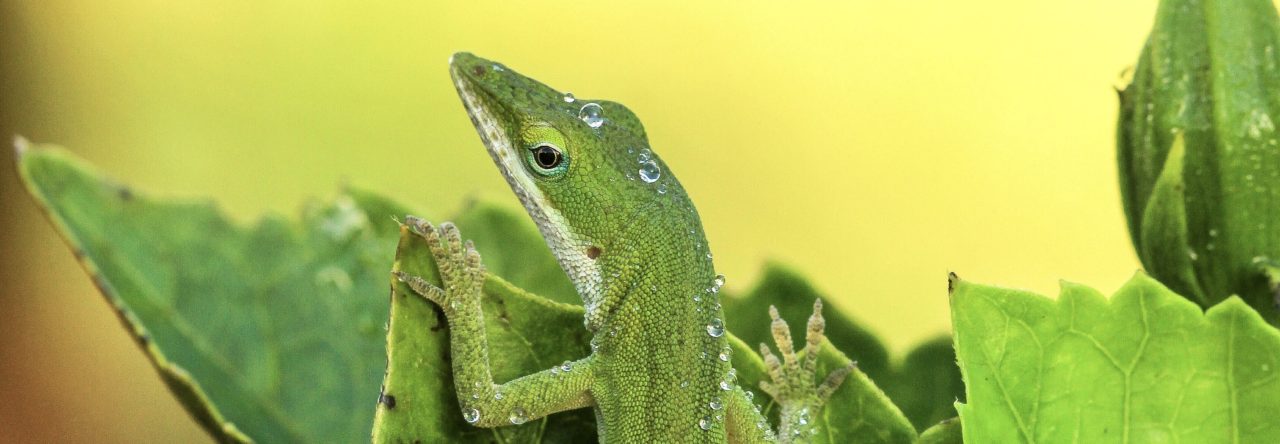
Alexis Harrison and I have spent the last two days on Grand Cayman collecting tail tips from Anolis sagrei. During our work, we’ve seen quite a few A. conspersus. Anolis conspersus is nested within the Jamaican A. grahami, splitting away approximately 2.5 to 3 million years ago when it colonized Grand Cayman. Both species vary in body color across their range from brown to drab green to emerald green to blue green with white mottling.

They are very different, however, in the dewlap. Anolis grahami’s dewlap reflects strongly in the long wavelengths, being orange with a yellow margin. The dewlap of A. conspersus, on the other hand, reflects in short wavelengths being blue and UV-bright.

Anolis grahami - Jamaica

Anolis conspersus - Grand Cayman

A Cayman Brac Invasion?

Over the last half-century, Anolis sagrei sagrei, a Cuban native, has become a global citizen. Likely as a stowaway in agricultural trade shipments, it has traveled to near-Cuba places like Florida, Jamaica, and Grand Cayman. It has gone as far Hawaii, Guam, and Taiwan. It is a stout lizard, males about 60mm long, brown in body color with a deep red dewlap bordered by a yellow margin. Jason Kolbe’s research documented the origin and spread of invasive populations of this subspecies around the globe.

Another subspecies of A. sagrei, A. sagrei luteosignifer, is endemic to Cayman Brac, the easternmost of the three Cayman Islands islands. On Brac, A. s. luteosignifer has evolved a mustard-yellow dewlap, in stark contrast to the red dewlap of A. s. sagrei.

Forum: What Makes the Best Lizard Lasso?

During recent fieldwork with several graduate students, the topic of lizard noosing materials came up.  I was accused of being an old fogey for my continued use of dental floss to make my nooses.  By contrast, these young whippersnappers used some yellow stuff, pictured above.  I can’t remember what it is, but it seems all the rage these days.  I know that other people use various types of fishing line (I think the yellow stuff is one such type), and that everyone has their own preference.  Of course, lizard noosing has doubtless been independently invented many times in various places around the world with all kinds of materials.  I’ve seen local boys use blades of grass—quite effective!—in several places in the Caribbean, and once in Sri Lanka, I saw the locals using copper wire on a Calotes (not recommended).  So, given all these options, what are the advantages and disadvantages of various noose materials?

Notes from Recodo Road: Anolis marcanoi

I had a bit of free time to take photos along the Recodo Road this afternoon and managed to get a few nice shots of Anolis marcanoi and its spectacular dewlap. Anolis marcanoi was among the first anoles to be described with the aid of genetic data, with early electrophoretic work being used to confirm that it was genetically distinct from sympatrically distributed populations of A. cybotes that have white or pale yellow dewlaps (Webster 1975, Williams 1975 [they’re a bit of a pain to access, but both articles are available via the Biodiversity Heritage Library]). Although they were initially regarded as ‘sibling species,’ subsequent phylogenetic work suggests that A. marcanoi is in fact the outgroup to all remaining species of cybotoid anoles (A. cybotes, A. longitibialis, A. strahmi, A. breslini, A. whitemani, A. shrevei, and A. armouri). Interactions between A. marcanoi and A. cybotes were also the subject of Losos’s (1985) famous ‘lipstick’ study in which “True Red” lipstick was used to experimentally render the dewlaps of A. cybotes a similar hue to those of A. cybotes (A. marcanoi males, in turn, had their dewlaps painted white with “Superior Clown White Make Up” to make them look like A. cybotes). This study remains one of the only investigations to date to address the role of the dewlap in species-recognition.  We have our last day of work in the field tomorrow before heading back to snowy Rochester!

New Developments on the Recodo Road: The Toll Collector

If you love anoles and have visited the Dominican Republic, chances are that you’ve spent some time on the Recodo Road.  Initially made famous by Ernest Williams and his students, this road running north of Bani into the foothills of the Cordillera Central remains one of the most interesting anole hunting localities in the DR.  My lab is particularly interested in the interactions between three types of trunk anoles in this region: Anolis brevirostris, A. distichus ignigularis, and A. distichus ravitergum (we’ve recently suggested that the latter two may deserve elevation to full species status and Luke covered this topic in a previous blog post).  We’re currently using molecular genetic and ecological methods to investigate the possibility of ecological speciation among these forms.

I thought it would be fun to share some recent developments along this classic anole hunting locality.  One feature of the Recodo Road that is both a blessing and a curse is the need to cross the Rio Baní.  Because there are no bridges, crossing the river requires driving through the river itself.  This generally isn’t a problem with a good 4×4, but getting stuck in the middle of the river is somewhat of a right of passage (the route can also be completely impassable after heavy rains).  Shabby bridges made of sticks are often constructed for pedestrians and motorcycles, but these tend to be somewhat shaky and wash out each time the river floods.  This winter, we found that some local entrepreneurs have constructed a somewhat more substantial stick bridge and have been charging a modest toll to motorcyclists interested in using it.  The photo on the left of the image above depicts the toll collector and his modest gate.  We were told that motorcycles were asked to donate what they could, rather than being charged a fixed rate.  The photo on the right of the above image shows where we cross in our 4×4.


Anolis distichus Eating (Again)

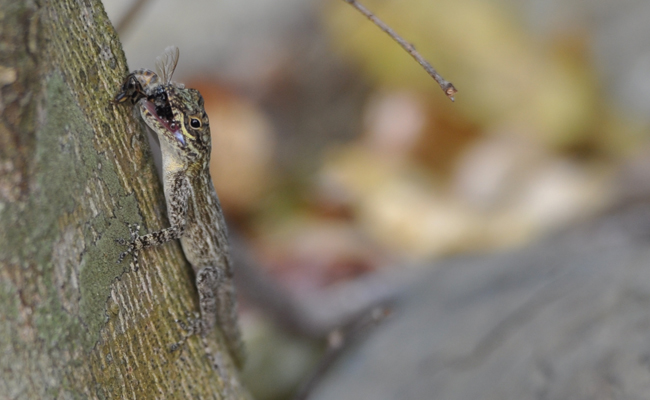
I’ve posted twice previously with images of the Hispaniolan trunk anole (Anolis distichus) feeding on tiny insects, crickets, and beetles (1, 2). I took another such shot yesterday along the Recodo Road in the Dominican Republic, this time of A. distichus eating a bee.  He spent the later part of this feeding episode scraping the wings off against the bark of the trunk.

Measuring the Light on High

Last summer the Glor lab began collecting light data to supplement ongoing research into the speciation of distichoid Anolis lizards.  Following methods developed by Leo Fleishman and Manuel Leal, our aim was to measure light levels at the exact location where a lizard had displayed.  Doing so involves holding a small sensor to the spot of the display and measuring the average light intensity for 15 seconds. That’s easy enough when the animal was 7 or 8 feet high, but most of our observations were substantially out of arms reach.

Necessity being the mother of invention (Plato, 360 B.C.), we rigged together our very own collapsible light meter pole using a broken panfish rod, utility cord and athletic tape.  This rig, pictured at right, has served us well, including our current trip to the Dominican Republic (for updates on the the trip see the Glor Lab Page).  It is our hope that by accurately measuring light at the site of displays we get a better handle on where males choose to display in their environment and how those sites differ between populations.

Norops’ last stand?

In the mid-1980’s, Guyer and Savage proposed dividing Anolis into five genera.  This proposal has mostly been rejected by the anole community, for reasons detailed in Poe (2004), Lizards in an Evolutionary Tree and the Wikipedia Norops page.  The main reason is that although Guyer and Savage’s proposed genus Norops is monophyletic, all of the other proposed genera are not.  Moreover, given the uncertainty that still exists about relationships at the base of the anole tree, sundering anoles into well-supported monophyletic subclades is still not possible.  Finally, in Guyer and Savage’s initial paper, Anolis sensu lato was found to be monophyletic—so why bother?  Even though we now know that Chamaeleolis, Chamaelinorops, and Phenacosaurus arose from within Anolis, it is much simpler to sink these genera into Anolis rather than to try to break anoles into umpteen different genera—many poorly supported.

Despite these points, and the general support for retention of an unsullied Anolis, support for Norops has one last redoubt, in Central America, and with particular strength in Costa Rica.  There, the use of Norops is nearly ubiquitous, as evident in the Reptiles of Costa Rica flashcard pictured above (and for sale throughout the country).

Results of the Costa Rica cristatellus Expedition

Map from http://www.costaricamapproject.com/InfoMaps/topographic.html

I’ve completed the brief survey of the distribution of A. cristatellus in Costa Rica (see previous post for explanation).  The work was hampered by rainy and cool weather.  Nonetheless, several new localities were identified.  In particular, we found cristatellus in Bribri, very close to the Panamanian border.  We actually went to the border town of Sixaolo, and even walked across the bridge, setting foot in Panama for a full 90 seconds (border officials apparently routinely allow tourists across the border to take a photo).  However, by that time, the weather was very overcast and cool, and no lizards were out.  Were I a betting man, I’d wager that cristatellus is already in the land of the canal.

Looking for the Puerto Rican A. cristatellus in Costa Rica

Anolis cristatellus in the front yard of a house in Turrialba.

I’ve just arrived in Limon, a port town on the Caribbean coast of Costa Rica, to track the spread of the introduced species A. cristatellus.  Several realizations occurred to me as we wended our way down the mostly beautiful road from San Jose.  First, I realized that not only have I seen cristatellus in its native range of Puerto Rico and the Virgin Islands, but I’ve also seen introduced populations in Miami and the Dominican Republic, as well as here.  This species gets around! 

Page 21 of 22

Powered by WordPress & Theme by Anders Norén