
Category: Notes from the Field Page 15 of 22

Anolis hendersoni in the Dominican Republic

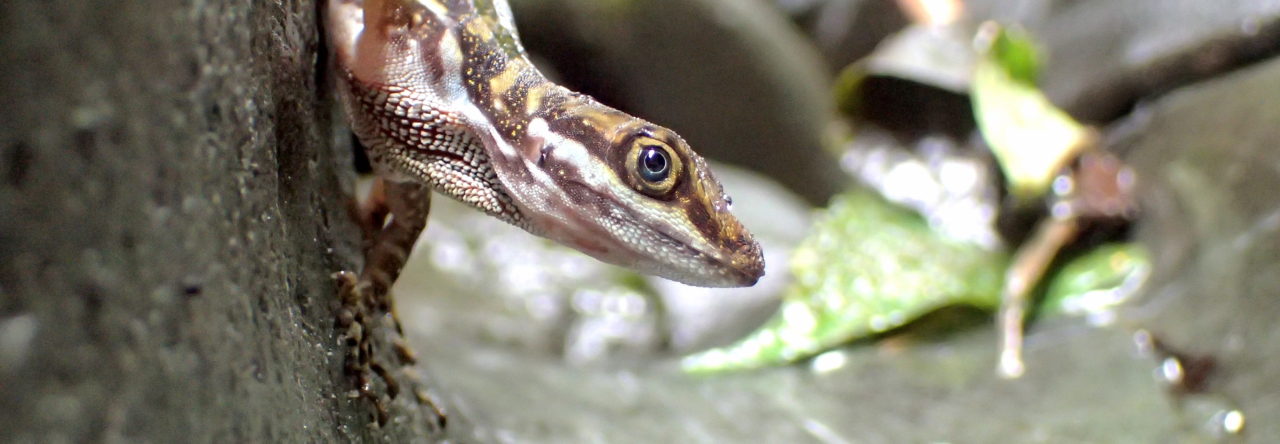
Here’s a close up of the Anolis hendersoni I found sleeping one fateful night inside the Dominican Republic.

Anolis hendersoni - male

Anolis hendersoni - male

Prior to finding this species, I had spent the evening looking for Sphaerodactylus armstrongi and S. streptophorus on the northern slopes of the Sierra de Bahoruco NW of Puerto Escondido.  Upon entering a patch of closed-canopy, broad-leafed forest with a dense, bushy understory, I remarked to myself, “I bet there will be Anolis bahorucoensis here.”  Anolis bahorucoensis is a bush anole that is common across the Sierra de Bahoruco, and often found alongside S. armstrongi.  I was not expecting to see A. hendersoni – another dolichocephalic bush dwelling species that is closely related to A. bahorucoensis – because it is generally considered a Haitian endemic whose range doesn’t cross the border into the Dominican Republic. When the sun set and I switched over to night hunting, I was happy to find out my intuition was, for once in my life, a close approximation of reality.


Animal, Vegetal, and Mechanical Perils of Fieldwork

Dan Scantlebury recently recently posted a pair of success stories [1] [2] from the field.  This post focuses on a darker side, the perils of field work.  I’ve highlighted three stories below, one animal, one vegetal and one mechanical.

Mechanical Perils
No trip to the Dominican Republic is complete without transportation issues; we generally lose about a day every two weeks to dealing with vehicles.  In our last few trips we discovered in the middle of a river that our supposedly 4WD truck was in fact FWD, had a Dominican gomero refuse to fix a flat because the tire was too worn (remarkable because nobody has lower standards for what qualifies as a functional tire than a gomero), and realized our rental truck had one tire that was significantly smaller than the other three only after driving from Santo Domingo to Barahona.  Pictured above is my “favorite” vehicular mishap.

Yellow Anole Eggs

A 'slug' next to a healthy, freshly laid egg. The scale bars in millimeters.

Anyone who’s raised anoles has likely run across the occasional slug.  I’m not talking about shell-less gastropod mollusks, but rather about the flaccid yellow eggs that anoles lay from time to time.  Slugs are uncalcified and generally considered infertile.  Because slugs never develop viable embryos and tend to quickly rot when incubated most lizard keepers simply discard them.  Is there anything to be learned from slugs?  In our colony, we tend to recover the most slugs early and late in the breeding season, but we’re not sure why this is the case.  Is it possible that the male and female are a bit out of sync, or that the female is priming her reproductive tract for the real deal?  We’re also recovering more slugs in our hybrid crosses than in pure crosses, but we’ll have more on that later.  Are any reproductive physiologists out there more familiar with the mechanisms responsible for production of slugs?

How Far Has the Brown Anole Invaded?

In a recent post, Alison Devan reported the presence of the brown anole, A. sagrei, in Savannah, GA. That prompted AA to inquire on the HerpGuide Facebook page where else the brown anole has been seen in the southeastern U.S., other than Florida and Louisiana. You can see for yourself the responses above, to which I can add a lawyer’s office in Boston and a plane out of Denver. Anyone else seen sagrei getting about? Any predictions how far it’ll spread (see this recent post for a distribution map of sagrei in the southeast today)?

By the way, the HerpGuide FB page is a place for people to post herp photos to be identified, as well as other herp related items. Worth joining.

Can You Spot the Sleeping Anole?

Somewhere in this photo is a sleeping anole. The species is one that has only been reported from the Dominican Republic a few times.

Somewhere in this photo is a sleeping anole. The species is one that has only been reported from the Dominican Republic a few times.

If you can find the sleeping anole in those photo, you will have contributed to cataloging the anole fauna of the Dominican Republic.  Points if you can identify the species.  Hint – the photo was taken on the northern slopes of the Sierra de Bahorucco approx. 12km east of the Haitian border.

White Nose Fungus? Or Just Shed Skin?

Anolis carolinensis hatchling in our animal facility.

I’ve noticed that many of the anoles in my breeding colony occasionally have white protuberances emerging from their nostrils, like the two-month old hatchling to the left. I haven’t been able to determine whether these protuberances are the remnants of an old shed or whether the lizards have a fungus growing in their nostrils. By the time I catch an afflicted individual in its cage the protuberances are gone, seemingly because the lizard blew them out while moving to evade my hand. Has anyone experienced this phenomenon?

Scantlebags: A New Innovation for Anole Field Work

Scantlebags being used in the field.

When in the field, we often need to temporarily house many animals from multiple localities for a short period of time.  While doing this, we need to keep animals healthy and track collection sites during transportation.  Anole researchers have used a variety of techniques to bag and sort captured anoles and often  rely on commercial reptile bags, pillow cases or plastic bags.

Thanks to the ingenuity of Dan Scantlebury and his mother, the Glor Lab has another solution: Scantlebags.  Scantlebags are individually manufactured in Stone Mountain, GA to our precise specifications.  They are made from white ripstop cloth material that is machine washable.  By making our bags from white fabric we can also write specimen data directly on the bag with a sharpie.  Each Scantlebag has a zipper closure, allowing easy access to captured animals without completely opening the bag.  You’ll have to trust us when we say that dealing with zippers is much easier than trying to constantly tie and untie pillow cases.  Scantlebags come in sizes ranging from a few square inches (for small anoles and Sphaeros), up to bags that are about the size of a typical pillowcase (which can temporarily accomodate ~20 small anoles). Finally, each bag has a webbing strap in one corner which allows Scantlebags to be tied to a belt, where they are easily accessible but secure from accidental loss.  The strap is at the opposite end of the bag from the zipper opening because the anoles we work with tend to aggregate at the top of the bag and are less likely to escape when the bag is opened from the bottom.

How does everyone else secure animals in the field? Any ideas for Scantlebag improvements?  Let us know in the comments.

Not All Embryos are Created Equal

The pages of Anole Annals were recently graced with beautiful photos of Anolis embryos (here), their allure attracting attention from far and wide (here). Unfortunately, development doesn’t always go according to plan. While slight perturbations to development can create fodder for natural selection, more extreme phenotypic mutations can create not-so-hopeful monsters (a play on R. Goldschmidt’s theory of hopeful monsters which predicts that relatively large homeotic mutations can contribute to evolutionary saltations). Several years ago I dissected this embryo of A. sagrei. Count the body parts.What do you see?

This is likely one of the most extreme mutant Anolis embryos I have collected. I regularly find dead embryos that appear normal morphologically and died for unknown causes. But this is the other extreme. This embryo clearly possesses a well-developed, seemingly normal head, limbs, and tail. It is even beginning to develop scales on the limbs and body. Without dissection I cannot be precisely sure about the nature of this mutation, but one can readily discern that there is no well-defined body axis, the head, tail, limbs all emerge from a nondescript central mass of tissue. Perhaps more interesting  in this light, there also appears to be an axis duplication. Eight limbs, two tails, and two sets of hemipenes are visible, but only one head (note, only one eye is visible but both are present). Can’t see everything? Check out the labeled photos below.

Staged Anole Fights on YouTube?


Fights among anoles are fairly common in nature, and we’ve had several previous posts documenting anole fights captured on film (1, 2, 34).  A casual browsing of YouTube reveals many more anole fights, mostly between male Anolis carolinensis (1, 2, 3, 4, 5).  Many of these videos use the Rocky theme music to set the tone.  I was really enjoying watching these videos until I got to thinking that some of them might actually be staged.  I browsed the comments to see if I could figure out if the fights were staged, but didn’t come up with any definitive proof (in a few cases, I added my own comment asking directly if the fights were staged).  However, there are certainly people who have commented that watching these videos has inspired them to raise fighting anoles.  What do you think?  Do some of these fights look staged to you?

Thanks-giving Far from Home

Giant anoles and new friends

Initially skeptical of my ambitions, a group of security guards celebrate the capture of a massive Anolis baleatus.

Part of any field-based research program are the random, unimagined discoveries that develop into fascinating side projects. (I’m sure that statement made my advisor’s blood pressure swell a tad).  One such “discovery” I’ve been a part of during my adventures in the Dominican Republic are the existence of maggot infestations inside the mouths of crown giant anoles.  Another crucial component to field research are the memories you take home with you – I mean the ones you’re not even sure you believe yourself when you tell your friends and family because they are just too random, bizarre and wonderful to be possible.  And that January night when Miguel Landestoy, Anthony Geneva, and I first glimpsed these writhing maggots in the mouths of giant anoles certainly qualifies…  (Cliff notes: Cipro and solenodon).

Page 15 of 22

Powered by WordPress & Theme by Anders Norén