
Read all about them here.
Category: Natural History Observations Page 31 of 34
Turns out that there are lizards out there besides anoles evolving on islands. Check out this award winning film from Nathan Dappen. The film took first place in the first annual NESCent Evolution Film contest. 11 films were screened and voted on by attendees at the Evolution 2011 meeting in Norman, OK.
Editor’s Note: all the entries in the film festival can be seen here. The runner-up, “Why Don’t You Teach Evolution,” is also great.
“You’ve gotta see this!” my fiancé Mark called to me one morning. He was outside, which could mean only one thing: a wildlife encounter was underway. Living in a semi-rural neighborhood in Florida, you never knew what you would see, from a mated pair of Sandhill Cranes walking down the street with their young, to Gopher Tortoises excavating burrows in the front yard.
I walked downstairs to the concrete area under our elevated house where Mark was staring at something on the ground. I looked down to see a frog (Cuban Treefrog) with the tail of an A. carolinensis protruding from its gullet.
“I knew that lizard,” Mark said forlornly.
Anolis argenteolus is not the only (Cuban) species that has this “window” on the lower eyelid. Anolis lucius also has transparent scales, but if I recall there are 3 in this species. Interestingly, both of these species are to some extent saxicolous or cliff dwelling. So perhaps the sunglasses theory is correct. Protects the eyes from reflection off the white limestone rocks? Attached is an image of this species from the Matanzas Province.
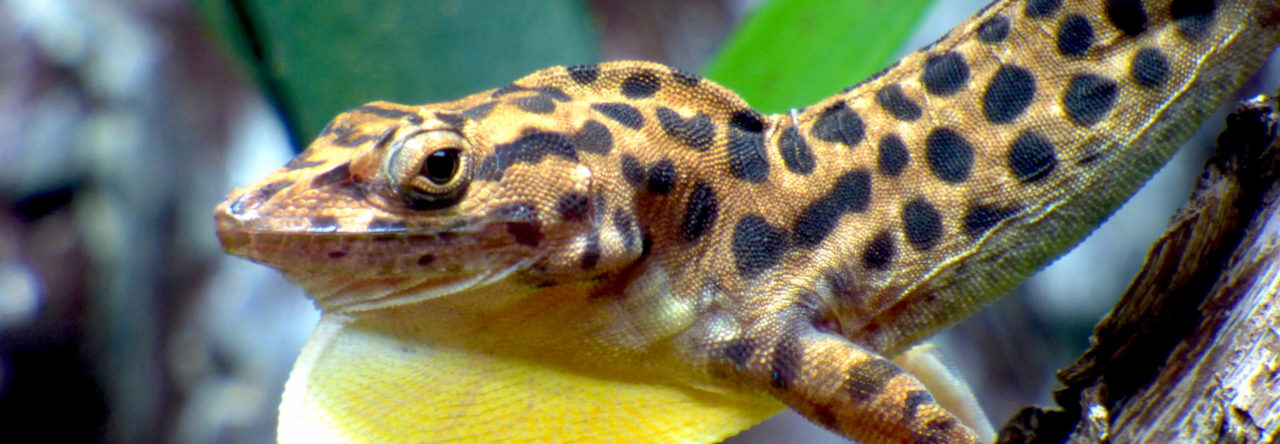
The last post makes me recall this weird situation while in Cuba in 2007. Anolis argenteolus seems to have a “fake eye” right at its eyelid. This is mentioned in the species’ descriptions as 2 transparent palpebral scales “as windows”… Looking at some pictures I noticed the scale’s surface being quite reflective and with some iridescence, but it is hard to tell whether they really can see thru it or whether it is just a false eye so when they roost or they close their eyes during the day they are able to show that they still alert. According to Williams & Hecht (1955), these “windows” in the lower eyelids are presumed to act as “sunglasses” in order to reduce light intensity, though I saw the animal doing this even in shady situations. Or they may serve to detect movement while sleeping (Vergner and Polak, 1996).
Anoles have served as great model organisms in studies of adaptive radiation and how form and function are molded by selection, but they have also been the center-piece for some of the most interesting (and classic) research on how the brain modulates aggression to determine dominance. For example, work by Cliff Summers and his laboratory (among others) over the years has provided great detail concerning how adrenal catecholamines and glucocorticoids, produced during “stressful” aggressive interactions, interact with serotonergic activity in the hippocampus to determine social rank. These neuroendocrine processes are outwardly expressed, in a sense, by the familiar eyespot seen prominently during male green anole (Anolis carolinensis) interactions. The formation of the eyespot is stimulated by catecholamines, and the latency of eyespot formation is dependent on serotonergic activity, which is influenced by glucocorticoid secretion. Males that develop the eyespot sooner tend to be dominant, and once eyespots have appeared in one combatant, aggression in the rival tends to be inhibited. At least that’s the way it seems to work in A. carolinensis.
A few years back I was asked to give a talk to some undergraduate marine biology students studying at the Discovery Bay Marine Lab in Jamaica. I brought a live Jamaican giant anole (A. garmani) to this presentation, and told the students that this species eats just about any other animals it can fit in its mouth – including other anoles. One of the students seemed shocked by this revelation and suggested that “they only eat other anoles in emergencies, right?” This necessitated a little lecture on nature red in tooth and claw that seemed to leave some of the students on the verge of tears. (Presumably readers of this blog already know that whatever concerns organisms might have about inclusive fitness do not extend to the intra-generic level.)
Although anole on anole predation is a well-known phenomenon, most reports involve adults feeding on much smaller juveniles. In the latest issue of Herpetological Review, Luke Mahler and I report an exception to this generality involving predation by an adult male Anolis cybotes on an adult female Anolis marron. With a prey SVL ~60% as large as the predator’s (70mm for the predator v. 45mm for the prey) this observation ranks as the highest predator:prey ratio ever reported for anoles. Given that the A. cybotes failed to fully ingest its prey during the 8+ hours we held it captive, we speculate that this event was at, or perhaps even above, this individual’s prey size limit.
It’s been very dry here in the Bahamas; we’ve barely seen any rain at all. So, when a few drops splattered mid-afternoon, out came the lizards, slurping up every droplet they could find. In the subsequent 30 minutes, I found six Bahamian green anoles (A. smaragdinus), compared to a rate of 1-2/hour for the rest of the day (this rate, in turn, twice as high as in previous days because it was cloudy and cool).
Ever watched an anole drink when it’s thirsty? This video shows what it looks like.
I noted recently that the brown anoles here in Staniel Cay seem exceptionally skittish, and we don’t know why. Perhaps it’s a coincidence, but we’ve found a trio of three-footed lizards. What’s going on?
I will admit here that I used to be a little jealous of other anole catchers. This twinge of want was not necessarily due to any perceived greater intellectual merit of the research, nor to collecting successes in terms of sheer numbers of lizards. My envy stemmed from the fact that the stories were exotic, involving international travel to islands in the Caribbean both great and small, where supposedly the anoles practically fall out of the trees and astonish you with their diversity and abundance.
I would think to myself how comparatively boring my field work must sound: driving in a blue van with New York plates, weaving across state lines, searching for A. carolinensis, the lone species that lives on the continent — the Drosophila melanogaster of an otherwise thrillingly diverse genus. Can there be a more boring species than a lizard with the word “green” in its common name? Even the folks I meet while traveling in the field hint at mundaneness when I tell them what I am looking for: “Where you really need to look is on my aunt’s patio!” Yes sir, I know they often pop up in the begonias, but will they be there when I need them to be (because they never are)? Plus, I have to be in southern Georgia by tomorrow afternoon so I need anoles from this latitude today!


