Category: Natural History Observations Page 23 of 34

Anolis equestris in south Florida

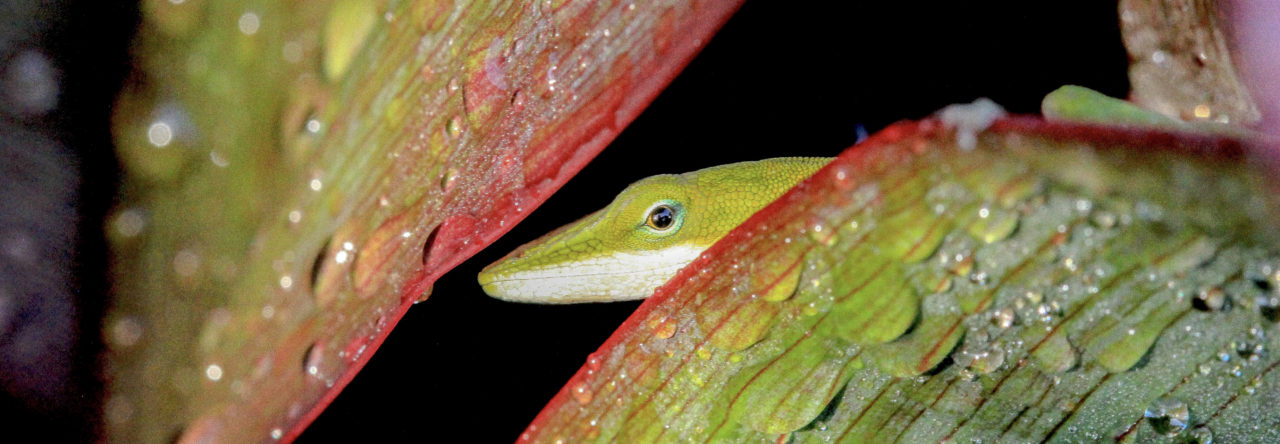
This young Anolis equestris was enjoying the recent bloom of a royal palm here in south Florida. After the freeze in 2010 there was a sharp decline in Anolis equestris (kill rate perhaps as high as 80%). The Iguana iguana population declined by 95% or more (so much for the “invasive invasion”). What has resulted from this die-off is that now I see many more of these young A. equestris. This particular specimen most likely hatched out last spring, there is also a smaller sized batch that must have hatched out in the fall. This staggered series of young animals is something I had not observed previously. Adult Anolis equestris (particularly the males) are notorious cannibals and young equestris are much slower and less agile than A. sagrei, A. porcatus, and A. distichus which often elude the sprinting attacks of equestris.

 There have been a number of citations of equestris eating birds and small rodents. Anolis equestris are opportunistic predators and will undoubtedly take fledglings if possible. I have seen mocking birds chase equestris from trees because they see them as threats, however, their fabled predatory exploits have been largely exaggerated. For nearly forty years I have made numerous field observations of A. equestris in south Florida. What I have found is that they spend their time much like their smaller anolis counterparts snapping up small arthropods. In fact, a fair proportion of their food intake isn’t even animal matter;

Indirect Mutualism Between Green Anoles and Dogs

Brown anole from Dust Tracks on the Web

Darwin famously pointed out that a surfeit of cats could lead to an abundance of flowers.  Janson Jones has transplanted that way of thinking to our favorite study organism, arguing that a population burst in green anoles in Florida is due to an influx of little dogs, whose ceaseless yapping and running amok has knocked brown anoles off their game, allowing the greens to proliferate. Read all about it here.

Animals and/or insects have a very weird yet amazing relationship with each other. Most of the time, a species will be wiped out without the other. When we think of our dogs, we often think about getting them the best life they can have, and we end up buying stuff from www.treehousepuppies.com or from our local pet shops. But nature does not operate that way, instead, it lets the animals and insects fend for themselves with the help of others.

And here’s what Darwin had to say:

Humble bees alone visit red clover, as other bees cannot reach the nectar. It has been suggested that moths may fertilise the clovers; but I doubt whether they could do so in the case of the red clover, from their weight not being sufficient to depress the wing petals.

Hence we may infer as highly probable that, if the whole genus of humble-bees became extinct or very rare in England, the heartsease and red clover would become very rare, or wholly disappear. The number of humble-bees in any district depends in a great measure upon the number of field-mice, which destroy their combs and nests; and Colonel Newman, who has long attended to the habits of humble-bees, believes that “more than two-thirds of them are thus destroyed all over England.”

Now the number of mice is largely dependent, as every one knows, on the number of cats; and Colonel Newman says, “Near villages and small towns I have found the nests of humble-bees more numerous than elsewhere, which I attribute to the number of cats that destroy the mice.” Hence it is quite credible that the presence of a feline animal in large numbers in a district might determine, through the intervention first of mice and then of bees, the frequency of certain flowers in that district!

Sighting Of The Gray-Dewlapped Anolis Carolinensis


The fabled gray dewlapped anole. Photo by Harry Greene

Harry Greene and Jed Sparks lead a two week graduate field trip to Florida. While there, they espied the lizard shown above in the Corkscrew Swamp near Naples, FL. Here’s what Harry had to say: “Jed Sparks, the other instructor, initially said “green” after I’d told him to expect pink, and that was the first of the two we saw–I got only a glimpse of the partly protracted dewlap and no photos of that one. Second animal I got 3-4 images of separate dewlap expansions, and can say that through binos they looked pale green, but when I look at the images I see white scales and gray or green interscalar skin, not sure which! In any case, I can tell you almost exactly where I saw each of them, and they were on the same first half stretch of the ~2 mi boardwalk, in each case in well lit sites on the outer edge of swamp proper.”

Note that Macedonia in his 2003 paper referred to the dewlaps of these species as “greenish-gray.” Gray-dewlapped green anoles are known from southwestern Florida, but have been little studied. The seminal work is Macedonia’s aforementioned study, that concludes:

Water Loving Green Anoles

Photo by Janson Jones

We’ve previously discussed how green anoles, Anolis carolinensis, are much more terrestrial in areas where A. sagrei doesn’t occur. Janson Jones, who has written on this previously, now adds a new twist–at one sagrei-less site in Georgia, they’re frolicking around in the water lilies and other aquatic vegetation. Read all about it here.

That got me thinking. Maybe this is how the famed “aquatic” anoles evolve? First you hang out on weeds in the water, next you’re jumping in for a dip?

And speaking of anoles, not only do they float, but they can swim, even those that rarely, if ever, enter the water. I’ve inadvertantly put A. sagrei into the ocean a number of times (think lizard noosing malfunction), and they just press their legs against their body and swim by undulating their tail, alligator-style. Green anoles do that, too, and I’ll bet all anoles innately can swim. I wonder what would happen if you put a crown giant in water. Anyone want to try that with their pet in the bathtub? I bet they can swim, too. So, anoles are pre-adapted (exapted, if you will) for becoming adding aquatic habitats to their repertoire.

And that leads me to one more thought in this ramble: Carl Gans published an obscure paper (Locomotor responses of Calotes to water (Agamidae: Sauria). J. Bombay Natural History Society, vol. 74:361-363, 1977) years ago about some Asian agamid lizards (Calotes) that he dropped into a swimming pool. At first they swam as described above, but then started flailing their legs ineffectually. Eventually, their head would drop below the water, they would breathe in some water, sink to the bottom and then start walking around, presumably until they would have drowned if not rescued. Doesn’t seem like they have much of a future in adapting to aquatic habitats. Similarly, if you dunk a baby duck under water (not that I’ve ever done that), they hold their breath, but baby chickens try to breathe, and things don’t go well. Take home lesson: basic motor patterns and behaviors are needed if a species is to have any hope of adapting to a new habitat. If it doesn’t have the necessary prerequisites to survive there, they have no chance of adapting. (This is, more or less, the theme of another Gans paper I stumbled across when looking for the one mentioned above).

Barbados: Caribbean Herpetofauna Island of the Day

Postage stamp for Anolis extremus, the Barbados Anole

Although advertisements on the Boston MBTA are trying to convince me that one visits Barbados for its white beaches and plush resorts, I know that the herpetofauna is the real draw!

A Giant’s Snack And As A Snack (itself)

Even with their large size, and one spending quite some time in their territories, it is somewhat difficult to find a Giant Anole during the day in the Dominican Republic. The most widespread and common species (at least in the Dominican side) is A. baleatus, which is not an unusual sighting at the mesic riparian forest of “Gran Cañada” in the botanical garden of Santo Domingo. But even there, observations are limited by spotting an animal right after it moves to hide away from view (squirreling or slowly sliding around tree trunks). The population in this particular locality seems to be stable and not pursued by people, whom locally have the misbelief that they are aggressive and harmful to humans.

Regarding a local species, A. barahonae, possibly the first encounter I had with this species was back in 2003, in the hills above Enriquillo, southwest of Barahona, where through binoculars, I saw at the distance and high in a large tree a White-necked Crow (Corvus leucognaphalus) holding a large, strong, greenish anoline lizard it its beak. Although I couldn’t see many details of the lizard, I think it must have been A. barahonae because it is the only Giant anole known from that locality. The White-necked Crow forages mainly in flocks and in the canopy, so I suppose that they represent a common predator to that anole species.

After that encounter, I have seen just a few more to date: one basking in a large tree in a shade coffee plantation, also in an epiphyte-packed tree in a cloud forest. This time (yesterday), a fellow local biologist and I were exploring some rivers in the Nizaito watershed, also south west of Barahona. Specificly at a tributary stream that pours into Río Paraiso, while taking photos to a basking Ameiva taeniura aside the road, about 11:00 a.m., I heard some noise coming from a nearby cluster of rather young Cecropia trees. Then my attention was caught by a glimpse of the wing beats of a sphinx moth, soon realizing that it already was in the mouth of a Baoruco Giant Anole. The anole kept still while holding its prey, with tail hanging outwards off the leaf where it was perched.

Unfortunately, I didn’t see the action before the attack happened, but as seen in the pictures, the dead leaf of the Cecropia was probably the perch that the moth used for roosting throughout the day. As most moths are nocturnal in habits, it is likely that it was inmobile siting there just relying in its cryptic coloration and pattern. In an earlier post: A. cuvieri On The Prowl, some excellent photographs by fellow naturalist Father Sanchez showed a Puerto Rican Giant Anole (Anolis cuvieri) deliberately moving about at moderate heights and using several kind of perches. I often imagine that all these anoles would take their prey mostly up in the canopy or high in the tree trunk, but these photographs of the A. barahonae eating this moth were taken at a height of 3 meters, atop of a small tree (Piperaceae) almost overlapping with a taller (8 m) Cecropia tree. Previous to when I heard the sounds coming from the attack, I didn’t notice any motion in the area as I was pretty close. The anole may have been stalking or more likely foraging and scanning this (unusual?) substrate in search of random prey.

The Anoles Of Guadeloupe

Guadeloupe is composed of two islands whose shape is that of a butterfly and that were joined together in 1806 by the wooden Union Bridge and then the Gabarre Bridge in 1929:

  • Situated to the west, Basse-Terre has an area of 848 km2. This is a volcanic mountain whose summit is the Soufriere, located at 1467m altitude. It is covered with a dense rainforest with many rivers and waterfalls.
  • Situated to the east, Grande-Terre has an area of 586 km2. The substrate is limestone and consists of a plain bordered by a mangrove forest in the southwest, an irregular succession of hills called “les Grands Fonds” in the center and an arid plateau of rocky coasts in the north.

The species of endemic Anolis of Guadeloupe is called Anolis marmoratus, with reference to the orange marbling on the head of the specimens described by Dumeril and Bibron in 1837. In fact, Anolis marmoratus is a species which has 6 subspecies of Guadeloupe and six others on the islands around (La Désirade, Petite Terre, Marie Galante, Les Saintes, Les ilets Pigeons, Les Ilets Kahouanne, les Ilets Fajous).

Regarding Anolis marmoratus of Guadeloupe, the subspecies are:

Anolis marmoratus marmoratus

Anolis marmoratus marmoratus, which Lazell in 1962, noted as “the most beautiful anole he never saw.” It lives around Capesterre, at the southeast of Basse-terre. Adult male are apple-green, shading to blue on the tail and yellow-green on the limbs. The head, the neck and the orbital area are marbled with orange, the throat fan orange-yellow with yellow scales. Preliminary work we have conducted suggests that it could be classified as a trunk-ground ecomorph.

Anolis marmoratus girafus

Anolis marmoratus girafus that lives along the west coast of Basse-Terre in the driest area of this island.

Anolis in the birdbath

Playing possum part 2

Anolis in the birdbath

A. maynardi pretending to be drowned

This A. maynardi comes fairly often to our bird bath in Little Cayman to drink, crawling down into the clear plastic tub and sunbathing on the rocks. After I took his picture (below) and went for a second shot, he got spooked and dove into the water, swam vigorously with much wiggling, and then started to play dead. He drifted at a very odd angle, not moving, tail end sinking slowly until only the tip of his elegant nose was exposed. When my husband tried to “save” him, he wiggled & swam away until he made contact with my husband’s hand, and then dove into a nearby pot plant. Has anyone else seen an anole playing possum?


Rare(ish) Puerto Rican Anoles

Another Revell Lab (Liam, Kristin, Graham) trip to Puerto Rico this spring, and another series of encounters with the diminutive Anolis occultus and the spectacular Anolis cuvieri. Both of these species can be quite challenging to find, but we have had some good success in several locations in the Puerto Rican karst region.  In January, we observed many individuals of both species


And managed to get a few in-hand for pictures


We also found a juvenile cuvieri, which has a gray coloration and an ontogenetic shift to green as they age:

Unless they happen to be one of the brown morph adults,

Fighting Hawaiian Anoles

Reader Louise Butler from the Big Island writes: “I am attaching two photos. One is a battle royale on the outerside of my kitchen window. Two anole-like dudes (?) duking it out, each grasping the other’s jaw. They remained this way, occasionally changing position but never letting go, for several minutes. Most amazing was that my indoor anole hardly noticed them and he was on the inside of the very same screen! Look at the difference in size.

I’ve never before, or since seen Anolis this big.

The second photo depicts the gold-dust day gecko’s most favored way of proliferation. They love the car. I’ve seen several emerging from the innards of my neighbor’s car after one of his trips to Kona from our location on the eastern tip of the Big Island.”

So, readers, what do you think about the size of those Hawaiians? And let’s not forget that geckos are not the only ones that use that means of transportation.

Page 23 of 34

Powered by WordPress & Theme by Anders Norén