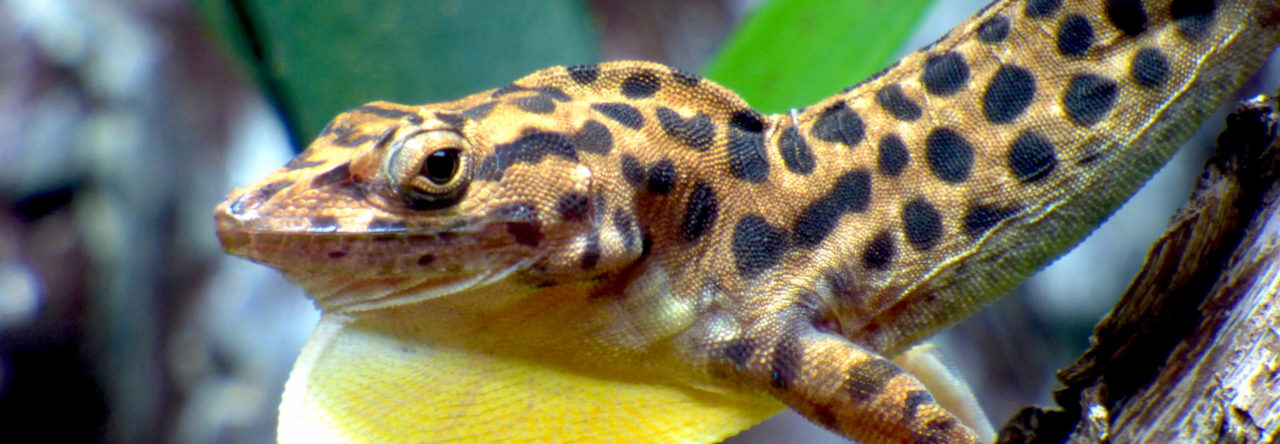

Anolis armouri basking on a rock.
Our era of human-mediated climate change has brought startling new realities that we must face – ocean acidification, desertification, and receding ice caps, among others. For those of us who study lizards, one message is pervasive and clear – many species are being pushed to their thermal limit, and it is likely that many lizards, especially those that prefer cooler temperatures, won’t be able to take the heat. But, how do we know this? One of the main methods used to determine how reptiles will respond to climate change is to compare their preferred temperature (i.e., where lizards would like to keep their body temperature, given the option) to a random sampling of the thermal environment.
From a lizard’s eye view, though, the thermal environment is more complex than just air temperature. Lizards have volume, shape, and color, all of which affect their core temperature. Essentially, the operative temperature (Te) describes a lizard’s thermal environment as the sum total of many different interactions, such as radiation and convection, among others. Because it describes how temperature is shaped by everything except behavior and physiology, the operative temperature essentially describes how a perfect thermoconformer instantaneously perceives the environment. As such, it has been used as the null hypothesis for behavioral thermoregulation – if we can describe the thermal environment by recording Te, then we can use field-measured body temperature to determine the degree to which animals are thermoregulating. Here on the Anole Annals I’ve considered how devices have evolved to capture the operative temperature. The earliest prototype was a water-filled beer can, and we now have copper models painted to match the organism’s reflectance and HOBO devices.

Copper models of Anolis cybotes in the making.
But just where did these devices come from? I’ve been in Terre Haute, Indiana working with Dr. George Bakken at Indiana State University for the past two weeks making copper models of Anolis cybotes for my field research in the Dominican Republic. Dr. Bakken, along with Dr. David Gates, operationalized the term “operative temperature” for the ecological community in a seminal 1975 paper. I sat down with Dr. Bakken for an interview to learn how the intellectual climate promoted this and other important foundational works for biophysical ecology and reptilian thermobiology.