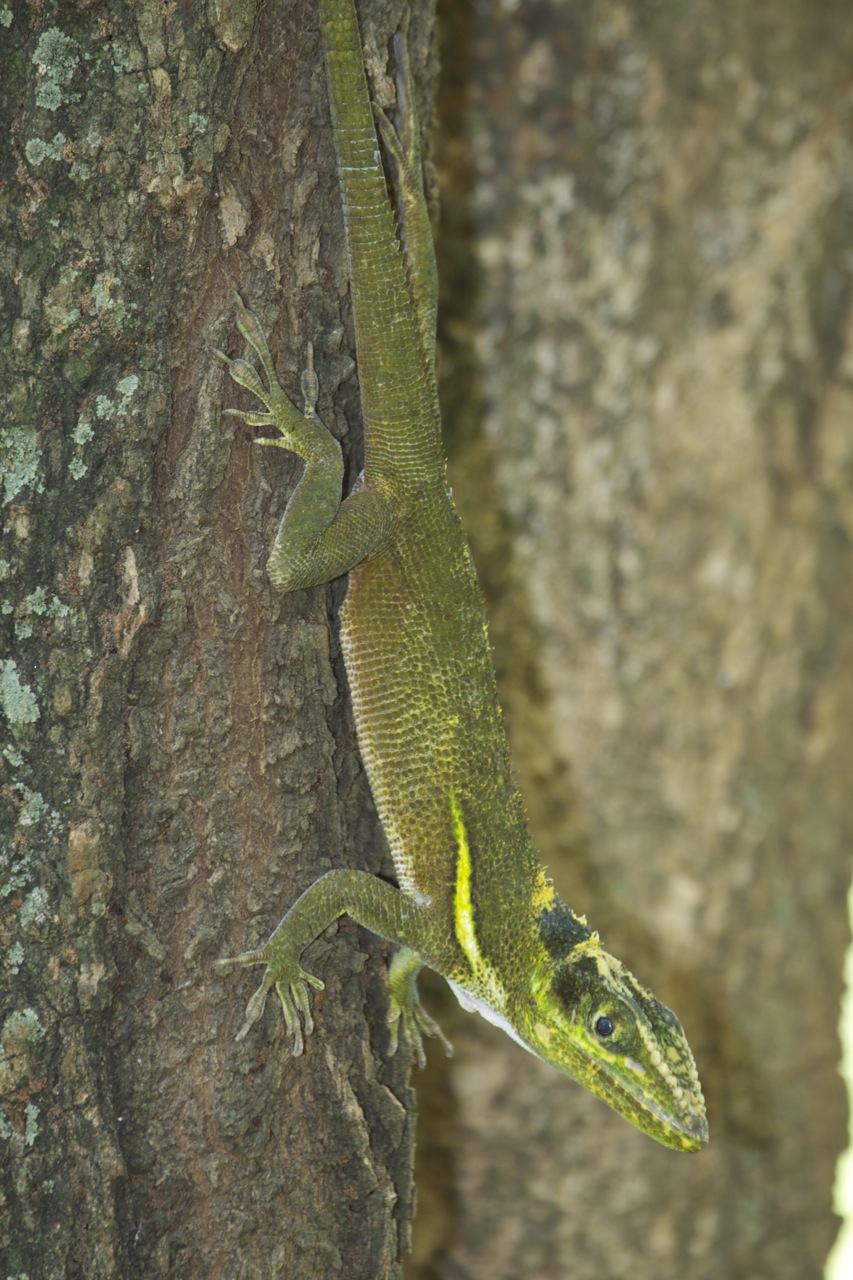

This individual might have arrived on Grand Cayman with a shipment of mango trees from Florida. We have some ideas, but want to solicit input from the experts.
![orange-anole-1[1]_1](https://i0.wp.com/www.anoleannals.org/wp-content/uploads/2014/09/orange-anole-11_1.jpg?ssl=1)
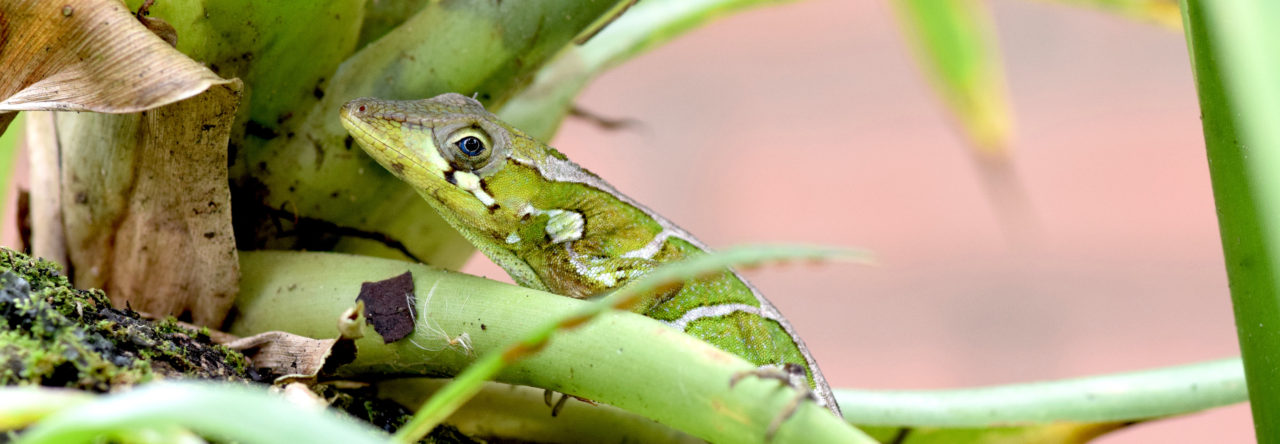
This individual might have arrived on Grand Cayman with a shipment of mango trees from Florida. We have some ideas, but want to solicit input from the experts.
A few weeks ago I had the opportunity to visit Puerto Rico for the first time, albeit briefly. Fortunately, a lot of anoles can be found even on a brief visit. With the help of caribherp.org and other references, I could identify most of them. I was hoping to get some help from the knowledgable readers of Anole Annals on the rest. I suspect they are mostly all juvenile Anolis cristatellus cristatellus, but the appearances are varied enough that I couldn’t be sure. Any ID help is greatly appreciated!

Unidentified Anole #1: Cueva María de la Cruz
This small brown anole and a couple of similar-looking buddies were dashing about on a large tree trunk at the edge of a grassy clearing at Cueva María de la Cruz. This small cave is in northeast Puerto Rico, near the coast, north of the western edge of El Yunque National Forest. I saw adult Anolis cristatellus cristatellus in smaller trees nearby, so it seems likely that this is a juvenile, though its pattern looked non-standard to me.

Crack that whip!
This proud Anolis cristatellus wileyae had snuck into the Butterfly Farm a few minutes’ walk from the cruise port in St. Thomas, U.S.V.I. So had a few dozen of its conspecifics, but this was the only one showing off its pretty two-toned dewlap while lashing its tail back and forth dramatically. Perhaps this is a common behavior, but it’s not one that I had seen before. Do other anole species also do this kind of double-showoff?

Three different individuals of Anolis cybotes that appear to have small pebbles or debris in their guts.
While analyzing some xrays of Anolis cybotes for my thesis work, I came across a few specimens that appear to have small dark masses in their guts. The numbers are pretty low – in over 200 xrays, I can only detect these masses in a handful of individuals. My curiosity was piqued. At first glance, they look like they might be gastroliths. Gastroliths, or gizzard stones, are rocks that animals eat to aid in digestion. Basically, the rocks help manually grind the food into smaller bits in a special portion of the digestive track called the gizzard. We know that many archosaurs (crocodilians, dinosaurs [including birds], and pterosaurs) have gizzards. Dinosaur gastroliths are some of my favorite fossils because they are usually polished and quite beautiful. However, unless I’m mistaken, lepidosaurs (squamates and rhynchocephalians) don’t have gizzards and aren’t known to have gut stones. Does anyone have an idea about what this could be? It’s possible that these are just accidental ingestions of small pebbles. Anolis cybotes do often forage near or on the ground, so perhaps it’s not so far-fetched for them to pick up a little rocky debris.
Also, check out this image of a regenerated tail!

Anolis cybotes with a regenerated tail.
I’m a little embarrassed to be writing this post, but I’m still unable to figure out some of the proposed changes to anole binomials in Nicholson et al.’s (2012) taxonomic revision of Anolis. I’m a real novice with implementation of “The Code” and the rules of the International Commission on Zoological Nomenclature, so I’m looking for a bit of help from AA readers who are more expert than I.
I understand that some of Nicholson et al.’s proposed changes to specific epithets are necessitated by the fact that their taxonomic revision would change the gender of generic epithets (e.g., Anolis chlorocyanus would be Deiroptyx chlorocyana due to the fact that Anolis is masculine and Deiroptyx is feminine). These types of changes are demanded by The Code’s article 31.2. However, I am struggling to understand Nicholson et al.’s proposed changes to twelve binomials that – to my novice eyes – do not appear to be due strictly to changes in the gender of generic epithets (see table below). Because the authors of this paper include leading authorities on taxonomy and nomenclature, I trust that these changes are not simply the result of typographical errors.
In most cases cited in my table, Nicholson et al. add or change vowels in the correct original spellings of species epithets, where the “correct original spelling” is defined under The Code as “the spelling used in the work in which the name was established.” Based on my amateur reading of The Code, changes to correct original spellings are not permitted unless it can be shown that the original spelling was inadvertently incorrect due to a printer’s error or related mistakes unrelated to the authors lack of familiarity with Latin (ICZN, Article 32). Can somebody enlighten me about which articles in the code govern the changes in the table below?
In this table, I provide the genus to which Nicholson et al. assign each species, the gender of this genus, the exact spelling for the specific epithet used in their manuscript, the spelling of the specific epithet from the Reptile Database, the spelling of the specific epithet from the original publication (NAs indicate that I have yet to check the original citation4), the type of change that Nicholson et al. have proposed, and the citation of the original description. Below the table, I provide some additional details about three specific cases. Thanks in advance for your help.
| Genus | Gender | Nicholson et al. | Reptile Database | Original Spelling | Change | Description Citation |
| Anolis | Masculine | anfilioquioi | anfiloquioi | anfiloquioi | o to io | Garrido 1980 |
| Anolis | Masculine | maclientus | macilentus | macilentus | e to ie | Garrido and Hedges 1992 |
| Anolis | Masculine | pumilis | pumilus | pumilus4 | u to i | Garrido 1988 |
| Ctenonotus | Masculine | monoensis | monensis | monensis4 | e to oe | Stejneger 1904 |
| Ctenonotus | Masculine | nubilis | nubilus | nubilus4 | u to i | Garman 1887 |
| Dactyloa | Feminine | anatolorus | anatoloros | anatoloros | o to u | Ugueto et al. 2007 |
| Dactyloa | Feminine | euskalerrari | euskalerriari | euskalerriari | ia to a | Barros et al. 1996 |
| Deiroptyx | Feminine | domincanus [see comments for correction and clarification] | dominicanus | dominicanus | delete i | Rieppel 1980 [Note: the original version of this post incorrectly referenced de Quieroz et al. 1998] |
| Norops1 | Masculine | forbesi | forbesorum | forbesi | si to sorum | Smith & Van Gelder 1955 |
| Norops | Masculine | schiedei [see comments] | schiedii | schiedii4 | ei to ii | Wiegmann 1834 |
| Norops2 | Masculine | williamsi | williamsii | williamsii | ii to i | Bocourt 1870 |
| Norpos3 | ? | parvicirculatus | parvicirculata | parvicirculata4 | rops to rpos and a to us | Alvarex del Toro & Smith 1956 |
I have a bit more information about three cases in this table.
1. Anolis forbesi is the original spelling in Smith and Van Gelder (1955), but Michels and Bauer (2004) corrected this name to Anolis forbesorum due to the fact that this species is named after more than one person. Michels and Bauer (2004) suggest that this change is a “justified emendation” under Articles 31.1.2-3 and 33.2.2 of The Code. We know that at least one author of Nicholson et al. (2012) was aware of this report because Michels and Bauer thank Jay Savage for having provided thoughtful comments on their manuscript. I’m not sure why Nicholson et al. (2012) reject this proposed change by using forbesi.
2. Nicholson et al. (2012) delete the final ‘i’ from a species originally named Anolis williamsii, in spite of the fact that article 33.4 of the ICZN states that “[t]he use of the genitive ending -i in a subsequent spelling of a species-group name that is a genitive based upon a personal name in which the correct original spelling ends with -ii, or vice versa, is deemed to be an incorrect subsequent spelling, even if the change in spelling is deliberate.” Which part of this rule or related rules in The Code permits changes from ‘ii’ to ‘i’ under some conditions?
3. Nicholson et al. (2012) change both the generic and specific epithets of Anolis parvicirculata when they refer to this species throughout their manuscript as Norpos parvicirculatus (see pages 91 and 96). Although I have included this change in my table for completeness, it is the one change that I think we must attribute to a typo, even though the misspelling of Norops as Norpos appears at least twice. The change from parvicirculatus seems likely due to the fact that this species originally, and incorrectly, had a feminine rather than a masculine specific epithet.
4. This post was revised to include original spellings confirmed by Peter Uetz, thus no more NAs in the table. Thanks Peter!
Last week, while going through some old pictures I had stored on my computer , I happened upon a few photos of A. equestris that I must have saved back when I used to surf the web for pictures of anoles. Taking a second to glance through the pictures for old times sake, I realized something: A. equestris is actually a quite variable species. Now I’m sure others besides myself have realized this before, the people who went about naming the long list of subspecies that I just found out this species has for example, but I can’t seem to find pictures of some of these subspecies so as to identify the animals in the photos, if they are indeed different subspecies that is, so I decided to post them here in hopes of getting an ID. I have chosen one photo for each of the different forms that I have noticed. I have my guesses about many of them and I’m pretty sure about a couple others. I have written my guess, if any, under each photo along with the photo reference; could anyone who knows the ID of a particular animal post their opinion in the comments? Thanks in advance!

Anolis equestris potior

Anolis equestris equestris
(introduced to Miami)

Photo from:http://www.fotos.org/galeria/showphoto.php/photo/76326
?
probably Anolis equestris or A.luteogularis
Photo apparently taken at La Habana.
two other photos: (1,2)

Anolis equestris, photo by Henk Wallays.
license:CC BY-NC
photo from http://calphotos.berkeley.edu
Anolis equestris thomasi

photo from this pdf.
?
Other photos of this form (1, 2)
And another one taken near Playa Larga.
 We found the lizard depicted above in the herpetological collection at the University of Kansas. We have no information about where it is from or who collected it. Can anybody help us identify what species it is?

An Anolis sagrei male from my study area in southwestern Taiwan.
Working with the brown anole (Anolis sagrei) is an eye-opener to the ability of some species to disperse far beyond the barriers that limit their natural dispersal potential. Anolis sagrei from Florida managed to reach Taiwan, most likely along with some nursery or agricultural products. They have also managed to reach Singapore, also I suspect along with some nursery products.

Can you identify this snake for us please?
Recently, an instance of a non-anole long-distance traveler came to my attention, and I would like to ask if anyone can help us identify the species involved. A friend told me about a snake that he obtained from someone, who got it from a person who imported wood from South America. Apparently, as the importer was about to start processing the wood he received, the snake slithered out of it. To me, the snake looks like a neotropical whipsnake (Masticophis mentovarius). However, it traveled by ship, meaning it could have gotten onboard at any port where the ship might have stopped. Thanks.

K. Rs, after correctly identifying the eye in this morning’s post as belonging to A. fraseri, posed a question of his own: “Could someone please tell me what the anole in the picture is. The photo is from Cuatrok 77′s flickr page but there is no species identification.It looks to be from the equestris group and is probably a subspecies of Anolis noblei, equestris or luteogularis. I am seeking to upload the photo to Wikimedia Commons and any help in it’s identification would be greatly appreciated.
In collaboration with the Conservation Biology course taught by Dr. Karen Beard here at Utah State University, where I am a Ph.D. student, I have been involved in gathering life history data on ~400 species of reptiles that have been introduced outside of their native ranges for an analysis of how life history traits (e.g., diet, fecundity, longevity) interact with other factors to influence the likelihood of successful establishment. Appendix A of Fred Kraus’ 2009 book Alien Reptiles and Amphibians is the source of the species list we are using, and included in this analysis are 26 species of Anolis. This is where you come in.
First, we coded all anoles as (i) sexually-dichromatic, (ii) diurnal, (iii) non-venomous, (iv) oviparous, (v) omnivores that lack (vi) temperature-dependent sex determination and (vii) parthenogenesis. Is anyone aware of any exceptions to these seven generalizations?
Second, we searched for data on clutch size, clutch frequency, incubation time, and longevity. The Anole Classics section of this site and the Biodiversity Heritage Library were particularly useful. After conducting what I feel to be a pretty thorough literature scavenger hunt, I am forced to conclude that some of these data simply do not exist at the species level for all of the species we’re interested in, or are not explicitly stated in a way that is obvious to a non-anole-expert. Of course, there is a lot of literature, including many books that I don’t have access to, and there are also lots of credible observations that don’t get published. I’m hoping that some of the readership here can help fill in at least some of the blanks in the table below. As one member of the team, I did not collect all of the data that are filled in myself, nor have I personally vetted every value, so if you spot an error please do point it out.
Two important points:
Without further ado (for your enjoyment, and because I know from my own blog that nobody reads posts lacking pictures, I’ve embedded an image of each species):
| Species | Median clutch size | Median clutches per year | Incubation time (days) | Maximum longevity (months) |
 A. aeneus |
2 | |||
 A. baleatus |
||||
 A.bimaculatus |
2 | 43 | 84 | |
 A. carolinensis |
1.15 | 6 | 41.5 | 65 |
 A.chlorocyanus |
1 | 18 | ||
 A. conspersus |
1 | |||
 A. cristatellus |
2.5 | 18 | 83 | |
 A. cybotes |
1 | 18 | 45 | |
 A. distichus |
1 | 16 | 45.5 | |
A. equestris |
1 | 1 | 48 | 149 |
 A. extremus |
||||
 A. ferreus |
1 | 18 | ||
 A. garmani |
1.5 | 18 | 67 | |
 A. grahami |
1 | |||
 A. leachii |
||||
 A. lineatus |
||||
 A. lucius |
1 | 3.5 | 60 | |
 A. marmoratus |
2 | 50 | ||
 A. maynardi |
||||
 A. porcatus |
1 | 18 | 63.5 | |
 A. pulchellus |
1 | |||
 A. richardii |
1 | |||
 A. sagrei |
2 | 20 | 32 | 22 |
 A. stratulus |
||||
 A. trinitatis |
2 | 50 | ||
 A. wattsi |
1 |
Thanks in advance. I think this is a great blog and I hope to post something more interesting on here soon.
Powered by WordPress & Theme by Anders Norén