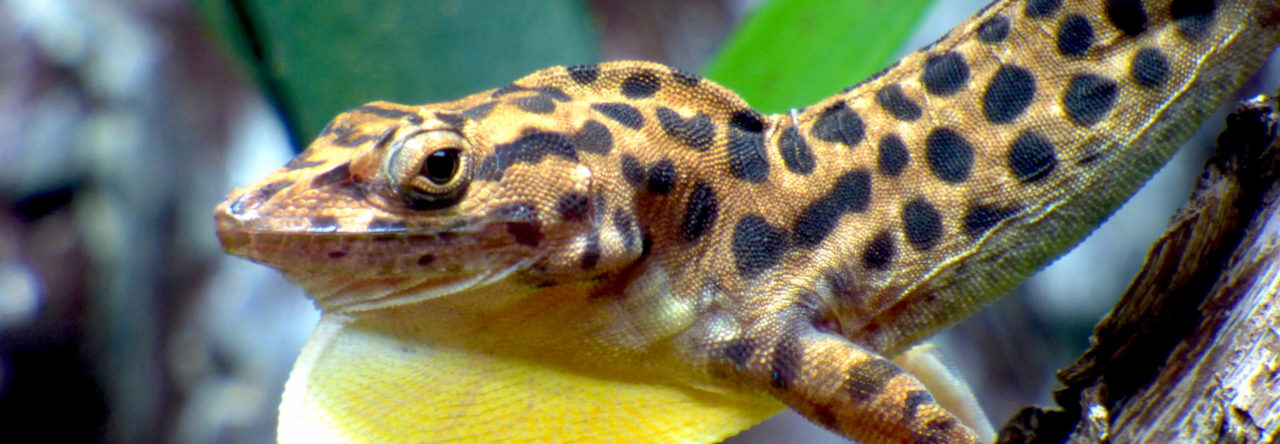
Anolis carolinensis is headlining the new exhibition on animal sex in the Natural History Museum Rosenstein, Stuttgart, Germany. Go check it out if you’re in the area
Category: Anole Art, Literature, and Humor Page 9 of 11
Genny Wilson, a certified medical illustrator (check out her work here), has tried to imagine what Anolis roosevelti, not seen for 80 years, might have looked like in life. This is her latest version. Have any thoughts or suggestions? Add a comment, or email her directly at hagginwilson@earthlink.net.
Check it out. Read the backstory here.
Turns out that there are lizards out there besides anoles evolving on islands. Check out this award winning film from Nathan Dappen. The film took first place in the first annual NESCent Evolution Film contest. 11 films were screened and voted on by attendees at the Evolution 2011 meeting in Norman, OK.
Editor’s Note: all the entries in the film festival can be seen here. The runner-up, “Why Don’t You Teach Evolution,” is also great.
Who would create such a page? And who are the seven people who “like it”? It seems possibly a response to the “Anolis” FB page (featuring the same ID photo), which reassuringly has 109 likes… For the record, of the plethora of anole themed FB pages, AA endorses “Anolis Lizards,” primarily because we created it. Check it out, and please add your own photos and posts.
Mark Catesby was a famous wildlife artist who preceded Audubon by 100 years. He is best known for The Natural History of Carolina, Florida, and the Bahamas Islands, which is the subject of an article, “Catesby’s Gallery: A Trailblazing Naturalist in the New World,” in the February, 2011 issue of Natural History magazine. The article has reproductions of a number of his paintings, mostly birds, but also plants a crab and… “in a whimsical painting, Catesby shows a Jamaican Anolis lizard, splay-legged and getting a toehold on leafy sprigs of a mainland tree, the sweet gum (Liquidambar styraciflua).” Elsewhere, the article comments that the pairing of the Jamaican anole with a Carolina sweet gum was “seemingly random.” More importantly, what is the anole? My guess is a female A. garmani. But, the color might also be consistent with an A. grahami aquarum. Thoughts?
(p.s. Thanks to Pops for pointing out this article to me)