Category: All Posts Page 88 of 153

Amazonian Green Anole Fails to See the Cryptic Cricket

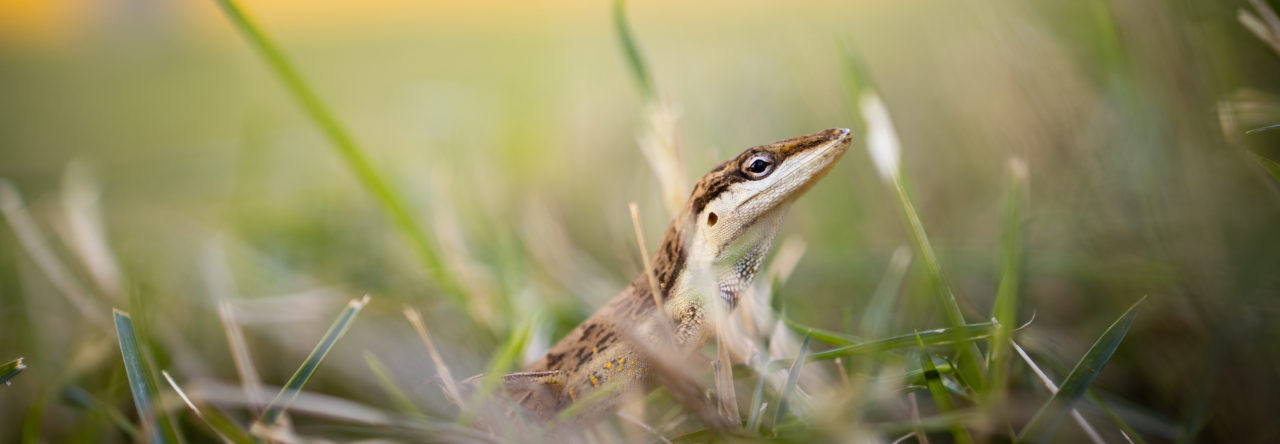
punctatusThe caption says: At first look this image may just look like an Amazon green anole (Anolis punctatus) climbing a tree; but look a little closer… there is a cryptically coloured cricket fooling the predatory eyes of the lizard. Jack Mortimer Photography

On the importance of Dorsal and Tail Crest Illumination in Anolis Signals

With a flurry of recent attention investigating how background light may influence the signalling efficiency of Anolis dewlaps (1,2,3,4), particularly those inhabiting low-light environments where patches of sunlight appear at a premium, it occurred to me that extended dorsal and tail crests may fall under similar selection. Below are some photos of Puerto Rican crested anoles (Anolis cristatellus) – a species in which males exhibit an enlarged tail crest and the ability to voluntarily erect impressive nuchal and dorsal crests during aggressive interactions (the mechanisms of which are detailed in this previous AA post) – that show how crests may contribute to signalling.

IMG_3833

I have no doubt this thought has crossed the minds of many anole scientists before, particularly those current graduate students so successfully studying A. cristatellus and familiar with their ecology and behaviour (namely Alex Gunderson, Kristin Winchell, Matt McElroy, and Luisa Otero). Dewlaps are undoubtedly of primary importance to anole signalling and communication, but what are people’s general thoughts on the relative importance of other morphological features?

IMG_3842

Anole Barely Moves While Snail Speeds Past

Anyone who studies animals behaving in their natural environments knows just how long they can spend doing nothing much. This is most definitely true of anoles as well. My colleague Jon Suh learnt this first hand last summer while working with me on Anolis sagrei in Florida. I think his video (from data he collected on lizard display variation, and sped up by 500%) perfectly captures what it feels like to spend a long time watching a lizard doing almost nothing.

Crayons, Anoles, and a College Education

Writing on the blog Cultured Vultures, Karl Koweski reports on a community college classroom exercise that involves coloring in anole ecomorphs and Caribbean anoles with different colored crayons. Surprisingly, he’s not thrilled about it.

Another Anole Amputee Doing Just Fine

I’m always amazed by the ability of anoles to survive–even prosper!–with dramatic injuries. How could a lizard get by missing half of a hind leg? How does it capture prey or escape predators? Display credibly? But they do. We’ve reported incidents of three-legged lizards before, and are always looking for more examples.

The photo above is a fine example, reported by Karen Cusick on Daffodil’s Photo Blog. The brown anole also had a mysterious dent on its site. Must have been a traumatic event.

Seasonality, Activity and Habitat Use of Insular and Mainland Populations of Anolis nebulosus

Seasonal fluctuations in the environment frequently lead to important modifications in the distribution of all kinds of resources in all sorts of ecosystems. Consequently, environmental seasonality has long been known to determine the biology, ecology and behavior of animals. Less known, however, is whether and how seasonality differentially affects populations of the same species inhabiting mainland and island areas.

By conducting field observations on  Anolis nebulosus from a mainland and a nearby island population in the Jalisco coast (Western Mexico), Siliceo-Cantero & Garcia (2015) investigated i) if anoles from these populations experienced similar degrees of seasonality and ii) whether they responded similarly to these seasonal changes. At each of the study sites, the authors conducted a series of transects at three different time blocks of the day within the normal activity range of the species. They collected information on each of the observed anoles including sex, perch height, temperature and humidity. Behavioral information was obtained for males by conducting focal observations in which researchers quantified movement rates, perch height and width, as well as the type of movements (i.e. dedicated to thermoregulation, socialization, and feeding).

Results showed several differences in substrate use and behavior between sexes, sites, and seasons. Overall, females perched lower than males (see Figure below), which could be a strategy of females to minimize competition with males. Interestingly, both sexes tended to perch lower on the mainland site. The authors suggest this could be a way of decreasing niche overlap with the larger lizard Sceloporus melanorhinus, a species that is not present on the island site. The reason why females perched lower during the rainy season whereas males did not remains unclear.

In general, males showed higher movement rates and covered longer distances on the San Agustin island site, maybe due to reduced environmental fluctuation on the island. The explanation for this is that, on the mainland, lizards may have to spend more energy to keep an appropriate body temperature so the costs of being active are higher that the potential benefits. Daily patterns of activity seem to be mainly determined by seasonal fluctuations in temperature and relative humidity (see Figure). The bimodal daily pattern of activity found during the dry season is possibly the consequence of an increased risk of overheating by direct solar irradiation, since the trees have lost their leaves during this time of the year. The lack of such bimodal pattern of activity on the island is compatible with possibility that this environment has less harsh weather conditions (e.g. lower temperatures due to regular wind currents), allowing anoles to be active with a lower risk of overheating.

AnoleAnnals1

Perch height differed among sexes, seasons and sites (means and 95% CI shown). Box shows significant differences among groups. Males (M), females (H), from island (I) and continent (C) during dry (S) and rainy (LI) seasons. (Figure 2 from Siliceo-Cantero & Garcia 2015)

In summary, the behavior of anoles is affected by seasonal fluctuations in their environment, but these effects seem to be the consequence of a complex interaction between several geographic and biotic factors. For instance, an increased seasonality in the environmental conditions of mainland may cause anoles to show a bimodal pattern of activity that does not exist on islands. In addition, the presence of a larger lizard is suggested to influence perch height in mainland anoles. Finally, increased intraspecific competition on islands could explain both increased activity of males (e.g. to defend their territories) as well as increased resource partition on perch height between males and females.

Revisited: What is an ecological community?

As I mentioned in a previous post (1), community ecology is a confusing field, confounded by the interchangeable use of many fundamental terms.

A group of graduate students and I discussed this paradigm and thought we would see what people’s own interpretations were, as an update and extension of a previous exercise conducted by Fauth et al. (1996). We created an online poll asking contributors to describe which factors are most important in defining the following key terms in community ecology: ‘community,’ ‘assemblage,’ ‘guild’ and ‘ensemble.’

There was certainly a lot of variation! We decided it was interesting enough to draft the results up into a manuscript, and it has eventually found some light in Ecology and Evolution. Specifically, we discussed the interpretation of each term from the perspective of undergraduate, graduate, non-academic, and professor perspectives, and conducted a thorough review of many ecology and evolution textbooks to investigate similarities in use. The abstract is detailed below, and you can find a link to the original paper here. Many thanks to all of you who contributed to the survey, your input it very much appreciated!

Abstract:

Community ecology is an inherently complicated field, confounded by the conflicting use of fundamental terms. Nearly two decades ago, Fauth et al. (1996) demonstrated that imprecise language led to the virtual synonymy of important terms and so attempted to clearly define four keywords in community ecology; “community,” “assemblage,” “guild,” and “ensemble”. We revisit Fauth et al.’s conclusion and discuss how the use of these terms has changed over time since their review. An updated analysis of term definition from a selection of popular ecological textbooks suggests that definitions have drifted away from those encountered pre-1996, and slightly disagreed with results from a survey of 100 ecology professionals (comprising of academic professors, nonacademic PhDs, graduate and undergraduate biology students). Results suggest that confusion about these terms is still widespread in ecology. We conclude with clear suggestions for definitions of each term to be adopted hereafter to provide greater cohesion among research groups.

Stroud_figure1
Figure 1. Relative interest in community ecology terms from 1977 to 2013, as reflected by respective citation histories (trends are overlayed, not stacked). The publication date of Fauth et al. is indicated by a vertical dashed line. Terms were searched for in the“ecology” category of ISI Web of Science (accessed 20 February 14).

Stroud, J.T., Bush, M.R., Ladd, M.C., Nowicki, R.J., Shantz, A.A., and Sweatman, J. (2015) – Is a community still a community? Reviewing definitions of key terms in community ecology. Ecology and Evolution, 5(21): 4757-4765

Although one tragedy did occur – we were a month too late to get into the issue sporting a beautiful green anole as the cover photo! Credit goes to Simon Lailvaux and colleagues for getting yet another anole front page.

Information Needed on Anolis carolinensis in the St. Vincent Grenadines

Surely green anoles would love it here

Bob Henderson writes to ask:

“Can anyone tell me the source of the record of Anolis carolinensis/porcatus on Canouan in the St. Vincent Grenadines?

It is listed as a waif in the Lesser Antilles island list by Henderson & Breuil (pp. 148–159 in Powell & Henderson, 2012. Island lists of West Indian amphibians and reptiles. Florida Mus. Nat Hist. Bull. 51: 85–166).”

Help, anyone?

Anole Question Stumps Jeopardy Contestants

From Yesterday’s Jeopardy round. Thanks to Joel McGlothlin for the videography, and Ian McGlothlin for the soundtrack. Note also Alex Trebek’s pronunciation of anole. And further note that Jeopardy has an understandable thing for anoles, having featured another anole question two years ago.

Take That Geico: Anole Eats a Gecko

Scott Trageser posted this photo on Herpnation of Anolis leachii eating a gecko in Codrington, Barbuda. Here’s a few more details he sent while travelling in Madagascar: “The story was, I was photographing the gecko for a distribution note and the A. leachii came down and grabbed before I could even pull the shot off! The leachi would stay high in the trees so despite being large, we seldom saw them.”

Note: it is proper to spell leachii with two “ii”‘s

Page 88 of 153

Powered by WordPress & Theme by Anders Norén