 Previous posts on AA are engendering a lot of discussion about the proposal to reclassify Anolis into eight genera. Because most of the comments are critical, we felt the positive side of the case should be presented explicitly to AA readers. What follows is a summary of the arguments in favor of dividing Anolis into eight genera, drawn primarily from Nicholson et al.’s paper.
The argument for splitting Anolis is straightforward and is laid out clearly in the paper (p.13): “The role of systematics is to advance our understanding of biological diversity in the natural world. Its practitioners are the guardians of the knowledge produced by past generations and responsible for the rational interpretation of new data and their implications. Within this framework, phylogenetic inference has consequences that we think bind its practitioners to produce a systematic classification of the studied organisms. Such a classification must be founded on the inferred evolutionary relationships and dictated by the canon of monophyly. Following the above precepts, in conjunction with our phylogenetic analyses, we recognize eight major evolutionary units (genera) and twenty-two subunits (species groups) of dactyloid lizards (Figs. 4–5). The current practice (following Poe, 2004) of treating all dactyloids as comprising a single genus underemphasizes the evolutionary diversity within the family (as currently recognized) and obfuscates major biological differences among clades. In addition, simply because of the large size of the family (nearly 400 valid species), the single genus concept can be a hindrance to scientific communication regarding evolutionary events and directions of future research.”
In other words, the authors argue that failing to recognize structure within the anole clade obscures knowledge of phylogenetic relationships. If we can identify such clades, we should give them generic status to promote dissemination of this knowledge. Todd Jackman, though somewhat neutral in his stance, concurred with the rationale in a comment yesterday (comment #2): “I would like anyone working on anoles to know these eight groups, and to be familiar with the 22 subclades as well — but how to best achieve better knowledge of the phylogeny of anoles is not straightforward. Using subgeneric or clade names is fine, if they get used and get used often. If only taxonomists and serious tree-making anole workers use the names for these clades, then the phylogenetic information hasn’t been conveyed. Splitting up the genus…forces everyone to use more phylogenetically precise language.” Looked at another way, our best hypothesis of anole relationships reveals eight clades. By highlighting these clades with generic status, we explicitly put them forth as a hypothesis for future testing and potential falsification. The authors conclude that failing to do so stymies systematic progress (p.4): “Systematic progress in this regard has been delayed by an extremely conservative taxonomic approach to recognizing the diversity within the group and its extraordinarily ancient historical roots.”
In addition, a genus of 400 may be unwieldy. How can one easily distinguish anoles that are closely related from those that are more distant? Lumping them all in one genus might obscure information and thus obscure evolutionary patterns and lead to inefficient or even misguided choices in research design and interpretation.
Finally, retaining a large—and very old—genus Anolis runs counter to prevailing practice these days, which is to split rather finely, producing genera that are young in age and with relatively few species. As a result, Anolis is an outlier, being very old (100 million years plus, according to this paper). Some—we won’t name names—have been known to crow that Anolis is the most species-rich amniote genus, but that’s not very surprising if Anolis evolved tens of millions of years earlier than other genera. Many in the community feel that old genera should be split up, a view shared by AA reader Barnaby (currently comment #5 in the string).
For these reasons, Nicholson et al. suggest dividing Anolis into eight genera.
KIRSTEN E. NICHOLSON, BRIAN I. CROTHER, CRAIG GUYER & JAY M. SAVAGE (2012). It is time for a new classification of anoles (Squamata: Dactyloidae) Zootaxa, 3477, 1-108

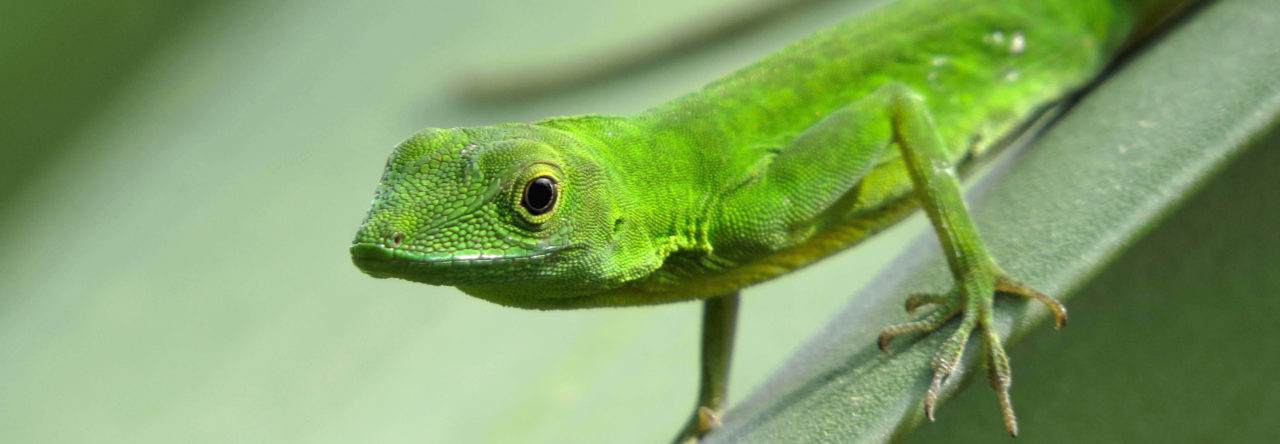
 No surprise to us at AA, but greenies apparently provide yeoman service as garden pest control. And the wonderful folks at www.getmypestout. com provide all kinds of good advice about how to foster a healthy anole population in your garden. Good on ’em!


 AA reader, anole scientist, and anole breeder Veronika Holáňová has written a beautiful book on anole husbandry. I can attest that the photos are exquisite, and here’s what she has to say about it: “It is a book for all Anolis lovers who would like to try to keep them in captivity. In that book I have my experiences with keeping different anole species after many years :-).” The only catch is that it is in Czech, though Veronika says that “maybe one day it could be in English too.” Let’s hope! The book has a