
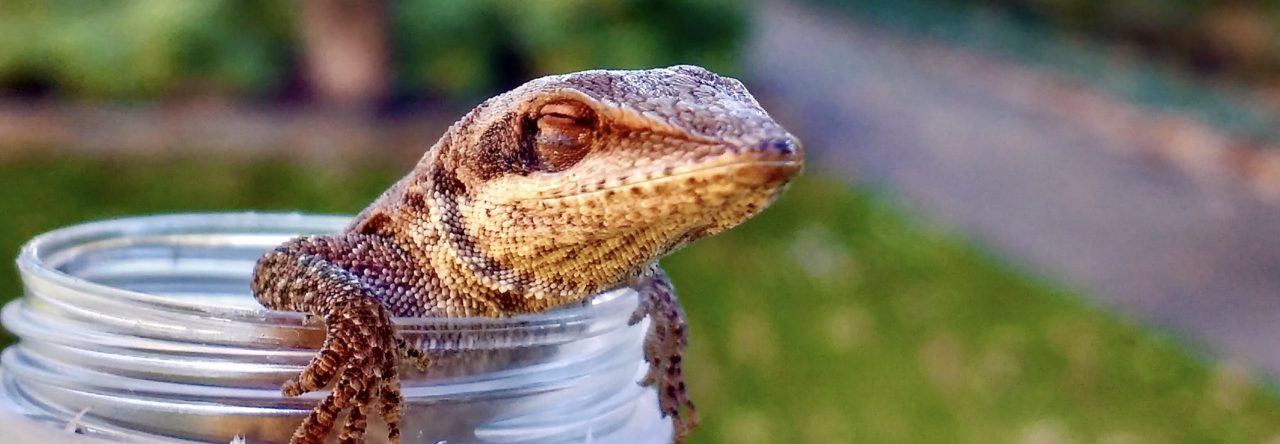
Sometimes anoles are lovers, too. But even when they love, they seem to fight. Photo of Anolis carolinensis taken from Wikipedia.
Greetings again from San Francisco! The anticipation for yesterday’s Animal Communication session was palpable. Usually a big Anolis hit at SICB, the Communication session did not fail to impress. The session was divided into two sections – Lovers and Fighters. Can you guess which one had all the anole talks? Three out of the five talks in the Fighters session were about anoles. Incidentally, most of the talks in the Lovers session were about tree frogs. This was perfectly to my liking – I’ll take the blood, guts, and gore any day. The three Anolis talks presented fascinating new work.
The first was by Jessica Edwards, a graduate student working with Simon Lailvaux at the University of New Orleans on aggressive encounters between Anolis carolinensis and A. sagrei, which has successfully invaded much of A. carolinensis‘ range. In a previous study, Jessica and Simon found that A. carolinensis tends to perch higher in the presence of A. sagrei than when found alone. For her experiment, Jessica placed one male of each species into a large cage with a single perch. At the top of this perch she placed a heat lamp, so that there was one optimal site (warm top) and one sub-optimal site (cool bottom) on the perch. She then scored behaviors and recorded the victor in each trial. She found that relative dewlap size was a good predictor of trial outcome, and that the each species was about equally successful at obtaining the optimal perch, although A. sagrei did have a slight advantage. She repeated this experiment using females of each species, and found something exciting and perhaps unexpected – Anolis sagrei was the clear victor in all but one of several dozen trials! Jessica posits that, in the wild, female A. sagrei push female A. carolinensis higher up in the trees. In polygynous systems such as anoles, where one male defends a group of two or more females, then we would expect the males to go where the females do, and so would expect males to increase their perch heights, as well.
As Martha Muñoz reported two months ago, the Society of Integrative and Comparative Biology meetings, beginning Thursday in San Francisco, will be awash with anole research. Check out the 


The 2013 Anole Annals Anole Calendar has been flying off the shelves, but a few remain, and for those of you savvy shoppers who’ve waited until after Christmas, now’s the time: Zazzle is offering 65% off through Friday. Never too late for a late holiday present! The order page is 