

From Rachel on Twitter.
Wouldn’t this be great? Maybe there’s one out there, still waiting to be discovered.
From Rachel on Twitter.
Wouldn’t this be great? Maybe there’s one out there, still waiting to be discovered.
httpv://vimeo.com/93621704
We’ve discussed the crisis concerning Jamaica’s Goat Islands previously. This film is the work of Robin Moore. Read more about the film and the efforts to preserve Jamaica’s iguanas on National Geographic‘s Newswatch. More relevant videos can be viewed at the Save Goat Islands website.
Here’s the first lizard talk from the Animal Behavior Society meetings! This is a guest post from Holly Brown, who studies visual and foraging ecology in herons at UConn.
Eye structure is remarkably similar among vertebrates. Therefore, one might, understandably, imagine human visual experiences to be representative of visual experiences across vertebrate taxa. However, this is not the case. Two important differences between mammalian and non-mammalian vertebrate vision are that, unlike us, the latter are able to move their eyes independently of one another, and they seem to lack stereopsis. Stereopsis is the ability to view the two independent images generated from each eye as a single image, which ought to make depth perception easier, and thus aid in important tasks such as capturing prey.
So instead of studying mammals, Gadi Katzir and his team of collaborators from the University of Haifa, Israel, are studying chameleons to better understand vertebrate vision.

Common Chameleon by Benny Trapp from Wikimedia
One of their recent experiments was aimed at finding out whether or not chameleons could simultaneously track two prey items independently with each eye, and if so, how independently (of one another) were the eyes able to move. They found that chameleons could simultaneously track different prey items with each eye, but at some point, they would always make a choice to converge both eyes onto their eventual prey target. Furthermore, they found that chameleons never struck at prey with their eyes still diverged. By pursuing this line of research, Katzir and his team may be able to glean insights as to how stereopsis may have evolved.

Anole jeans! Now marked down to $25. Get ’em while they last!
Extensive googling reveals that the jeans are made by Nice Work Textile Jeans, Inc.
Long time AA readers will know that anoles frequently pop up in haute couture, perhaps most recently when Tommy Bahama created an anole-colored T-shirt.

Distribution records for Anolis cristatellus in Costa Rica reported in 2011 AA post.
Four years ago, we reported on the distribution of the Puerto Rican crested anole all along the Caribbean coast of Costa Rica. We also found the species inland, as far west as Turrialba and Siquerres, but not Guapiles (see map to right). A year later, we returned for a quick follow-up as part of a herpetology course spring break trip to Costa Rica. The weather wasn’t great and we failed to find cresteds in any place not previously reported; however, observations of brown basilisks, another sun-loving species, suggested that the weather was suitable enough, and that perhaps the absence of the anoles was real.
Two years later, this past March, another herpetology class trip ensued, and so another expedition was launched to Guapiles and environs. The team included AA correspondent Katie Boronow, an award-winning senior with expertise on A. cristatellus, and a sophomore in training for Miami field work this summer (more on them in posts to come).
And the results???
The journal Herpetological Review, published by the society for the Study of Amphibians and Reptiles, frequently has interesting anecdotal reports of natural history observations of anoles. This quarter’s edition has two: nocturnal activity in Anolis cristatellus and prey stealing behavior in Anolis sagrei. Here is a synopsis:
Dean and Jennifer Metcalfe report on nocturnal behavior of A. cristatellus wileyae observed (while perhaps on vacation) at the Nanny Cay Resort and Marina on Tortola, British Virgin Islands. The authors observed that the subject anole had navigated the interior of their hotel room in near darkness after dusk, selecting a nocturnal perching site on a lampshade. They suggest that this is similar behavior to that of an anole selecting an arboreal perch site at dusk. Two questions come to mind though. First, whether the room was completely dark- as the authors acknowledge that some light might have been entering the room- and whether the animal came from the outside into the room to perch or was residing in the room. Second, the author mentioned that this was the only anole seen on Tortola during her brief stay, which is also a bit unusual as the species should be abundant there. This might not add much to our understanding of anoles, but it certainly raises some questions about the co-habitation of humans and anoles.
The second note comes from David Delaney, a master’s student in Dan Warner’s lab at UAB, and friends, who report on an opportunistic A. sagrei in Ormond Beach, Florida. The anole had apparently been observing a predation attempt of a spider-wasp on a funnel-web spider. To summarize, the wasp attacked and envenomed the spider, captured it, and began dragging it across the ground. At this point the anole jumped to the ground, grabbed the spider, and took it up the tree to eat it. The wasp, likely disappointed, fled the area to hunt again.
Metcalfe, DC and JE Metcalfe. 2014. Anolis cristatellus wileyae (Vrigin islands Crested Anole). Nocturnal Activity. Herpetological Review 45: 323-324.
Delaney, DM et al. 2014. Anolis sagrei (Brown Anole). Prey stealing behavior. Herpetological Review 45: 324-325.
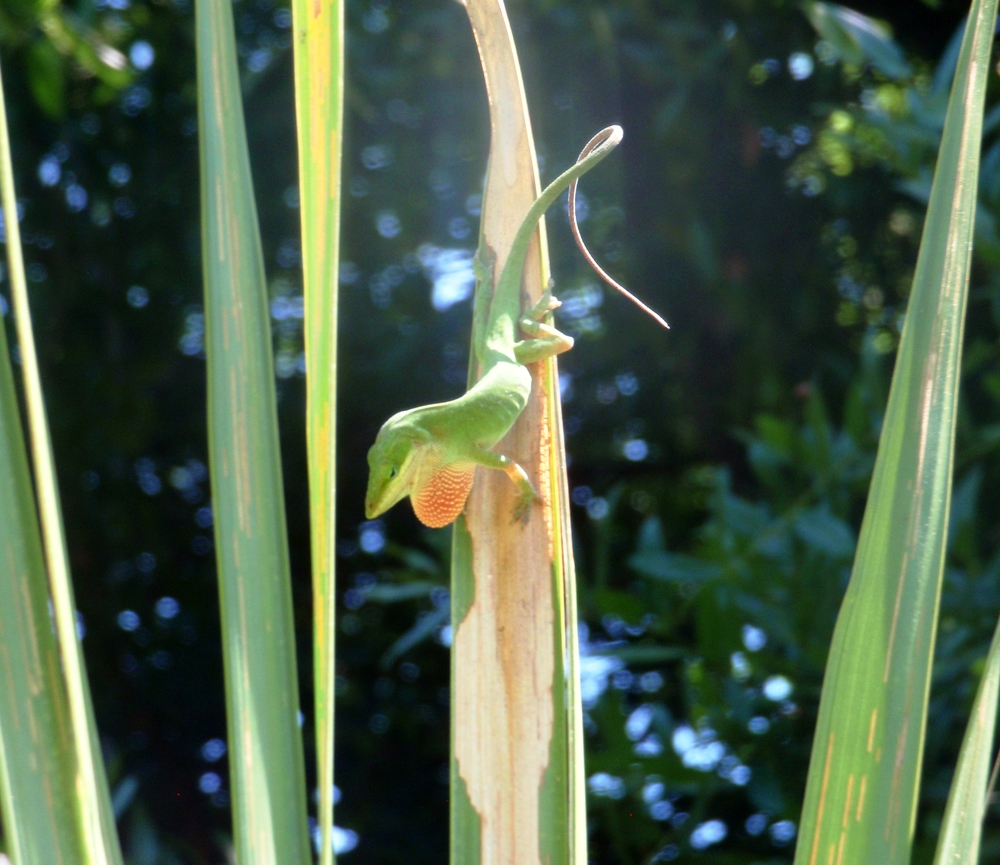
Great photos on Adventures Down South
Where do anoles poop? Will they chase laser points? Find out on Casey Gilman’s new blog on her Florida field research, Adventures Down South. Meanwhile, Chipojolab keeps the world abreast of goings-on in the Leal Lab. Most recently–Leal back in the Bahamas and multiple lab members cavorting in Puerto Rico! And Ambika Kamath’s afoot with her field crew in Gainesville, dodging frisbees and fire ants in quest of the wily festive anole. Finally, at Lizard and Friends, Michele Johnson talks about Puerto Rican anoles that are biting off more than they can chew. Or are they?
Do you have a blog on your research? If so, let us know!

Field laboratory in Puerto Rico. Read all about it in Chipojolab.
Andrew Battles from the Kolbe Lab gave a talk at JMIH presenting data on performance-habitat relationships comparing lizard performance on rough and smooth surfaces. The data were collected on Guana Island in the British Virgin Islands using Anolis cristatellus and A. stratulus as study species. Andrew and his advisor, Jason Kolbe, were interested in whether lizards perform differently on artificial and natural surfaces.

Major differences between natural and artificial habitats
They used three different running tracks (37°-incline rough track, 90°-incline rough track, 90°-incline smooth track), assuming that artificial surfaces are smoother than natural ones. The rough tracks consisted of a board covered in window screen and the smooth track was a plain 2-by-4 board. They used a high-speed camera to measure maximum velocity, how often a lizard paused during the run and how often it slipped. While both species ran significantly slower, paused and slipped more often on the smooth surface, A. cristatellus performed even worse than A. stratulus. Andrew and Jason then conduced a field survey to test whether lizards in a human-modified habitat use both artificial and natural perches. In addition, they rated roughness of natural and artificial perches. When both types of perches were available, lizards used artificial perches more often than natural ones.

In human-modified habitats, lizards were found mostly on artificial perches
This is surprising, because artificial perches are significantly smoother than natural ones and lizards perform worse on smooth surfaces. Possible explanations are that other factors such as food availability and/ or predation may drive habitat selection on artificial substrates.
Following up on yesterday’s post, more research results from the Warner Lab on egg incubation were presented at JMIH. Corey Cates, a masters student from the Warner Lab, presented his data on developmental plasticity in Anolis sagrei. He used an experimental approach to test whether lizards incubated under dry conditions would survive better in a dry habitat than lizards incubated under moist conditions and vice versa. The idea for the study came from the observation that habitat and substrate differs among small islands in Florida. Some islands are scarcely vegetated and have dry substrate consisting of broken shells. Other islands are more densely vegetated and have dark soil that contains organic matter.
Corey collected 128 breeding pairs from four islands and incubated the eggs using the two different substrates. He also tested two different moisture conditions (wet and dry). He found that lizards incubated under wet conditions hatch on average 4-5 days later and hatchlings were significantly heavier than those incubated under dry conditions. In addition, lizards hatch significantly later when incubated in the soil substrate, which retains moisture longer than the broken shells. Corey further tested whether lizards raised under dry conditions have higher desiccation tolerance than lizards from wet conditions. He measured body mass before and after keeping the lizards in a desiccation chamber. Lizards that had developed under wet conditions lost 5% more mass than lizards developed under dry conditions.

Hatchlings incubated under wet conditions lost significantly more mass than hatchlings incubated under dry conditions.
This suggests, that plastic responses to different developmental conditions have an effect on physiological traits that might increase survival in a specific habitat. To test this, Corey then released the hatchlings on four experimental islands and measured hatchling survival using a recapture method.

Significantly more hatchlings survived in the open, arid habitat when eggs were incubated under dry conditions.
He found that significantly more hatchlings survived in open, arid habitats when eggs were incubated under dry conditions. No effect of incubation condition on hatchling survival was found in the shaded, moist habitat.
 I saw two talks on brown anoles in the same session this afternoon at JMIH. The second reported on the response of brown anoles (A. sagrei) to potential avian predators. Lisa Cantwell presented results of her work with Joe Altobelli and Sandy Echternacht on the behavior of brown anoles exposed to the calls of potential avian predators in a controlled laboratory environment. Cantwell has previously reported that anoles respond more strongly to the calls of predator birds than to white noise or non-predator birds (see also prior work on A. cristatellus in response to predator and non-predatory birds). Cantwell played the calls of four bird species to captive brown anoles and monitored their reactions. The four birds in the study included one species that co-occurs with, and preys upon, A. sagrei: the American Kestrel. The other birds were species that do not co-occur with A. sagrei: the White-rumped Falcon (gotta love the ornithologists and their descriptive common names), the Shikra, and the Lesser Kestrel (this name seems kind of demeaning and should probably be changed). Cantwell tested if the anoles responded more to the predator that they or their ancestors have likely encountered in nature than to the calls of predators that they or their ancestors have likely never encountered. The types of reactions that were viewed as indicative of increased vigilance in the lizards included head shifts, eye opening, and movement around the enclosure. Although Cantwell found that the lizards responded to all of the various bird stimuli at a similar level to white noise, she hypothesized that this resulted from hyper-vigilance in a contrived laboratory environment. She also reported that the lizards responded significantly more quickly to the American Kestrel and that they remained vigilant for twice as long in response to this sympatric predator than they did in response to the non-sympatric predators.
Powered by WordPress & Theme by Anders Norén