
Photo tweeted by Stingray Tom
Photo tweeted by Stingray Tom
 Arthur Loveridge was one of the great scholars of African herpetology, and a fascinating individual, curator of the Museum of Comparative Zoology for 33 years. AA has recently come across a pdf of his obituary written by Ernest Williams, who succeeded him at the MCZ.
The obituary is fascinating not only because it details the career of an important, yet quirky, individual in our field, but also marks how the profession of museum curator has changed markedly from the days in which curators were wealthy amateurs, popping around to satisfy their curiosity. Of course, I’m sure Loveridge’s sentiments would find happy agreement today: “Probably only a zoologist can look at an uncaught cobra and feel the joy a child feels on Christmas morning.”
The paper’s worth reading for the various stories about the “Demon Curator,” including the drawer labelled “string too short to use” and the famous footnote in the 1957 Loveridge and Williams turtle monograph.


Anolis transversalis, female on the left
We’ve talked previously about anole species that differ in the color of their dewlaps, but I don’t recall any discussion of species in which the males differ markedly in body patterning. Certainly, that happens a lot. For example, we’ve talked a lot about polymorphisms in female back patterns, but in most of these species, the males don’t have any of the patterns shown by the females. And in this case, and many others, one sex is patterned and the other one pretty much isn’t.
In any case, Anolis transversalis is a great example of a species in which both sexes are patterned, but differently. And to boot, their dewlaps are differently colored as well. What a species!
Does anyone want to suggest–or better yet, supply photos–of other species in which both sexes are patterned, but differently?

 Recently, a 2006 paper on giant land tortoise dispersal has been going around social media. The story is that a tortoise from Aldabra, a tiny speck of an island north of Madagascar, washed ashore in Tanzania, some 700+ kilometers away. Barnacles encrusted on the tortoise’s legs suggest that the chelonian had been adrift for 6-7 weeks, an estimate that makes sense given the prevailing currents. The article summarizes several other, not-quite-so-well documented, cases of tortoise dispersal. These stories make clear that tortoises can disperse over long distances of open ocean. Thus, it is not surprising that they occupy far-flung islands around the world (and remember that until the onslaught of humans, they used to occupy many more islands, such as Madagascar, Mauritius, and New Caledonia).
This is all well and good, but why discuss it in Anole Annals? After all, our little four-legged friends weigh a few grams, not many kilograms, and they don’t carry a flotation device on their back. Does the dispersal ability of these behemoths tell us anything about how anoles reached their island homes?
Let’s go to an example closer to home, from a paper in 1998 published by Ellen Censky in Nature. In that paper, Censky et al. reported an observation from 1995 of a large mat of vegetation washing ashore on the Caribbean island of Anguilla (described as “a mat of logs and uprooted trees, some of which were more than 30 feet long and had large root masses. Local fishermen say the mat was extensive and took two days to pile up on shore.”). This in itself was not so unusual—such mats wash ashore regularly, especially in hurricane season. What was unusual is that riding this vegetation was a passel of green iguanas, a species native to some islands in the Caribbean, but not Anguilla. As onlookers watched, the vegetation washed ashore and, like tourists disembarking from a cruise ship, the 15 iguanas stepped off onto the beach. And like the occasional tourist, the iguanas liked it so much that they never left. Rather, they settled, put down roots, and raised a family. As far as I know, the iguanas are still there to this day.
 But where did they come from? One bit of information did not make it into the article, but Ellen Censky has kindly allowed me to report it here. There was a clue in the mat of vegetation, in the form of a street sign. In French! That narrowed the possibilities considerably, and a bit of sleuthing established that the street sign, and hence the saurians, came from the island of Guadeloupe, where iguanas are native, and where Hurricanes Luis and Marilyn had struck some weeks before. Hurricanes often knock enormous amounts of vegetation into the water, explaining the formation of the vegetation mat.
True, iguanas are bigger than anoles, but otherwise this is exactly the mode of transport hypothesized for anoles. For example, large amounts of vegetation often fall into the Amazon and Orinoco Rivers in South America and end up floating far out to sea, as chronicled by Blair Hedges in a paper a while back. It’s not that hard to imagine a female, with eggs or storing sperm, hunkered down in such vegetation and managing to survive such a journey. It probably doesn’t happen often, but as Ernest Williams pointed out in an overlooked paper on colonization years ago, given millions of years, the unlikely becomes probable. Phylogenetic evidence indicates that the Caribbean anole radiations are the result of two colonization events from the mainland. In addition, it suggests that the Norops radiation on the mainland is a result of back-colonization from the islands—over the 40 million plus year history of anoles, that doesn’t seem very unlikely.

Mystery Anole
Can you identify this species? It was recently observed in Pinellas County in Florida, where Anolis sagrei is established but not any other Anolis spp. This photo is your only clue.
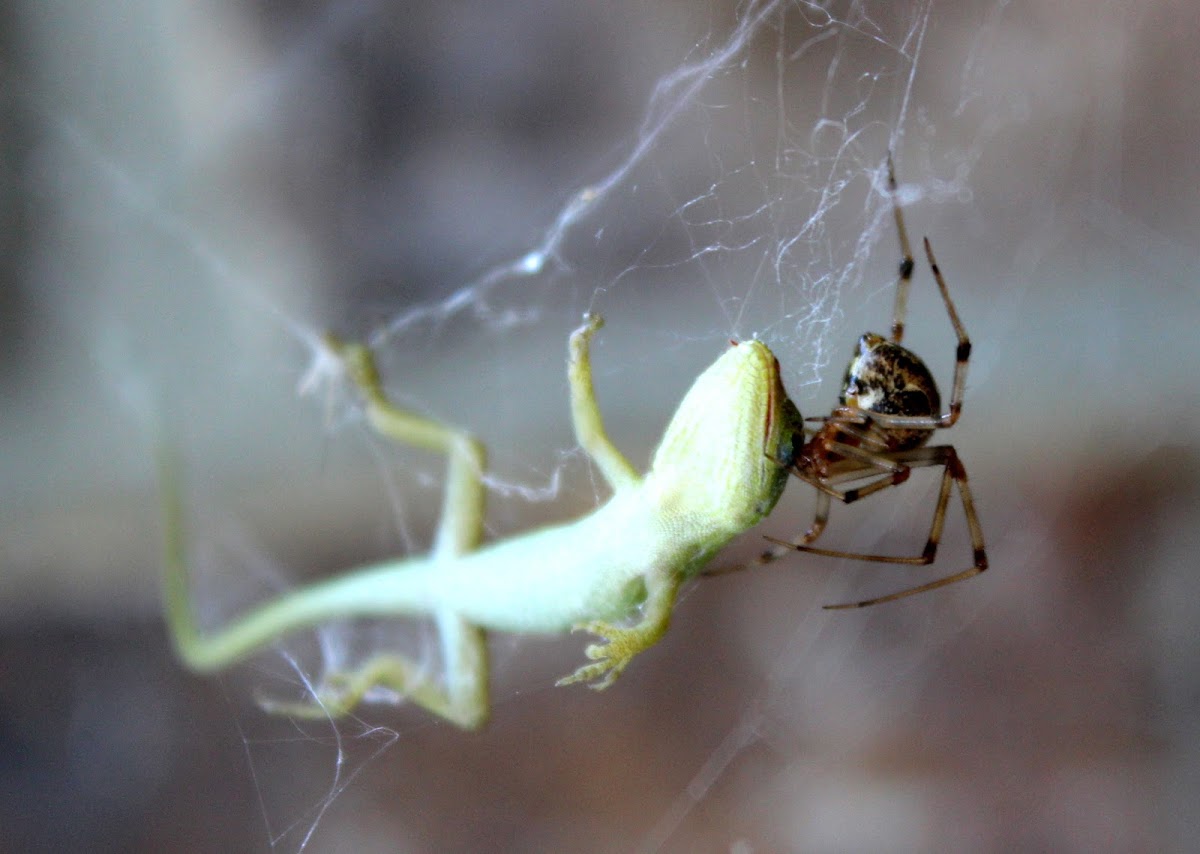
Read the sad details on Project Noah. We’ve reported on saurivory in spiders previously, most recent a Nephila eating a brown anole.

Anolis nebulosus
In a recent paper in the Italian Journal of Zoology, Senczuk and colleagues report an interesting finding on the clouded anole, Anolis nebulosus. On the mainland, the species is fairly petite, with males averaging 40 mm SVL. However, on a very small, offshore islet, only half a kilometer from the mainland, males grow to an average of 53 mm, and the average female is larger than the largest male on the mainland.
What is responsible for such great disparity in size? Two prime possibilities are that most of the anoles predators are absent from this small island and that the island has a seabird colony, which may lead to greater quantities of insect prey.
In a fascinating previous study, some of the authors of this paper documented many other interesting differences between the mainland and island populations, such as the fact that lizards in the island population are much more active and display more. Clearly, this is a situation worthy of further study.
Abstract:
The clouded anole Anolis nebulosus (Squamata: Polychrotidae) is widespread on the Pacific coast of Mexico. The species also inhabits Don Panchito, a small islet located near the coast of the Chamela-Cuixmala Biosphere Reserve in the state of Jalisco. We studied the extent of intraspecific differences in morphology (absolute size and body proportions) and in mtDNA sequences (16S and NDH2) between the population living on the islet (N = 18 for morphometry; N = 12 for mtDNA) and the one on the facing mainland (N = 38 for morphometry; N = 16 for mtDNA). The individuals on the islet are larger than those on the mainland with little overlap in size for either males (islet: 52.79 ± 1.82 mm; mainland: 40.96 ± 2.99 mm) or females (islet: 46.18 ± 3.24 mm; mainland 37.14 ± 2.13 mm). The presence of insular gigantism, as here found in A. nebulosus, seems uncommon in the genus and could be explained as a combination of low predation pressure and higher intraspecific competition on the island. Moreover, we found that sexual dimorphism (SD) is higher in the island population than in the mainland one. The molecular analysis shows the absence of shared haplotypes between the island and mainland populations. Ten mtDNA haplotypes belonged to the mainland population and three to the island population. The shape of the minimum spanning network and of the mismatch distribution indicates a single colonization event. These molecular data indicate a certain degree of isolation of the island population notwithstanding its proximity to the coast. The morphological characteristics of the anoles on Don Panchito match with the expectation of the so-called “reversed island syndrome” theory, which predicts an increased body size and sexual dimorphism in lizards living on very small islands characterized by unpredictable environmental conditions.

Anolis ventrimaculatus. Photo by Jonathan Losos.
We (Rosario Castaneda, Anthony Herrel, Luke Mahler and I) have just completed the first leg of our 2.5 week Colombian anole sojourn. First up: La Cumbre in the hills north of Cali. At 2000 meters, it was chilly! Going out our first night, we found plenty of long-legged Anolis ventrimaculatus. Imagine our surprise the next day when they were hard to find when active! This was reminiscent to us of A. gemmosus in Mindo, which also is very abundant at night–we’re talking Caribbean anole night abundance–but not easy to find while active.
The ones we did find were generally low to the ground, often on tree trunks, sometimes on vegetation. They refused to move when we filmed them, but their stomach contents indicated that they had been foraging, even at temperatures in the upper teens. These are tough, wily buggers!
We found two other species in smaller numbers, but only at night. The most exciting was A. calimae, which was not known from the locality at which we were working. We found a male and a female. They look moderately like twig anoles–elongate, slender body habitus–but there limbs are on the long side. We’ll see what the morphometrics say. However, when we released them, they behaved exactly like twig anoles, squirreling to the far side of a branch, creeping forward, carefully placing one foot, then the next, freezing. Unfortunately, despite intensive efforts, none were located during the day, perhaps not surprising, as many twig anoles are very cryptic and hard to find, particularly given that they live in dense vegetation.

Female Anolis calimae. Photo by Jonathan Losos.
Lastly, we found a number of A. mariarum in dense fields of high, stout grass. The photo below shows one such area. These lizards have to be living in the grass; they’re too far from anything else (the occasional tree notwithstanding. Yet search as we might, we couldn’t find them during the day. Our guess is that they are active in the spaces on the ground beneath the grass. In fact, when we let the lizards go, they seemed quiet happy to scamper about, and even display at each other, under the grass canopy.

Anolis mariarum’s field of dreams, where several were found sleeping, but none could be found during the day.
An exciting, if chilly start, but we’ll soon be thinking wistfully of cool days and evenings as we head to our hot and steamy next location.
Martin Whiting of Macquarie University began his talk at the Animal Behaviour Society 2014 meeting by lamenting how little we know about the social lives of lizards, especially when compared with mammals, certain insects and fish, and most of all, those pesky other reptiles, birds. But the more we examine lizard social behaviour and cognition, the more apparent it becomes that these animals are capable of substantially more complexity than we previously thought possible. Whiting presented some recent research on the Eastern Water Skink, Eulamprus quoyii, that bolsters this view.

Eastern Water Skink, from the Whiting Lab Page
Though not often social, many lizards, including Eastern Water Skinks, live at densities high enough to allow individuals to be within sight of each other. This is a sufficient prerequisite for social learning, defined as learning a task by observing others and modifying one’s own behaviour accordingly. Whiting asked whether Eastern Water Skinks were capable of social learning by training “demonstrater” individuals to perform certain tasks, letting “observer” individuals watch these demonstraters, and then measuring whether this exposure to the demonstraters enhanced the observers’ success at the task at hand.
The answers to Whiting’s questions were not simple. First, age matters—young individuals were twice as likely to demonstrate social learning than old individuals. Second, the task matters—lizards learnt to associate a colour with a food reward by watching others, but the prerequisite task of actually flipping over the coloured cap to access a mealworm was not spurred by observing other individuals do the same.
In the future, Whiting and his students hope to conduct similar experiments with a variety of lizard species that differ in their degree of sociality. These experiments will definitively address the role of learning in shaping the social lives of lizards, and I can’t wait to see they find!
When I think of colour and pattern in lizards, I tend to think about showy visual displays. An example that springs to mind is this fantastic footage of Draco lizards using multiple appendages as colourful signals.
But despite all the effort an individual lizard puts into signalling to conspecifics, it must constantly remain wary of predators. Mimicry and camouflage are tried and tested means by which to evade predation, but little effort has been made to quantify the colours and patterns that may help lizards escape being eaten. Research presented by Danielle Klomp from the University of New South Wales at the Animal Behaviour Society 2014 meeting addresses this question in Draco cornutus, a South East Asian agamid lizard that uses the patagium, an extendable membrane attached to elongated rib bones, to glide from tree to tree.
Sampling in two populations of D. cornutus, Klomp noticed that though individuals in the two populations had identical dewlaps, they differed substantially in the colour and pattern of the patagium. Remarkably, the colours exhibited in each population seemed to perfectly match the colour of falling leaves of trees in the same habitat.

Patagia and falling leaves from two populations of Draco cornutus. Photos by Danielle Klomp.
By measuring spectral reflectances as well as the proportions of black on lizard patagia, falling leaves, foliage, and dead leaves, and accounting for how these colours might appear to predatory birds, Klomp demonstrated that in both colour and pattern, D. cornutus patagia in each population most closely matched falling leaves in the same population. This suggests that Draco are especially vulnerable to predation while gliding, and have undergone strong natural selection to mimic non-prey items in the particular environment they experience while gliding.
Here’s a link to Klomp’s poster from the International Society for Behavioural Ecology 2014 conference, and here’s a link to a blogpost about some very cool technology that Klomp used to make her poster come alive while presenting it.
Powered by WordPress & Theme by Anders Norén