
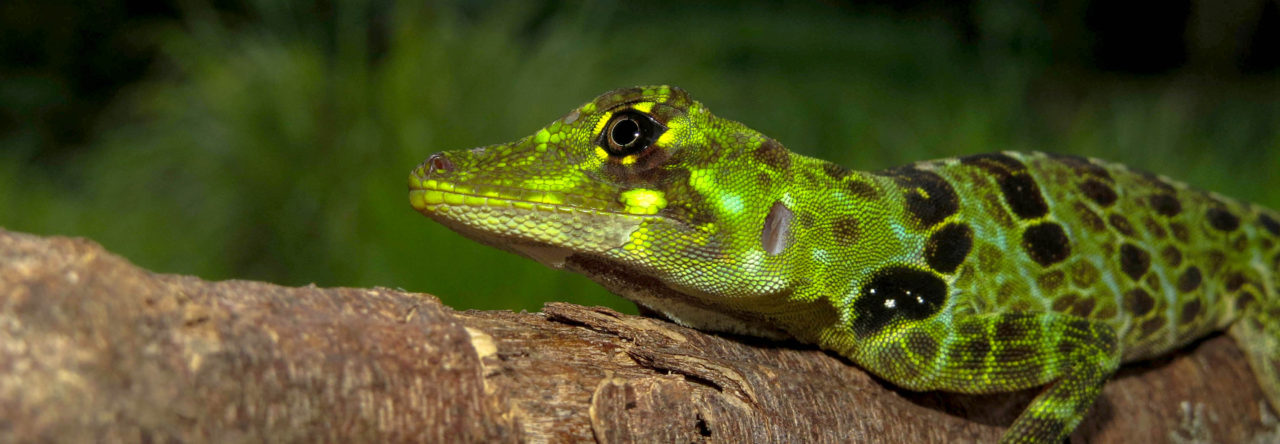
Greater Antillean anoles would not be a model system for studies in ecology and evolutionary biology without the foundation provided by a century and a half of careful work by anole systematists. Because their contributions often go unrecognized, I thought I’d use this post to call attention to the work of some of the most important figures in Greater Antillean anole systematics. I’m going to focus here on alpha-taxonomy, and specifically on description of new species (we’ll do later posts on the history of anole phylogenetic systematics and descriptions of subspecies). The majority of the nearly 120 species of anoles found on Cuba, Hispaniola, Jamaica, and Puerto Rico were described by five key figures and their colleagues.
Author: Rich Glor Page 8 of 13
Fights among anoles are fairly common in nature, and we’ve had several previous posts documenting anole fights captured on film (1, 2, 3, 4). A casual browsing of YouTube reveals many more anole fights, mostly between male Anolis carolinensis (1, 2, 3, 4, 5). Many of these videos use the Rocky theme music to set the tone. I was really enjoying watching these videos until I got to thinking that some of them might actually be staged. I browsed the comments to see if I could figure out if the fights were staged, but didn’t come up with any definitive proof (in a few cases, I added my own comment asking directly if the fights were staged). However, there are certainly people who have commented that watching these videos has inspired them to raise fighting anoles. What do you think? Do some of these fights look staged to you?

Leiocephalus macropus attempts to consume a juvenile A. jubar in southwestern Cuba. Photos copyright R. Glor 2000.
Anole Annals has a long, gut-wrenching history of posting photographs of our favorite lizards being consumed (or at least partially consumed) by other organisms, including snakes (1, 2, 3), birds (1, 2, 3), other anoles (1, 2), a frog, a spider, and even a plant. As far as I can tell, however, we have yet to post any images of anoles being eaten by one of their fiercest predators across the northern Caribbean: Curly-tailed lizards (Leiocephalus). Curly-tails are notorious anole predators and can have a profound impact on anole abundance and behavior (see for, example, Losos et al. 2004). The photos above were taken in southeastern Cuba and show Leiocepalus macropus killing and attempting to eat a juvenile Anolis jubar. Manuel Leal initially spotted the Leio plucking the young anole off a tree trunk. Although the Leio successfully killed the anole and got it part way into its mouth, it seemingly wasn’t able to swallow its intended prey (at least not until we interrupted the event).

Using a Shopvac can really speed-up cleaning dirty cricket cages (left) and also help knock-down spider populations (right).
As we’ve discussed previously in our series on the evolution of a lizard room, some little tools and tricks can save you lots of time when maintaining a reasonably large lizard breeding facility. One useful new tool that we added to our lizard maintenance repertoire a few months ago was a Shopvac. We purchased a 3-gallon Shopvac model for around $60 with the initial goal of using it primarily for clearing substrate from the bottom of dirty lizard and cricket cages. The Shopvac works like a charm for this purpose. We no longer have to endure awkward and time-consuming cleaning sessions that involve tipping unwieldy cages into a garbage bin. Another unforeseen use of the Shopvac is to knock-down the massive population of spiders that persists on a diet of our feeder crickets. Sucking up spiders, spider webs and spider eggs is much easier than trying to knock them down with your hands or a broom (at the end of the process you also get the satisfaction of looking into the Shopvac’s dustbin and seeing all the hundreds of spiders and spider egg cases that you’ve taken down). In my view, the money we spent on the Shopvac was money well spent.
When its not trying to kill off distinguished herpetologists, the Center for North American Herpetology’s (CNAH‘s) mailing list is a great way to keep abreast of all kinds of herp related news. Today, the CNAH’s list called attention to the fact that the New York Public Library is selling reproductions of classic prints from Holbrook‘s North American Herpetology. Included among Holbrook’s plates is a rendering of Anolius Carolinensis that would look excellent on any good anolologist’s wall! The prints being offered by the NY Public Library appear to be from the second edition published in 1842. I’m not sure if the same print appeared in the first edition, or even which volume the anole was originally in; Holbrook famously recalled and burned many copies of the first edition in a bonfire at his house due to problems with the plates and with the organization of species accounts. It looks like an 8 x 10″ Anolius Carolinensis print will set you back around $35. Alternatively, you could get a facsimile of the whole edition for $70 from the SSAR!

Anolis smaragdinus is one of the species that participants in Bob Powell's REU program are likely to encounter on their trip to Eleuthera this Summer. Photo by Jonathan Losos
Are you an undergraduate student with dreams of traveling to the Caribbean to study lizards? If so, your dream could be realized through the NSF-funded Research Experiences for Undergraduates (REU) program organized by Bob Powell at Avila University. Now in its 10th iteration, Bob’s program has provided nearly 100 students with opportunities to conduct research in places like the Dominican Republic, Anguilla, Grenada, St. Eustatius, St. Vincent, Dominica and the Grenadines. I can tell you from personal experience – I was a participant in 1995 – that Bob’s program is among the best of its kind. Students in Bob’s REU get a complete research experience, from personal instruction on how to find and read the primary literature to supervised preparation of research for publication. Just about everyone who participates in Bob’s program comes out with one or more publications. This summer’s REU will involve field work on the Bahamian island of Eleuthera, which is home to four species of anoles! Applications are due by February 15th.

The old (portable pesticide pump), and the new (premium watering wand). Note that watering wand is connected via a hose to the DI water supply at the top left.
The thing about keeping captive anoles that most surprises the uninitiated is the fact that they don’t drink out of bowls. Instead, anoles generally lap up water provided in the form of daily sprayings. If you have a few anoles in a terrarium at your house, a handheld pump action sprayer is more than sufficient (think Windex bottle with water in it). When you scale up to hundreds of cages, however, you’re going to need another solution. In this post, I briefly review some our lab’s efforts to improve spraying efficiency.
As Julienne mentioned in the introductory post in our series on lab anole husbandry, we’ve been through a lot of trial and error over the past few years. One fairly persistent issue has been maintaining our lizard rooms temperature and humidity. Without humidification, our room’s humidity fluctuated from lows of around 5% in the winter months to highs around 30 or 40% during the summer months. We’ve used a number of different techniques to introduce more humidity into the room, with varying degrees of success. A brief recap of our experiences is below.
Even though anoles aren’t the only lizards to have evolved dewlaps, their spectacular diversity of dewlap shapes and sizes certainly makes them leaders in the global arms race for dewlap dominance. Nevertheless, I recently came across some photos of the spectacularly dewlapped-agamid Sitana ponticeriana doing something I don’t think anoles are capable of – displaying while standing on two hind limbs. I’ve seen Australian agamids stand up for extended periods of time to display, dissipate heat, or scan the horizon, but I’ve never seen an anole do this for more than a few seconds while reaching for a new perch. Sure, anoles can do lots of other stuff to get the message across – push-ups, full-ups, elaborate tail-wags, tongue protrusions, nuchal crest extensions, gapping, etc. – but I’m just not sure they’re built to stand. My question to all the anoles lovers out there: has anybody ever seen one of our beloved creatures displaying while standing on its hind-limbs?
PS – Lots of other amazing photos of the dewlapped agamids are on Flickr

T-shirts photographed in gift shops in the Santo Domingo airport (left and center), and a guy wearing a Punta Cana iguana t-shirt photographed during a layover in Atlanta (right).
We’ve previously discussed how difficult it is to find gifts featuring anoles (aside from some cafepress fare). Even more depressing is the fact that introduced green iguanas (Iguana iguana) are regular features on gift shop fare in the Dominican Republic, a country with one of the coolest of all anole faunas. Heck, there aren’t even shirts with the native rock iguanas (Cyclura)! We really need to recruit an entrepreneur to start making Dominican paraphenalia featuring endemic wildlife.

